Debt Securities
A practical tour of debt securities — yields, Treasuries, municipal and corporate bonds, issuance rules, covenants, convertibles, and structured bonds.
Chapter 10: debt securities.
This is the grand tour of bonds, so think of it as a tasting menu rather than a single deep dive. We will start with the basic cash flows, move through the main issuer groups, and finish with contractual features and some of the stranger structures that appeared in my original 2016 study note.
The basic promise
A debt security is a contractual claim. An issuer borrows money and promises specified payments to investors. A conventional bond may pay periodic interest, called a coupon, and repay its principal or par value at maturity. The old word “coupon” comes from paper certificates whose physical coupons were detached and presented for payment. Today the recordkeeping is mostly electronic, but the name stuck.
Longer maturity does not automatically make every bond riskier than every short-term instrument. It does, however, give interest rates, inflation, credit quality, calls, and other events more time to affect value. Before buying one, I want to know who owes the money, what cash flows are promised, what can interrupt them, and where my claim ranks.
Source correction — market boundaries. My 2016 note treated “one year or more” as a universal bond-market boundary and said the money and bond markets together exhaust the capital market. That is too neat. U.S. Treasury bills currently mature in one year or less, while Treasury notes and bonds cover longer issued terms. “Capital market” also commonly includes equity and other long-term financing markets, so it is safer to treat these labels as useful conventions rather than a complete identity. TreasuryDirect lists the current marketable-security terms.
Bonds can be grouped by issuer—Treasury, government-related, municipal, or corporate—but that is only one map. They can also be classified by maturity, seniority, collateral, coupon design, tax treatment, registration, embedded options, or the assets behind their cash flows. The original note also contrasted registered bonds with old-style bearer bonds and joked about bearer instruments appearing in bribery scenes. That cultural aside is useful for remembering that possession once played a larger role, but it is not a statement about how modern bonds are normally held.
Price, yield, and the return actually earned
The promised coupon rate is not the same thing as the return an investor earns. A bond bought above or below par has a price that changes the economics.
Yield to maturity (YTM) is the discount rate that equates the bond’s current price with the present value of its promised coupons and principal. It is a compact way to compare a price with a promised payment schedule; it is not a guarantee.
Source correction — YTM. The 2016 note treated “market yield,” “interest rate,” and YTM as interchangeable and said that holding to maturity makes realized return exactly equal to quoted YTM. Realizing that YTM also assumes promised payments arrive and coupon cash flows can be reinvested at the assumed rate. Default, a call, taxes, transaction costs, and actual reinvestment rates can all change the return. FINRA explains these assumptions and the difference between yield measures.
If I sell before maturity, my holding-period return depends on the purchase price, coupons received, sale price, and timing. The future sale price is unknown when I buy, which is why a quoted yield should never be read as a fixed personal outcome.
U.S. Treasury securities
The U.S. Treasury issues several marketable security types. Bills mature in one year or less. Notes are currently issued at 2, 3, 5, 7, and 10 years, and bonds at 20 and 30 years. Notes and bonds pay interest every six months. TreasuryDirect currently describes a $100 minimum purchase for marketable securities, and eligible securities can be transferred or traded in the secondary market. Treasury interest is subject to federal income tax but exempt from state and local income tax.
Source correction — terms and auctions. The source divided notes and bonds at ten years and described a quarterly auction cadence. Current product terms are the ones above, and auctions follow the Treasury’s published schedule rather than that stale rule. TreasuryDirect explains pricing and issued terms; investors should use the live auction schedule for dates.
In dealer markets, the direction of the quote matters: a seller generally receives the dealer’s bid, while a buyer generally pays the dealer’s ask. The difference helps compensate the dealer, although actual transaction costs can also appear as markups or markdowns.
Source correction — dealer roles. The original note reversed bid and ask and froze old dealer headcounts. The New York Fed maintains the live list of primary dealers. These firms are counterparties of the New York Fed and participate in Treasury auctions; that official role is more useful than an old count. See the New York Fed’s primary-dealer page and FINRA’s bond-market overview.
The source also called Treasury bonds uniquely worldwide and attached Tokyo trading hours. I could not bind that timeless superlative to a primary authority, so I am not repeating it as fact. Treasuries do trade in deep international markets, but “the only government security traded worldwide” is a much stronger claim.
STRIPS
STRIPS stands for Separate Trading of Registered Interest and Principal of Securities. Eligible Treasury notes, bonds, and TIPS can have their individual interest and principal payments separated into zero-coupon components. That lets an investor choose a payment with a particular maturity instead of buying the whole coupon-bearing security.
Source correction — how STRIPS arise. Treasury does not issue a separate “STRIPS bond.” Market participants create STRIPS through the commercial book-entry system, and investors obtain them through brokers, dealers, or financial institutions. The original Korea-availability claim and “unique worldwide” comparison were not verified as current facts, so they are omitted. TreasuryDirect’s marketable-securities FAQ describes STRIPS creation and trading.
The old note used “IO” and “PO” as memory aids for interest-only and principal-only pieces. The useful point is simpler: each separated payment is its own zero-coupon obligation with its own maturity date.
TIPS
Treasury Inflation-Protected Securities adjust principal using inflation data. Principal can rise with inflation and fall with deflation. Interest is paid every six months at a fixed rate applied to the adjusted principal, so the dollar interest payment changes with that base. Treasury uses CPI-U data published monthly and daily index ratios. At maturity, redemption is not less than the original principal.
Source correction — TIPS mechanics. The 2016 note said TIPS necessarily carry lower coupons, principal only rises, and CPI is measured every six months. None of those formulations is safe. Coupon levels depend on the issue; deflation can reduce adjusted principal before maturity; and the index mechanics use monthly CPI-U data with daily ratios. See TreasuryDirect’s TIPS page and its TIPS/I-bond comparison.
Savings bonds
The two savings-bond series currently offered are Series EE and Series I. New EE bonds earn a fixed rate. I bonds use a composite rate combining a fixed component with an inflation component. They are savings products rather than exchange-traded securities.
Both generally become redeemable after 12 months. Redeeming before five years forfeits the last three months of interest; after five years that penalty no longer applies. Interest is subject to federal income tax but not state or local income tax. A federal education exclusion may apply only when its statutory conditions are satisfied.
Source correction — savings bonds. “Interest income” is not a third bond series, EE is not simply a market-rate product, and the three-month penalty does not continue forever. Current terms are summarized by TreasuryDirect for EE and I bonds, redemption, and tax treatment.
Government-related mortgage securities
Fannie Mae and Freddie Mac are congressionally chartered, shareholder-owned government-sponsored enterprises (GSEs). They buy mortgages, pool loans into mortgage-backed securities, and guarantee principal and interest on those securities. That is different from calling them federal agencies. Ginnie Mae, by contrast, is a government corporation within the Department of Housing and Urban Development.
Source correction — the GSEs and 2008. The source called Fannie and Freddie agencies and reduced their 2008 distress to buying too many risky subprime mortgages. That one-cause story is not adequate. The institutional distinction and business functions are documented by FHFA, which also distinguishes GSE securities from Ginnie Mae and other agency-related programs. A proper crisis history would need its own sourced treatment, so I will not improvise one here.
Municipal securities
Municipal securities are issued by states, cities, counties, and other governmental entities; conduit structures may finance projects for eligible third parties. Two familiar categories are:
- General obligation bonds, supported by an issuer’s taxing power or other broad resources.
- Revenue bonds, paid from specified project or system revenues, such as a toll road or utility.
Interest is often paid semiannually, but the actual documents govern. Many municipal bonds are callable, which lets the issuer redeem them on specified dates and prices before maturity. A call can leave the investor reinvesting sooner and perhaps at a lower rate. Municipal tax treatment is conditional: federal, state, local, alternative-minimum-tax, residency, and use-of-proceeds rules can matter.
Source correction — municipal scope. Federal Treasury debt is not municipal debt; payment frequency is not universal; and “almost every muni is callable” is too strong. The SEC’s municipal-bond bulletin explains issuers, general-obligation and revenue structures, calls, default risk, and tax qualifications. MSRB’s investor facts also emphasizes that call provisions and prices vary.
The source’s aside comparing a Korean city’s rating with Samsung was not supported by dated rating documents. The durable lesson is that municipal credit is not risk-free: read the official statement, follow continuing disclosures, and understand the pledged repayment source.
Corporate bonds and how they reach investors
Corporate bonds do not share one universal maturity, coupon frequency, or denomination. Each offering has its own term sheet and governing documents. Issuers may deduct qualifying business interest expense, subject to tax rules and limitations such as Internal Revenue Code section 163(j). Dividends are distributions on equity, not issuer interest expense.
Source correction — corporate generalizations and tax. The old $1,000, semiannual, 10-to-30-year template describes some issues, not every corporate bond. The source also put the deduction on the investor and explained it as government support for bond financing. The relevant rule concerns an issuer’s qualifying business interest expense and is limited; see the IRS section 163(j) questions and answers.
Registered public offerings
In a registered offering, a registration statement includes a prospectus—the legal offering document delivered to investors. It describes the issuer, business, finances, risks, management, planned use of proceeds, securities, and audited financial statements. Underwriters help structure and distribute the deal.
Source correction — SEC review. A prospectus is not merely a business plan, and effectiveness of a registration statement is not the SEC blessing the investment. It permits sales under the registration regime; it does not mean the SEC approves the security, issuer, merits, accuracy, or completeness. The SEC explains registration-statement contents and its no-approval rule.
Rule 415 can permit delayed or continuous offerings, including eligible shelf registrations. A shelf lets an eligible issuer register securities and offer portions later under the governing form and rules.
Source correction — shelf registration. The source described a general two-year “batch processing” window. Current shelf rules are more specific, and relevant shelf registrations generally operate within a three-year replacement framework, with exceptions and transitions. See the SEC staff’s Rule 415 interpretations and the Securities Offering Reform release. This is a regulatory framework, not a promise that every issuer or security qualifies.
Private placements
“Private placement” is not a magic phrase that erases securities law. An offering avoids registration only if it satisfies an exemption. Antifraud rules still apply; Form D and state notices may be required; and purchasers often receive restricted securities. Those securities may later be resold through registration or a valid exemption, including Rule 144 when its conditions are met.
Source correction — private markets. The 2016 note said private placements require no SEC process, must offer a better price, and have no secondary market. All three statements are too absolute. The SEC describes Rule 506(b), antifraud and restricted-security rules, and private secondary-market routes.
The contract: indentures, covenants, calls, and collateral
A bond indenture sets out the payment obligations, priority, collateral if any, events of default, remedies, covenants, call terms, and other rights. The details matter more than the label.
A sinking fund requires retirement of debt under a specified schedule. The mechanism may involve open-market purchases, redemptions, tenders, or other contractual methods; it is not simply another name for a call and does not prove the issuer is safe.
Covenants are promises. Affirmative covenants require actions such as delivering reports. Negative covenants can limit liens, additional debt, asset sales, dividends, or other conduct. Bondholders and shareholders can have different incentives, but shareholders do not universally want more debt. Leverage magnifies both gains and losses.
A call provision gives the issuer a contractual redemption right. Dates, notice, call price, make-whole provisions, and any premium vary. A call is often unfavorable when it ends a high coupon during a lower-rate market, but the exact economics depend on price and timing.
Secured debt has specified collateral. A debenture is unsecured debt. A subordinated debenture remains debt: it ranks behind designated senior obligations and ahead of equity in the contractual priority structure. It does not become a stock-bond hybrid merely because it is junior.
Source correction — contract terms. The original note treated sinking funds, covenants, call premiums, debentures, and subordination as universal formulas. They are contract-specific. “Creditors rank ahead of equity” is a priority principle, while a covenant is an actual promise in the documents. Unsecured issuance is not reserved by definition for only giant, unquestionably healthy firms.
Other structures
Zero-coupon and low-coupon bonds
A zero-coupon bond makes no periodic coupon payment and is generally issued or traded at a discount to the amount due at maturity. A low-coupon bond does make a coupon payment, just at a comparatively low stated rate. Credit, tax, duration, and call features still matter.
Floating-rate bonds
A floating-rate bond resets its coupon by a contractually specified benchmark, spread, schedule, and fallback. Those terms differ by instrument.
Source correction — LIBOR. The source made three-month LIBOR the universal formula. All LIBOR settings have permanently ceased. New U.S.-dollar instruments may use SOFR or another specified benchmark, while legacy contracts depend on their fallback language and applicable law. See the FCA’s LIBOR transition page and the New York Fed’s ARRC page.
Convertible bonds
A convertible bond lets the holder exchange debt for equity under specified terms. The conversion option can give investors upside participation, but no return is guaranteed and conversion can dilute existing shareholders.
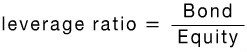
Source correction — leverage direction. The source’s formula graphic defines leverage as Bond/Equity, then the Korean text says conversion makes that ratio increase. Under ordinary positive-equity assumptions, conversion reduces bond debt (the numerator) and increases equity (the denominator), so the debt-to-equity ratio decreases. That may make displayed leverage look healthier, but it does not create value automatically.
High-yield bonds
“High yield” generally refers to an issue or issuer rated below investment grade, not to a fixed spread over a same-maturity Treasury. The spread changes with credit conditions, liquidity, structure, and the specific borrower. Higher promised yield compensates for risk; it does not remove it.
Source correction — high yield. The source’s 3–7 percentage-point premium is not a definition. FINRA’s bond overview describes the rating-based distinction and the accompanying credit risk.
Preferred stock
Preferred stock is equity, even when its cash flows resemble a bond. Dividend rate, cumulative treatment, redemption, conversion, voting rights, and participation are security-specific. Preferred claims generally rank below debt and above common equity. A missed preferred dividend does not have the same contractual consequence as a missed bond payment, although the actual certificate controls.
Source correction — preferred terms. Preferred stock does not universally promise an unavoidable fixed dividend. Its priority and rights come from the security’s terms. Investor.gov’s stock overview distinguishes common and preferred equity.
Asset-backed and mortgage-backed securities
An asset-backed security (ABS) is supported by cash flows from a pool of assets such as auto loans or receivables. Mortgage-backed securities (MBS) are backed by mortgage loans and are commonly discussed as their own category within the broader securitization market. Calling every structure an “asset-backed bond” hides differences in legal form, cash-flow waterfalls, servicing, prepayment, and guarantees.
Catastrophe bonds
Catastrophe bonds transfer specified disaster risk to investors. If a defined trigger occurs, investors can lose interest, principal, or both according to the contract. That is unusual compared with a plain corporate bond, but it is still a rule-bound risk-transfer instrument rather than a random casino bet.
The anecdotes in the 2016 note
For source fidelity, I am preserving the roles of four colorful examples: the original note linked high-yield debt to the 2015 Homeplus acquisition, film and music royalties to securitization, Electrolux to a Japan-earthquake bond, and Winterthur to a Swiss-hail bond. I did not locate transaction-level primary documents that verify those exact issuer, date, and structure claims; the Electrolux attribution is especially doubtful. Treat them as unverified anecdotes from the 2016 study note, not as evidence.
The better habit is to read the actual prospectus, indenture, official statement, or offering memorandum. A familiar label—Treasury, muni, convertible, high yield, ABS, cat bond—starts the analysis. It never finishes it. Original source: the 2016 Korean article.
Comments
Discussion happens via GitHub Discussions. You'll need a GitHub account to comment.