Bond Valuation and Risk
We actually price a bond this time: add up the present value of its coupons and its face value, then watch the coupon rate, the required return and the maturity push the price above or below par.
Last time we just kinda glanced at the types and features of bonds… like, “oh, so there’s stuff like this~~~” — that much. So now, here, we take “some bond!!!” — a bond with some coupon rate — and put a price on it.
Setting the price isn’t actually that hard. The idea sitting underneath it all: the present value of the money the bond throws off?!?!
Say you start with an amount of money $A$. Park it in the bank, leave it alone, and the money swells. By how much?!?! It swells by $rA$, so one year later we’ve got $A + rA$, or  , in our hands.
Why am I telling you this? Because I want to see this:
Money we’ll get in the future — what is it worth right now?!?!
Say we’ve been promised an amount $B$ in the future. The present value of that “promise”???? We don’t know it yet, so let’s call it  . How much money (
 ) left sitting in the bank turns into $B$ a year from now???? That’s the logic we’ll find it with.
If you hold  , then $rx$ gets added on and it becomes $B$:
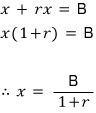
So being promised $B$ one year from now is the same as having  right now. That’s all this is saying.
And what if we were promised $B$ two years from now?!?! Let’s see.
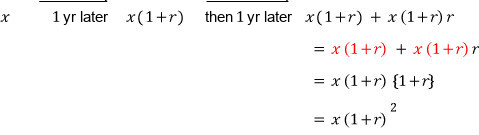
This is the principle we’re going to use.
OK so now the situation is — I went out and bought a bond.
If you hold a bond, you get a coupon rate $c$ of its Par value (I’ll call it $F$) every year, with $c$ written as a decimal — 10% means $c=0.10$. So you get $cF$ after 1 year, $cF$ again after 2 years, $cF$ after $(n-1)$ years… and at year $n$ (maturity) you get $F$ back along with the $cF$.
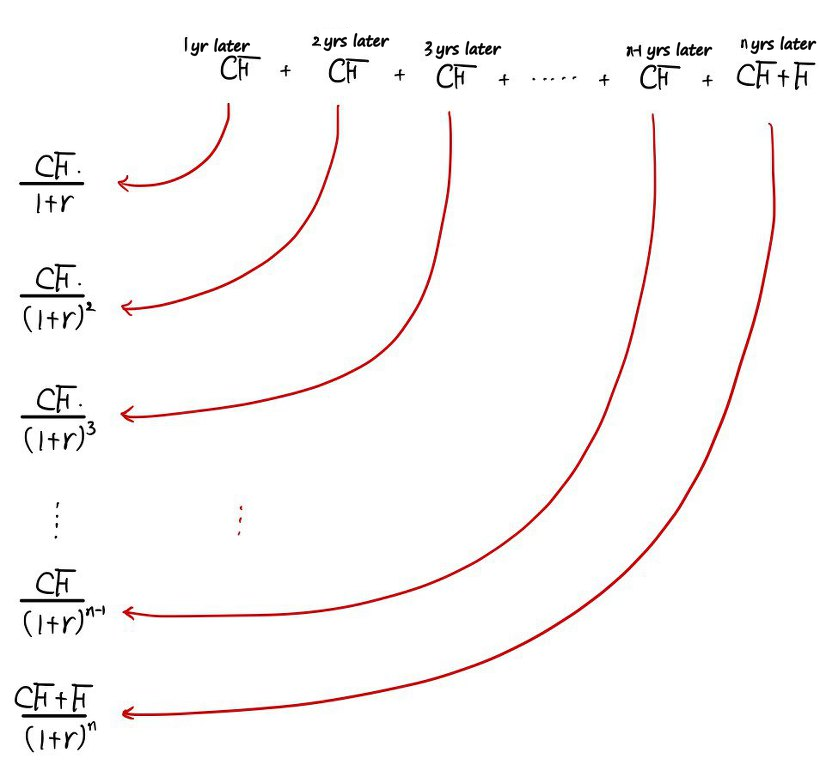
Now if we add up aaall~~~ of those red things, we get the “present value” of holding the bond.
In other words, what holding that bond is worth right now is the sum of the red stuff. We can call it the Present Value of the Bond, and this would be the bond’s price.

Written out all fancy as a formula, that’s what it’d look like.
Oh — why did I write $k$ in that formula instead of $r$? $k$ stands for the required rate of return: I put in the interest rate the investor wants. I mean, the investor doesn’t fancy parking money in the bank and skimming off $r$, so they went looking for something else, and right now we’re zooming in on that something being a bond. So: $k$, not $r$.
Ah… let’s do an example. An example.
A bond with a Par value of 1,000 dollars, and the issuer says it’ll pay coupons of 100 dollars a year! And it’s got 3 years left, and the annualized Yield going around in the bond market is 12%. Let’s see what this bond’s present value comes out to, shall we~

So it’s rational to pay 951.97 dollars for a bond with a face value of 1,000 dollars. A bond can sell at a discount to its Par value like this, and how deep that discount goes, as a share of par, is what we’ll call the discount rate here.

Well, we could write it like that.
So this time, let’s see how the coupon rate affects the bond price, and how the required return affects the bond price.
Said like that it sounds kinda hard, but it isn’t. Let me think it through roughly first.
A high coupon rate means the money paid out every period (the interest) is big, so PV will be high. A high Required Return means the investor wants to earn more interest on their money, so PV will be low!!!
A bond that sells for less than its face value (Par value) is called a discount bond, and the higher the investor’s required return is compared with the coupon rate, the deeeeeper the bond’s discount goes. What does that mean? Let’s look at it with the PV formula.
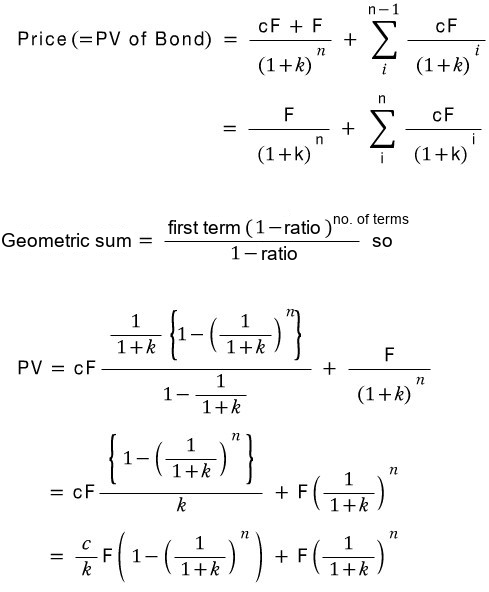
All cleaned up. Now let me write the letters a bit more compactly so the meaning is easy to read off.
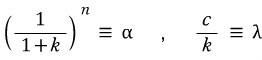
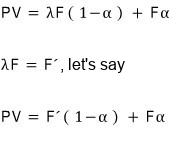
Now let’s read off what it means.
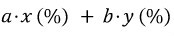
Look at this formula and you’d think, “Ahhh~~~ so what’s being added up is $x$ worth of $a$’s effect plus $y$ worth of $b$’s effect~~” — right???? The formula above is exactly the same.
For the positive yields we’re using here, PV is a weighted average of $F$ and $F'$: the weight on $F$ is $\alpha$, and the weight on $F'$ is $(1-\alpha)$!!! Those are weights on the two values, rather than their percentage shares of the final PV.
i) If $c=k$, then $\lambda=1$, so $F = F'$. So PV is
$$PV = F(1-\alpha)+F\alpha = F$$PV is just the face value $F$.
ii) If $c \gt k$, PV is a weighted sum of $F'\,(\gt F)$ and $F$, so the sum is bigger than $F$, no matter what. That means $PV \gt F$: the bond’s price is higher than its face value. A bond like that is called a premium bond~
iii) If $c \lt k$, by the same logic, $PV \lt F$. So the bond’s price is lower than its face value, which means it’s a discount bond >_<
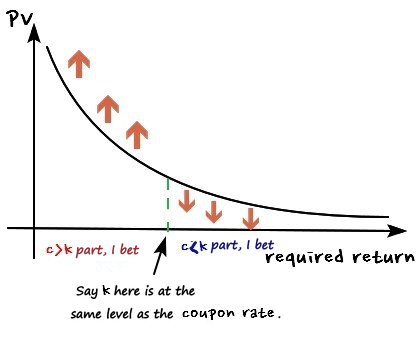
Now we can graph PV against $k$!!!!
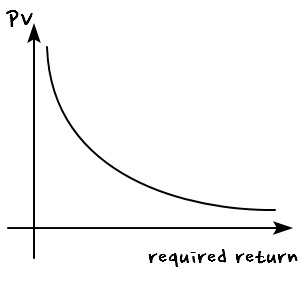
It’d come out like this, right!?!? Now let’s put what we just learned to work on that graph.
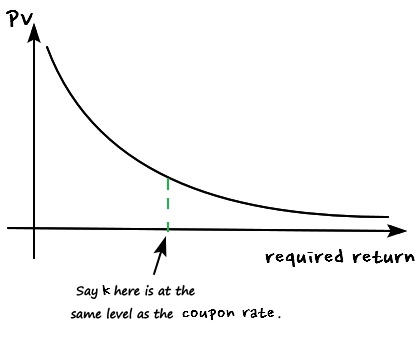
First, if I mark it like this,
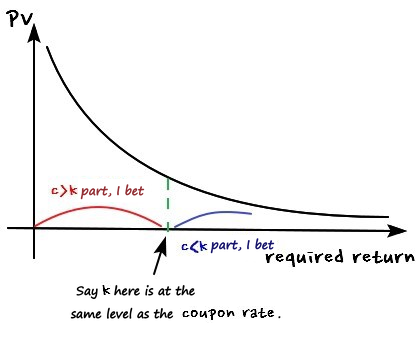
we can say this?!?!~~~~
OK OK OK OK OK but — what happens as the maturity gets longer and longer?!?! What happens to that graph?!?!
First, as $n$ gets bigger,
$\alpha$ gets smaller.
Then, in the formula

we get
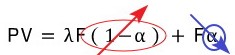
this, right?!?! The longer the maturity, the bigger the share of $\lambda F$, and the smaller the share of $F$.
So what happens to the overall PV? “Sometimes it gets smaller, sometimes it gets bigger.”
- When coupon rate $=$ required return: change the maturity all you like, PV stays put.
- When coupon rate $\gt$ required return: the $\lambda F$ share grows, so PV gets bigger.
- When coupon rate $\lt$ required return: the $\lambda F$ share grows, so PV gets smaller.
That’s how we can sum it up.
So as the maturity grows, the graph goes
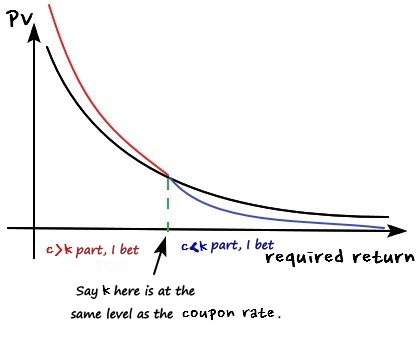
— as the maturity grows, the graph changes as if it’s rotating around one point as its axis!!!~~~
Drawn this way it might be confusing, so let me redraw it like this.
Heads-up. The figures here are the original notes, slips and all. A few things to watch for:
- In the general bond price, the last payment is discounted over all $n$ periods: $\frac{cF + F}{(1+k)^n}$, not $(1+k)^2$.
- In the 12% example, the three payments are discounted for 1, 2 and 3 years: $\frac{100}{1.12} + \frac{100}{1.12^2} + \frac{1100}{1.12^3}$ (the picture’s exponents read 1, $i$ and 2). The exact sum is 951.96; 951.97 comes from rounding each term to the cent first.
- The sum of a geometric series is $\text{first term} \times \frac{1 - \text{ratio}^{\,\text{no. of terms}}}{1 - \text{ratio}}$: the exponent belongs on the ratio, not on the whole bracket. The working below it uses it that way, so the result is right.
- The figure’s ‘discount rate’ = (par − price)/par is the discount as a percentage of par. It is not the annual discount yield k used to present-value the cash flows.
Comments
Discussion happens via GitHub Discussions. You'll need a GitHub account to comment.