Balance Sheet
Kicking off the FRA grind from absolute zero — what Financial Reporting Analysis even is, why accounting matters, and a first peek at the balance sheet.
Alright — let’s start the hellish FRA grind!
So first up: what kind of subject even is Financial Reporting Analysis? Is it the subject where you study financial statements?????
Nope nope~ The old name of this thing was Financial Statement Analysis, apparently. Back in those days, sure, you could’ve said it was about studying financial statements.
But these days they call it Financial Reporting Analysis, which means something broader. As in — on top of the financial statements themselves, you also need to chew on the “+ α” that comes bundled with them, and then you can analyze a company^^ A subject name carrying that whole philosophy…..
But like… when you actually study it… even just the regular financial statements are brutal. No hope. lol
But…. When I first cracked this open, I was starting from literally the infant stage — didn’t know the first thing about accounting. So I’m going to try and lay this out in a way that even an accounting infant could follow….
(For the record…. if you’re an accounting toddler, around chapter 3 or 4 you genuinely will not understand a single thing lol — but don’t sweat it, after that it’ll start clicking step by step, it’ll get fun, and whoever’s reading this might even end up googling the online academy that CPA candidates use…. and start ripping through accounting principles….. just like me….lol)
So what is accounting?
Accounting is — and this is really important —
“providing useful information about a company to information users”
(wow this looks completely unimportant, doesn’t it? It’s actually super important — you need to keep it tucked in your back pocket because it’s going to keep popping up later)
Oh right right. Do you know what financial statements are? lol Financial statements lol
It literally means “multiple tables related to finances.” In the Korean word for it, jaemu-jepyo, the middle syllable je is the one that means “multiple/various.”
What multiple things are there? Five of them: statement of financial position, income statement, statement of cash flows, statement of changes in equity, notes. These five.
In CFA Level 1, the heavy hitters are the first two — the super-ultra-main ones — and the cash flow statement also shows up, sure~ For the statement of changes in equity and the notes, it’ll feel more like we’re glancing at the rough shape of them and moving on.
OK so the main characters in CFA — shall we just take a peek at the basic form?????
1. Statement of financial position
Old term: balance sheet (B/S). This one’s still called a “balance sheet” in Korean commercial law, by the way. The accounting standards renamed it to “statement of financial position.” And in the posts ahead I’ll just call it B/S, for convenience.
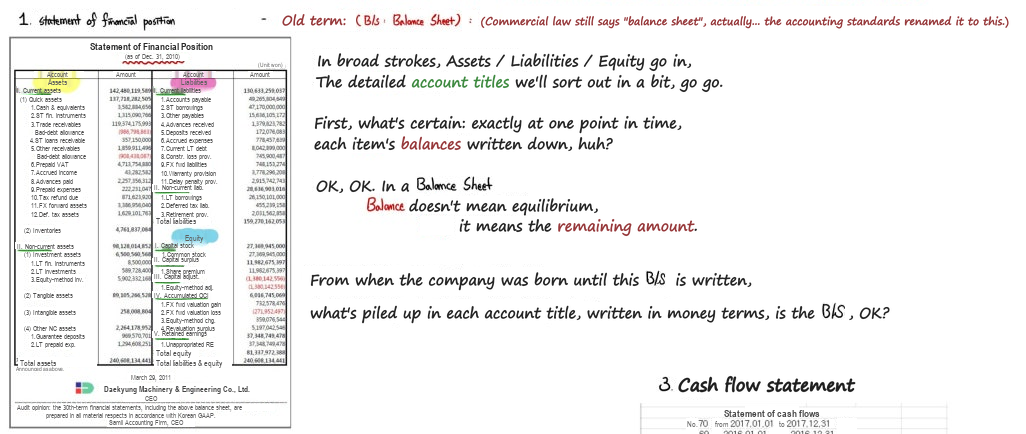
In broad strokes, you’ve got Assets / Liabilities / Equity, and the detailed account titles inside each. We’ll be looking at each one streeeeetched out one by one in the content that follows lol
(However — CPA candidates, please leave. lol lol Compared to your level, the depth here is unbelievably shallow.)
OK so, to get a feel for the B/S: you can see it’s “writing down the balances for each item at one single point in time.” Actually — in “Balance sheet,” that English word “Balance” doesn’t mean equilibrium. It’s “balance” as in “remaining amount” — the leftover.
From when the company was born up until the moment that B/S is written, what’s accumulated for each account, written down in monetary units — that is exactly the B/S!!!!
2. Statement of profit or loss and other comprehensive income
Old term: income statement (I/S). Of course, until the end of this post I’m just calling it I/S.
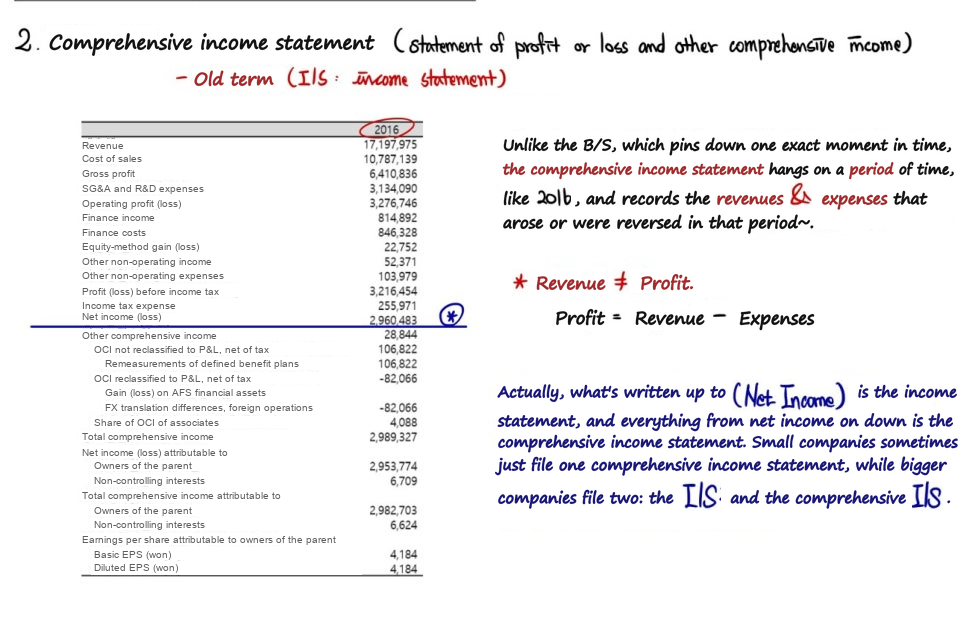
Unlike the B/S, which pins down a single point in time, the comprehensive income statement isn’t a moment, it’s a period. Like 2016, or 2020. And it’s a record of revenues & expenses (profit and loss: P/L) that happened or got reversed during that period~
But hold on!!! Let’s get straight on the difference between revenue and profit. Profit = revenue − expenses.
Oh, also — what’s the difference between an income statement and a comprehensive income statement? This is something you only really nail down at the very end of FRA, but I’ll just give you the simple version here.
Stuff written only up to net income → income statement. Stuff written below net income, including other comprehensive income — that whole P/L package is the comprehensive income statement.
Big companies submit both the income statement and the comprehensive income statement. But smaller companies that don’t have that much to report just smoosh the whole thing into one stretched-out comprehensive income statement, like in the picture above.
I’ve been dabbling in stocks lately so I get what “net income” means now. But “what on earth is other comprehensive income, why is this even a thing -_-” Yeah — that’s something we’ll learn step by step later, no rush~
(Also a way of saying: read this thing all the way to the end^^^)
3. Statement of cash flows
The statement of cash flows. The one with a notorious reputation even among people grinding for the CPA.
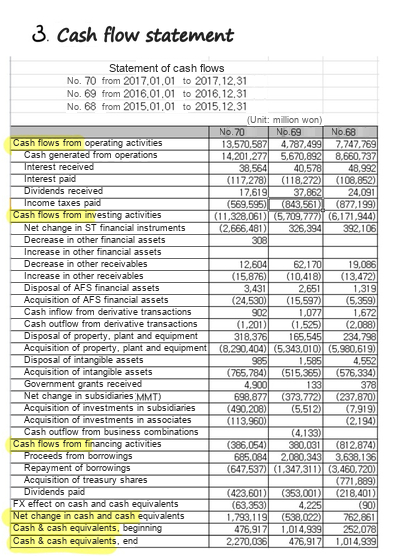
For this one — the content only really clicks once you fully understand both B/S and I/S, so I’m planning to do the cash flow summary near the very end.
And even then it’s going to be super surface-level, so don’t get your hopes up.
A rough framework of the B/S
OK so let’s just grab a rough overall framework of the B/S and keep moving. This post is exam-first, even though stock investing is its own kind of investing too. So I’ll go with the English terms.
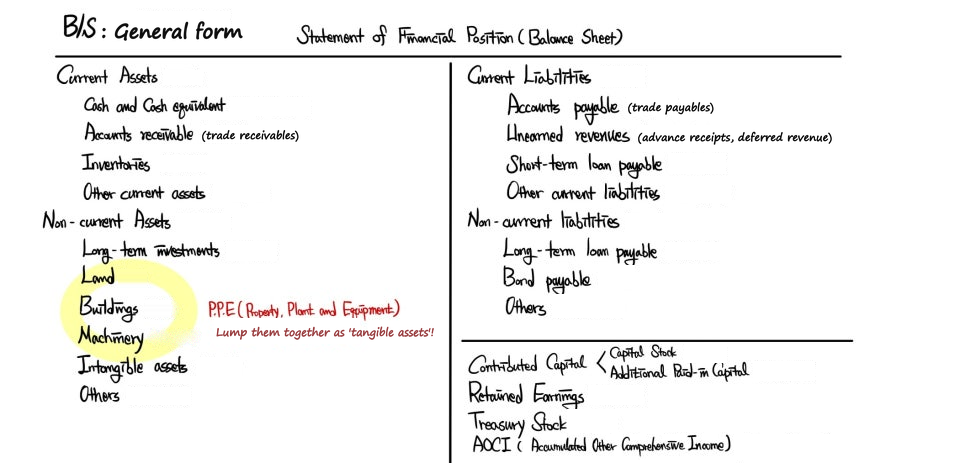
This is just general overview content. After reading this, “now I fully understand the B/S” — that thought is forbidden! Just think of it as: oh, there are these kinds of account titles~
-
Cash & cash equivalents: stuff that’s quick to turn into cash, so you can use it to pay bills (original maturity of 3 months or less).
-
Account receivable: also called receivables — money not yet collected after credit sales (basically “I’m owed money by that person~”). If you judge there’s a low probability of actually collecting it later, there’s a thing called the allowance for doubtful accounts that knocks down the trade receivables.
-
Inventories: stuff produced “for sale” and sitting around, plus stuff not yet finished still on the factory floor, plus raw materials bought for production etc… (Construction and shipbuilding companies have accounting differences because the time it takes to manufacture is so different.)
-
Other current assets: supplies that get expensed each time they’re used, prepaid expenses paid in advance but not yet recognized as expenses, etc.
-
Long-term investments: financial assets like stocks and bonds held for investment purposes rather than business operations (parking temporary surplus funds, or doing this to exercise significant influence over another company). If a company that makes cars has a lot of this… you’d want to look closer, but you might judge it as “doing something pointless~”
-
Property, Plant and Equipment: land, buildings, machinery and equipment etc. bought for use (for Use) in operations. If it’s a manufacturer, you’d expect a lot of this…
-
Intangible assets: assets without physical form — patents, trademarks, copyrights etc. (If the right has a limited life, you amortize it; if it’s perpetual or unlimited, no amortization.)
-
Account payable: “I have money I need to pay on credit~”
-
Unearned revenue: payment received before you’ve delivered the product or service (i.e. goods/services you still owe).
-
Short-term loan payable: funds raised short-term within 1 year.
-
Other current liability: unpaid wages (wage payable), unpaid interest (interest payable), unpaid corporate tax (income tax payable), etc.
-
Long-term loan payable, bond payable: among bonds, the short-maturity ones go up in the short-term bucket above, but a lot of them have long maturities. Bonds have this annoying property that extending their maturity is hard!
-
Capital stock: initially raised funds. Based on the par value per share set when the company was founded, and if you raise more capital later through a rights offering or whatever, only the amount up to par value gets recognized as capital stock.
-
Additional paid-in capital (PIC): funds raised in excess of par value (par value goes to capital stock; the excess goes here as additional paid-in capital). But why on earth would you do that???? — we’ll get to it later when we cover Equity.
-
Retained earnings: the accumulated net profit the company has earned through business activities (basically the money earned since founding minus what got spent — the source for future dividends).
Wow…. The self-loathing I feel even as I’m typing this out… Is anyone reading this actually going to understand it????? Absolutely not. Because I was literally just listing them out, kind of copy-pasting without fully grasping it myself…… Anyway sorry sorry.
But — the important thing is, if you read this whole series, you’ll end up knowing at least everything written above plus the + α ^^
OK so now — let’s zoom in just a tiny bit more on B/S and I/S.
Honestly, the first time I sat through this part I didn’t get a single thing…… So if accounting is brand new to you, you might not get it either. Don’t worry. Even if this part ends up being a once-over that goes in one ear and out the other — it’ll be worth it.
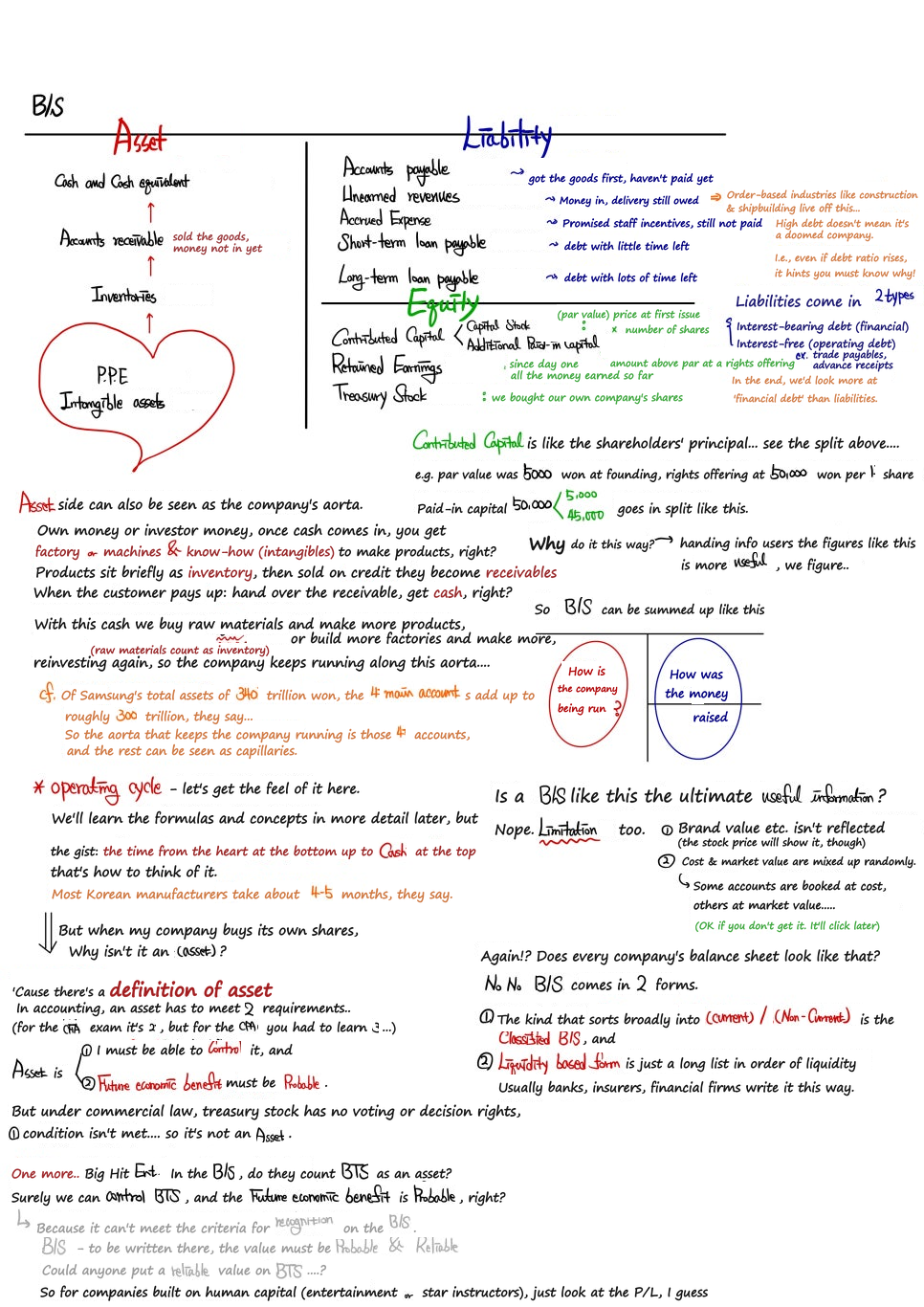
OK then — let’s look at this page.
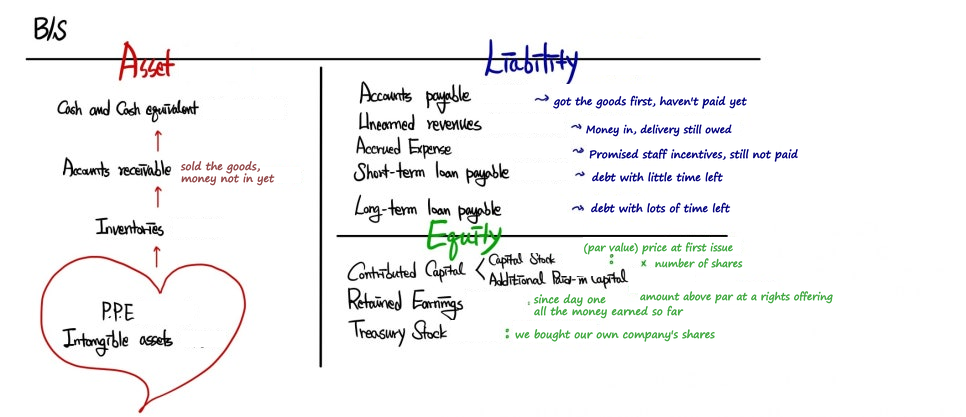
Like we said, B/S is a sheet of paper showing the “balance” of how much has piled up in each account title from the company’s earliest days. It’s laid out like this.
On the left side (debit side) you’ve got Assets. And on the right side (credit side) you’ve got “what money was used to acquire that Asset on the left?” Because that Asset on the left could’ve been acquired with borrowed money. Or it could’ve been acquired with the money of you and your partners (shareholders) when the company was set up. Those two things show up as Liability and Equity respectively.
The Asset side
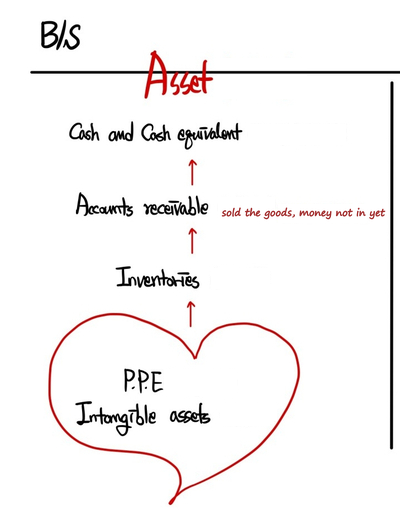
In Korea, financial statement info is pushed out to anyone who wants it through an electronic disclosure system called DART. If you head over there and crack open the actual B/S of some random company — just the Asset side alone has so many line items it’s ridiculous. But — we’re accounting infants, so let’s think in broad strokes.
We’re running a company. But hold on — what is a company???? I mean, the reason for running a company. To make money, right?
How do you make money????? Whether you make something and sell it, or provide a service and sell it — there has to be some kind of tool, right? That stuff is what we call PPE. You need Property, Plant and Equipment before you can even try to do anything????? Of course there can be assets here without physical form — patents, copyrights — and that’s why PPE and Intangible Assets share the same nature.
So after the company makes something to earn money — it sits in a warehouse or wherever, and that “asset intended for sale” piles up under the name inventory. Now you’re going to sell that inventory, right? Who pays in cash these days, c’mon. You sell on credit first, and that lands in our company under the name trade receivables. In trade receivables there’s basically a “we’ll send you this much within xx months~” attached. Well… it’s money, it’s money, heh, nice nice.
And then when that money eventually rolls in — it comes in as Cash. So that cash is in.
If you’re the company’s boss, what do you do??????
What do you mean what do you do, you go make stuff again (annoyed face). Gotta earn more money lol.
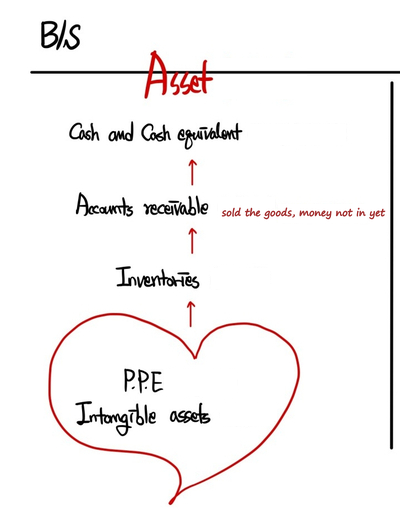
That’s why I drew PPE and intangible assets at the very bottom as a heart……heh. Pumping blood up to the top, push push push. And that blood circles back down to those guys again and becomes the driving force that pumps blood upward all over again, push push push. That’s why — the heart!!!!
Wow…… We only roughly skimmed Assets and you can already see how a company actually breathes….
Liabilities
Now let’s look at the right side.
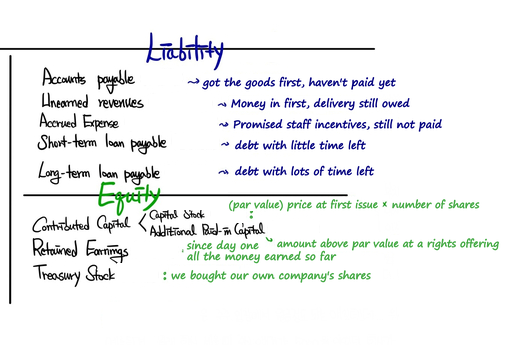
Liabilities are, simply put, just money you’ve borrowed from other people. Plain and simple — there’s money borrowed from banks. And money borrowed from bondholders by issuing bonds.
(Picture a person or a company that can’t do business with a bank. A bank is a pretty conservative beast — it doesn’t just lend to anyone. So how do they raise money? They go to someone willing to lend and beg “I’ll pay you thiiiiiiiiis much interest, please lend me money (sob)” — and the kind of pledge you write up for that, that’s basically a bond.)
OK OK liability = borrowed money, got it got it.
Hmm? I also see trade payables and advance receipts. What are these though…
Ah… so these are things where, when you’re running the company — well… it’s not exactly borrowed money. But they’re things you’re “under an obligation” for. For example: to make my product, I need to buy stuff from someone. So I’ll be buying things too, like this. And — who pays cash these days — you buy on credit. At that point a trade payable shows up, a pledge that says “I’ll pay you.”
And as for advance receipts — hard to explain right this second, so Pass. I’ll get into it properly when we cover “accrual basis,” heh.
Anyway — in Liabilities, these “unavoidable obligations” all get bundled in. You get why they go into liabilities and not assets, right? OK?
And one more thing to lock in before we move on — the liability side has 2 flavors….
-
Liabilities that generate interest.
-
Liabilities that don’t.
For interest-bearing ones, just think of it simply: you borrowed money, so you have to pay interest, which is the time value of that money. Called interest bearing debt…
And things like trade payables and advance receipts are also liabilities.
But — do these spit out interest??????
Maybe sort of — pay up quickly and get a 2% discount, or otherwise just pay within 60 days~ — that kind of arrangement, right???? (in corporate finance you’ll bump into this as “2/10 net 60”). But they’re not nominally interest-bearing the way financial liabilities are. Anyway!!!!
And while we’re on advance receipts — order-based industries like construction and shipbuilding basically live on advance receipts, apparently. Which means!!!! Slapping a “100% going to fail” label on a company just because liabilities are high could be a really dumb call.
So what we actually need to do — even if the debt ratio is high, even if it’s gone up — is look at why and how it went up!!!!
Equity
OK now let’s move to Equity.
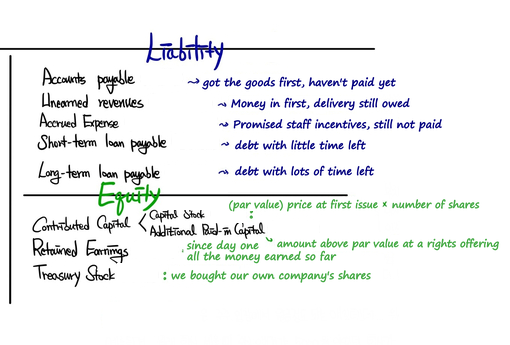
I’ve only put 3 things under Equity here. When we look at the Equity side later we’ll lay out something like 6. But right now I’m just trying to grab the basic concept, so let’s just know 3 and roll on.
The first thing you see is contributed capital. What is this. It’s the money from the partners.
You’re a businessperson. And you’ve got insane confidence in some business idea. Would you take on debt to start that business? Or would you find a partner and start it together? The money from the partners who came in that way — that gets parked in Equity as contributed capital, heh.
Now this contributed capital is shown split into two — capital stock and additional paid-in capital.
Capital stock = par value × number of shares. Shown like that (par value is most often 5,000 won).
Additional paid-in capital = not the founding moment, but when you receive more than par value in a later rights offering — that excess goes here.
Example: a company whose original par value when founded was 5,000 won per share — did a rights offering, and offered shares at 50,000 won apiece. Out of that 50,000 paid in, 5,000 goes to capital stock and the remaining 45,000 lands as additional paid-in capital.
Why????? Why bother?????
lol The answer is always “in the reasoning behind the accounting treatment,” apparently. The reason for splitting it up like this is because they decided “writing it this way and handing it to information users is more useful information.”
From what I can tell — splitting it up like this makes it easy to calculate market cap? But honestly telling you that now would just confuse you, so for now just — lock in on “USEFUL INFORMATION”… grasp it at about that level and let’s keep going!!!!
And then below that is Retained Earnings. This is the total money the company has earned and held onto, from founding stretching alllllllllllllllllllll the way to today. So when shareholders go — “Hey, share some of what you made?” — that comes out of retained earnings now.
That is — the money that can be paid out as dividends isn’t cash, it’s retained earnings, heh.
And one more: treasury stock! When a company trades its own shares, you say it traded treasury stock, right? You’ve probably seen the stock price ride huge waves on rumors of “buying treasury stock or not buying treasury stock.” That treasury stock is this treasury stock.
Then you might be sitting there going: I’m the company president, and I made the call to have my company buy my company’s shares —
But why????? Isn’t this an Asset?????
That’s because there’s a definition of Asset in accounting, and treasury stock doesn’t meet it, so it gets bounced over to the right side and ends up in Equity.
For CPA exam purposes you learn 3 requirements for something to be an Asset. For CFA purposes you learn 2, apparently. Let’s just stick with 2. An Asset is:
-
Something I have to be able to Control, and
-
Future economic benefit must be probable.
Treasury stock, under commercial law, has no voting rights and no autonomous decision rights, apparently. So it doesn’t satisfy condition 1 — and that’s why it’s not an Asset.
So — if you go pull up the B/S of, say, an entertainment company — the entertainers under that company aren’t recorded as assets.
Which actually would be hilarious to see…. Imagine ripping open JYP’s financials and there’s a B/S with the entertainers listed one by one, each with a value next to them….
But clearly for an entertainment company, it’s the entertainers who bring the money in. And shareholders investing in it are investing because they believe a specific entertainer is going to blow up — right? In 2020, JYP’s NiziU was about to go absolutely huge in Japan…. And I watched the stock price moonshot when that activity became locked in.
Anyway — the source of profit for an entertainment company is clearly the entertainers… Similar example…. for Megastudy too, it’s the star instructors who bring the money in….
So why aren’t the star instructors in Assets… You could argue the company can control them, and that future economic benefit is sufficiently probable, right?????
That’s because the requirements for Recognition aren’t met. To recognize something on the B/S — anywhere, really — you have to satisfy the recognition requirements. And those are: Probable & Reliable.
I mean, who on earth could write down the value of a star entertainer or a star instructor in a Reliable way……
(That’s why for human-capital-based companies, you’re supposed to look mainly at the P/L…… there’s common sense that’s just common sense, apparently, heh.)
Anyway — the B/S can now be summarized like this.
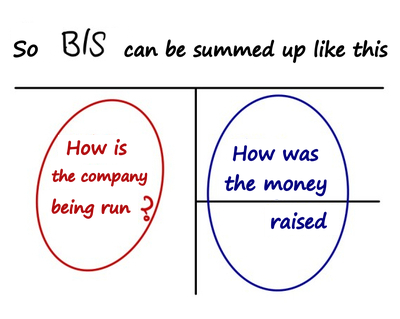
So — now that we’ve got the king-ultimate-best B/S that provides Useful Information, are we done????
Limitations of the B/S
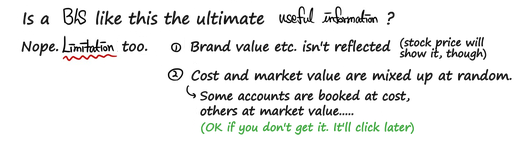
For exams they also ask about the Limitations of the B/S. For exam takers, this needs to get drilled in mechanically.
-
Nope nope nope nope nope — B/S can’t reflect things like brand value (it would obviously be reflected in the stock price, sure).
-
Nope nope nope nope nope — cost and market value are mixed in there all over the place. Some account titles are cost-based, some are market-value-based.
You don’t really need to understand #2. Just simply — a company bought land for operations, built a building, started doing business. They got going by paying 1 billion won when it wasn’t expensive — but then land prices start ripping. It became 10 billion won….
So now, clearly — should this Asset go in at 1 billion (cost)? Or at 10 billion (market value)? That’s the kind of issue we’re talking about. Inventory goes in at cost. Tangible assets can go in at market value… Yeah, there’s stuff like that — but this is content you’ll naturally understand once we walk through each account title one by one, heh.
Wow, so I now know everything about the king-ultimate-best B/S!!!! Let’s go to DART!!!!
Let me yank up Shinhan Financial Investment at random~~~!
As you can see on DART, B/S comes in roughly 2 forms — let’s note that and move on.
-
Like we saw in the body above, there’s the Classified B/S that broadly splits things into current and non-current.
-
And there’s the Liquidity-based form, like the Shinhan Financial Investment one I just pulled up, which just lists everything in order of liquidity in one stretched-out column. Financial companies — banks, insurance companies — usually write their B/S in this form!
Wow…. Let’s call it here for today…. The side notes have piled up like crazy……
Comments
Discussion happens via GitHub Discussions. You'll need a GitHub account to comment.