Income Statement and Cash Flow Statement
Quick rundown of the income statement — what it shows, why revenue ≠ profit, and why accountants split out discontinued operations so shareholders don't get played.
Last time we took a quick look at the B/S — this time, let’s do the same for the I/S.
Like I mentioned before, the I/S shows — over “that period” — what the company earned revenue from, what it spent costs on, and how much profit it ended up with… basically, it shows the company’s performance. (The B/S was about the state, not performance.)
(Did you catch that? Revenue and profit are different words, heh. The thing you get when you subtract costs from revenue — that’s what we call profit.)
(Science/engineering meatheads like me probably had no idea?? lol right?? lol or am I the only thick-skulled one here hehehe)
Like, say retained earnings on the B/S (the money the company has earned cumulatively from founding up to today) went up —
just looking at that, you can’t tell if they made the money by selling a ton of products, or if their actual operations completely tanked and they got bailed out by some lucky bet on coins or real estate let’s gooo!!
Point is, to figure out exactly how they made money during this period, you have to look at the I/S.
OK, first let’s look at the general form of the I/S.
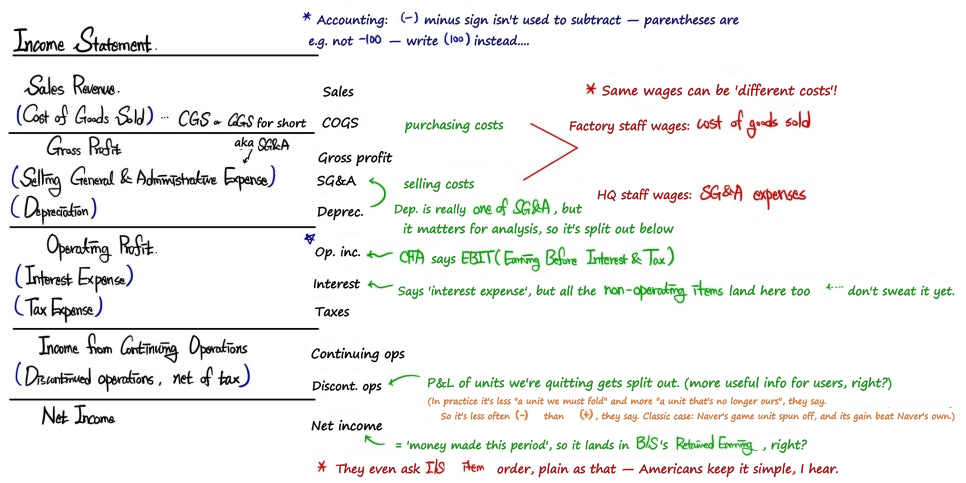
Let me re-explain the stuff I scribbled on the right side —
first, in accounting, when you need to write a negative number, you don’t just slap a (-) sign on it.
You write the number inside parentheses. So instead of writing -100, you write (100).
Next, cost of goods sold is for costs related to purchasing,
and costs related to selling go into SG&A — you can kinda guess from the name, ok ok —
but the part where factory workers’ wages go into cost of goods sold while HQ employees’ wages go into SG&A… ;;;
What is this nonsense even… hahahahahahahahaha
We’ll go through this one piece at a time when we actually dig in later! hehehe
Anyway, just hearing once that “oh, there’s a thing like this” will help.
And then at the bottom, it keeps splitting things out into continuing operations income vs. discontinued operations income —
what this means is: after the interest expense that needs to go to creditors gets pulled out of the money the company earned, and after the taxes that need to go to the government get pulled out,
now only the money that goes to shareholders is left, and that gets split into “the part of the business that’ll keep going” & “the part of the business that won’t keep going.”
Why??????????????????????????????
Why bother going to all that trouble?????????????????
The whole point of accounting is
“to provide Useful Information to Information Users,”
and chopping it apart like that gives you more Useful information.
If I’m a shareholder and the company’s profit is high so I decide to keep holding the stock —
but actually, the majority of this period’s profit came from a business that won’t continue — then I’m basically getting scammed, right????
So splitting it out like this kinda makes sense.
So discontinued operations income
means a business “that won’t be done anymore,”
and you might be thinking — ah, so the losses from some failing business getting wound down show up there —
but apparently in practice, that’s not really how it works.
Usually it’s because some specific business division is doing so well
that it’s getting sold off or spun off, so “since it won’t be inside our company anymore,”
it actually shows up as a profit under discontinued operations income way more often, hehehehe (kind of interesting, heh)
And in the middle, I starred operating income —
if you read articles or news, they’re always talking about a company’s “operating income.”
I don’t think I’ve ever once heard the news talk about net income….
Why on earth do people care so much about operating income????
To cut to the chase: in a financial sense, the answer to “what makes a company a good company?” is
“a company that brings a lot of profit to its stakeholders,”
and a company’s stakeholders aren’t just shareholders.
A chunk of the money the company earns goes to creditors, then to the government, and then to shareholders.
To creditors — interest expense, as the price for having lent money.
To the government — taxes, as the price for providing social overhead capital.
To shareholders — net income, as the price for these folks also having put up money.
The profit that wraps all of these in is what you can think of as operating income.
And for CFA exam purposes, you can basically treat operating income as EBIT, apparently. (The details are actually a little different, so the saying goes.)
(Even when you pull data from FnGuide, it has a field literally called “Operating EBIT,” and that value matched operating income exactly.)
OK now now now now now now now now now now now now,
the I/S records the money earned during that period, etc.,
and the money recorded each period — two years ago, last year, this year… — accumulates into the B/S
to become the current B/S state, right?!?!?!?!
How does that accumulation actually happen?
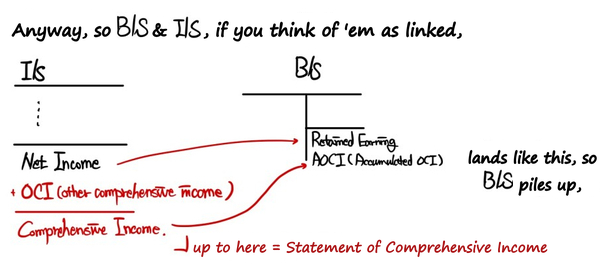
Net Income piles up into Retained Earnings, and —
though we’ll cover this at the very end — OCI (Other Comprehensive Income) piles up into AOCI (Accumulated OCI).
OK none of that really matters right now, so for now —
“Aha, so the money the company earns gets distributed to creditors, taxes go to the state, and the shareholders’ leftover share keeps getting dumped into retained earnings.”
And dividends come out of those retained earnings — that’s the structure!
Let’s just hold onto that much and move on.
(Well, if you wanna get more specific there’s more to say. Whether it stops by the I/S first and then hits the equity section of the B/S, or whether it skips the I/S entirely and goes straight to the B/S… and depending on that, it gets classified as operating income vs. comprehensive income, etc. — but CFA Level 1 doesn’t go that deep…. If the day ever comes when I write up intermediate accounting, I’ll get into it then :-) )
And one more thing —
if you look at the I/S, there are entries that look like the same kind of income/loss,
but some are Revenue and some are Gain.
Same with losses — there’s Expense and there’s Loss —
so what’s the difference?
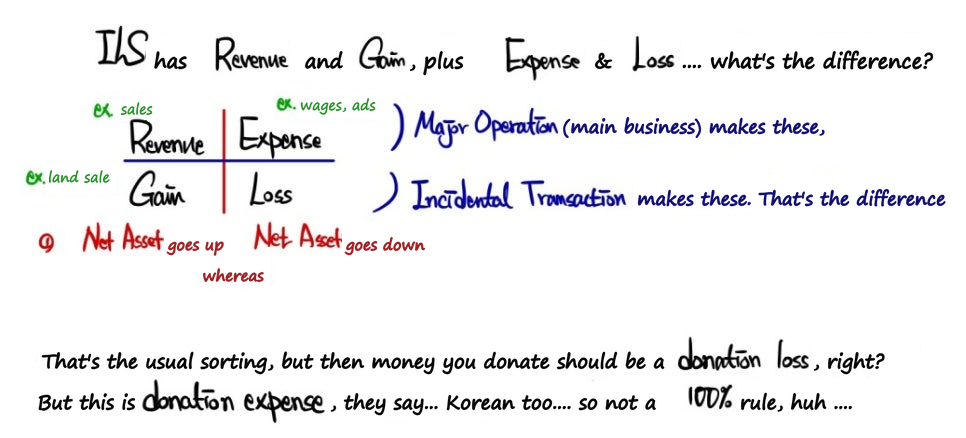
First, Revenue or Gain, both increase Assets in the (+) direction.
Expense or Loss, both act on Assets in the (-) direction —
so the difference is whether it came from “primary operating activities” or not.
For example, Hyundai Motor Co. buys a bunch of materials to manufacture cars. This obviously acts on Assets in the (-) direction,
and this is clearly tied to their primary operations, so yeah — it’s correctly classified as an Expense.
But the value of some stock they were holding dropped??????? This obviously acts on Assets in the (-) direction too, but it’s not related to their primary operating activity, right?
So something like that gets classified as a Loss.
The interesting bit is — for a company whose primary business is stock trading, if a stock price falls and hits Assets in the (-) direction,
for them it’s a loss related to their primary operating activity, so it’d actually need to be classified as an Expense…
So there’s a distinction like that, hehehehe
OK, now —
the C/F (Statement of Cash Flow) — the so-called flower of accounting —
is really a flower hahahahahahahahahaha
It’s taught briefly almost dead last,
but since it’s such a complete flower of a thing,
let’s just glance at the overall form for now and move on, hehehe
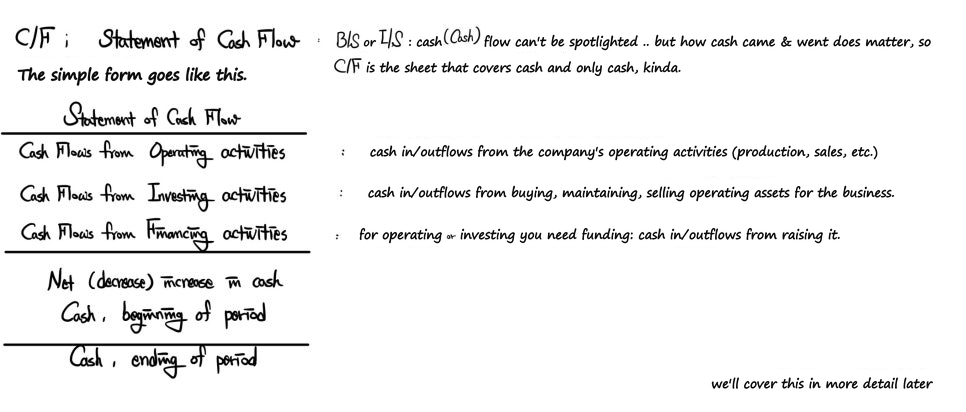
Just one thing worth noting for now —
the B/S and I/S use “accrual basis accounting,” which we’ll cover later.
For someone new to all this, it might sound like “huh? what’s that? why do they do that?” —
Yeah. Fair.
And here’s the thing — even the people who write the accounting standards admit it: “accrual basis” isn’t the be-all-end-all~ they straight-up acknowledge it~
Which is exactly why the cash-basis C/F got included as one of the five financial statements :-)
Comments
Discussion happens via GitHub Discussions. You'll need a GitHub account to comment.