Accrual Accounting
A casual breakdown of why accrual accounting exists — from the 'does undelivered revenue count?' dilemma to how GAAP, IFRS, and K-IFRS all fit together.
OK so we’ve got a rough sense of what financial statements are,
what’s actually written on them, what companies have to file every quarter,
and what people are squinting at when they pull stuff up on DART. Cool. That’s the foundation.
So let’s chew on this scenario.
Our company exported semiconductors to the US back in November 2020 (yeah, I’m the boss now~).
We got paid the full 1 billion won that we’d agreed on for the sale.
And right now, in December, the ship hauling those products is somewhere out on the Pacific, scheduled to land in March.
But our company has to write up and disclose financial statements covering everything through December —
so do we just dump that whole 1 billion won into revenue????
Even though the stuff hasn’t even gotten there yet?????? What if the ship sinks halfway across the ocean?????
But on the flip side, not counting even 1 won of that 1 billion as revenue feels way too harsh…..?
In other words —
we need a standard. Some shared rule that every company uses to write financial statements the same way.
Which is exactly where we have to start understanding what GAAP is…
Generally Accepted Accounting Principle
(Generally Accepted Accounting Principle; GAAP)
If every company used its own accounting principles, accounting’s whole point — “delivering useful information to users of that information” — would be impossible.
So people put in the work to build GAAP and unify the rules for writing F/S (Financial Statements).
BUT!
The bodies that put GAAP together are different country by country…. so for example, the US has US-GAAP, and Korea has K-GAAP or K-IFRS. (We slapped the “K-” prefix on stuff long before “K-quarantine” was a thing lol — anyway, K-GAAP is supposedly modeled pretty heavily on US-GAAP.)
For reference: the thing that was put together with the goal of unifying accounting standards globally is IFRS (International Financial Reporting Standard),
and apparently it’s still going to take more time before things are properly unified. Oh, and IFRS came out of Europe.
In our country, we used K-GAAP benchmarked off US-GAAP, then adopted IFRS starting in 2011,
and 2011 was a transition period — large corporations were required to use IFRS first, and then gradually smaller companies switched over to IFRS too.
(You can actually see this pretty clearly in the data, which is also kind of interesting.)
To pin all this down nicely for reference:
Korea’s accounting standard-setting body is the ‘Korea Accounting Institute (KAI)’, and the accounting ’theory’ it puts together is GAAP.
In the end, the standard you actually apply when preparing financial statements is, in theory-speak, GAAP — and over here we call it the ‘Corporate Accounting Standards,’
and what we plug in as those corporate accounting standards is K-IFRS.
So… GAAP, IFRS, and corporate accounting standards are all the same thing — keep that in your back pocket. ( — straight from intermediate accounting)
And after deliberation and resolution it gets reported to and finalized by the ‘Financial Services Commission.’ Meaning: KAI builds the theory, but the final say belongs to the Financial Services Commission!!
Anyway!
“Commonly accepted accounting principles” definitely exist,
and there are “major principles” of Generally Accepted Accounting Principles (GAAP). We’re going to look at 4 of them,
and we’re going to treat 2 of them as the really important ones!
So let me just dump the whole list out first.
-
Accrual-basis accounting treatment
-
Matching principle (of revenues and expenses)
-
Going concern
-
Measurement principles
Alright, let’s dive into number 1, accrual-basis accounting treatment!
This is a concept that gets applied “when you’re recognizing revenues and expenses.” Honestly, it’s easier to understand if we look at the opposite of accrual basis first.
That’s cash-basis accounting.
It’s an accounting method that recognizes cash inflows as income and cash outflows as expenses.
At first glance this might feel like the most common-sense approach, but GAAP said nope — you have to follow the accrual basis.
So then what’s accrual basis…..
It’s, regardless of whether cash is flowing in or out or whatever, “the method that recognizes revenue/expenses at the exact moment!!! when certain conditions get satisfied.”
OK OK OK OK OK OK OK OK OK
Let me first walk through how “revenue” gets recognized — it’s called the “Five Steps of Revenue Recognition (Five Steps in English).”
The whole revenue-getting-recognized-this-way thing is from a piece of legislation that kicked in in 2018 (called IFRS 15).
(We’ll come back to the Five Steps later.)
OK, that’s it for revenue! All I’ve talked about so far is revenue.
Then what about expenses?
Expenses get recognized through principle number 2 — the matching principle of revenues and expenses.
- Matching Principle (of Revenues and Expenses)
The principle is: “in general, expenses are recognized at the same time as the revenue they go with.”
You can read it as embodying the philosophy that ’expenses = the resources you sacrificed in order to earn that revenue.’
That probably doesn’t land right away, so easy example —
if you spent 1 billion won making 100 products, and out of those you sold 50 and pulled in 800 million won in revenue,
then the expense is “only the 500 million won corresponding to the 50 units that hit revenue!” — that’s what gets booked as expense.
(See how they line up exactly?)
Oh but — for stuff like advertising costs, interest expenses, depreciation expenses, etc., where there’s no per-unit count to attach to…. matching seems impossibly hard, right???…..
For those bits, GAAP also worked out a way to match them in a reasonable fashion,
and that’s something we’ll get into later…..
(You can basically think of 1 and 2 together as the accrual basis.)
- Going Concern
Sounds obvious, but it’s still an assumption that absolutely has to be there.
I mean…. when you’re writing financial statements, shouldn’t they be written under “the assumption that the company is going to keep operating”????
If accounting is supposed to give people information, and somewhere in there is the vibe of ‘oh by the way, this company might shut down’ —
the user receiving that kind of information is going to be totally lost……
BUT! There’s a concept that’s the opposite of this — liquidation —
and liquidation is when a company disposes of its assets in order to dissolve.
Financial statements can be prepared on this liquidation basis, and in that case the financial statements get prepared by a different set of standards.
- Measurement Principles
This one’s going to come up over and over later.
Say I bought a car for the business.
I bought a Sonata for 20 million won.
Two years go by, and well, GD Park Corporation still has to put together financial statements at that point,
and this car…. a lot of time has passed…. and apparently if I sold it now it’d go for 15 million.
So at what price exactly is this car… clearly my asset, this car… supposed to show up on the financial statements….??
Because it’s a car, it might feel like there’s one obvious answer,
but let’s say it’s real estate….. and the price shot up by 1 billion won in a single year…. should we…. bump it up by 1 billion and write that on the financial statements….?
All of these various things…. at exactly what amount are we supposed to measure them?
That’s what this principle is about.
I’m just going to show you 2 here.
a. Historical cost: the price recognized on financial statements as the purchase price. Even as time goes on, it stays recognized on the financial statements at the original cost as of the purchase date. This is a methodology that leans into reliability….
Since US-GAAP is broadly a reliability-focused style… this is something you see a lot in US-GAAP….
b. Fair value principle: this is the angle of ‘how much would it go for if I sold it right now?’ It might be better for conveying the company’s current state… but reliability takes a hit.
Put simply, if a car-manufacturing company shows a huge swing in assets not from making cars but just from land prices going up….
Even so, even if the reliability of that valuation drops, it might still be more useful for ‘decision-making’…
(To pile on a tiny bit more — well, how inventory gets measured, what principle decides the price if that inventory’s price suddenly skyrockets, and how it gets measured if it tanks too far… we’re planning to learn all that stuff later^^ heh heh heh Just hearing about it sounds exciting, right? Whoops, typo. whoops whoops whoops ugh ugh)
OK, listing’s all done.
So let me circle back and flesh out a bit more of what didn’t get fully covered above, before we move on.
I want to talk a little more about the criteria for recognizing revenues and expenses.
First off, revenues and expenses are what go into the I/S, right?!?! (a company’s performance over a period!) So everything we’re about to talk about is going to be about the I/S.
OK OK OK OK OK OK OK OK OK
If you’re brand new to accounting, you’d probably naturally(?) think the I/S is cash-basis.
I mean, it kind of feels natural to slot money that came in as Revenue and money that went out as Cost.
Unfortunately………… (very unfortunate, T_T) GAAP doesn’t use that as its principle for capturing revenue…
The reason, in one sentence, is:
“Recognizing revenue that way isn’t useful information~” — that’s apparently how they think about it, right?!!?!?
So then what do we do?
Let’s check out the “Five Steps”!!!
(Once you’ve captured revenue this way, costs get matched matched to line up with it! You haven’t forgotten that part, right?!)
For exam purposes you have to memorize these 5 steps….. if it’s for an exam…. let’s just memorize them with these keywords:
-
identify contract
-
separate or distinct performance obligation
-
transaction price
-
allocate of 3 into 2
-
satisfy a performance obligation
Let’s break them down. Here we go.
-
First, look at the contract and check it. Go go.
-
Then split it up by each performance obligation. (Usually a contract doesn’t just have one tidy obligation like ’transfer the goods.’ It’s more likely a contract that’s all knotted up — transfer the goods — provide 2 years of free A/S — unconditionally swap out any defective items — ….. all bundled together like that.)
-
What’s the price?
-
Distribute that total price appropriately across each of those split-out performance obligations, and
-
When that performance obligation is fulfilled, recognize only the chunk allocated to that fulfilled obligation as revenue!!!!!
For reference: when this kicked in in 2018…. did every company take a big hit because of the changed revenue recognition standard?? More like… not so much a hit as a lot of changes???
The industry that got the most shaken up was apparently SI (System Integrator: an IT/communications company that handles everything related to system development — design, development, operation, maintenance, management)…..
I mean, they’re a company providing exactly those kinds of services, and in their contracts all sorts of performance obligations like that are tangled together…..
Another place where a lot of stuff changed was… airlines that hand out mileage points.
The miles that get racked up when we buy a 1 million won plane ticket…..
are conceptually a prepayment for a service to be used again later.
So because of this, the Performance Obligation isn’t fulfilled until we actually use those miles,
and even if the airline sold a 1 million won ticket, they can’t recognize the full 1 million as revenue — a certain chunk just keeps piling up as a liability —
and that’s why every time you walk into an airport they pressure you, not-pressure-but-totally-pressure, with “You’ve got mileage, would you like to use it?!”
This is stuff we’re going to bump into a ton later when we look at how transactions get reflected on the B/S,
but let me flag it once here.
When companies are out there doing transactions, compared to everyday life, transactions where money gets paid up front or paid afterward are apparently super common.
But, money received up front before the performance obligation has been fulfilled — like I just said — has to stay in a state where it’s not counted as revenue,
and if the performance obligation has been fulfilled but the money hasn’t come in yet, then regardless of whether cash has actually moved or not, it has to stay in a state where it is counted as revenue, right?
So how does that show up on the B/S?
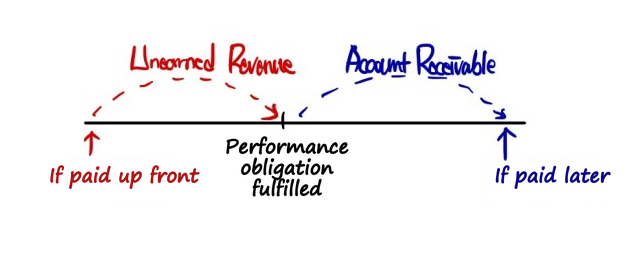
Money received up front piles up under Liabilities as Unearned Revenue, in a state not yet recognized as revenue,
and money to be received later gets recognized as revenue first and piles up under Assets as Accounts Receivable!
(You don’t quite get it yet, right?! That’s totally fine heh heh heh)
And let’s wrap this post up with “expenses” —
revenue is captured using the Five Steps I just talked about,
and then expenses get matched to that revenue, and “only the cost you actually incurred to generate that revenue!” is what gets written — that’s what we said, right?!
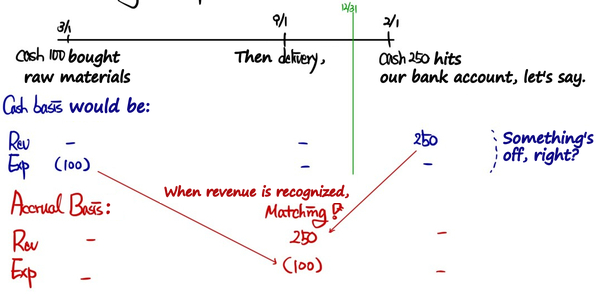
This is on the I/S side.
And just like before, here’s how this transaction now shows up on the B/S:
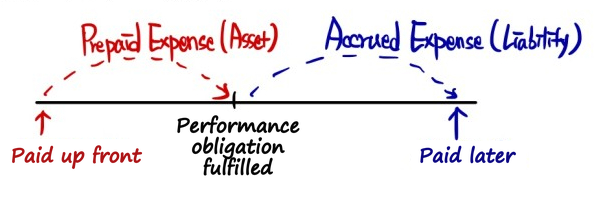
Up to this point was the most boring part of learning accounting.
From the next post onward we’re going to walk through account titles one by one,
learning stuff like how each one gets recognized -> how the follow-up accounting treatment is handled -> and how they get dealt with when they disappear.
Something along those lines!!!!!!!!
From the next post on it’s planned to actually get pretty interesting!!!!!!!
Nice work everyone!!!!!!!!!!!!!!!
Comments
Discussion happens via GitHub Discussions. You'll need a GitHub account to comment.