Property, Plant and Equipment (1): Acquisition
We kick off long-lived assets by diving into PP&E acquisition — what counts as an asset, why it's not just an expense, and how initial recognition works.
Alright, we’re finally moving on to the next asset type: Long-Lived Assets!
The inventory we’ve been looking at up till now was a Current Asset (stuff generally convertible to cash within 1 year). But the tangible assets we’re about to look at? Those are Non-Current Assets (stuff generally not convertible to cash within 1 year).
(This is also based on one accounting period — to count as a tangible asset it has to be used, or expected to be used, beyond one accounting period. Anything used for shorter than that gets classified as ‘supplies’.)
Two types we’re covering: tangible assets (Tangible Asset, aka P.P.E — Property, Plant and Equipment) and intangible assets (Intangible Asset). From here on out I’m just going to write PPE without the dots!!! Let’s start with tangible assets!!!!
(Oh — the things that actually get recorded as tangible assets include land, buildings, machinery, ships, aircraft, vehicles, fixtures and office equipment, bearer plants, and so on. These details don’t really matter for CFA purposes so I’m keeping them small. :-))
Learning order — same feel as inventory. 3 topics:
- Initial recognition: how do we do the accounting when the company first buys it?
- Subsequent recognition: how does it show up on the year-end B/S?
- Derecognition: how do we do the accounting when it’s no longer ours (thrown away, sold, etc.)?
And within each of those, for PPE, here are the subtopics:
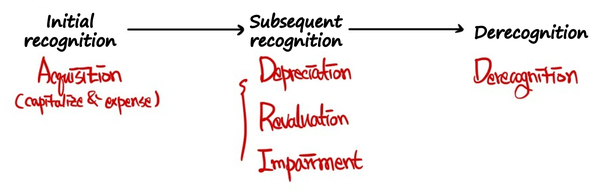
Under subsequent recognition — Depreciation is just depreciation. Revaluation (revaluation model) is optional: a company may do its PPE accounting under the revaluation model, and it’s also fine if it doesn’t. And Impairment is, well, ‘impairment.’ We’ll walk through each, so let’s start with Acquisition.
Assets are expenses (eventually)
Everyone, assets are expenses — eventually. Assets turn into expenses!
Say we buy a PPE for 5 million won — a machine that automatically assembles boxes. At the end of the day, this is money spent on my business, so it’s an expense, right?
So does this 5 million won go to PPE on the B/S? Or should it just be a one-time expense on the I/S?
Huh?! Either way, it’s eventually going out as an expense — same thing.
We can apply this to our own CFA-studying selves too. Are the lectures and books we bought an asset on the B/S of ‘me’? Or is it just money walking out the door as an expense??? At times like this, it’s always better to go back to Basics and ask from the definition.
What is an Asset?
For something to be recognized as an Asset, two things have to hold —
- I have to Control it.
- Future economic Benefit has to be Probable.
Only when both of those are met can something be recognized as an asset.
Remember? I talked about the definition of assets way back at the start! Like with treasury shares — “bro, I bought the stock of my own company, with my own money, so why!!!!! does it have to go as equity instead of an asset!” And we could answer, ‘Under the Commercial Act, treasury shares have no voting rights or resolution rights, so you can’t really consider them under your control ^^’ That’s how we got out of it, right?
OK so — can we CFA candidates book our lectures and books as an asset?! Honestly, this can be accounted for differently depending on how each person sees this whole studying thing. People who see that money as having Probable Future economic benefit — future salary bumps, investment returns, whatever — would capitalize it. (I expensed it lol.)
Back to PPE, then. PPE is obviously under control. The real question is whether Future economic benefit is probable — and isn’t that just up to the boss? A boss who thinks it’s Probable records it as an asset (Capitalize) and lets it run off as an expense gradually later (this process is depreciation). A boss who doesn’t — just takes it on the chin as an expense all at once.
So when PPE is acquired, this acquisition cost can be capitalized or expensed.
And here’s the accounting cycle for each treatment:
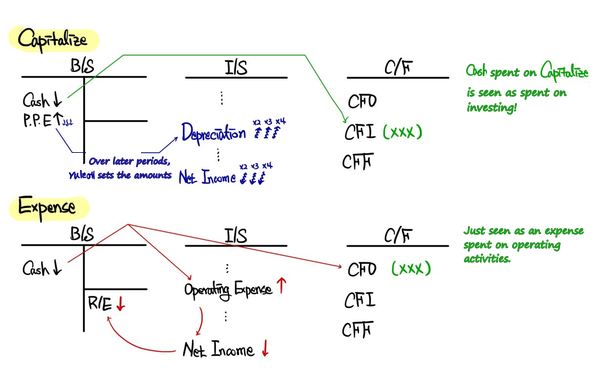
The Cash Flow Statement on the far right might look like “what the heck is this,” but don’t stress. There is no such thing as an accounting beginner who understands the cash flow statement at this point — and that’s fine, that’s correct.
Anyway. Looking at the Capitalize vs Expense treatments above — unlike Expense, which smacks Net Income all at once in one shot, Capitalize nibbles at Net Income little by little over several years through depreciation. There’s even a saying:
“Capitalizing is smoothing out the expense recognition.”
Getting a feel for what that means?!?!
We only glanced at the Net Income effect of Capitalize vs Expense above. Since we’re already here, let’s also summarize how the two treatments differ in their relative effects on Financial Ratios.
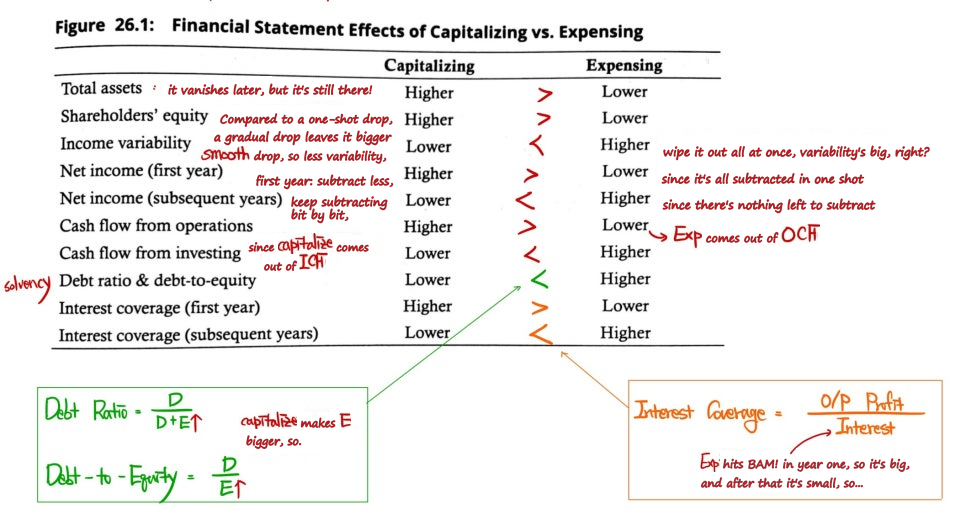
Sorry about the Cash Flow column….. The Cash Flow Statement section (coming later) doesn’t actually have a ton of content, but you need to fully understand everything up to Cash Flow Statement before it makes sense……. Little preview:
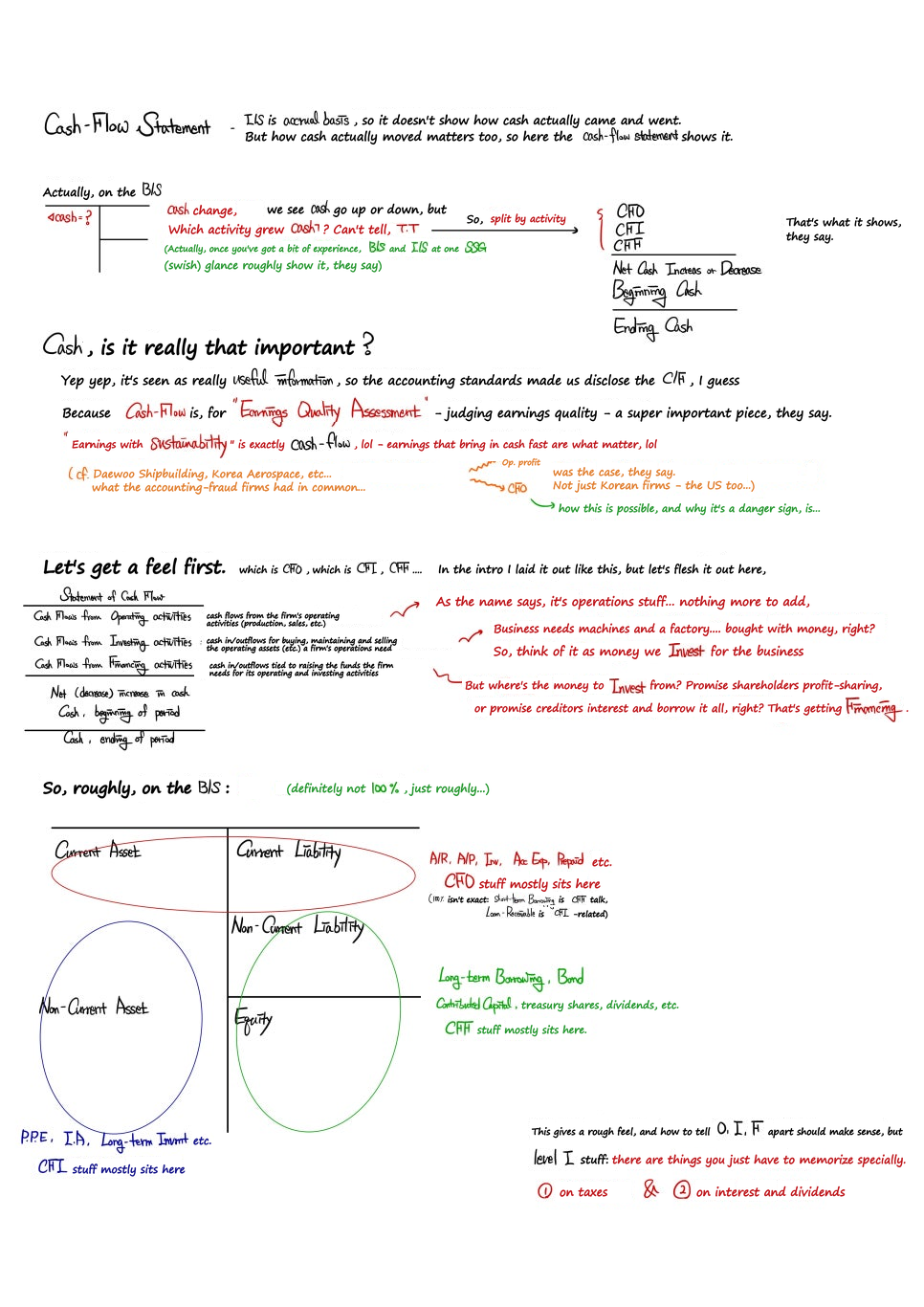
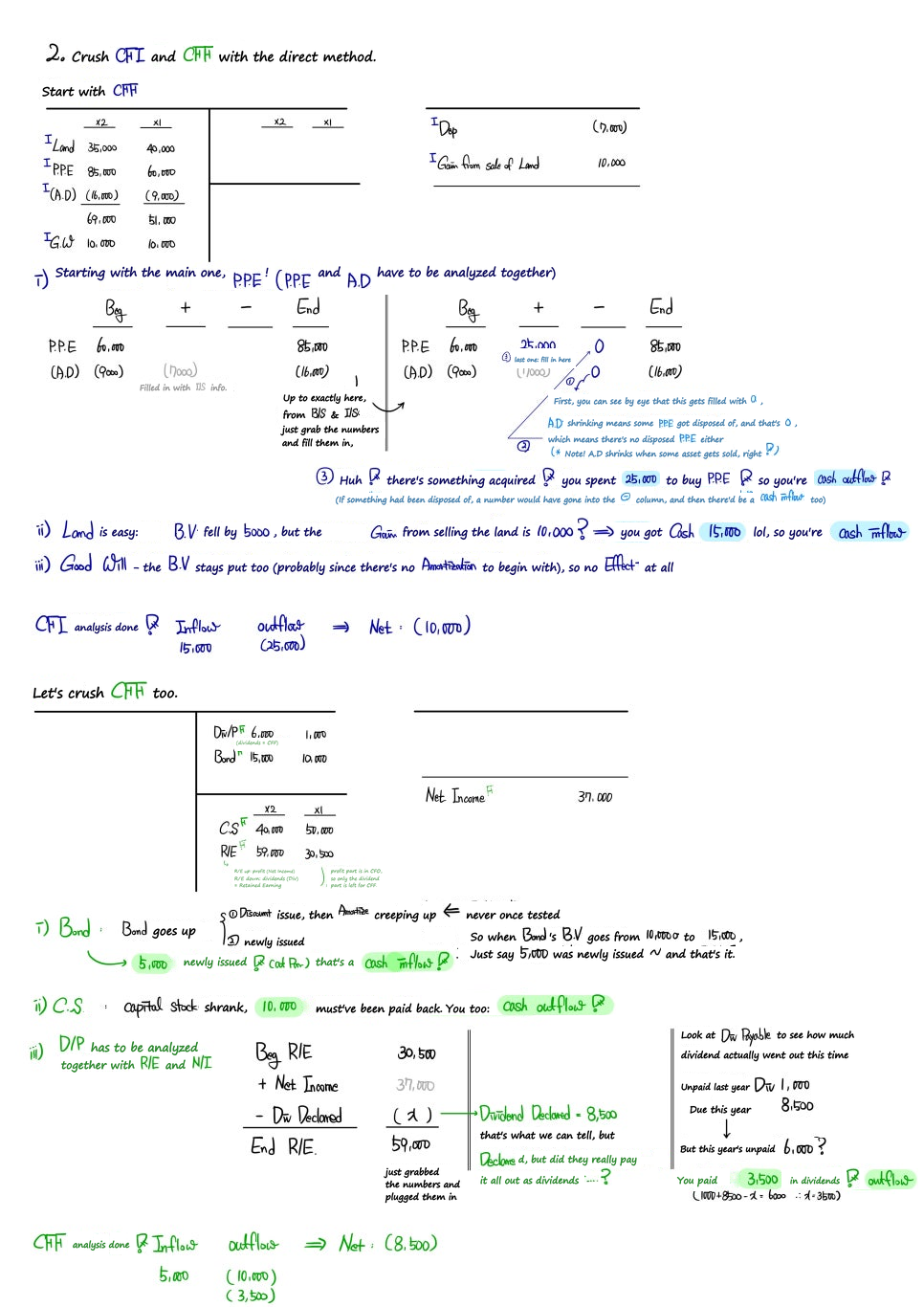
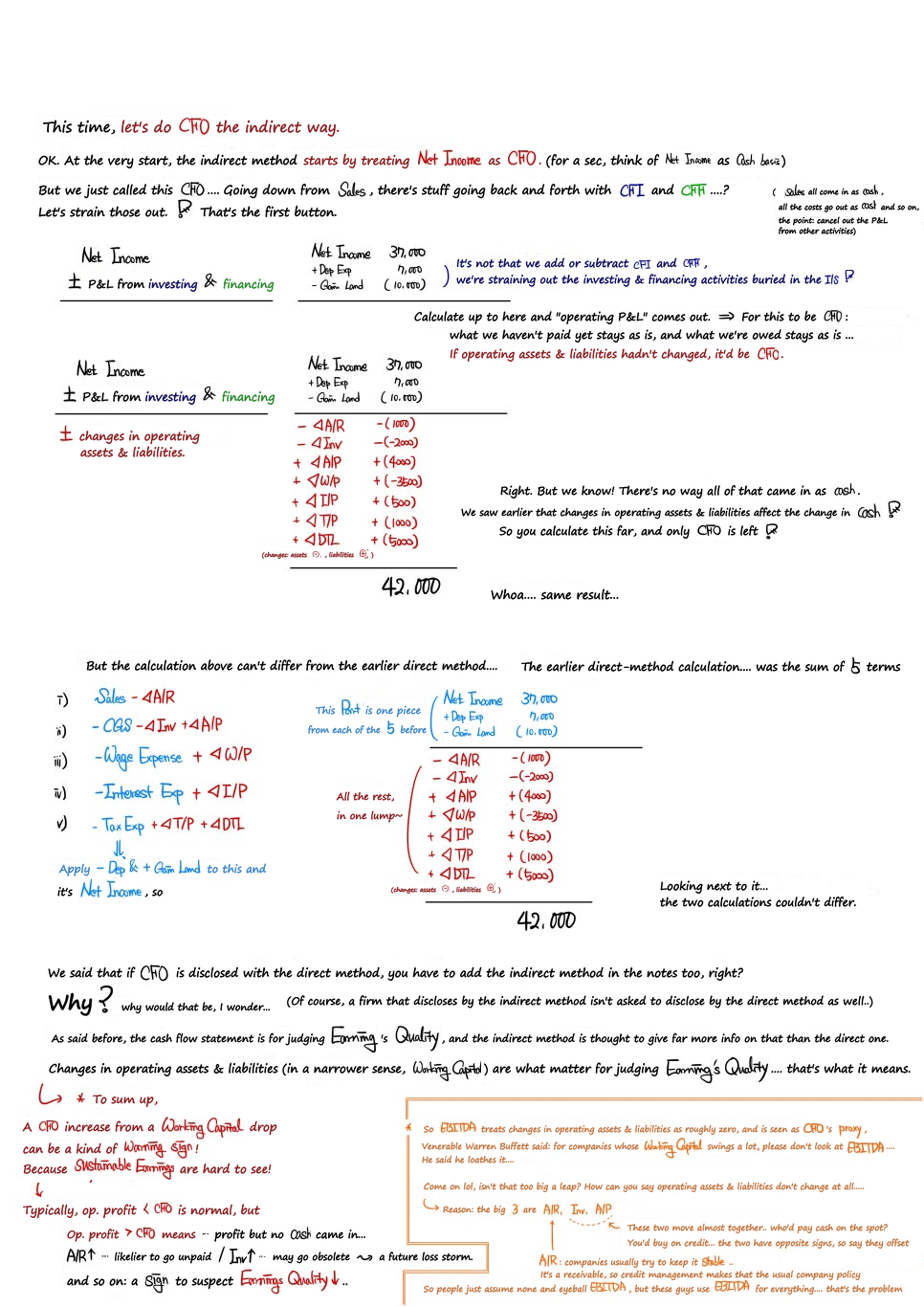
Not a lot!!! Heh, it’ll be fun, right?!?! Bear with me just a little longer!!! There are some related Quiz questions I should cover here too, so let me run through them real quick before moving on!!!!
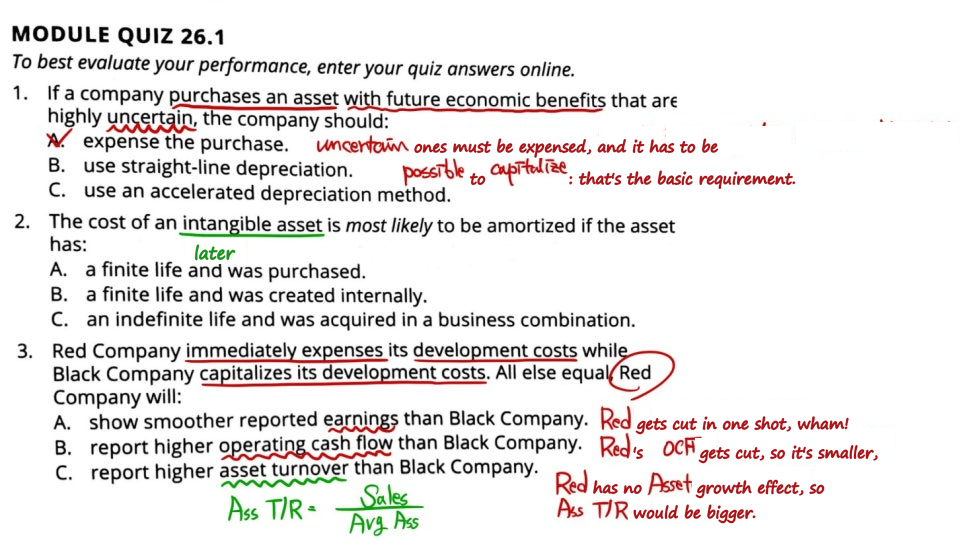
(Oh — the right word is probable, not possible. Possible has a weaker vibe of maybe-ness. Probable has a stronger, high-likelihood vibe.)
Acquisition cost — what goes in?
OK, one step deeper into Acquisition. I’ve decided in my head to book this thing as an Asset.
Then — from where to where do I roll into acquisition cost, and what number do I actually write next to the Asset?!?!?!
We saw something like this with inventory. With inventory, since the purpose of acquiring an inventory asset was Sale, we said: every reasonable incidental cost up until the thing is Ready for Sale gets recorded as acquisition cost.
PPE is the same. The acquisition purpose of PPE is Use, and every reasonable incidental cost up until it’s Ready for Use also gets recorded as acquisition cost.
This word “Use” is a funny thing, actually. Speaking of Use — fun little story: a beer company has bottles and cans. Bottles get retrieved, washed, refilled with beer, and sold again. So bottles have a use purpose. Cans don’t do that, right??? So bottles are booked as PPE as an Asset, and cans are expensed… heh heh.
One more — at an automobile company, test-drive cars apparently never get sold. haha haha (I actually asked a friend who works at an auto company, and I think they told me those get sold to employees.) Anyway — not every car a car company makes goes into inventory for Sale. Apparently some of them are PPE for use purposes. haha haha
So the items that do end up booked into PPE:
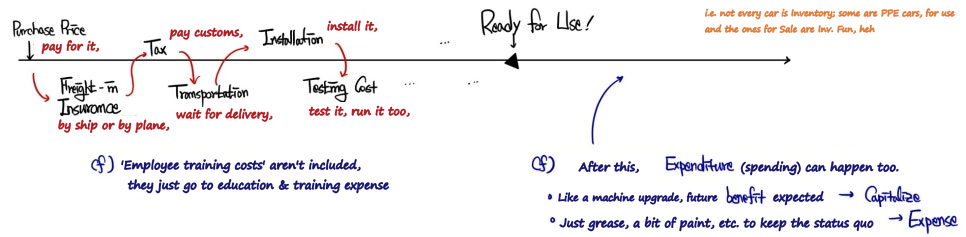
The cost of buying the tangible asset. If it flies in, the transportation cost and the insurance for that transport. If there’s Tax, tax goes in too (the non-refundable kind). Installation. And the test run — all of this has to happen before it’s Ready for Use, so every cost that goes into this whole process gets bundled into the tangible asset’s acquisition cost and put on the books. heh heh
(People studying for the CPA don’t learn it as “Ready for Use” — they learn something like: “All costs that are directly related to bringing the asset to the location and condition necessary to operate it in the manner intended by management” — everything in that bucket gets captured. And over in CPA land, ‘asset retirement obligation’ tied to tangible assets is also a big subtopic. But mentioning that here would just cause more confusion, so I won’t even bring it up.)
The items that are exceptionally never included in acquisition cost — there’s a bunch, but for CFA exam purposes I think there’s just one to know and move on. That is “employee training costs.” This one is always, always, always expensed, right?!!?!
And one more thing. Say we’re past Ready for Use. The tangible asset is running along nicely. Let’s say it’s a machine.
But after about 3 years of use, if we spend another 5 million won we can give the machine a super-ultra-saiyan upgrade. Shouldn’t that 5 million won get added on top of the amount already sitting in that Asset???
But what if it isn’t a super-ultra-saiyan upgrade? What if it’s just 500,000 won of grease and a fresh coat of paint on something that’s gotten worn and loose — does that also get tacked onto the Asset???
Answer —
A machinery upgrade that will generate future Economic Benefit! gets capitalized (capital expenditure). Grease and paint, just maintaining current condition, gets expensed!!! (revenue expenditure)
Know that much and move on heh heh heh heh!
Capitalize Interest
Interesting topic, let’s listen to this one too.
Say we’re not just buying some small machine — we’re building a whole big factory. (construction-in-progress asset — CIP for short.) A factory is still a tangible asset, right?!?!?! So it follows the PPE acquisition-cost logic above —
But for a massive… acquisition like building a factory, it’s usually hard to do it all out of pocket, and kind of inefficient to do so anyway. So you’ll borrow money somehow — bank loan, whatever — and interest expense is going to rack up during construction…
So does that also go into the acquisition cost of the PPE?!?!?!
Hmm hmm..
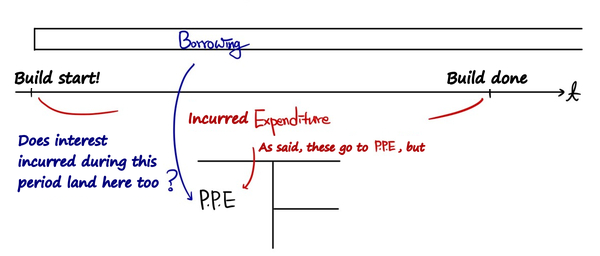
The answer is… is… is… is… is… is… is —
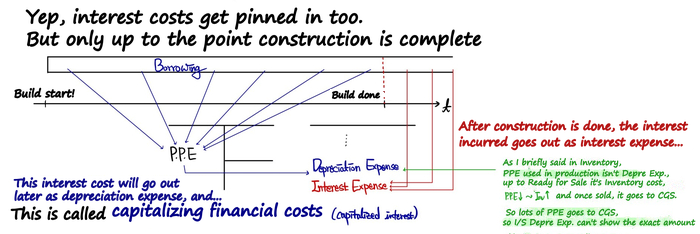
It gets recorded…..
This is called capitalized interest. However — of the interest expense, only the portion up until construction is completed goes into PPE. And the acquisition cost that grew this way will later drip back out as expenses, via depreciation. After construction, you keep paying the loan back with interest, and the interest expense at that point is what hits Interest Expense on the I/S.
So what you need to know is —
Don’t trust the interest expense on the I/S at face value.
Always check whether there’s ‘construction-in-progress’ sitting on the asset side. Because the I/S number could be lower than what’s actually being paid out in interest…. And some construction wraps up in a couple years, but some drags on for 10+ years,,,, So we can’t get fooled, right?
Meaning — if there’s construction-in-progress, the interest coverage ratio (Interest Coverage = operating profit / interest expense) could look artificially great compared to reality, right???
(I actually found some relationship between the interest coverage ratio and stock prices in the data….. but it turned into something I couldn’t really trust. (crying) Shame.. (crying).)
Quick side note
By the way — quick aside — not everything in PPE walks out as Depreciation Expense…..
Like I briefly touched on back in Inventory — the wages of factory workers don’t go out on the employee-wages line of the I/S. They get folded into the acquisition cost of that inventory asset. Because it’s a direct cost of getting Inventory to Ready for Sale, that cost has to pass through the inventory.
And when some machine has to run to make that Inventory — the cost of using the machine also has to go into the cost of Inventory. So it passes through Inventory, and when that gets sold, it hits CGS and becomes an expense!!!
At the end of the day, what exits PPE through CGS is not a small amount. Which means — trying to figure out how much depreciation a given company is recognizing just by staring at the Depreciation Expense line on the I/S is genuinely hard….
OK so that’s it for this week’s talk.
Next post (next week) — depreciation!!!!
Comments
Discussion happens via GitHub Discussions. You'll need a GitHub account to comment.