Property, Plant and Equipment (2): Depreciation
A casual breakdown of accounting depreciation for PPE — turns out it's about spreading costs over useful life, not just saying an asset lost value.
OK so now let’s talk about depreciation (Depreciation) for property, plant and equipment.
Depreciation is also the word we use for “the price of a used car going down,” so
it’s not that unfamiliar a concept, right?
Of course, I’m not saying a used car losing value over time is exactly the same thing as accounting depreciation. heh heh heh
Anyway, in accounting,
the process of slowly writing down the cost of property, plant and equipment as an expense is called Depreciation,
and there’s a similar process for intangible assets too — that one’s called Amortization.
Anyway, this post is about depreciation of property, plant and equipment. heh heh heh
To state the definition of depreciation precisely,
“Systematic & rational cost allocation process over useful life based on MATCHING PRINCIPLE”
i.e., based on the matching principle (revenues ↔ expenses), allocating the cost of PPE over its useful life in a systematic and rational way
— that’s depreciation.
So,
the act of gradually knocking down the value of PPE
is not about appraising “the asset is worth less now, so let’s mark it down” (Valuation is not the purpose).
The point is to spread the cost systematically and rationally. That’s what depreciation is for.
There’s a pile of unfamiliar terms incoming,
so let me get the vocab out of the way first.
Carrying Value (Book Value): the price still sitting on the books after we’ve been gradually depreciating it.
Historical Cost: simply, “how much did you pay to get this thing?”
Hmm, so that’s the dollar figure that got recorded on the B/S the moment you first acquired the PPE.
Useful Lives: “how long are you planning to use it?”
Salvage Value (Residual Value): the estimated disposal value once the useful life ends and the thing’s basically toast.
Accumulated Depreciation: the total amount you’ve depreciated up to today.
Depreciation Base = Historical Cost − Salvage Value: the total amount that gets spread out as depreciation expense across the Useful Life.
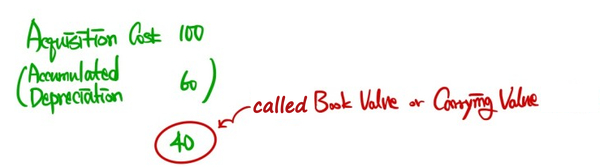
Quick example. I needed a car for work, so I went and bought a Sonata for 100.
Looks like it’ll last about 10 years, and after 10 years I figure I can dispose of the used Sonata for basically 0.
I’m gonna depreciate it by the same amount each year. (100 split evenly over 10 years → 10 per year.)
Now fast-forward — 6 years have gone by.
By now, I’ve depreciated 60 in total, and 40 should still be left on the books.
In this setup, Historical Cost is 100, useful life is 10 years.
I set Residual Value at 0.
So the total amount I’ll depreciate over those 10 years (Depreciation Base) is 100.
And the B/S 6 years in looks like this:
※Side note (not super important)※
Writing it out like that — “originally this much, knocked down by this much, this much remains” — is called accounting “at gross amount,” and that’s how PPE gets shown.
The other approach — skipping the breakdown and just writing “this much remains” — is called accounting “at net amount.”
Anyway, the value that ultimately sits on the B/S is called the Book Value. :-)
OK, I think we’re more or less done with the terminology now.
So let’s take one more step.
In the simple example above I said I’d depreciate by “the same amount each year,”
but that’s not the only option.
There are a bunch of methods. Here they are:
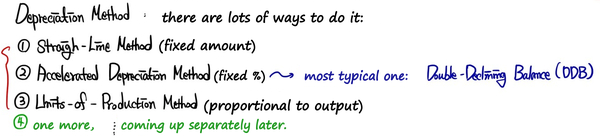
(This is the CFA breakdown. For CPA purposes,
apparently it gets classified as 1. Straight-line method / 2. Fixed-rate method / 3. Double Declining Balance (DDB) / 4. Sum-of-the-years’-digits method / 5. Units-of-production method. :-) )
The Straight-Line Method does exactly what the name says — depreciate by “the same amount every year.”
The Fixed-Rate method (you’ll also see it written as Fixed Rate Depreciation) is about depreciating by “the same % every year.”
And I mentioned that the most representative example of the fixed-rate methods is Double Declining Balance,
but honestly saying “most representative” is kind of a stretch,
because — real talk —
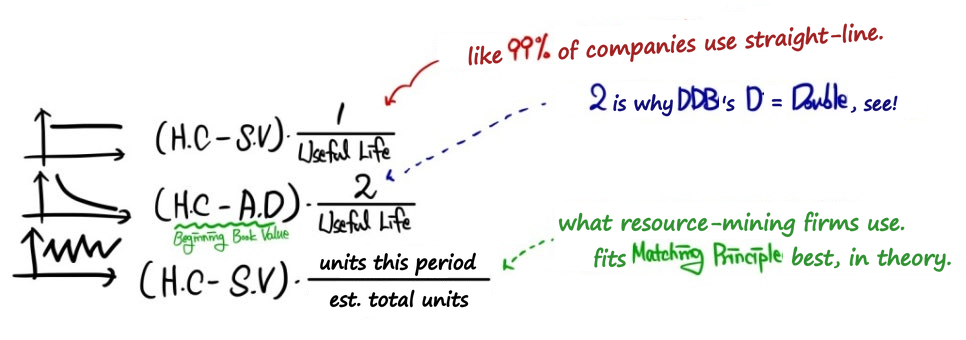
the fixed-rate method has this thing called a “depreciation rate” that fixes “the same % every year,” and… it’s actually computed like this.
But computing an n-th root — sure, today you’d just punch it into a computer and bam,
but back in the day? That was a pain.
So somebody came up with a formula that approximates it well enough,
and that became the standard. The reason “double” shows up in the name is the 2 sitting in the numerator. That’s it.
Then there’s the units-of-production method, whose vibe is “only depreciate as much as you actually used.”
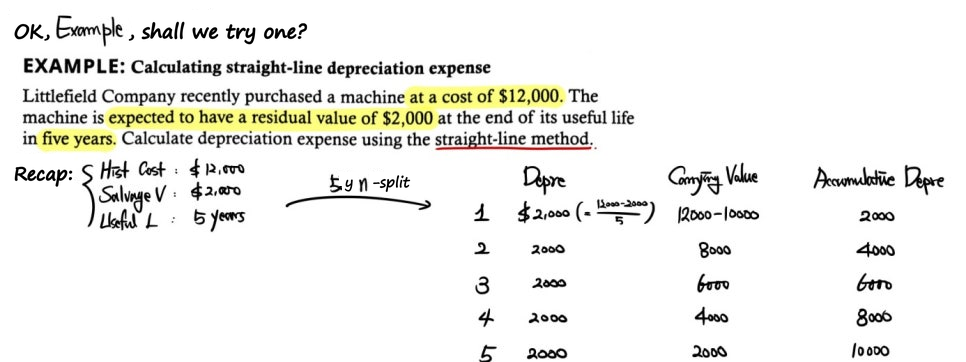
To make these click with a quick example:

Those are the methods. Each company picks one and just keeps depreciating away~.
That picture up there looks pretty important,
so let me drop it again, bigger this time. heh heh
A natural question:
“OK so which method is the best?"
Honestly, there’s no best-or-worst here.
The whole point of depreciating is to honor the Matching Principle, right?
If you bring in PPE and the revenue it generates seems like it’ll roll in steadily and consistently year after year, straight-line is the right call.
If revenue comes in heavy in the early years and tapers off over time, fixed-rate is the right call.
That is — which method matches revenues best?!!!!!
Pick on that basis. That’s the move. heh heh
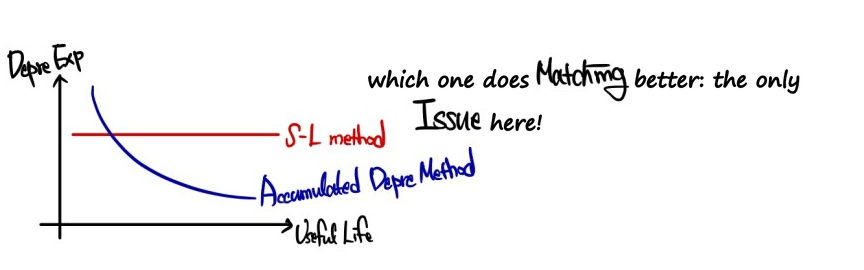
(Lol… I wrote “Accumulated” hahaha — it’s Accelerated.)
Different depreciation method → different cost treatment → different net income for the period.
And depending on how big the profit is,
couldn’t there be some kind of knock-on effect on,
like, the taxes you owe???
NOPE!!! There isn’t.
Because tax law spells out its own Depreciation Method, separately…..!!!
We’ll cover corporate tax in the next Chapter, so this comes back around.
Apparently a lot of people give up and tap out at the corporate tax section. haha
Anyway!!!! No tax effect!!!!
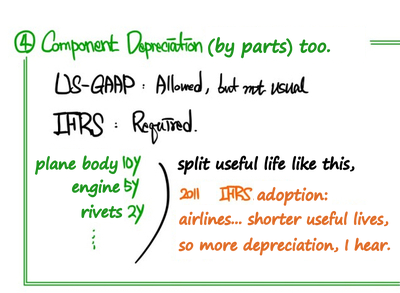
One more thing on depreciation methodology.
Instead of depreciating something like an airplane as a single big asset,
IFRS recommends component depreciation when certain parts/portions are deemed significant (= material).
OK now, on to depreciation methods —
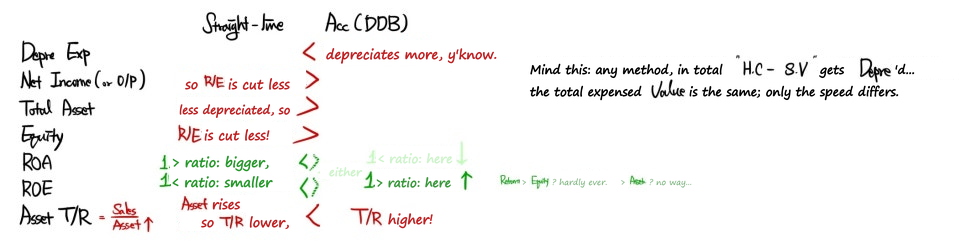
let’s compare straight-line vs. fixed-rate.
Same drill as before: how do they each push the financial ratios around?
(Yeah, we need to know this stuff cold (T_T))
One thing’s certain: whether you use straight-line or fixed-rate,
the total amount that ends up expensed is the same anyway!!!
The speed is just different,
so things look a bit different depending on whether you’re in the early stretch or the tail end of the depreciation schedule.
The picture below checks the early-period case with inequality signs. heh heh
Average Age, Total Useful Life, Remaining Useful Life —
you can pull these from the footnotes of the financial statements,
but if these come out older??? Does that automatically mean bad????
Could be — you could read it as “less efficient, less competitive, just genuinely aging out,”
or you could read it as “these guys are about to drop a fat capex bill on new equipment,” signaling future spending.
It’s that kind of information. But for the CFA exam….. you gotta be able to crank the numbers.
The book gives the formulas like this,
(Extreme stress mode: everything gets written as exp for exponential, I swear haha)
But honestly, you can just common-sense your way through this:
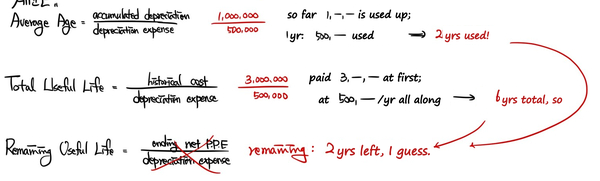
Approach it this way and it clicks pretty easily. :-)
Fun real-world story~
Say you set the useful life at 5 years and you’ve been depreciating accordingly. After 5 years, the Book Value should be 0.
But…. what if in reality the machine is still humming along and being used just fine after those 5 years???
(Which is why, apparently, whoever you happen to get as your plant manager is a massive asset.)
Things like this get called “ghost assets” in the field,
and if a company’s got a lot of ghost assets, the Margin is gonna come out looking high — like, structurally.
Because the cost has already been fully expensed, but the asset is still generating revenue.
So between POSCO and Hyundai Steel, who’s got more ghost assets…..
But the two of them have similar Margins…
Could it possibly be… Hyun… dai…?
Aaaaa I don’t know I don’t know I don’t know I don’t know I don’t know hahaha
hahaha hahaha
hahaha
In the process of handling Depreciation, what knobs can I actually turn?

Useful life and salvage value are things I set myself.
(Apparently, between Samsung Display (5-year useful life) and LG Display (4-year useful life), that one-year gap creates a difference in operating profit on the order of 300–400 billion won. Stuff like this is exactly what’s worth digging up in the footnotes, apparently.)
Setting useful life longer & salvage value higher → smaller annual expense → upward push on this period’s net income.
Setting useful life shorter & salvage value lower → bigger annual expense → downward push on this period’s net income.
But can you change useful life and salvage value mid-stream?!!??!
Of course!!! You can change them.
And actually,
there’s a routine that requires reviewing useful life / salvage value / depreciation method at least at the end of every fiscal year!!! There is — but for CFA purposes it’s not the important part, so I’ll keep it short,
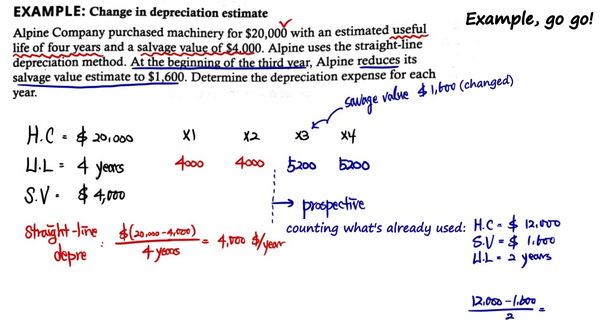
What you do need to know for CFA: changing these values is a Change in Estimate!!!
Remember when we did inventory earlier — switching between FIFO and LIFO
is treated as a Change in Accounting Principle, right???
But here, changing useful life and salvage value
is a Change in Estimate, so it gets applied prospectively. Meaning —
what was done in the past stays as it is, and from the change onward you go forward with the new values. That’s what “prospectively” means.
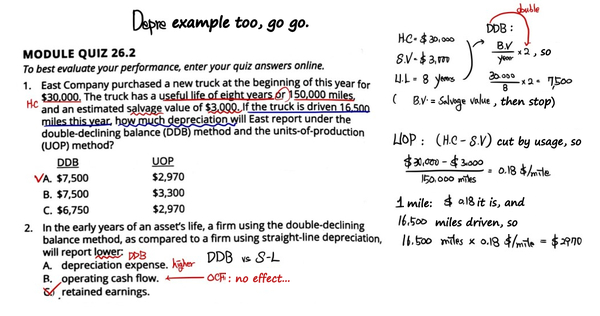
Let’s run roughly one example on this and then move on!!!!!
And with that, I’m wrapping up depreciation!!!!
Coming up next is none other than!!!!
The revaluation model!!!
Phew… barely hit the goal this week too (T_T)
This is too hard hahaha
Is this project ever gonna end haha
Comments
Discussion happens via GitHub Discussions. You'll need a GitHub account to comment.