Property, Plant and Equipment (4): Impairment
Breaks down PPE impairment — what 'gone bad' actually means, how US-GAAP's two-step recovery test works, and where IFRS handles things differently.
PPE’s next subsequent treatment!!!!! Impairment!!! This one’s a Valuation thing :-)
With Depreciation, the point wasn’t to value the asset — it was to spread the cost out so the expense gets Matched to revenue. Impairment is different. Here the whole goal is to say “hey, the value actually dropped,” and push that onto the B/S.
So whether you’re running the cost model or the revaluation model for PPE — doesn’t matter —
if the PPE on your books has gone bad, you have to recognize an Impairment Loss!!!
(So: Depreciation, every single period. Impairment, not every period — only when there’s a real gap between book value and what the asset is actually worth now. In practice, apparently, people do this maybe once every 2–3 years.)
(And the order goes like this: under the cost model, you run depreciation first → then, if there are impairment indicators, you do the impairment. Under the revaluation model (IFRS): run depreciation → revalue to FV using the revaluation model → then if impairment applies, do that too.)
Wait — what do I even mean by “gone bad”?
I mean the value of the thing as an asset has fundamentally collapsed. That’s “gone bad.”
(A big drop in Market Value doesn’t count as “gone bad.”)
Example. Say I own a Sonata right now and I’m pulling 5 million won a month doing delivery. If the Sonata’s resale price suddenly tanks to 1,000,000 won — that’s not “gone bad.” I can keep running it exactly as is and pull my 5 million won a month.
But what if the government drops a “Sonata Prohibition Act” on us tomorrow? Now this Sonata has no expected future economic benefit at all…..? That’s gone bad.
OK. Impairment also splits depending on why you’re holding the PPE:
- Held for Use — US-GAAP and IFRS handle it differently.
- Held for Sale (asset held for sale) — the two are basically the same.
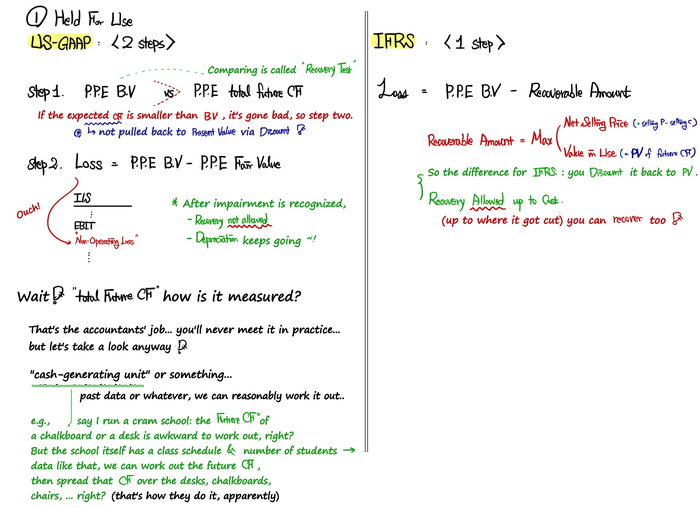
1. Held for Use — US-GAAP
Two steps here.
Step 1. Recovery Test
You compare the BV of the PPE against the total future cash flow you expect to squeeze out of it. (That comparison is the “Recovery Test.”)
(Heads up though — when you tally up that total future cash flow, you do not discount it back to present value. The idea is probably “don’t let people massage the discount rate to get whatever answer they want.”)
If BV comes out bigger than that cash flow, the asset is considered “gone bad,” and you move on to step 2. Step 2 is figuring out how big the loss is.
Step 2.
LOSS = PPE BV − PPE FV
That runs through the I/S as a loss — and it stays inside operating income, not down in the non-operating section.
Once you’ve booked the impairment? No recovery allowed. Done. And depreciation just keeps chugging along, from that new lower price.
OK but how do you even measure total future cash flow?
Honestly — the accountants handle that, you don’t really need to know…. Apparently they use historical data based on cash-generating units or something.
Like — imagine I’m running a cram school. Trying to pin down the future cash flow of a single chalkboard or a specific desk? Awkward, right? But you can estimate future CF for the whole operation, using stuff like the class schedule and student enrollment, and then you spread that CF across the desks and chalkboards and chairs and… somehow they sort it out, heh.
That’s it for US-GAAP.
2. Held for Use — IFRS
IFRS: just one step.
LOSS = PPE BV − Recoverable Amount
Recoverable Amount = Max(Net Selling Price, Value in Use)
Net Selling Price = Selling Price − Selling Cost
(What’s the difference between Net Selling Price and Fair Value…? Here it’s not just fair value — it’s net fair value, basically the price it sells for in a normal market..!)
Value in Use = Present Value of Future Cash Flow
Differences from US-GAAP: one, IFRS does discount to PV when rolling up future CF. Two, Recovery is allowed. Under the cost model, you can win it back up to where it got cut.
(Technically this is called reversal of impairment loss, and the ceiling is “the post-depreciation balance as it stood before the old impairment loss was recognized.” Put simply: the ceiling is ’the book value you’d have right now if impairment had never happened at all and depreciation had just kept ticking down the whole way.’ …OK I didn’t really want to get into this because it gets confusing, but — this is about impairment under the cost model. Under IFRS you can also recognize impairment while using the revaluation model, right? And the standard does not actually clearly specify the recovery ceiling when you’ve impaired something that’s on the revaluation model. lol lol)
Ugh so confusing lol lol ugh seriously….. lol this is stuff you 100% do not need for CFA lol lol But aren’t you kinda curious???? Eh whatever, I don’t care. Because it’s not clearly specified, different textbooks do it different ways. Some recover up to Fair Value, some recover up to the Recoverable Amount I defined above. lol lol lol And then — if this showed up on an exam other than CFA, like CPA??? Apparently whenever it’s come up, they write the question so the answer works out the same no matter which method you use. lol
Speaking of impairment under the revaluation model — if you’ve been using the revaluation model, you might have Revaluation Surplus piled up, right? If so, the impairment loss eats the Revaluation Surplus first, and whatever’s left over runs through current period P/L and dings Net Income. And when you reverse it: if there was a past hit that ran through P/L as a loss, you recover that first, and anything beyond that goes back into Revaluation Surplus…..
But wait. The revaluation model marks PPE at Fair Value, and Impairment uses Net Fair Value… so can impairment even happen under the revaluation model, really? If you caught that — you’re a genius!!!! Go get your CPA right now. lol lol Apparently — when you’re on the revaluation model, if the Selling Cost (disposal incidentals) is negligible, the chance that the revalued amount has somehow been impaired is pretty slim. Ehhh just don’t bother knowing this lol lol)
I set all that in tiny, faint type. I figured it’s better if you can’t see it lol You’re gonna read it anyway, aren’t you???? Then brace yourself lol lol — extremely hazardous to your mental health lol lol
OK OK OK OK OK — all that blabbering above, in one single picture! heh heh heh heh
And here’s how the financial statements actually move when you book this impairment loss:
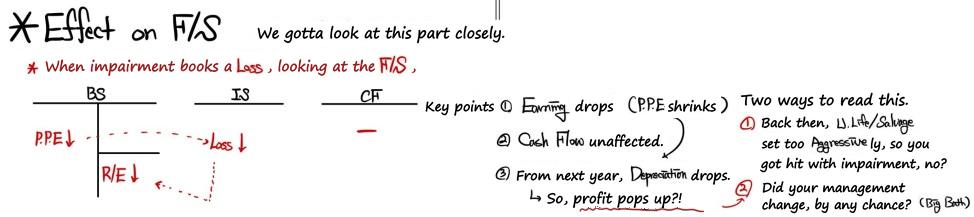
- PPE goes down → Earnings go down.
- Zero impact on Cash Flow though.
- From next year on, Depreciation charges are smaller, which can actually boost reported profits — boom.
So apparently there are two ways to read this:
- “Hmm, weren’t you guys way too aggressive back when you set that Useful Life and Salvage Value…?"
- “Did management just… change, by any chance?” (As in — write down the old stuff in one big hit so the smaller-depreciation profit bump next year looks like the new team’s achievement.)
→ …Pos-X is one company that pulled exactly this kind of big bath….. If you can look at statements like theirs and read it right off them, then you!!! Go invest in stocks! Right now!!! I’ll hand you my money too, so please grow it along with yours ^^
OK let’s see where we’ve gotten to heh heh heh heh
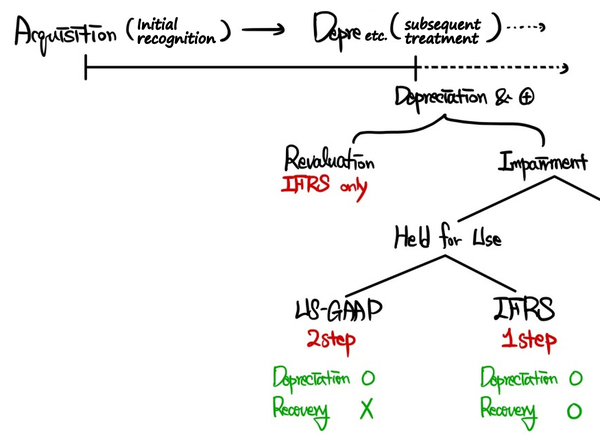
We made it to Impairment. And Impairment depends on why you’re holding the PPE — tangible assets you’re actively using and plan to keep using, vs.
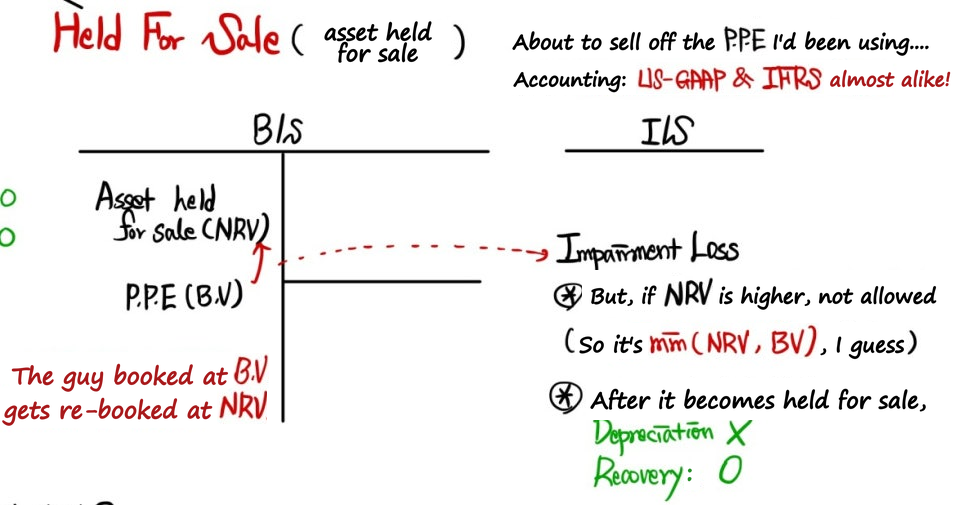
3. Held for Sale — (US-GAAP, IFRS)
Once it’s fully decided the asset is getting disposed of, from that point on it gets reclassified as a ‘Held for Sale’ asset.
(And the moment it’s classified as Held for Sale, depreciation fully stops.)
Impairment for this kind of asset is a little different from the Held for Use case like I mentioned, and here, US-GAAP and IFRS treat it pretty much the same heh. Quick touch and move on:
OK — Impairment, done.
Derecognition
Let me also knock out Derecognition real quick while we’re here, and wrap this thing up! There are all kinds of scenarios where an asset just vanishes off the B/S: Disposition / Casualty / Condemnation / Abandonment / Exchange, etc… But in every single one, the treatment is the same:
Book Value goes out, and the difference between that and whatever new consideration comes in (at Fair Value) gets booked as a Gain or Loss.
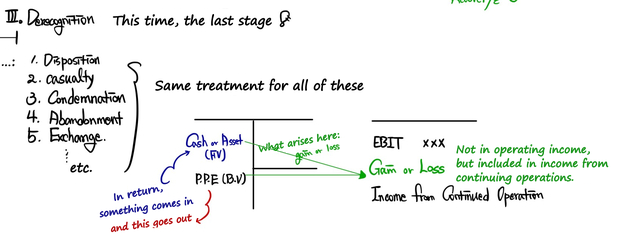
Apparently this isn’t a huge deal for CFA purposes…. But if they wanted to crank the difficulty up to max, apparently it’d look something like this.
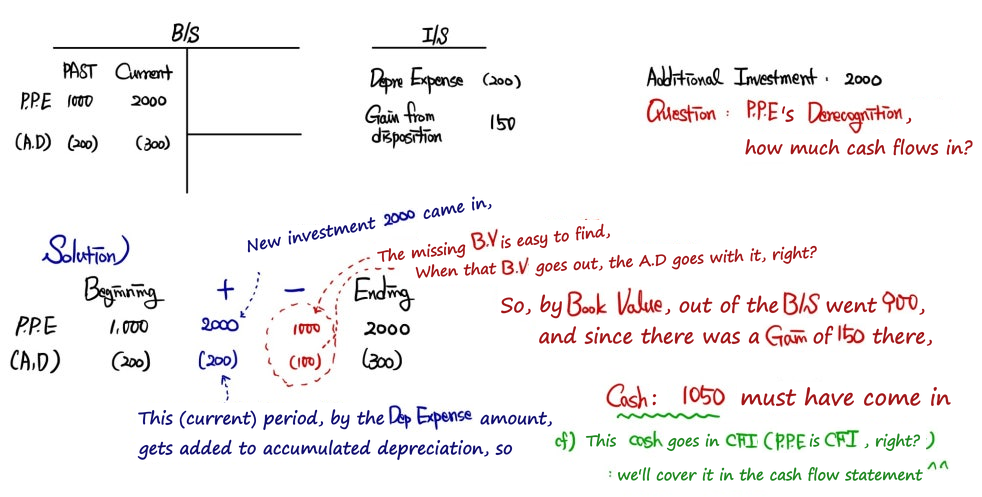
Yeah…. I’m just gonna get this one wrong……………
Heads-up. The figures here are the original notes, slips and all. A few things to watch for:
- In the first picture, the US GAAP impairment loss is labelled “Non-Operating Loss”; it belongs in income from continuing operations and, when an operating-income subtotal is shown, inside it. On the IFRS side, “Recovery Allowed up to Cost” means up to the carrying amount the asset would have had without the impairment (after depreciation), as the text explains, not up to the original cost.
- In the derecognition picture, the gain or loss on disposal goes to income from continuing operations (the label’s “Continued Operation”), and it is not automatically left out of operating income: under US GAAP, an operating-income subtotal includes it.
Comments
Discussion happens via GitHub Discussions. You'll need a GitHub account to comment.