Investment Property
Investment property is just rental real estate — not speculation — and here's how it differs from PPE under IFRS (spoiler: US GAAP doesn't even have this account).
Let’s take a quick look at this account called investment property.
And I mean quick. This one’s gonna be short, I think.
Just from the name, you’d probably guess: oh, this is where a company parks real estate it bought for investment or speculation purposes, right?
NOPE. Wrong.
Think about it — the second a company writes “speculation” on its books, the corporate image takes a hit, and the tax authorities instantly lock on. So even if a company genuinely, honestly, truly bought something to speculate on… no way in hell are they labeling it “for speculation.”
So then what is investment property?!
It is, it is, it is, it is —
Property held for rental.
Stuff you acquired to rent out. That’s investment property.
(The accounting standard phrases it as “for investment purposes (rental income, capital appreciation, etc.)” — same idea.)
For example: say you bought a 10-story building. You use the top floor yourself, and rent out the other nine. What happens?
Top floor = held for use → PPE. The other nine floors → investment property.
(Sigh… the actual truth is a bit messier. If the self-use portion can’t be sold separately and is insignificant, you just dump the whole building into investment property. If you can sell piece by piece, you split it. That kind of nuance exists too…)
Now here’s the thing — US GAAP doesn’t have an “investment property” account at all.
I imagine the philosophy over there goes something like: “You’re using it to generate rental income? Cool, that’s PPE too~”
So this whole investment property business is an IFRS thing. IFRS takes the view that stuff-being-rented-out and stuff-being-used-yourself are two different animals. US GAAP just shrugs.
But for our purposes — we don’t need to know all of it. For the CFA exam, apparently it’s enough to lock down the differences between PPE and Investment Property. And those differences are about this much:
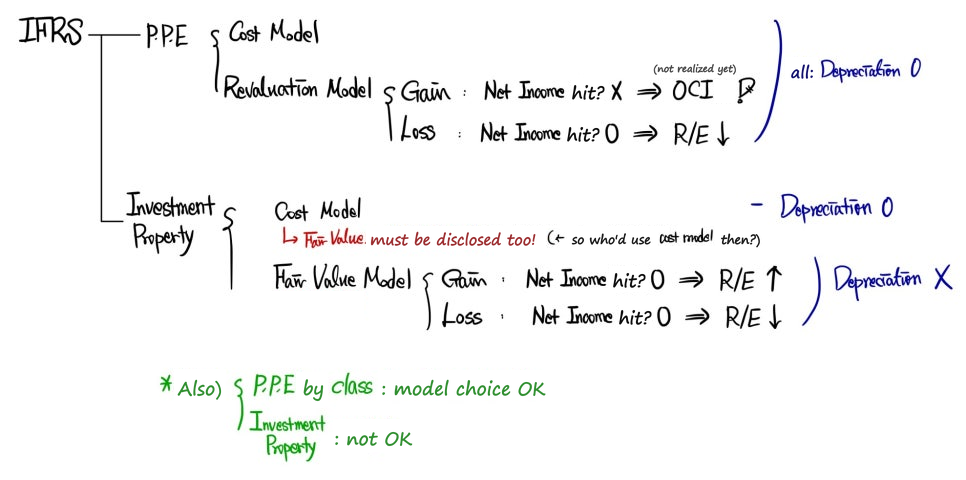
Yeah. About that much.
Let’s leave it at that.
A few things I was wondering about got cleared up while I was studying intermediate accounting, so let me just share bits and pieces.
First — the fair value model.
You might go: “Wait, isn’t this the same as the revaluation model? Both measure at fair value, right??”
But as the picture up there shows, the key difference is: fair value model changes don’t go to OCI. They hit the income statement directly.
Another difference: under the fair value model, you don’t apply depreciation, and you don’t recognize impairment either. Because when you’re remeasuring at fair value, depreciation and impairment are kind of… already baked in. And even if you tried to record them, they’d just get reversed/overwritten by the fair value remeasurement anyway, so why bother :-).
Other accounts that get the fair value treatment like this: FVPL financial assets, biological assets, and (what we’re talking about today) investment property that’s been designated for fair value measurement.
Biological assets came up once back in the inventory chapter — at year-end B/S, you measure them at net realizable value, remember? Which means you can recognize a loss immediately upon initial recognition lol.
Here’s another fun one.
Property held to earn rental income = investment property. OK.
But wait — think about a hotel. A hotel company owns its hotel. And hotel guests are, technically, paying for… hotel rooms in exchange for what is essentially rent, right?
So does that mean a hotel, for a hotel company, is investment property?? lol that’s wild
Nope, and here’s the carve-out:
“When the property owner provides services to the occupant, and those services are significant (material), the value of the services is considered more relevant than the rental, and in such cases the property is treated as owner-occupied (PPE).”
Right — when you actually check into a hotel, you’re not really paying for the physical room itself. You’re paying for all the services the hotel wraps around it. Room service, concierge, housekeeping, the whole deal.
When services are the dominant thing like that, it’s not investment property.
OK another example. Let’s say you start a company and rent an office. You pay rent to the building, sure.
But the building also provides something like a “cleaning service” — the people who come clean your office at night.
Now imagine the building owner goes, “Hey, I provide a service, so I’d like to classify this as PPE instead of investment property.”
“SHUT UP. It’s not significant!” lol
Oh — another question. Investment property… is it always land?
Nope. Not at all. There’s no requirement that it has to be land. Classic non-land examples of investment property: buildings provided under operating leases, or buildings held to be provided under operating leases, that kind of thing.
One more wrinkle. Say you have investment property A, and you’ve decided to apply the fair value model to it. From that point on, the company has to — no wiggle room — measure all of its investment properties under the fair value model.
But then, as luck would have it, you later acquire asset B, also investment property, and its fair value genuinely can’t be measured reliably.
Hmm… you can’t split and choose by class… so what do you do?
This is the exception, heh. In a case like this, you can apply the cost model to B specifically. BUT — B must have its residual value set to 0, no exceptions, and this treatment can’t be changed midway. Cost model all the way through to disposal.
And then there’s cases like this, lol —
You’ve been holding something as investment property, and then one day: “Oh!!! You know what, I’m not gonna rent this out anymore — I’m gonna use it myself!!!”
So investment property can, out of nowhere, get reclassified as PPE, inventory, whatever.
The accounting for that is disgustingly complicated lol. For this part, just go look at my intermediate accounting notes lol.
Intermediate accounting is gonna be fun too!!!!!!!
The scope is absurdly wide and absurdly complicated and hard, but I’m grinding through it :-).
Comments
Discussion happens via GitHub Discussions. You'll need a GitHub account to comment.