Intangible Assets
A breakdown of intangible assets — what they are, how they stack up against PPE, and the surprisingly messy rules for getting them onto the B/S.
Intangible assets, huh.
OK so — to put it simply, stuff like patents, copyrights, intellectual property rights. Those are the textbook examples of intangible assets a company can actually slap onto its books as an asset.
Easiest way in: compare them with tangible assets first. Remember PPE? Four conditions and you’re in:
- Tangible
- Long-term
- For Use
- Normal Operation
Intangible assets? Same list, only #1 flips. Four conditions:
- Lack of Physical Substance
- Long-term
- For Use
- Normal Operation
So honestly, just think of it like this — does it have a physical body or not? That’s the line between tangible and intangible.
(Yeah… it’s actually a bit messier than that. To really qualify as an intangible asset, there’s this thing called identifiability you also have to satisfy. The short version: “Can you measure its value, and can you sell / transfer / lease / exchange it?” or “Did it come out of a contract or a law (like a patent)?” If yes, it’s identifiable. IFRS spells this out, but the CFA curriculum doesn’t really push on it, so you don’t need to know it :-) The reason it matters: if companies could just walk around going, “Guys, guys!!! This invisible thing right here? Totally an Asset!!! And this one over here? Also an Asset!!! All of these have value as intangible assets!!!” — then literally anything formless could end up on the B/S. So they had to draw a line.)
OK. Normally when we pick up a new account item, we go through it in this order: acquisition → subsequent treatment → derecognition. But for intangible assets at CFA Level 1, we really only need a rough handle on acquisition and subsequent treatment. So that’s all we’ll touch.
Even that much is gonna be plenty annoying, so don’t worry, heh heh.
1. Acquisition
Acquiring an intangible asset = the moment it first goes pop! onto the B/S. Two cases here.
i) Externally Purchased: basically, you bought it. You handed over money. Individually acquired. And if your company paid actual cash for an intangible asset, well, your company isn’t an idiot — they bought it because there’s a future economic benefit on the other side. So no agonizing back and forth about “do we expense this? do we recognize it as an Asset?” — just capitalize it.
(Same as all the other asset account items we’ve already seen — every incidental cost at the time of purchase also goes onto the Asset.)
This case is easy.
ii) Internally Developed (internally generated intangible assets): this case is the messy one. You can’t just take a company at its word when they go, “We have birthed a magnificent formless asset! Onto the B/S it goes!” So this part has a bunch of gates you have to clear before something gets recognized as an intangible asset.
Now!!! First and foremost!!! The default rule is… expense it!!!
Internally generated intangible assets get treated as “future economic benefit is uncertain” by default. That said… if a company has dumped enormous amounts of money into something and even gone and filed a patent on it, telling them “nope, never an asset” is also kind of unreasonable. But flipping the other way and recognizing all of that as an asset? Also unreasonable.
So they’ve split it like this. When a company internally cooks something up pop! and that something becomes an intangible asset, it’s basically come out of an R&D (Research & Development) pipeline. Developing some new tech, filing a patent, that kind of thing.
But when the patent finally lands with a thud!, do you just sweep up every cost that went into making it and call that the acquisition cost of the patent?
Yeah, that’s iffy. So they made a split, at least under IFRS.
Research (research activities — exploring, investigating): all costs here just get expensed.
Development (development activities — applying, implementing): costs here can be capitalized if certain requirements are met!!!!! (US-GAAP doesn’t recognize this.)
The “certain requirements” are:
- Technical feasibility: is this actually a real, working technology?
- Rights viability: can it be properly legally protected?
- Business viability: will it actually make money?
(The standard technically says you have to be able to “demonstrate” all “6 criteria”: technical feasibility / the entity’s intention / the entity’s ability / the manner in which future economic benefits will be generated / availability of adequate technical and financial resources / the ability to reliably measure the expenditure attributable to it. That’s the truth — and legal protection, my #2, isn’t actually one of the six. But… honestly, knowing it as roughly the same vibe as those three above is plenty.)
And let’s be real — these are written down as requirements, but in practice deciding whether they’re actually satisfied is brutally hard. And on that note — Korea is the land of “let’s gooo, BIO!!!” and there’s a real risk of investors here making bad calls because of it. The lecturer also told us a fun real-world story about this, but I’ll just let a picture tell that one :-)
OK so if I diagram everything we’ve got so far, it looks like this.
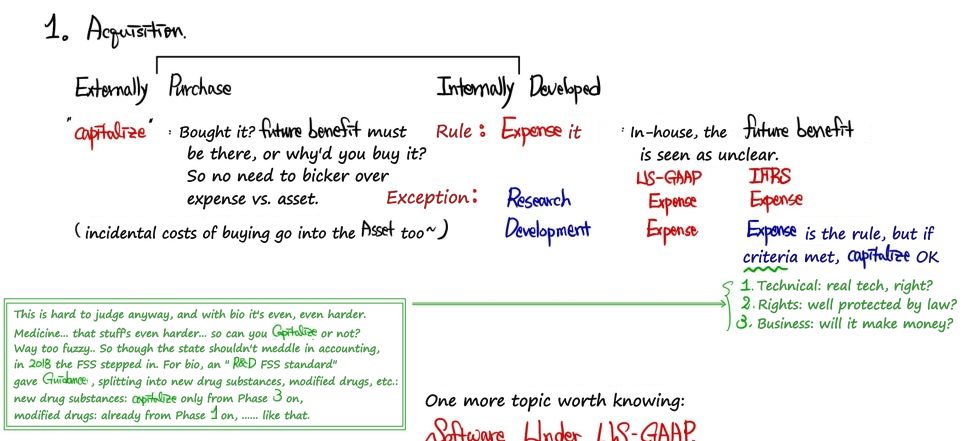
Ah — there’s actually a little something extra peeking out at the bottom of that pic, haha. Yeah hahaha, there’s one more US-GAAP wrinkle.
Up above, we covered Externally Purchased and Internally Developed, and US-GAAP basically slammed the door on Internally Developed and went “Shut it!!! All of you~~~ expense it!!!!” But — there’s actually one thing US-GAAP leaves a crack open for.
Software. With software, US-GAAP cuts you a little slack.
Doesn’t matter if the software is being developed for internal use or to sell — once you hit technological feasibility (that’s the bar for software you’ll sell; for in-house software, the bar is the point where it’s probable the project gets finished and used as intended), after that point, capitalization is allowed!!!!
(Why is IT specifically the one thing US-GAAP gives breathing room to…? Oh! Never mind, heh heh. Conspiracy theories aren’t a good look!~)
That’s it for acquisition! Heh heh heh. Since this is a CFA-prep post! Heh heh heh. For CPA-prep, there’s a whole other layer of stories at this depth~~~ which I’m not going to get into, haha. Because compared to what we just did, there is vastly, vastly, vastly more stuff to talk about there. It’s not the kind of thing I can casually toss in and move on from, so… I’ll pass, heh heh heh.
(Also, honestly, CFA Level 1 doesn’t really feel like it’s asking you to deeply know intangible assets, heh heh.)
2. Amortization & Impairment
OK then — onto theme #2: the subsequent accounting treatment, Amortization & Impairment!
Quick refresher: spreading the cost of a tangible asset across the periods it covers was called Depreciation, and the equivalent cost-allocation process for intangible assets, which have no physical substance, is called Amortization :-)
Useful life of intangible assets can be either finite or indefinite (no foreseeable end, which isn’t the same as infinite), and based on that split, here’s all you need to know.
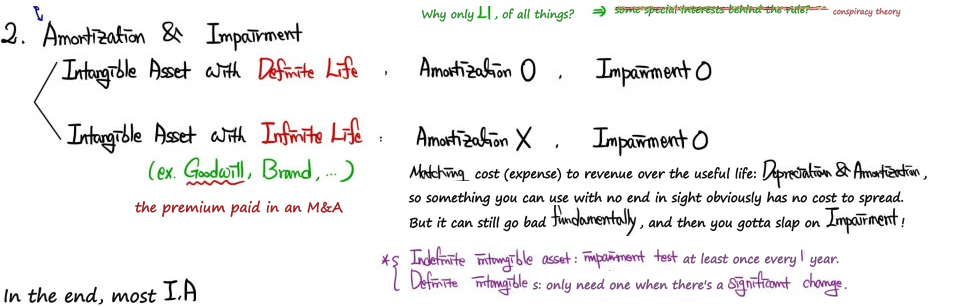
So to keep going, haha — and yes, it’s already poking out of the photo, haha — ultimately, most intangible assets get handled like this:
Purchased → recognize as an Asset including all incidental costs → use it while applying Amortization → if its value as an asset fundamentally rots out, slap on Impairment and goodbye.
Internally developed → start out expensing during the research stage → enter the development stage, and if the requirements are met, you may capitalize (IFRS) → use it while amortizing, same as above → and if it too rots out at the core, goodbye.
Yeah, I think you can hold it in your head pretty much like that.
3. Goodwill
Now let’s spend just a sec on Goodwill, which made a brief cameo earlier. (This is the last bit on intangible assets… heh.)
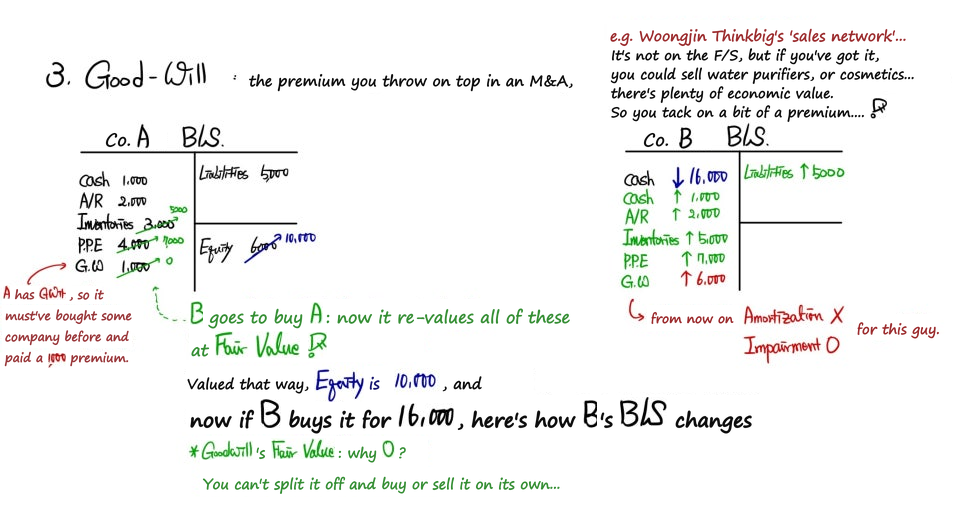
Goodwill is the premium value tacked on during mergers and acquisitions, and it goes onto the books under an account item called Goodwill — which is a type of intangible asset.
Let’s grab an easy example to make this click. Say we’re acquiring Woongjin Thinkbig.
(When I was little, an absurd number of households in my neighborhood were signed up for Woongjin Thinkbig…)
We pull up the financial statements to do the deal. Whether or not Woongjin Thinkbig has stretched its sales network across the entire country and is running a real operation on top of it, that’s not gonna show up in the books anyway.
But from the seller’s side: “Are you kidding me right now? Our sales network spans the entire country, and you’re gonna value our company off the financial statements alone and pay that?? Are you out of your mind???? Get!!! out!!!!”
That’s how it goes. So from the buyer’s side: “Hey hey~~ why you gotta be like that, we know there’s value there too^^ We’ll throw in another xxxx won, so please sell^^”
So, in an actual M&A deal, paying a premium on top to buy the company is something that can absolutely, reasonably happen as a matter of business. Heh heh.
Three things fall out of this.
- Goodwill is an account item that can only show up via M&A.
- If there’s Goodwill on the financial statements → at some point, this company did an M&A.
- And Goodwill acquired this way gets treated as an indefinite-life intangible asset — no amortization, but you record an impairment whenever an impairment needs recognizing.
Here’s the summary of all that :-)
And with that, intangible assets are truly done, heh heh heh. We worked through a few quick quizzes on this, so let’s take a fast look at those and wrap up~
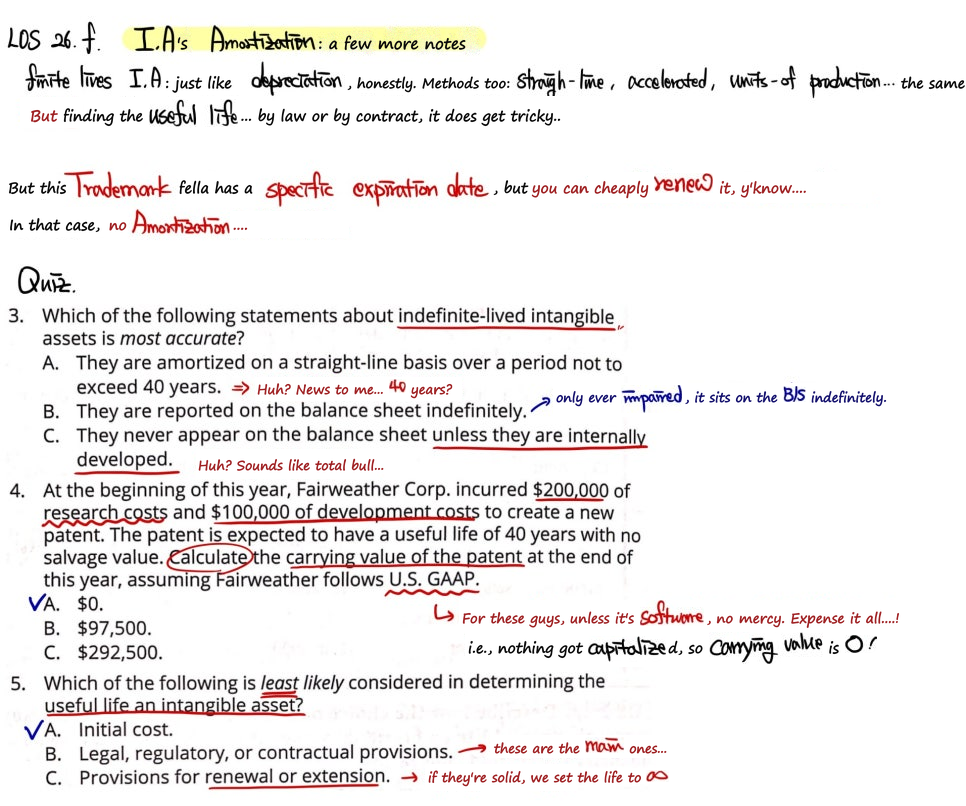
One last thing, heh.
A website that a company built — is it an intangible asset or not? Heh heh heh.
This one’s apparently from an interpretation rather than an IFRS standard itself, and the thing we can’t forget is that an intangible asset is, before anything else, an asset. Which means:
- Future economic benefit must be probable, and
- It must be under our company’s control.
But there are absolutely cases where a website doesn’t have a probable future economic benefit, right? A website like that → not recognized as an intangible asset!!!! Heh heh.
I felt like I never explicitly hammered “intangible assets are assets first” up above, so I’m tacking this on at the end :0
Heads-up. The figures here are the original notes, slips and all. A few things to watch for:
- In the first picture, the green conditions for capitalising development costs are a shorthand: under IAS 38.57, legal protection (#2) is not one of the six criteria, which are technical feasibility, the intention to complete, the ability to use or sell, probable future economic benefits, adequate resources and reliable measurement.
- In the second picture, “Infinite Life” means an indefinite useful life: no foreseeable limit on the period the asset brings in cash, which is not the same as infinite (IAS 38.91).
Comments
Discussion happens via GitHub Discussions. You'll need a GitHub account to comment.