Effective Interest Rate Method: A Complete Accounting Guide
Breaking down the effective interest rate method and amortized cost from the issuer's side — because honestly, I had to fully get it myself before I could explain it!
Originally, the plan for this post was to write about Non-Current Liability.
I started writing a bit, then deleted everything….
Anyway — first, about the effective interest rate method that gets used in bond accounting,
I figured it’d be way easier to talk about it once I’d fully understood it myself first.
So basically, I’m going to fully wrap my head around the whole Amortized Cost measurement process here before moving on.
Oh, and this is from the issuer’s perspective!!!!!! The acquirer (investor) side is lol lol lol lol lol lol lol lol so freaking wild heh anyway,
I mean, this is from the issuer’s side — the one recognizing it as a liability~
OK OK, so we’re going to study corporate bond accounting.
Corporate bonds?!!?!
Hmm… when the government issues bonds those are government bonds, and when a company issues them they’re corporate bonds — in accounting these are called “bonds” — but…
I’ll just say “bond”. Easier that way!? heh
When you go to the bond market to buy bonds,
you’ll see a bunch of different bonds trading at all kinds of prices.
How are those prices decided????
Supply and demand, right?
But bonds are a really weird financial product. Because everything is predetermined — exactly how much will be paid out in the future.
“We promise to pay you coupons of such-and-such amount, every such-and-such interval, for x years, and at maturity we’ll repay the face value~”
It’s literally a piece of paper with that written on it!? That’s why it’s called a security.
(I actually went into the theory side way more here.)
Bond and Stock Valuation and Bond Pricing, Bond Valuation and Risk
OK so let me give you an example of a bond.
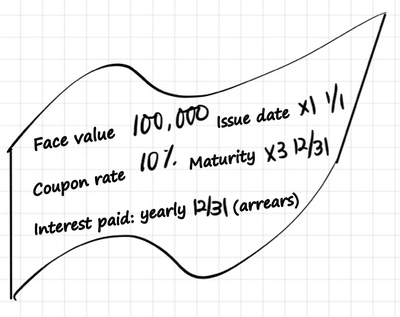
There could be a bond like this.
Let’s say that bond exists.
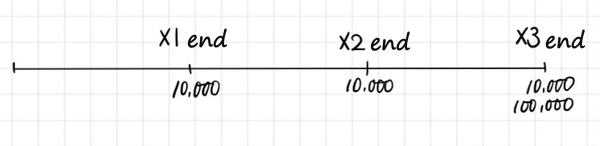
Probably between the issuer and the acquirer (investor), some transaction went down with this bond at the center of it.
It probably looked like this! heh heh heh heh
Right!?!?
OK so now,
Par Bond / Premium Bond / Discount Bond —
let’s get these straight first.
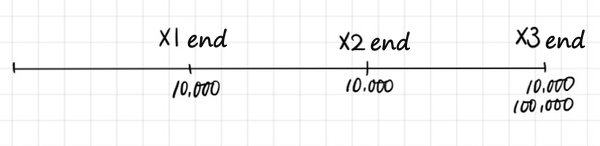
When you issue a bond promising this kind of future cash flow,
“Hey everyone! Please invest in this bond that promises this kind of future cash flow! It’s yours for 100,000 won!!!”
and that’s what happens —
then yeah, you’d say a Par Bond just got issued~
“Everyone, invest in this bond promising this future cash flow!!! 90,000 won!” and
if it’s issued for less than the face value, that’s a Discount Bond,
and lastly, if it’s issued for more than the face value, that’s a Premium Bond.
People hearing this for the first time might be like
“Wait, are you nuts? Why would anyone pay more than face value for that???” but
think about it.
When Apple issues a bond right now,
it really doesn’t seem like this company is going to suddenly yell Default in the middle and stiff you on the future cash flows.
So if someone says they want to buy that future cash flow for 100,000 won,
probably the person standing next to them goes “I’ll take it for 100,500 won, sell it to me!”
Because this person, after paying out 100,500 won today, is going to receive 10,000 won three times in the future and then get the full 100,000 won back at the end,
and being totally convinced Apple isn’t going belly-up, they’d happily try to grab it at 100,500 won.
(So yeah — premium bond trades absolutely can happen, that’s what I’m explaining here.)
Now I’ll get into the principle behind how these things actually get issued.
For that you need to get a feel for the principle behind how bond prices are determined.
So let me think about this first.
If I invest 100,000 won somewhere and want to steadily earn 10% a year for 3 years,
how much do I need to be earning each year?????
If your balance grows like this, that means you’re earning 10% per year — you’re with me right!??!?!?!
Now flip it around.
“Please lend me just 90,910 won! I’ll give you a 10% return! Then I’ll give you back 100,000 won after 1 year!”
True or false???
True.
Because the math works out like this. heh
Let me stretch it out one more year!
“Please lend me just 82,645 won! I’ll give you a 10% return. Then I’ll give you back 100,000 won after 2 years!!!”
Is that true?
Yep, also true.
Because the math works out like this.
The principle by which bonds get traded is basically the same.
Because bonds are a financial product where all the future cash flows are locked in before issuance,
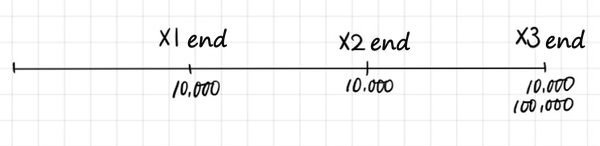
if for this kind of financial product
there’s someone who shouts “I’ll buy it for 88,584 won!!!!!!!"
then what that person is really saying is “I want a 15% return on my investment in this thing!!!"
Because,
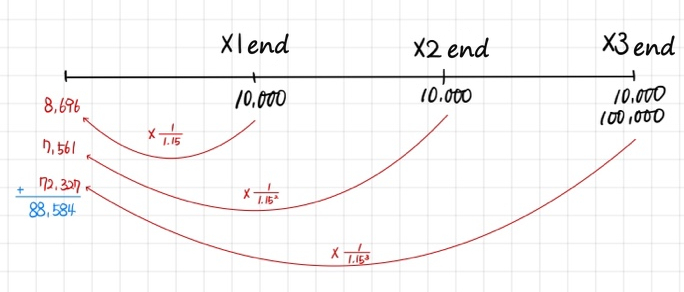
through this kind of calculation,
the investor calling out that price actually has, in their head,
a very specific idea of what investment return they’re going to get out of those promised future cash flows — that’s what I’m saying.
OK OK, so we’ve fully cracked the principle behind how bond prices are determined.
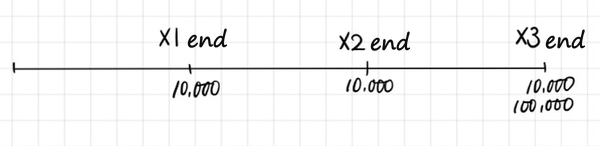
For a bond promising this kind of future cash flow —
if you want an 11% return, what should you pay for it?
if you want a 10% return, what should you pay for it?
if you want a 9% return, what should you pay for it?
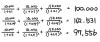
If you want a 10% return, you buy that bond for 100,000 won,
if you want a 9% return, you buy it for 102,531 won,
if you want an 11% return, you buy it for 97,556 won!!!!!!
We’ve been talking the whole time about what return you’re going to earn on the bond,
but actually, up to this point — the 10% coupon rate hasn’t shown up once, has it?
That’s right.
The coupon rate is just a tool that says what percentage of face value gets paid out as future cash flows,
and it has zero — and I mean zero — influence on the investor’s actual return.
A bigger coupon doesn’t automatically mean a higher investment return —
what’s decisive is the price at which this security promising those future cash flows actually trades,
and at what price someone buys, at what price someone sells — supply and demand decides that.
Which means the discount rate you use there (the % when you take present values) is something that reflects how investors view that company,
how the company views itself — that kind of stuff gets baked in and determines it.
That’s why this discount rate also gets called the market interest rate.
So,
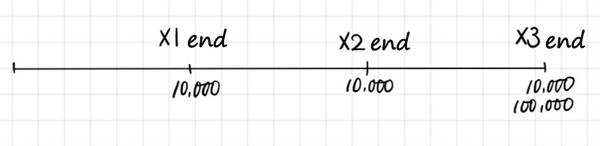
for a bond promising this kind of future cash flow, if Samsung Electronics issues it, investors are like
“y’all are never going under~~~~ giving us just 3% is fine” — and it gets issued at a premium,
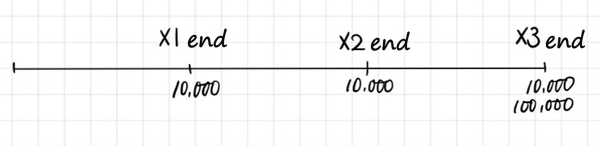
and for a bond promising this same future cash flow, if GD Corporation issues it, investors will probably be like
“You look like you could go bankrupt tomorrow and nobody would even blink, so if you want me to invest in you right now, you’d better promise me at least 30%~”
and so this absolutely-shredded discount bond gets issued~ that’s what it means. heh
(I just took a quick detour into the meaning of the market interest rate — back to the main thread.)
Wow!!!!!!!!!!!! I totally get par / premium / discount bonds now.
How’d that go?
If the coupon rate written on the face value and the discount rate used for present value are equal, the PV comes out equal to face value,
if the discount rate is higher than the coupon rate, you get a discount bond,
and if the discount rate is lower than the coupon rate, you get a premium bond!
Why does it work this way!? Because the formula is structurally built that way!!!!!
I’ll explain a little more carefully how the formula is structurally built that way, using a par bond issuance as the example.
For a bond with a face value of 100,000 won and coupon rate set at 10%,
it just so happens investors looked at the company and concluded
“hey if I’m investing in y’all, you’re going to need to give me a 10% return,”
and the company says “Yes sir! In that case you can buy this bond for 100,000 won!”
Now look.
Beginning of year x1 — the company borrowed 100,000 won. The investor lent 100,000 won.
End of x1 — since the investor expects 10%, the figure 110,000 won (principal + 10%) becomes “the money y’all owe me!” in their head,
oh! 10,000 won got deposited. So now it’s back to 100,000 won as “the money y’all owe me!”,
end of year x2 rolls around, slap another 10% on, that’s 110,000 owed, another 10,000 deposited. Back to 100,000.
End of year x3, same thing — it becomes 110,000, and the company pays out the 10,000 coupon plus the full 100,000 principal,
says “Thanks for investing~” and the deal is done.
Right!?!??!
Wow wow, am I actually pretty good at explaining this?
lol lol lol lol lol lol lol lol lol I’m sorry.
Now if we just run that exact same example for discount bonds and premium bonds,
you’re going to walk away with a complete understanding of effective interest rate accounting.
But before getting into the actual accounting treatment, let’s pretend we’re really in this transaction with our money sloshing around in the middle of it,
and just feel out what’s happening.
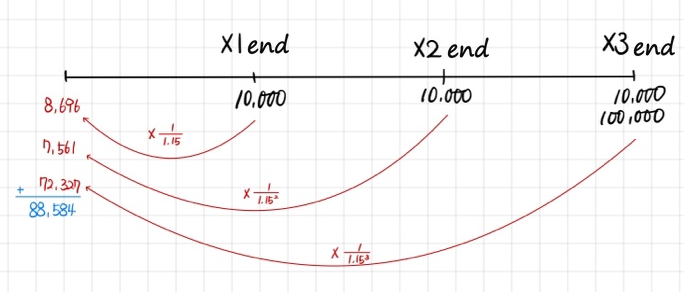
For the company that issued a bond promising this future cash flow,
we thought
“hmm… y’all… shouldn’t you be giving us like 15% return?”
so I said I’d buy that company’s bond for 88,584 won,
and the company called too heh heh heh, so on January 1 of year x1, I bought this bond at the 88,584 I wanted.
And then December 31 of year x1 rolled around.
That company borrowed 88,584 from me, and they promised me a 15% return!!!!!!!
So how much should they be giving me at the end of year x1?!?! Since it’s 15% of that,
heh heh I need to receive 13,288 this time around for the 15% they promised to actually land! heh heh heh
and then when they pay the promised future cash flow of 10,000 won to the person thinking that, what’s the investor supposed to do?
You’d add the difference onto the principal! heh heh
The principal was 88,584, this period the payment that should have come was 13,288, but they only paid 10,000 won,
so 3,288 gets tacked on,
“Right now the debt y’all owe me is 88,584 + 3,288 = 91,872” !!!!!!!!!!!!!
And the company plays along.
“Yes yes of course sir heh heh heh I’m not gonna run off with the money^^ I’ll record it nice and properly in the books! 91,872!!”
End of year x2 arrives.
Same dance.
(Investor): “The debt y’all owe me right now is 91,872, and to give me 15% on that, you’d need to be paying me 91,872 × 0.15 = 13,781! But since you only paid 10,000 won, 3,781 gets tacked onto the principal!”
91,872 + 13,781 - 10,000 = 95,653
Now it’s the end of year x3 — maturity. This guy is going to pay out 110,000 like he promised.
15% of 95,653 is 14,348, right? Let’s add that on.
It comes out to 110,000. lol lol lol lol lol lol lol lol lol
Surprising, right!?!?!?!?
OK well — it came out this way because the whole thing was set up to come out this way. lol lol lol lol lol lol
Anyway lol lol lol lol lol
This is exactly the secret behind the bond discount issuance difference (discount on bonds payable).
That balance sheet account called discount on bonds payable — that’s the thing that handles the amount being tacked onto the principal,
and yeah, that’s the thing that absolutely fried people’s brains the first time they encountered accounting…………
So really,
once you have all the info about a bond from the start,
assuming the promised future cash flows actually get paid, you can already see every future situation.
Like this! heh heh heh
People prepping for the CPA call this an ‘amortization table’ —
basically that picture, written out as a table —
but personally I just doodle this one picture every time a bond question shows up. heh heh heh
Anyway — from the issuing company’s side,
you can see now that the financial liability shown on the B/S at each period-end is the blue numbers down below,
and what’s actually paid on each interest payment date at period-end is the yellow 10,000 won every time,
and the amounts that actually need to be repaid as promised to the investor are the green numbers running diagonally, right???
Those green numbers are precisely the “interest expense” the company has to recognize in that accounting period.
That’s right!!!!!!!!
That’s how the interest expense accounting treatment works!!!!!!!!
So at the end of the day, isn’t it like this?
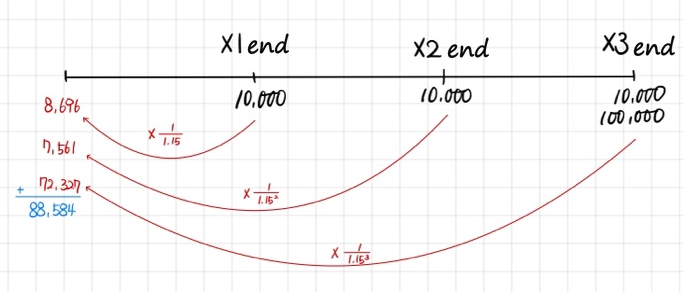
The value you get discounting at 15% is 88,584,
and discounting at 15% means it was set up with the intent of “I want my investment return to be 15!”,
and the company that promised to honor that is going to calculate the interest expense to recognize each period at 15%,
so the market discount rate (15%) you used calculating the bond’s PV becomes that figure!!!!!!!!!!!!
— you might think,
but unfortunately it doesn’t shake out that way. (sigh)
The company is going to use an underwriter — like a securities firm — to actually issue the bond.
And of course the company’s going to pay fees.
So even though they called it at 88,584 on a 15% return promise to investors,
transaction costs like fees pop up in the middle, and the amount that actually lands in the company’s bank account ends up smaller than that.
(Let’s say 3,584 won in fees came out in the middle.)
The amount that actually got deposited is 85,000 won, but since they promised 15% to the investor,
they need to process the numbers in a way that 15% works out as the return!!!!!!!
So when the company processes interest expense based on 85,000 won,
the company is not going to recognize interest expense at 15% — they’ll recognize it at some % higher than that, right??!?!
I crunched it roughly and 0.167624 does the trick.
That is, you process interest expense at the figure 16.76%.
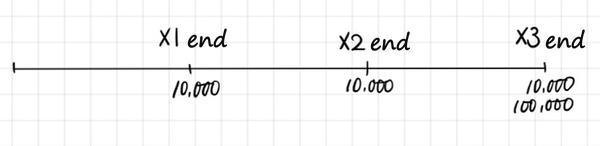
If you take the PV of this cash flow at 16.76%, you get 85,000 won.
So bottom line — in the market this company is being valued at 15%, and investors want a 15% return,
but transaction costs popped up, so the company is effectively recognizing interest expense at 16.76% on each interest payment. (sigh)(sigh)(sigh)
THIS!!!!!!!!!!! is what’s called the effective interest rate!!!!!!!!!!!!
Wow!!!!!!!!!!!!!!!!!!!!!!!!
I get the effective interest rate now too!!!!!!!!!!!!
Now I think all that’s left is figuring out how to display it on the B/S.
For starters, we already know all the values (Book Value, let’s call it BV) that need to show up on the B/S at each period-end. heh heh heh
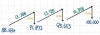
Here!!!!!!!!! what I’m calling BV — that’s exactly AC (Amortized Cost)!!!!!!!!!!!
(If there are transaction costs, the amortized costs are each going to shrink a little!!)
So at each period-end,
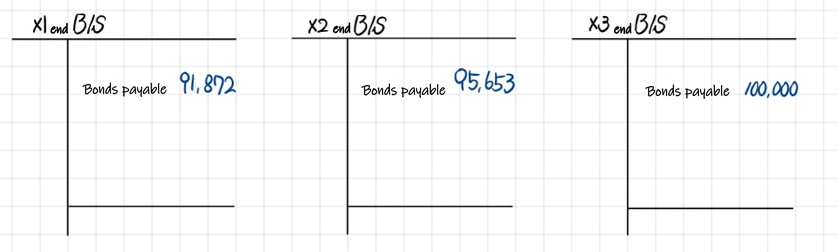
isn’t it just done by displaying the amount on the B/S like this????
Unfortunately, (sigh)
nope.
Because bonds are accounted for on a gross basis,
using an account called discount on bonds payable, which is a Contra Account against the bond account,
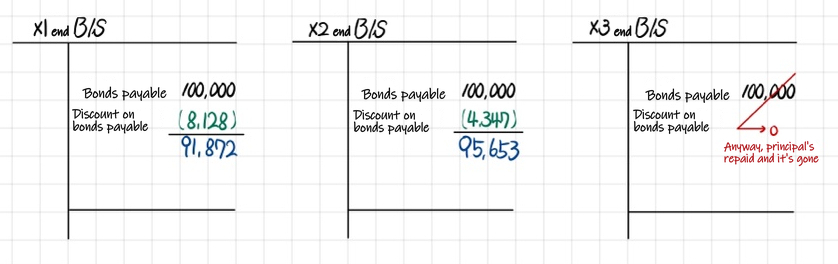
you have to display it together with the principal like this. (sigh)(sigh)(sigh)
(I’m using a discount bond as the example here — if it were a premium bond, you’d use the account called premium on bonds payable, and the BV would be a number higher than face value.)
This actually really requires double-entry journal entries — running through x1 January 1 → x1 December 31 → x2 December 31 → x3 December 31 — to be properly complete,
but since I’m writing this for CFA purposes, I’ll skip the journal entries.
When I get into the intermediate accounting I studied later, I’ll do the full journal-entry treatment.
Anyway — y’all get all of it now, right!?! heh heh heh heh heh heh
Discount with the market interest rate (discount rate) to get the PV,
if there are transaction costs, subtract them off the PV,
and re-derive the effective interest rate based on that subtracted value
(if there are no transaction costs, the market interest rate and the effective interest rate are obviously going to be the same),
then recognize interest expense using the effective interest rate method, recognize the coupon payments paid in cash,
and show the amortized costs you just calculated, one by one, on the company’s B/S!!!!!!!!!!
That’s the conclusion. heh heh heh
Honestly, even without knowing any of this, you can pretty easily clear the Non-Current Liability section of CFA Level 1,
but I figured it’d be nice to have the bigger picture in your head, so I randomly cooked up this post. heh heh heh
I’m not posting this off some clean draft —
I just wrote it all in one shot, so it might be a little…
scattered and chaotic, but if you read all the way down to here…..
thank you so so much! heh heh heh heh!
I hope it was even a tiny bit helpful for understanding bond accounting.
Then in the next post,
I’ll write about Non-Current Liability for real, CFA-exam style! heh heh heh
The truth……………is
that not all liabilities are actually accounted for this way. (sigh)
Only liabilities classified as AC financial liabilities are accounted for this way….
Liabilities classified as FVPL financial liabilities are treated totally differently……..
Oh oh oh oh forget it!!! CFA fighting!!!!!!!
Comments
Discussion happens via GitHub Discussions. You'll need a GitHub account to comment.