Leases
A quick rundown of lease types and lessor/lessee basics you need to know — even though leases are basically gone from CFA Level 1 now, heh heh heh.
First things first — heads up: the lease side of the standards got revised, and the new rules apply from 2019, apparently. So lease used to be in CFA Level 1, but with this revision? Leases are basically gone, apparently. (OK, not completely gone — a tiny bit was left. But for all practical purposes, gone.)
So when we go through the concepts, yeah, we’ll cover leases. But the odds of it actually showing up on the test are low, and Level 2 is gonna deal with it for real anyway. So let’s just learn enough to know it exists and move on, heh heh heh!
OK so first — what even is a lease (contract)?
It’s buying and using only the ‘right of use’ of some asset. Some folks lease a car long-term and drive it around — but during the lease term, all the contractor actually has is the right to use that car. The ‘ownership’ stays with the original owner :-)
(Under Korean law, ownership is guaranteed by ‘possession’ for movable property and by ‘registration’ for real estate, apparently, heh heh heh.)
It’s kinda fun, heh heh — there really are all kinds of transactions out there, heh heh heh.
OK OK OK OK OK. Lease transactions come in 4 flavors total:
Financial Lease / Operating Lease / Sales-Type Lease / Sale and Leaseback
But — very fortunately — Sale and Leaseback isn’t in CFA Level 1. You only need to look at the first 3. And honestly? Even those, it’s basically like we’re not really looking at them. Let’s just go in knowing these transactions exist.
OK so let me define some stuff first:
- Whichever entity — legal person or natural person — provides the right of use: Lessor (lease provider) → e.g., Boeing builds the airplane and…
- Whichever entity — legal person or natural person — obtains the right of use: Lessee (lease user) → e.g., …leases it to Korean Air.
That’s the terminology. Let me walk through these one by one~
So I’m starting a business right now, and I need a car. Buying one outright is a bit much, hmm….. I want to borrow a car, use it, and decide later, you know? So you go to a financial company….. (yep, this is where leasing happens…. it’s OK, you may be a little thrown — just keep listening.)
You go to the financial company, and they say sure, deal. Now this financial company is gonna typically be something like a capital company —
(In financial operations, the headline services are deposit-taking and lending. Deposit-taking: receiving money from people. Lending: loaning money out to people. The bank — the kind of financial company everyone knows — is a very special type that gets to do both. Normally you can’t do both. A capital company is the kind that does only lending, no deposit-taking!)
So what does the capital company do? “I buy a car with my own money~ this is mine (ownership = capital company’s). And I’ll transfer the right of use over to that company~” That contract, exactly that, is the lease contract. Among leases, this form is what we call a “Financial Lease.”
In diagram form it looks like this:
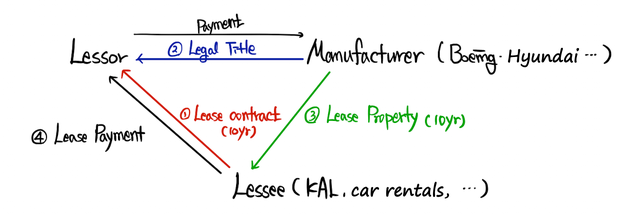
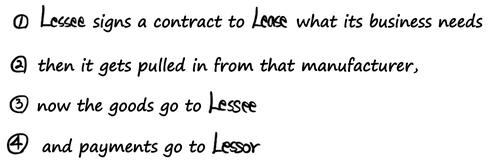
(Apparently the manufacturer ships it directly to the lease user.)
But — common sense — that probably isn’t what you were picturing, right? You were thinking, “rent a car for a few days when I go on a trip,” weren’t you?
So what kinda transaction is that?? Couldn’t that just be viewed as a rental contract — like, “I’ll use it for a few days, here’s the rental fee”??
This kind of lease is called an “Operating Lease.”
You’re a little thrown, aren’t you….. The capital company buys a car, says “this is a car with a 10-year useful life~”, and lends it out for 5 years, collecting the value of the right of use — whether that’s 100,000 won a month or 200,000 won a month.
Like…. what’s actually different between the two??
Financial Lease vs. Operating Lease
OK OK, first let me tell you how Financial Lease and Operating Lease are considered different. I’ll just give you the answer up front:
“A lease in which the lessor transfers substantially all the risks and rewards of ownership” → classified as Financial Lease.
“A lease in which the lessor does not transfer substantially all the risks and rewards of ownership” → classified as Operating Lease.
(Here, risk means: possible losses from idle capacity or technological obsolescence, and swings in return as economic conditions change. And reward means: profit from operating over the economic useful life, value appreciation, and profit from realizing residual value.) That’s what the standard says — but since this is for CFA, we can get by knowing it a bit more loosely.
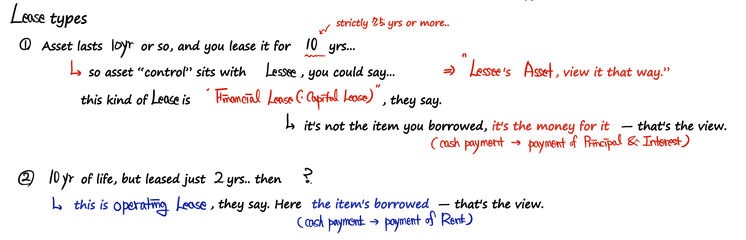
Financial Lease and Operating Lease — because there’s a difference in how you view it (a contract of lending and receiving money / vs. lending an item and just collecting a usage fee), the accounting treatment ends up flowing in totally different directions. (And accounting always looks at the substance of a transaction….)
As we’ll see in a sec, Financial Lease follows the exact same accounting treatment as the bonds we did earlier, while Operating Lease does not.
And the reason becomes really easy to see if you just look at the future cash flows under this kind of lease contract.
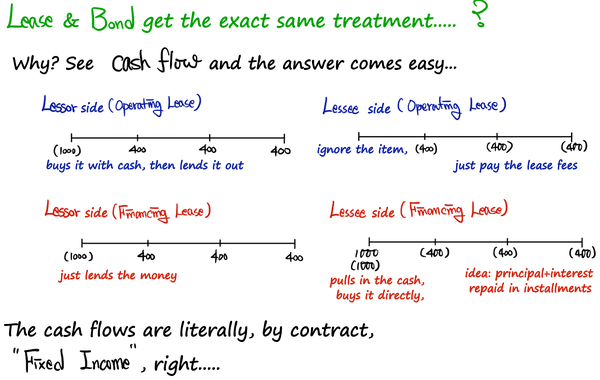
The lessee side
OK now let’s actually look at how the accounting works. Let’s start with Operating Lease on the Lessee (lease user) side, because the accounting is a bit simpler there. Operating Lease, remember, gets accounted for like a rental contract. So picture the case where you’ve taken a studio apartment and you’re paying monthly rent.
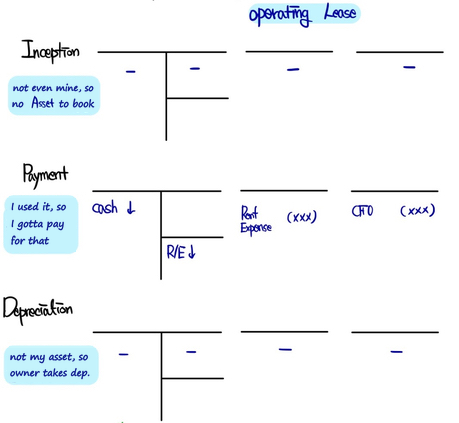
Is there anyone who, just because they rented a studio, recognizes that studio as their own asset on a balance sheet?? Nope, right?
So at the start of the contract, nothing hits the B/S, and since there’s nothing being paid yet, nothing changes on the I/S or the C/F either. Then when payment time rolls around — month-end, year-end, whatever — you hand over cash, and that cash becomes an expense. This is, of course, classified as operating cash flow.
And since the studio isn’t mine anyway, I don’t need to depreciate it, right? Wait — no, I never even recorded it as an Asset to begin with, hahaha. So there’s literally nothing to do.
Now let’s look at the Lessee side of a Financial Lease. Like I said, the substance of a Financial Lease is “a transaction of borrowing money and paying it back,” so it gets accounted for like such a transaction.
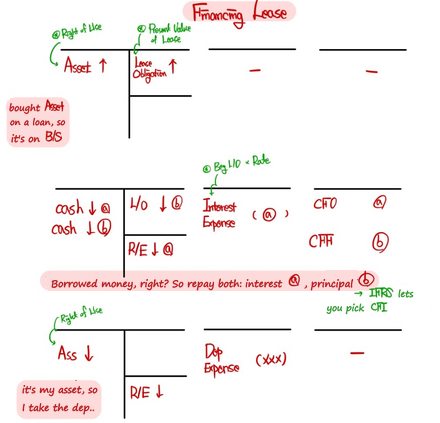
So first, since we view it as having borrowed money to buy that asset, you recognize the asset that’s come into your hands (using an account called right-of-use asset), and you recognize the part you have to pay back as Lease Obligation (Lease Liability).
This asset is now considered mine, and the lease liability is a debt I now have to pay off. So, for the asset, I have to recognize Depreciation, and for the liability, I follow the effective interest rate method and account for it like financial debt.
So just like with bonds earlier — the interest expense under the effective interest rate hits the I/S as interest expense, and shows up as operating cash flow (though under IFRS it could also be classified as Cash-Flow from Financing). And depreciation expense goes out too. That’s the structure.
OK OK OK.
If you were management at a company, which lease would you wanna use, even when you’re using a lease?
Of course you’d wanna ride the lessee-side Operating Lease treatment!!!?!?! For one thing, no liability gets recorded, hahaha — your debt ratio looks massively better. And on top of that, when you go raise more financing, you can make a great impression on banks and investors….
(In accounting, this is called the off-balance-sheet financing effect (the advantageous effect of having assets and liabilities not show up on the books).)
So companies — because there’s a rule that says “a major part of the leased asset’s economic life” can’t be in the lease term if you wanna be classified as Operating Lease — apparently started pulling tricks like “extend it after the contract” and getting everything to follow lessee-side Operating Lease treatment….
So!!! Both IFRS and US-GAAP got fed up, and as part of this big lease standard overhaul — “As for lease users — forget it. You follow Financial Lease lessee accounting treatment, unconditionally!!!!” they changed it, apparently….heh heh.
(Strictly, that’s IFRS. Under US-GAAP a lessee’s operating lease now goes on the B/S too, as a right-of-use asset and a lease liability, but it keeps one straight-line lease expense.)
(That said, short-term leases are exceptions, and under IFRS so are low-value ones… apparently. But I’m keeping that to the small print….heh heh.)
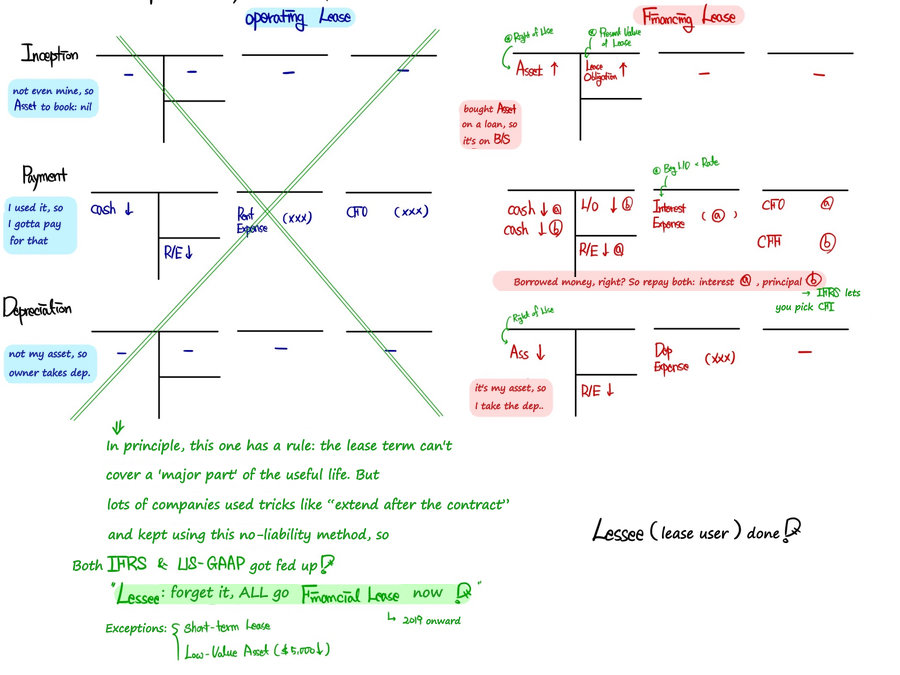
Don’t get this confused.
The party that can no longer keep a lease off the B/S with Operating Lease accounting is the lessee side!!!!
The lessor doesn’t have that restriction, heh heh heh. The lessor can still do it!!!!
(Ahh, honestly I just wanna say “yeah it’s all fair game”… but the lessor in a Sales-Type Lease — i.e., the seller — can’t use Operating Lease treatment….. since this is technically outside CFA scope…… just forget it please T_T From my perspective as the one writing this….even so, telling a flat-out lie just to make things easier feels a bit off, so I’m sticking it in parens, small as it is……T_T)
The lessor side
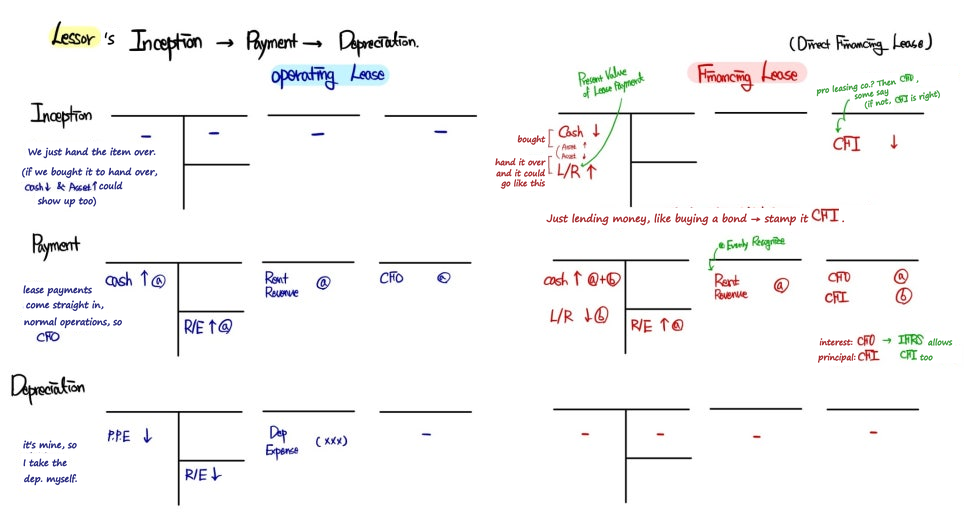
Starting with Operating Lease — since I’m handing over my home, my studio, on a monthly rent basis, when the contract kicks off~~~! there’s no change on my B/S. Then the operating lease income that rolls in afterwards gets recognized as current-period profit or loss on the I/S, and that piles up in Retained Earnings. This is, of course, part of operating cash flow. And since the asset is mine, it makes sense for me to depreciate it, heh heh.
The Financial Lease side might be a bit trickier. Like I said, the substance of a Financial Lease is “borrowing money and paying it back,” so this is just the opposite position from the lessee who’s doing the borrowing. Think of it as having loaned money out by investing in another company’s bond, heh heh.
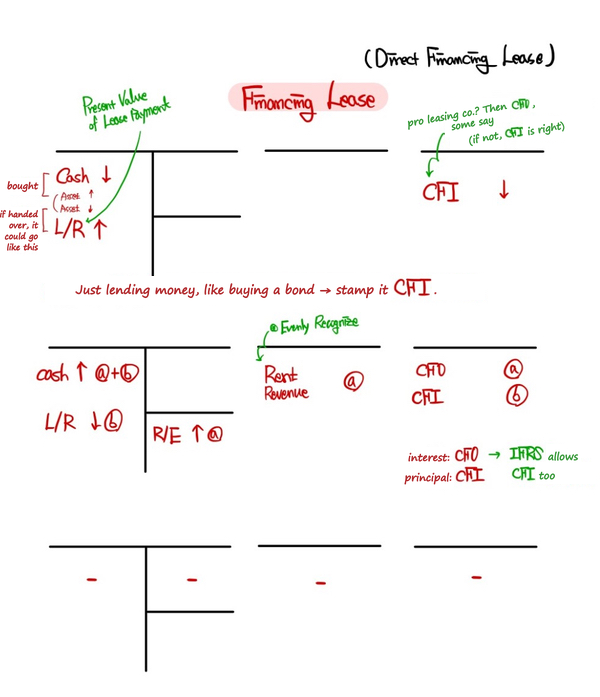
So, at the initial start, Cash gets used, and what gets booked on this side is an account called Lease Receivable (similar in spirit to Accounts Receivable). (In fact, the financial company spends money to buy the asset, briefly creates an asset under its own ownership, and then transfers only the right of use — that’s why an Asset popping up and disappearing in the middle is noted as an extra detail.)
And since this is money loaned out, it gets classified as Cash-Flow from Investing!! (With bonds and on the lessee side above, that was borrowing money, which was CFF. But here we’re in the investor’s position, lending money. In that case it gets classified as CFI…. don’t worry. We’ll cover this all the way at the very end, in the cash flow statement!)
Right now, “what is this nonsense -_-” is the totally natural reaction! T_T
Anyway — for the subsequent accounting treatment, since it’s accounted for like having loaned money, you just recognize income using the effective interest rate method. Knowing this much is about it…… since the odds of it being tested at Level 1 are apparently super low, it’s fine to just know it roughly!
Sales-Type Lease
Last one — Sales-Type Lease. How should you think about this one —
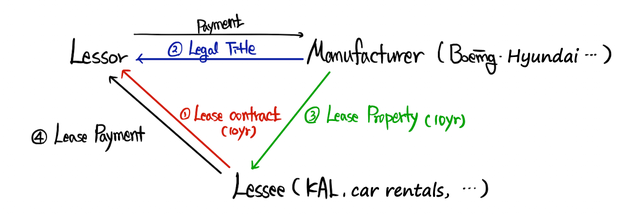
In a transaction with this kind of structure, from the Manufacturer’s perspective — from a company like Hyundai Motor’s perspective — “Yo;;;; financial company, who are you to cut in the middle and skim off something like a fee…..?” “We can do lease sales too!!!!” You can think of it as a transaction that came about like that.
So what the original manufacturer would’ve been doing if it’d just made a sale — recognizing sales revenue through the 5 steps of revenue recognition, bundling up the corresponding costs into cost of goods sold and sending them out, all the way through capturing profit — now turns into this: “record that car as sold to me, book it all as a lease receivable, and then transfer the right of use to the lease user.”
i.e., since we sold it, we first record revenue and cost of goods sold → where normally either cash would come in or accounts receivable would come in, here, since the actual operation is transferring only the right of use, the accounting goes the route of recognizing lease receivable instead.
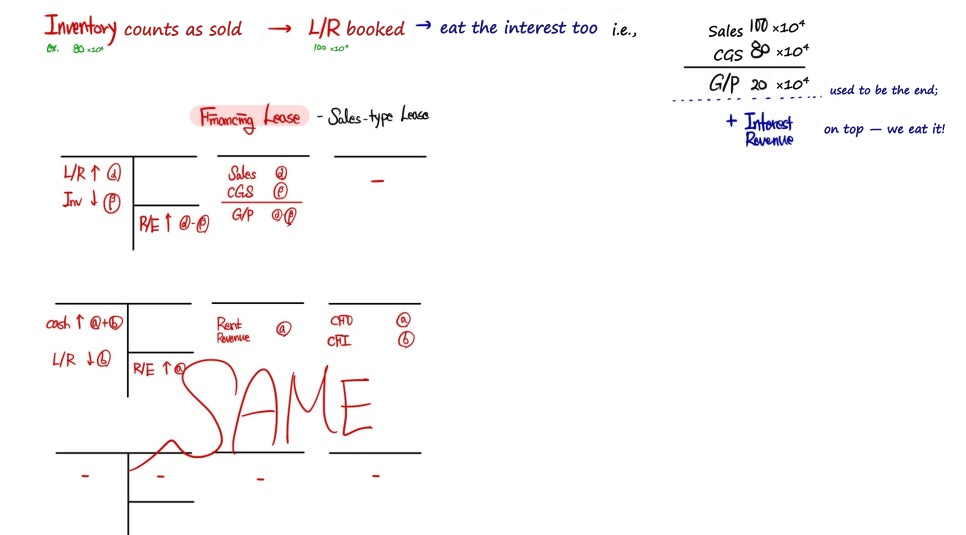
So first, revenue gets booked and lease receivable gets recognized. Then the subsequent recognition follows the effective interest rate method and interest income gets recognized. (And since the principal is gonna be melting away little by little alongside that, the BV of the lease receivable keeps drifting down.)
It just ends up being the same as Financial Lease!!!!
Oh, and as I mentioned briefly — because Sales-Type Lease doesn’t recognize lessor-side Operating Lease accounting treatment, there are only Financial Lease examples, all the way through!!!! heh heh.
Well — wrapping up Sales-Type Lease like that means I’ve crammed an enormous amount of content into an absurdly condensed form, but^^ we’re exam-takers here, so let’s call it good at about this level!
(On top of that, when I was actually doing practice problems, I just skipped every single lease problem……heh heh heh.)
Heads-up. The figures here are the original notes, slips and all. A few things to watch for:
- For the lessee’s finance lease, the interest paid goes to CFO or, under IFRS, can go to CFF (IAS 7.33), not CFI as the note says; the principal repaid is CFF.
- The “every lessee goes financial lease” rule is IFRS 16’s single lessee model. Under US GAAP (ASC 842), a lessee still has operating leases: on the balance sheet, but with one straight-line lease cost. The low-value-asset exemption is IFRS only; both standards have the short-term exemption.
- In the lessor’s financing-lease pictures, the income from a direct financing or sales-type lease is interest income at the effective rate, so it shrinks over the lease instead of being recognised evenly as “Rent Revenue”.
Comments
Discussion happens via GitHub Discussions. You'll need a GitHub account to comment.