Pension
Quick intro to post-employment benefits and why you can't just slap a retirement payout on the I/S all at once — matching principle, retirement allowance systems, and more.
I’m guessing this one’s gonna be super short!!!
Big picture first — if you were learning this for the CPA, this stuff lives under an accounting standard called “Employee Benefits.” A company hands out a bunch of things to its employees as benefits, and the ones it covers are:
- Short-term employee benefits (monthly salary, paid leave, that kind of thing) / 2. Post-employment benefits (what you get when you retire) / 3. Termination benefits (a little extra for being let go) / 4. Other long-term employee benefits (everything else)
So those are the categories, and what we’re looking at today is post-employment benefits. Good news though — post-employment benefits is part of the CFA Level 2 curriculum (it’s one of the 5 main themes in Level 2 FRA^^), so here the plan seems to be just to introduce it so you’re not blindsided later, and that’s it.
So let’s start with: what even is a Pension system? heh heh heh
I work for a company. In exchange, the company pays me.
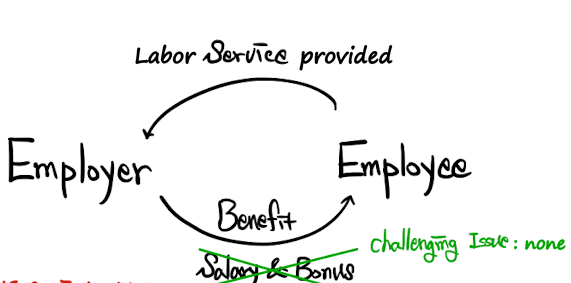
Oops, I went and used the word “labor”….lol
We Employees provide labor services, and what do we get as Benefits in return? First, monthly salary and performance bonuses — and since there’s nothing tricky about salary or bonuses accounting-wise, there’s also nothing worth putting on an exam.
But aside from salary, one of the things you get is a Benefit paid out at retirement. The retirement benefit is basically the company going “thanks for sticking around all this time~” and handing you some money.
Let’s say someone works for 5 years and then leaves, and they’re handed 10 million won for those 5 years of service. Now — if you just SLAP!!! that whole 10 million won onto the I/S (income statement) as an expense in one go, that violates the matching principle of revenues and expenses.
Meaning: that 10 million won should be expensed bit by bit during the years the employee is actually working, so it gets matched against the revenue those employees are generating each year. Which translates to: “as each year passes, the retirement benefit owed to the employee also has to be expensed little by little.” So year by year, the company makes entries like this:
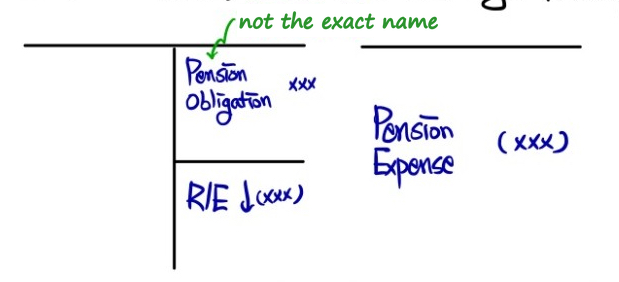
Something gets booked as a liability while also being expensed, and then when the employee actually leaves, you knock that liability off and offset it against the Cash going out. Right? This setup isn’t called a Pension system — it’s called a “Retirement Allowance System (internal reserve system).”
(The company I work for right now runs a retirement allowance system, and apparently when you resign, you get paid out as average salary of the last 3 months × years of service. lol I literally went over to the management support team and asked about this while I was studying this part. lol (There was a whole scene, everyone asking if I was switching jobs… seriously, don’t ask about stuff like this. lol))
Now, the retirement allowance system has one big problem.
What problem? Let’s do the extreme case: suppose the company suddenly goes bankrupt. Employees with unpaid wage or retirement-benefit claims are creditors too — shareholders get a residual only after creditor claims. The real problem is that an unfunded company may not have enough assets to meet those employee claims; their priority depends on local insolvency and labor law.
(The exact priority differs by country. In Korea, under labor law, 3 months of wages and 3 years of retirement pay get priority over even secured creditors… it’s this really powerful protection for Korean workers’ rights, and apparently foreigners look at it and go “whoa, that’s extremely strict…” heh heh)
So the thing built to patch this problem is the Pension system, and simply put: you stash the money somewhere completely independent — outside the company — where creditors can’t touch it. That is,
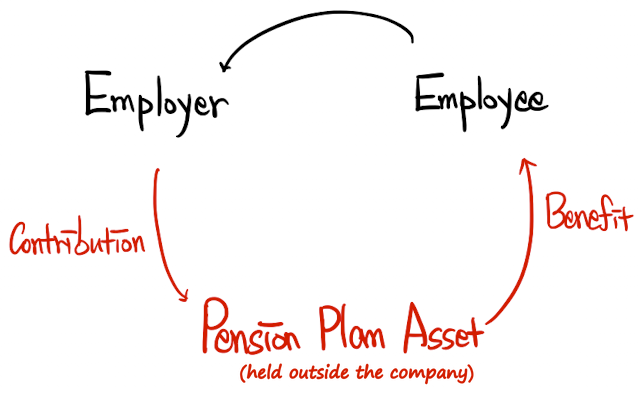
The plan assets (assets held outside the company) are usually kept with a financial company (banks, securities firms, insurers) etc., and the money just sits there.
So what entries does the company actually make?
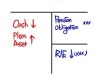
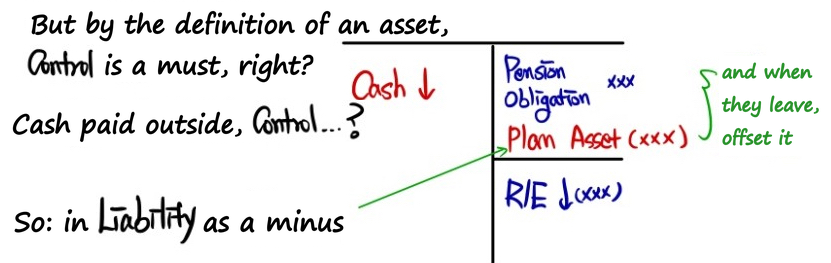
Cash gets handed over to the financial company and moves into the plan assets account, and since the employees’ service gives us a present obligation, a liability shows up as well.
But — as mentioned in the intro section — for something to be recognized as an asset, Future Economic Benefit must be Probable / AND it has to be under the company’s control. And wait — if the company can just control this money, does it still mean anything as a Pension? Obviously the company has to be kept from messing with it.
So!!!! It’s not an ordinary pot of cash the employer can freely spend. But it is still a plan asset: under defined-benefit accounting, its fair value is netted against the benefit obligation.
The employer reports a net defined-benefit liability or asset. Under IFRS, a surplus asset is limited by the asset ceiling — the economic benefits available through refunds or reductions in future contributions.
OK OK OK so now, that financial company we’ve signed with has money steadily piling up right about now, right?!?!
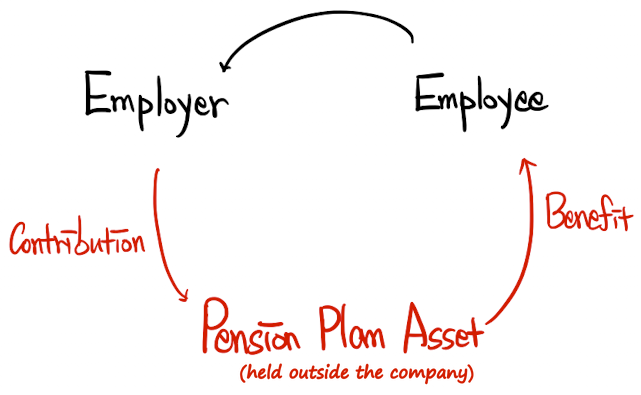
Raise your hand if you want to just leave it sitting there~~~ I mean — the longer money just sits, the more of a loss it is, right?!?! lol So naturally you’d want to invest this in financial assets, put it somewhere…… but whatever investment vehicle you use, to get a return, you have to eat the corresponding risk… T_T
Who eats that risk…….?? Is it our company that put the money in, each employee who’ll collect the money later, or the financial company????
Whoever bears the investment risk is exactly what splits the retirement pension system into its types! heh heh
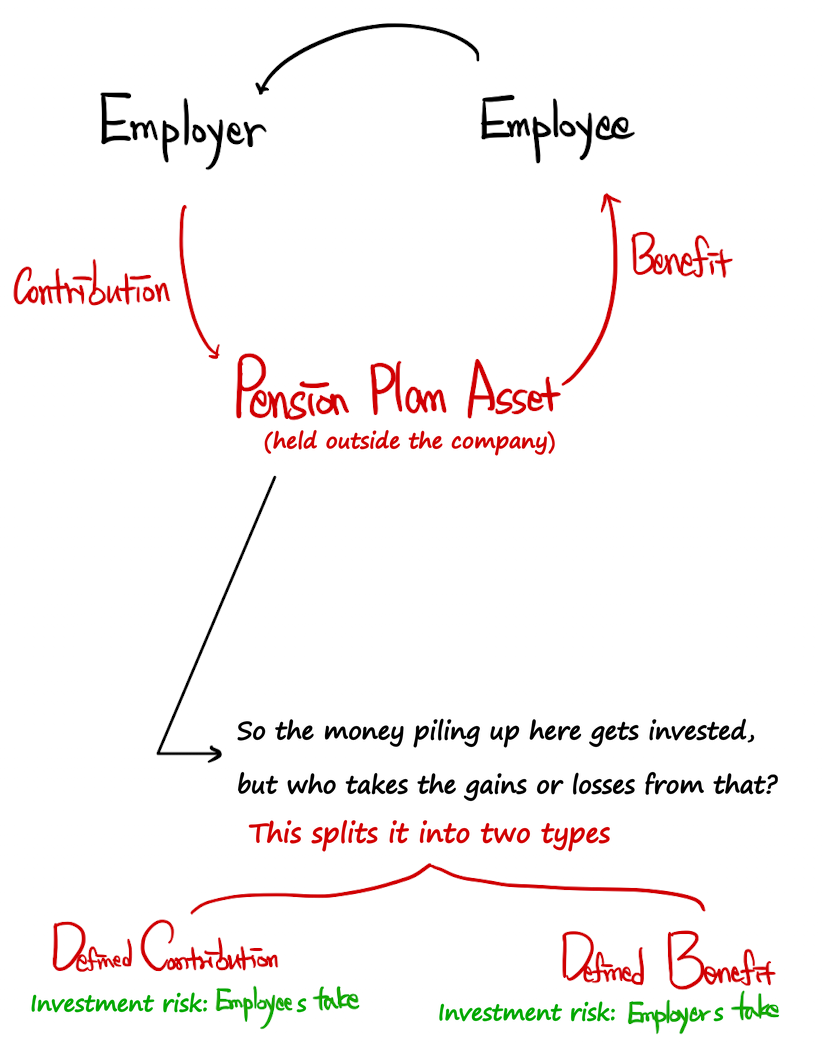
Out of these, the DC type (Defined Contribution pension plan) is super simple. Because we’re studying the accounting from our own company’s point of view, and our company’s obligation is completely done the moment it plops the cash over.

Whether there’s a loss or a gain after that, whatever — it all just gets paid out to the employee when they leave~ heh heh
The problem is the DB type (Defined Benefit pension plan)……
The company is on the hook for the investing, and the benefit is defined by the plan’s formula — often linked to salary and years of service — rather than guaranteed to be one fixed cash amount…. heh And the company also doesn’t know when the employee is going to retire. lol And has to estimate all of this on top….. Ridiculously, absurdly, stupidly complicated — and apparently all this complicated stuff gets covered in glorious detail in CFA Level 2. heh heh
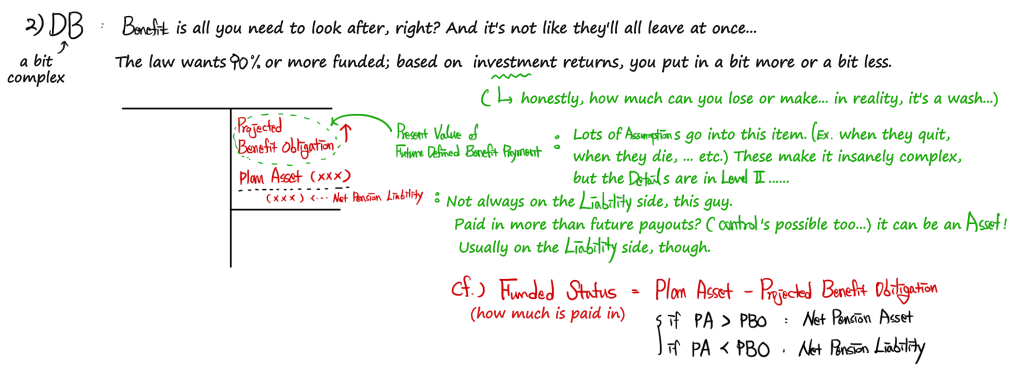
Is it really OK to just fly past it with a picture like this???? lol See you all at Lv2 for it! heh heh heh
Phew~
(There’s that moment where your brain just goes bang for a second — wait, which one is the head-splitting pension plan, DC or DB?!?! You can work it out step by step: “OK what’s being Defined — the Contribution, or the Benefit…” and “which one has the employee carrying the investment risk…” but I just memorized it the simple way:)
DB is the bad guys that make my head explode!!!
(Sudden apology to DB Group (the Korean conglomerate). T_T But what am I supposed to do…. the first thing that pops into my head when I hear “DB” is DB T_T…. sorry~)
I actually studied the intermediate accounting that CPA candidates study, as a hobby, and honestly, I’d already gotten a teeeensy~~~ taste of this part. lol But looking at intermediate accounting as a whole, it wasn’t actually a huge wall. The accounting stuff that really felt like a wall to me was… not this, but actually……….. the revenue recognition section….. probably??? lol
Anyway — want a little sample of defined benefit pension accounting? lol
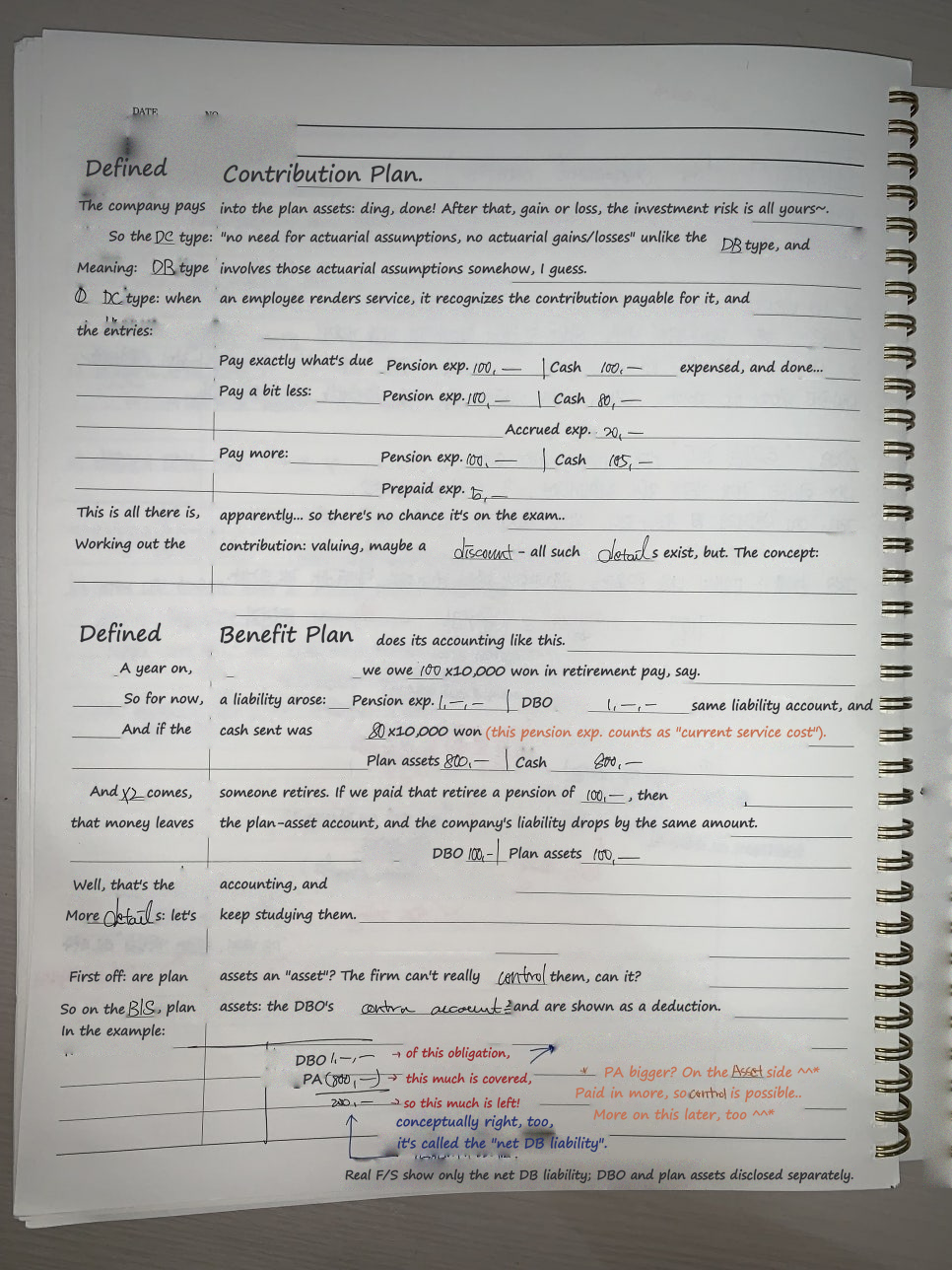
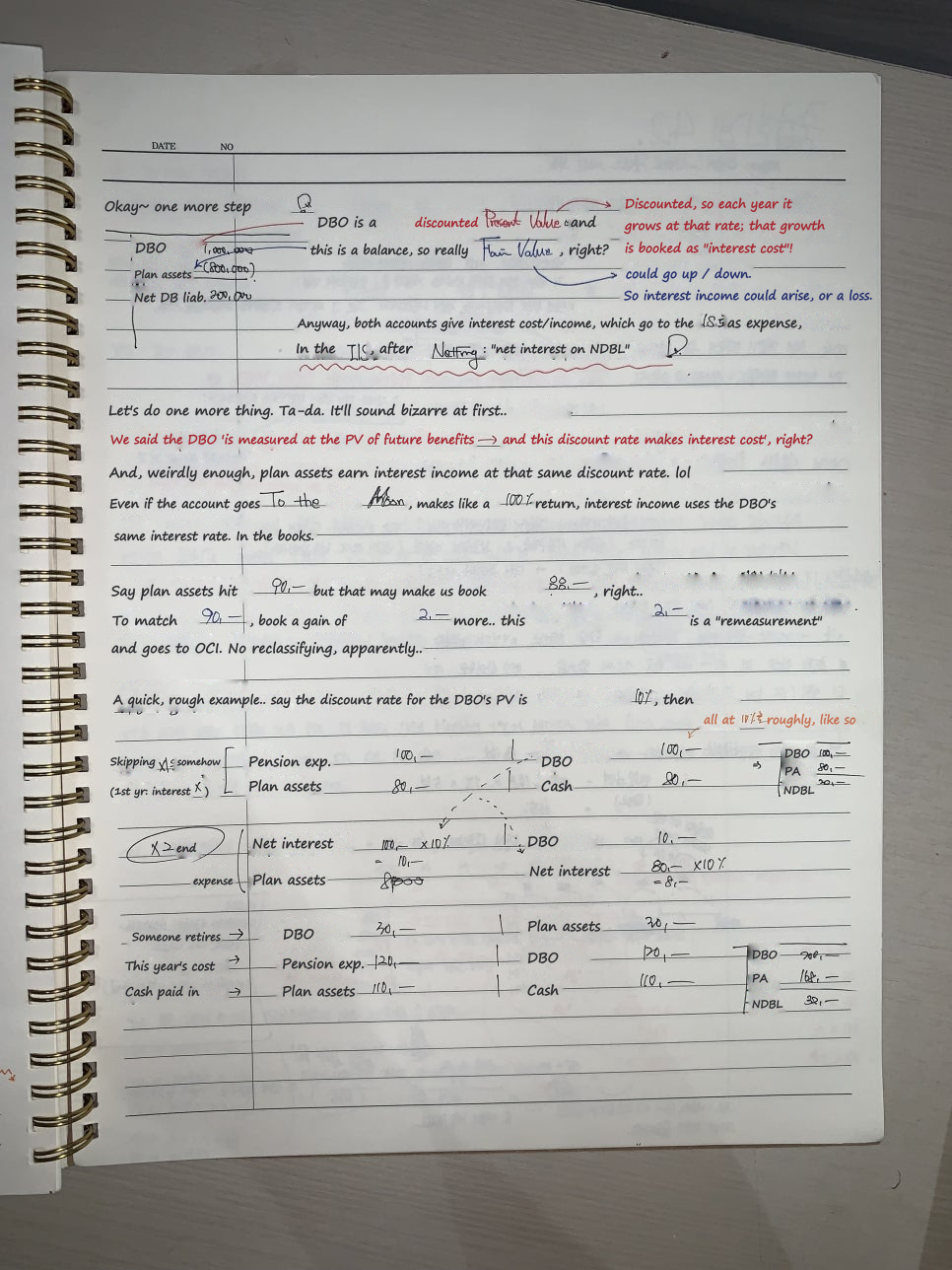
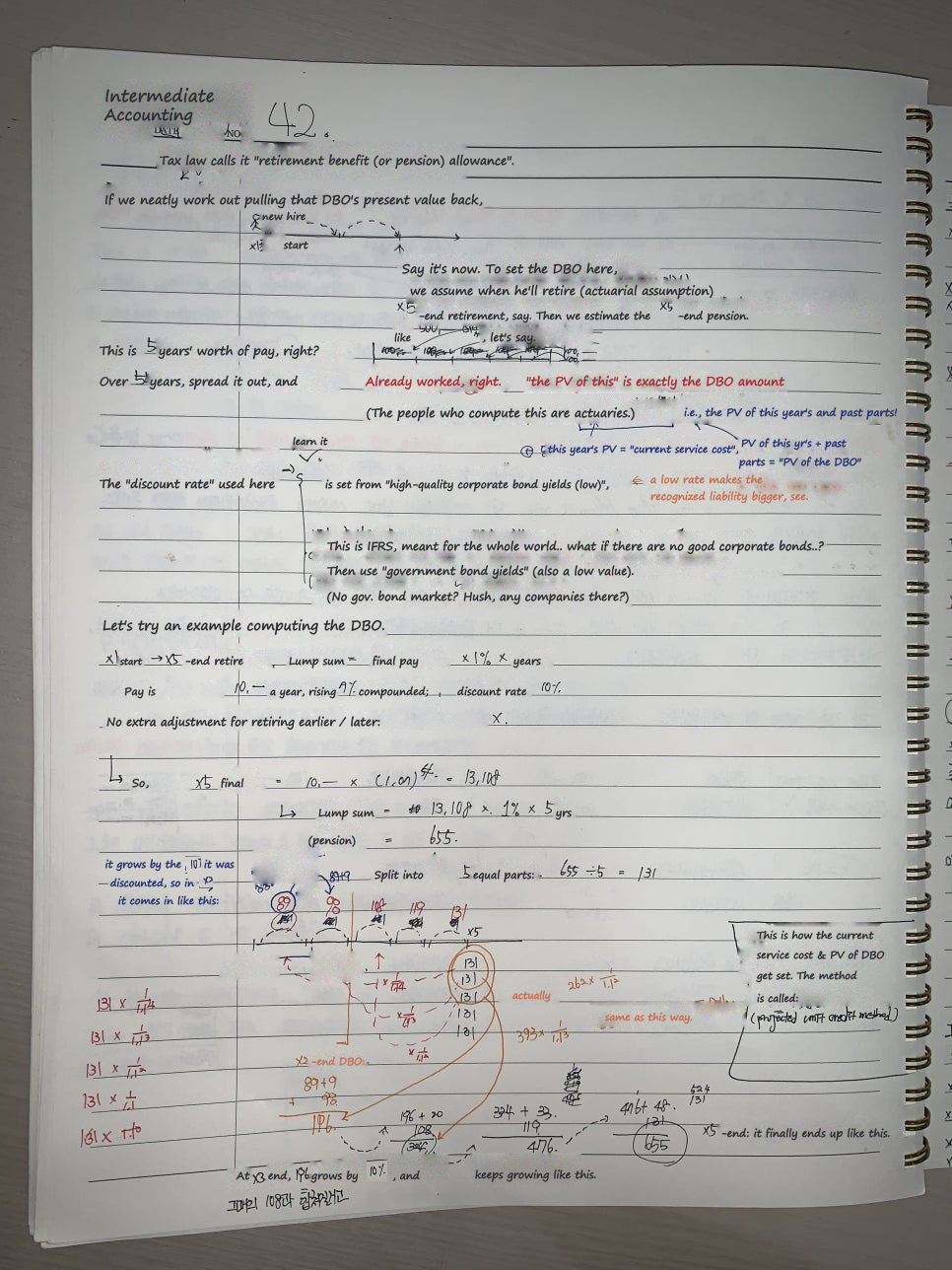
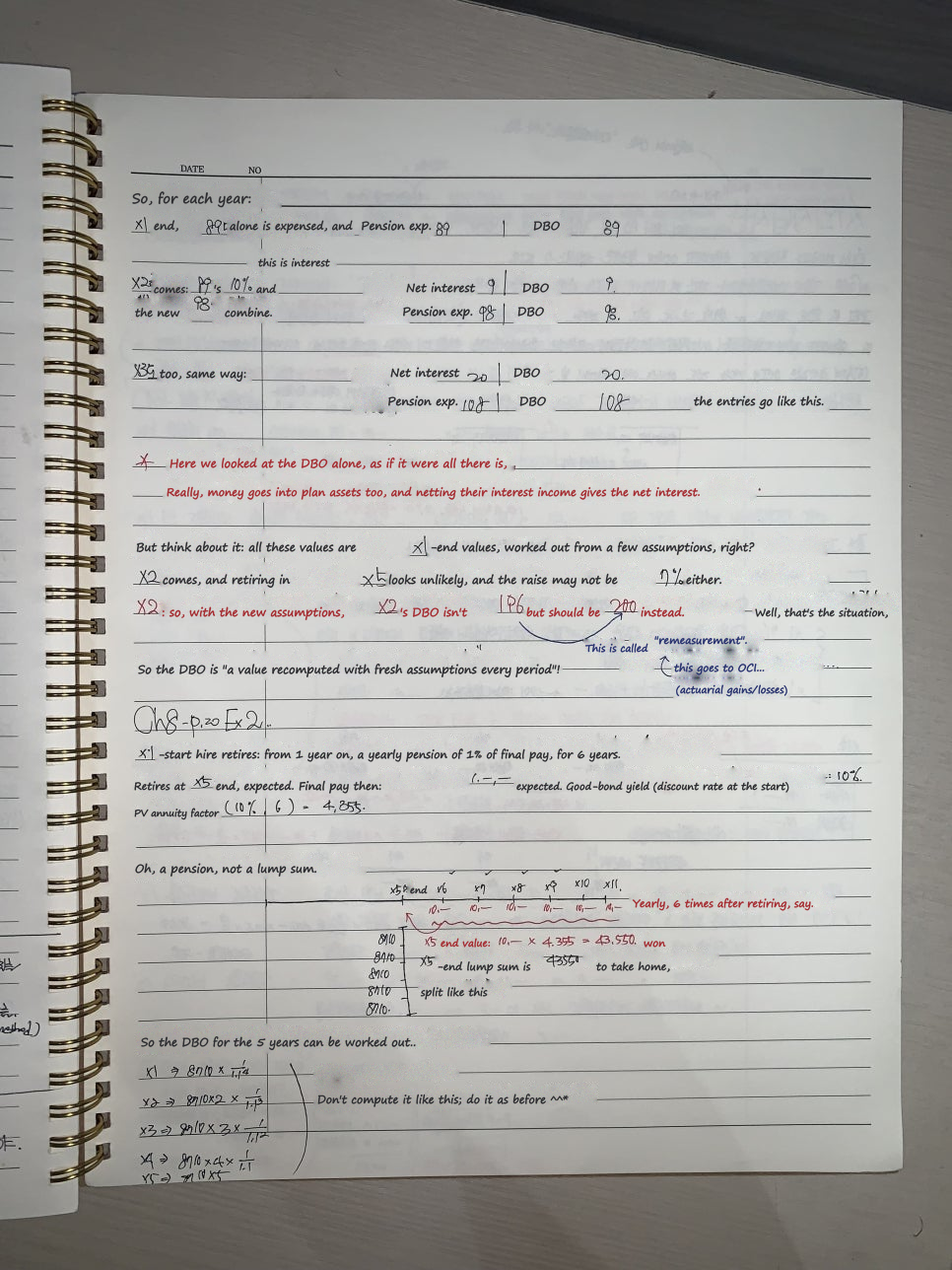
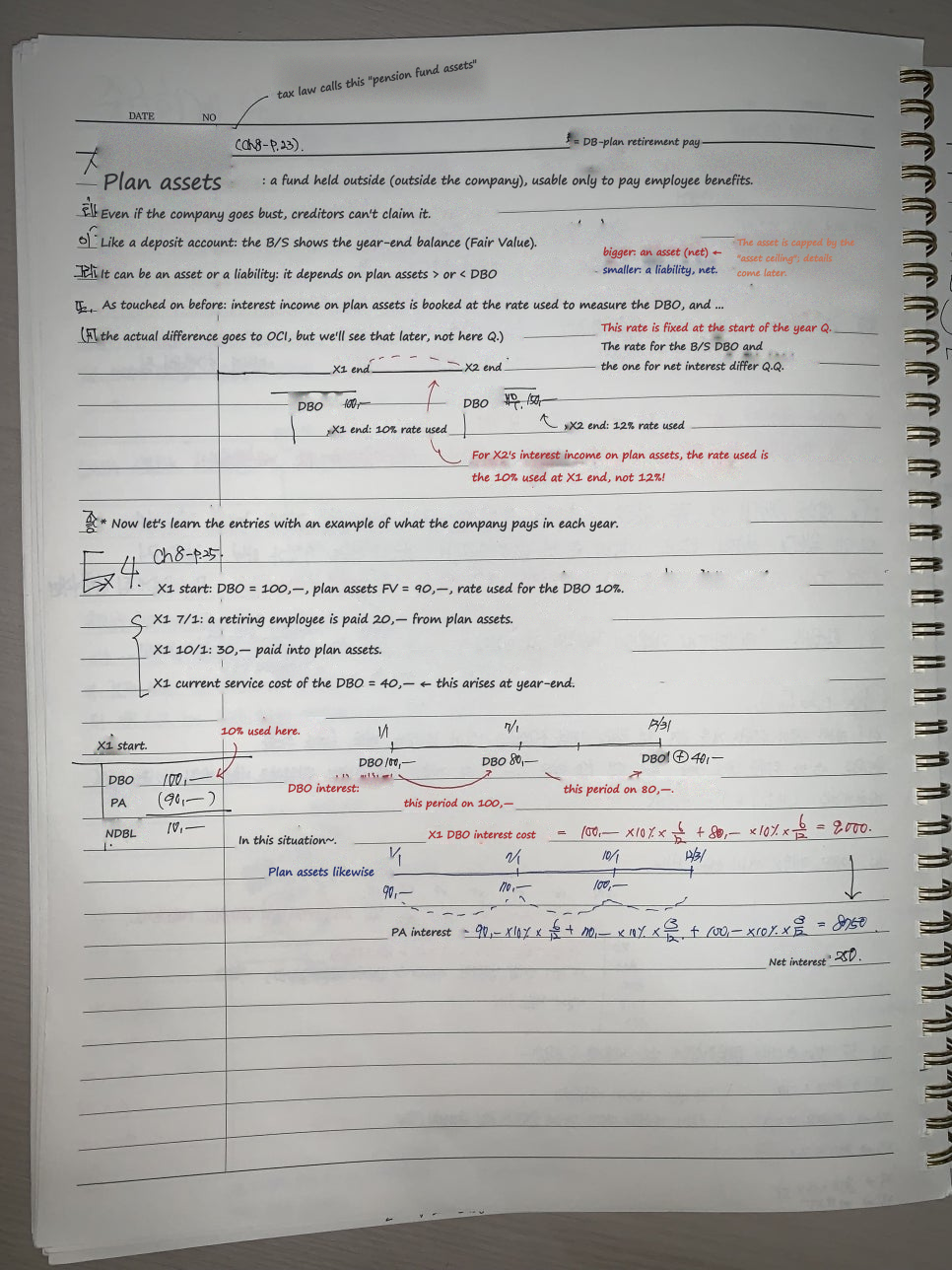
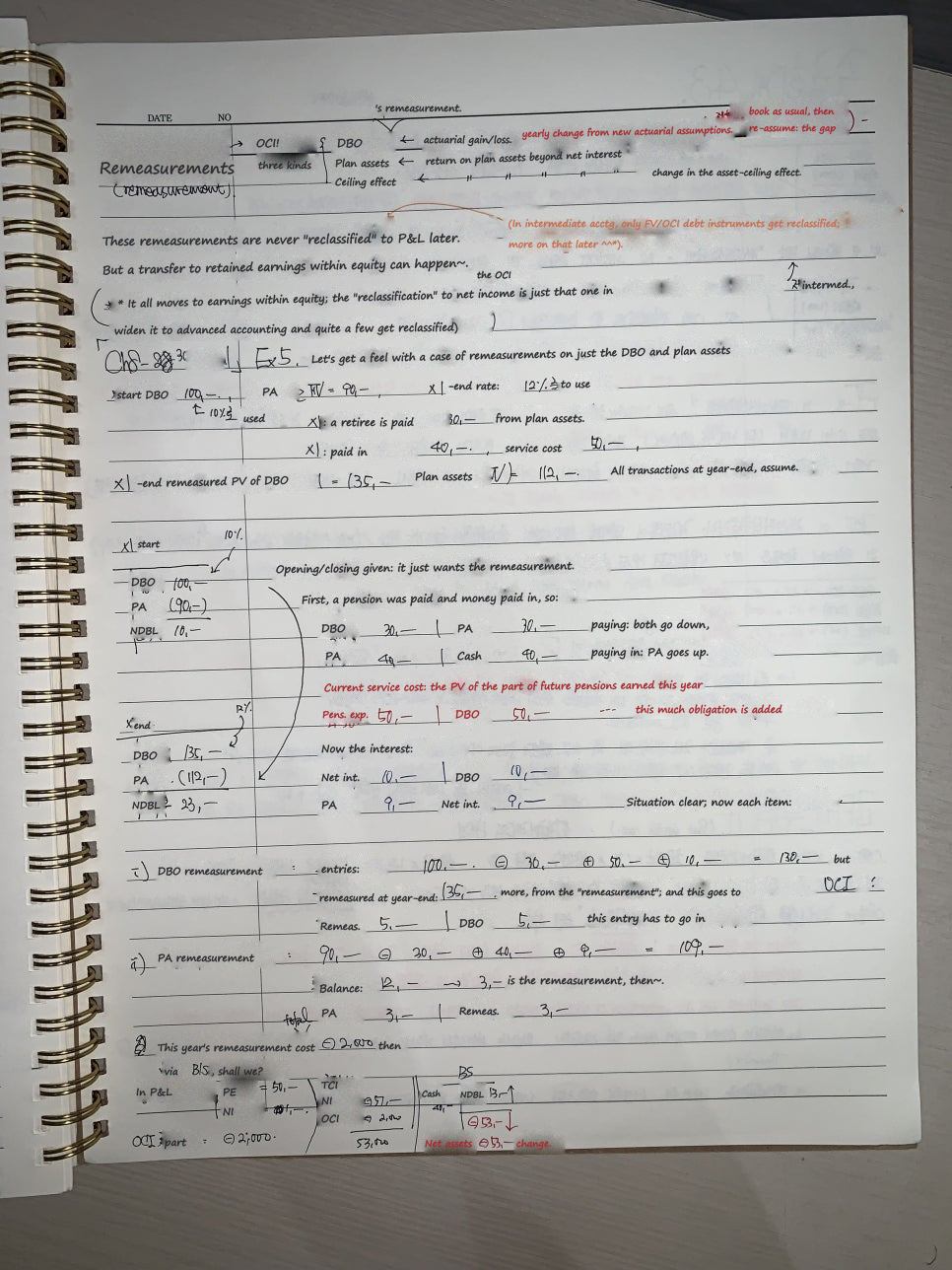
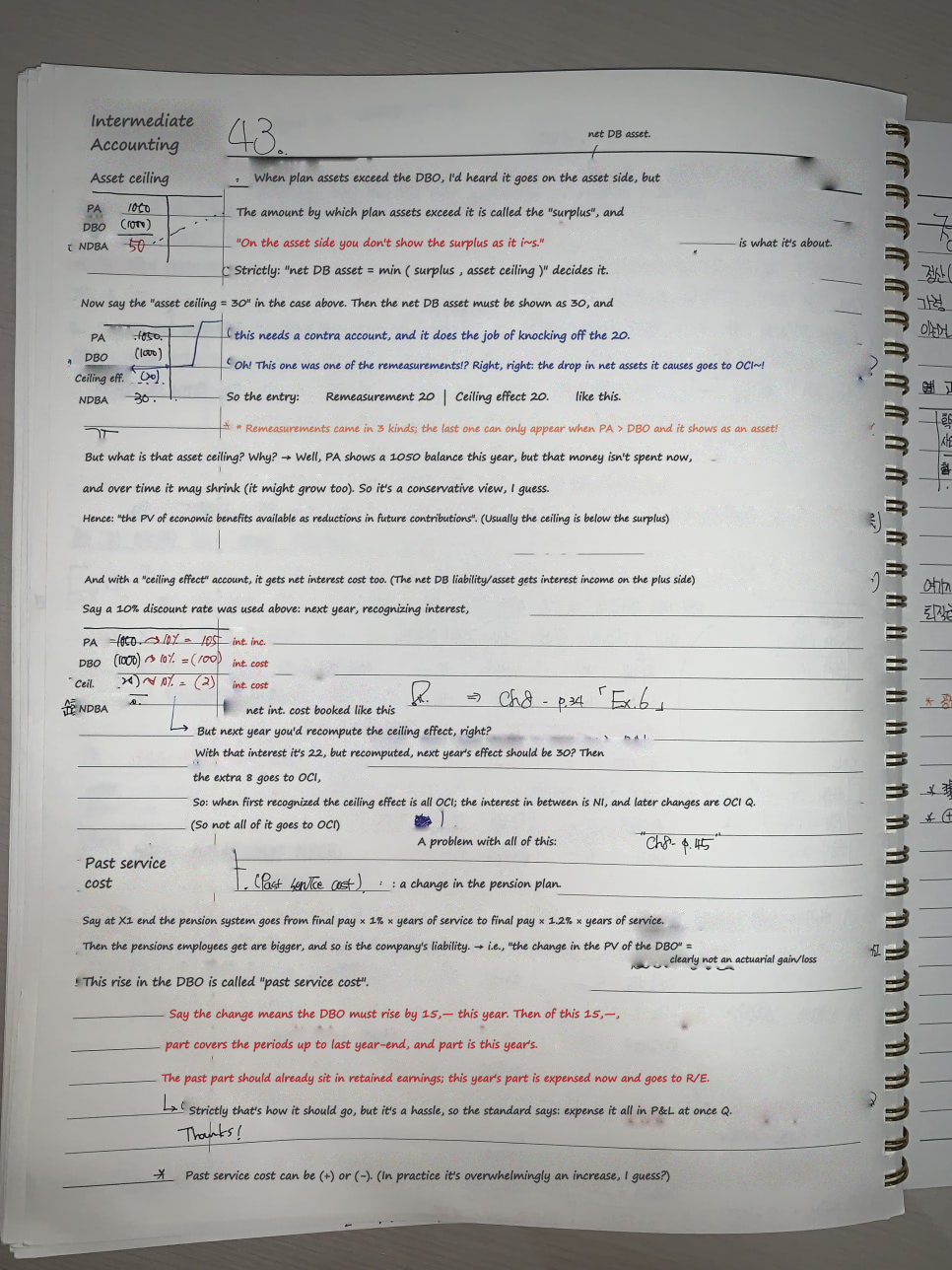
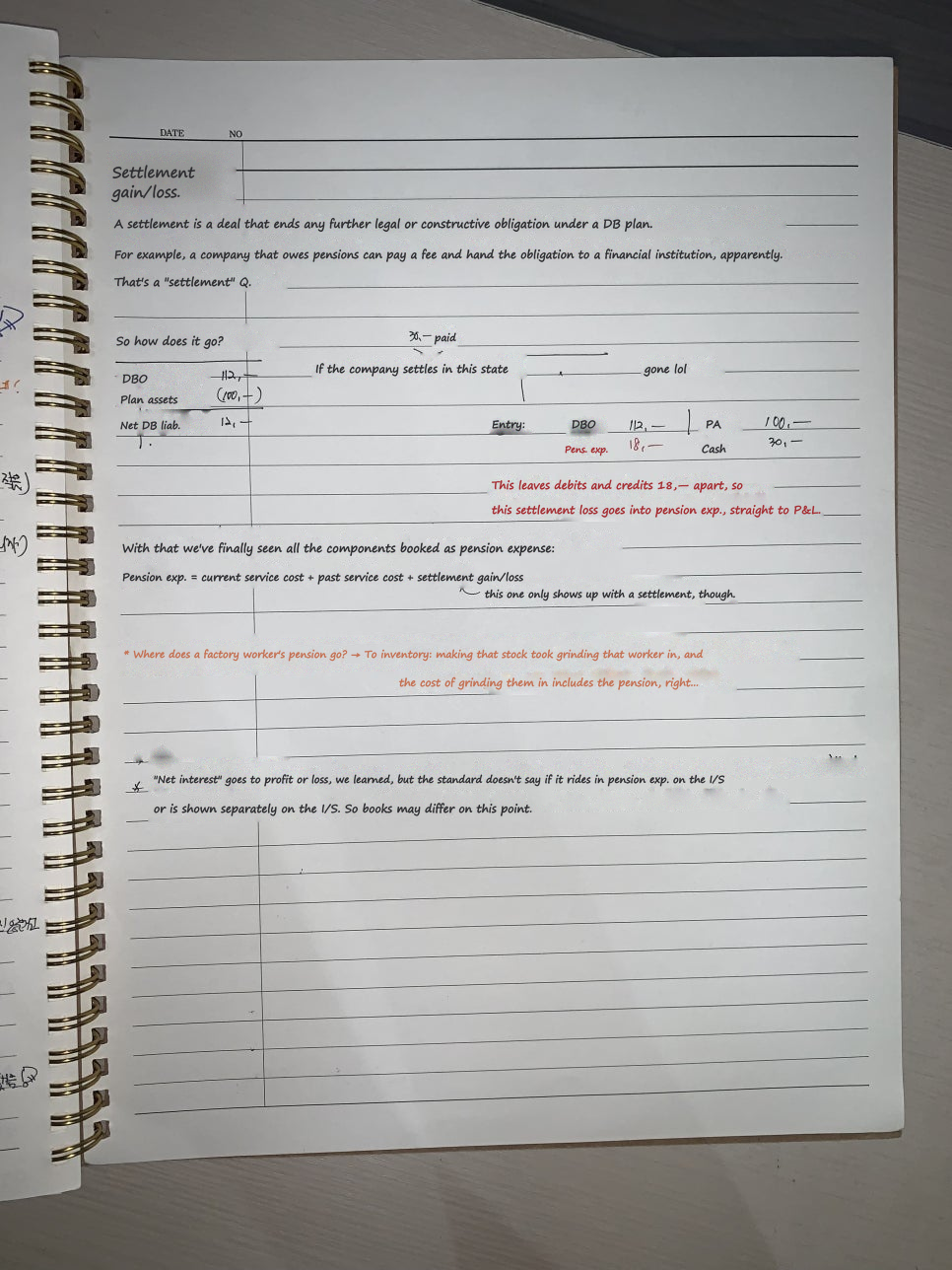
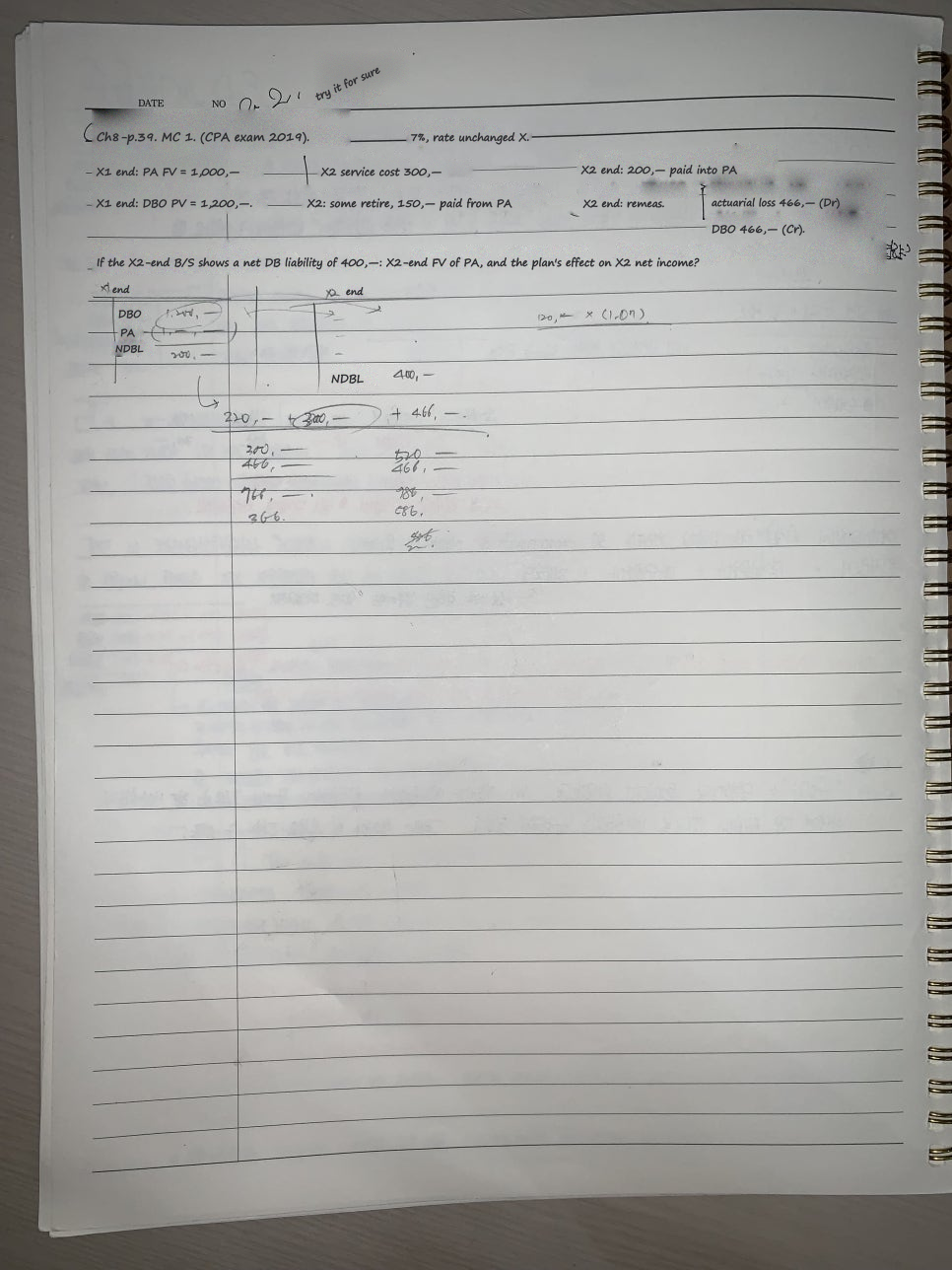
Exciting, right?!?!?!?! lol
Heh heh — see you again next week! heh heh heh
Heads-up. The figures here are the original notes, slips and all. A few things to watch for:
- In the orange notes of the DBO example, two discount exponents are swapped: $262 \times \frac{1}{1.1^3} \approx 196.8$ and $393 \times \frac{1}{1.1^2} \approx 324.8$; the totals in the notes are right.
- In the CPA 2019 exercise the rate is 7%, so the opening net DB liability of 200 earns net interest of 14 (the working rolls it to 220, as if at 10%). At 7%, the DBO at the end of X2 is $1{,}200 + 84 + 300 - 150 + 466 = 1{,}900$, the plan assets are $1{,}900 - 400 = 1{,}500$, and the plan lowers X2 net income by $300 + 14 = 314$ (the 466 remeasurement goes to OCI).
- In notebook page 6 (Ex. 5), the given current service cost is 40, not the 50 used in the working. Before remeasurement, DBO is 100 + 10 − 30 + 40 = 120, so reaching 135 gives an actuarial loss of 15; plan assets give a remeasurement gain of 3. Thus pension expense in P&L is 40 + 1 = 41 and the net OCI loss is 15 − 3 = 12. Total cost is still 53.
- The ‘not an asset’ wording in the introductory sketches means plan assets cannot be freely used for ordinary business spending; it does not negate their role in measuring the net pension asset/liability. The 80% funding comment is a historical Korean-plan note, not a universal or current funding requirement. The asset ceiling includes available refunds as well as reductions in future contributions.
Comments
Discussion happens via GitHub Discussions. You'll need a GitHub account to comment.