Financial Ratios (2): Financial Analysis Techniques
Part 2 of financial ratios — breaking down liquidity ratios like the Current, Quick, Cash, and Defensive Interval ratios with actual intuition, not just exam memorization.
Continuing from the last post, I’m going to introduce a few more financial ratios!
Like I said last time — for exam purposes, the priority is memorizing them accurately and calculating without slipping up. Buuut studying only like that is no fun, so I’ll mix in some of the practical stuff that came up in class~ Let’s get it!!!
Liquidity Ratio: Current Ratio / Quick Ratio / Cash Ratio / Defensive Ratio
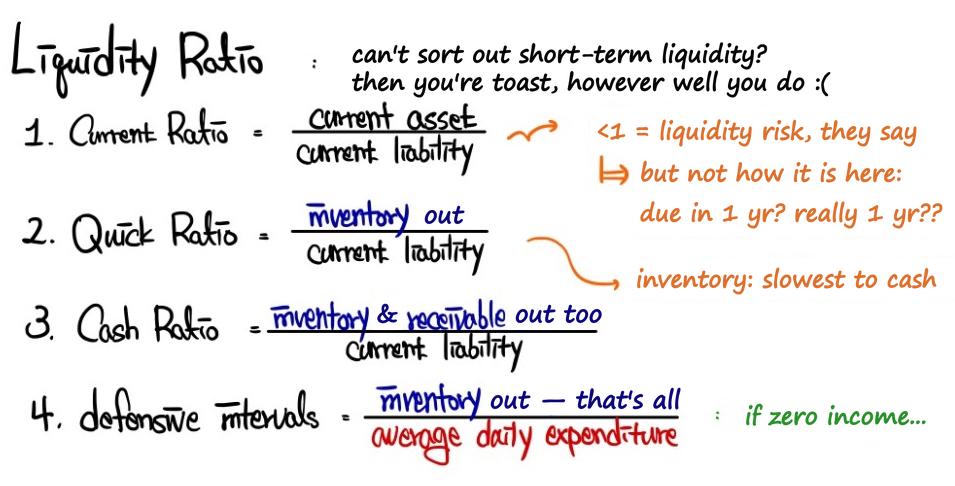
1. The Current Ratio simply compares the assets that can be turned into cash within one year (cash and cash equivalents, quick assets, accounts receivable, inventory, that kind of stuff) with current liabilities, the obligations you have to settle within one year, and looks at the ratio.
(It doesn’t strictly have to be within one year! Trade receivables expected to be collected in the normal operating cycle are current even when that cycle exceeds a year. But not every receivable is automatically current — outside that cycle, the timing matters. That’s the idea: assets and obligations in the near-term operating cycle.)
2. Quick Ratio. In Korean it’s named after quick assets, and ah…. quick assets are basically current assets minus inventory. (The CFA textbook is a bit stricter and counts only cash, short-term marketable investments and receivables, so prepaid expenses and the like are out too.)
But hey — in Korean, that same word for “quick” also shows up in the name of a checking account, so some of you might’ve thought of checking deposits. That kind of thing gets talked about under “cash and cash equivalents,” and I’ll go into it in more detail when we get there!
Anyway, the Quick Ratio is the perspective of: take Current Assets, kick out inventory (the slowest thing to convert to cash), and then look at the ratio against current liabilities. So it’s a way more, way more, way more, way more conservative version of the Current Ratio. heh heh heh
3. Cash Ratio: here, anything less than cash is junk. The Quick Ratio only kicked out inventory, but the Cash Ratio also kicks out Accounts Receivable, leaving just cash and short-term marketable investments. So this one’s a much more conservative way to evaluate the company’s liquidity. heh heh heh heh
Last one — 4. Defensive Interval. What’s this one?
So actually, with accounts receivable, it’s not like you’re totally helpless until the counterparty company pays up. If you really, really urgently need cash, you can discount that AR and sell it off to a bank. The bank evaluates the counterparty company, sets an appropriate discount rate, and takes that AR off your hands. And then the bank just has to collect from that client, right??????
Anyway, the Defensive Interval Ratio uses cash + short-term marketable investments + receivables, the quick assets from before, divided by average daily cash expenditure. You put in what this company spends on an average day, and the ratio asks: “If they couldn’t earn a single cent (and had to fend off default with those current assets), how many days could the company hold out (on the cash-convertible stuff it has piled up)?” heh heh heh
What else can we look at skeptically here….?
It’s this: is what the financial statements label “convertible to cash within 1 year / obligations to be fulfilled within 1 year” really truly bound to happen within 1 year?
Example. Say GD Corporation borrowed 1 billion won from a bank. It took the loan on a 10-year maturity, somehow 9 of those years have flown by, and 300 million won is left. Then maturity day arrives. GD Corporation couldn’t pull together the 300 million won……………… So does the bank just declare them bankrupt on the spot and let the company go under??????
From the bank’s point of view — never mind the principal — a company that looks like it can keep paying the interest is worth lending to again,…… so they may agree to refinance……. But that’s a new credit decision, not a guarantee; interest coverage alone doesn’t settle it.
And on top of that, lol: apparently more than half of Korean listed companies have a Current Ratio below 1, lololol. What can you even do, lol.
Wait, is it seriously more than half?? lol
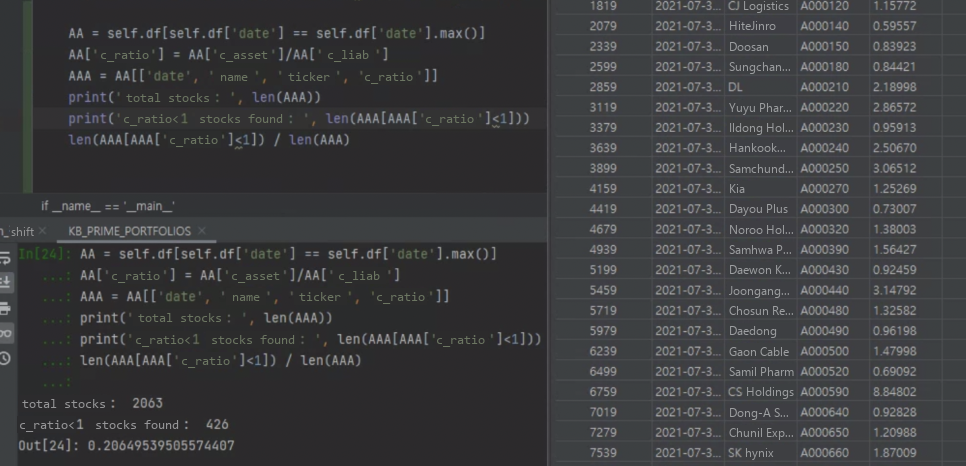
Running it on the full quarterly financial statement data, the companies with a current ratio below 1 come out at about 20% of Korea’s roughly 2,000 listed companies (426 of 2,063) heh heh heh
Anyway……. the gap between theory and practice…… yeah, it’s there………..heh heh heh
Solvency
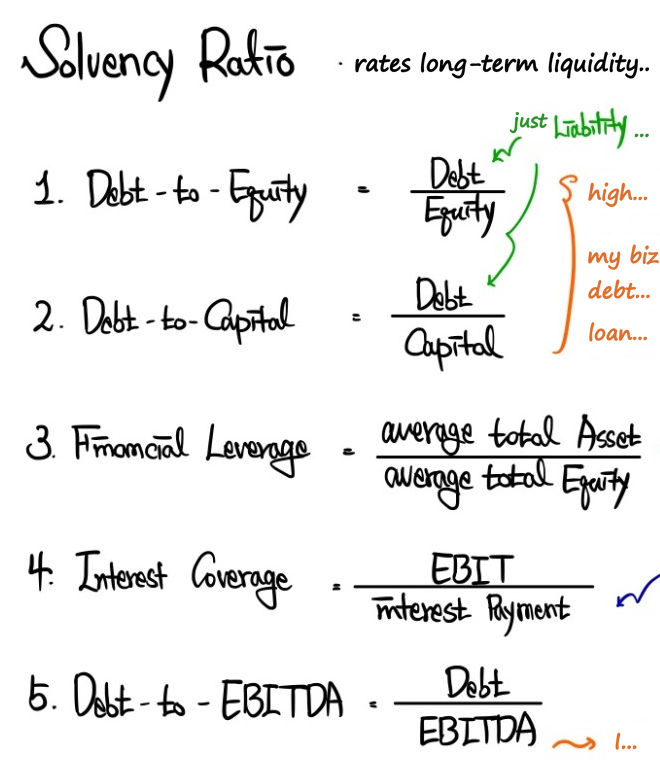
If you crack open a dictionary, “solvency” comes up as something like “ability to pay” — and you can think of it as the name for evaluating long-term liquidity :-) What we’re going to look at: Debt-to-Equity / Debt-to-Capital / Financial Leverage / Interest Coverage / Debt-to-EBITDA.
Let’s start with the first two. I get what Equity is, but what exactly do Debt and Capital point to… I used to wonder whether Debt and Liability were just synonyms, but apparently they’re terms with a slight difference in meaning, like this.
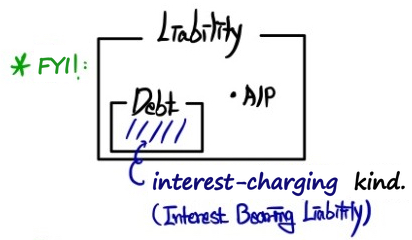
And I used to wonder if Capital was a synonym for Asset. The values only match when every liability is debt (in Debt-to-Capital, capital = debt + equity), but apparently there’s also a subtle difference in the term, depending on which side you’re speaking from.
But it’s kind of ambiguous. Going by the explanation in Differences between debt and liabilities, they do say the difference between Debt and Liability is Interest.
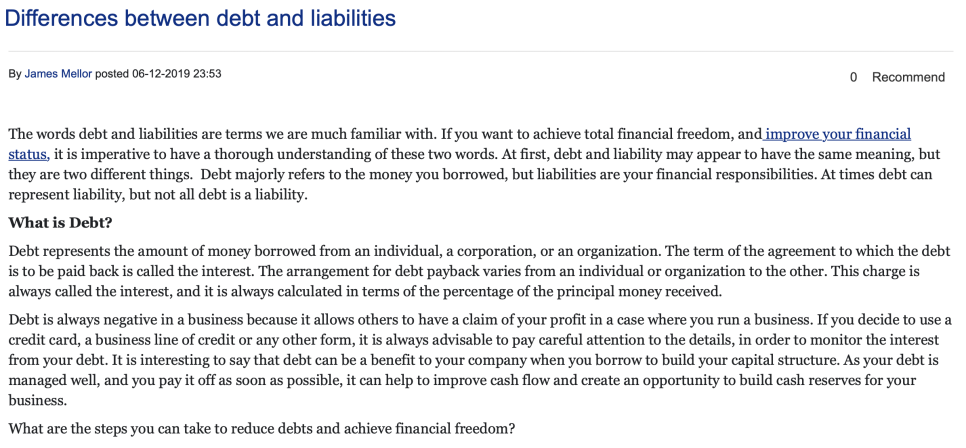

But if you look at the page where Investopedia introduces the formula for Debt-to-Equity,
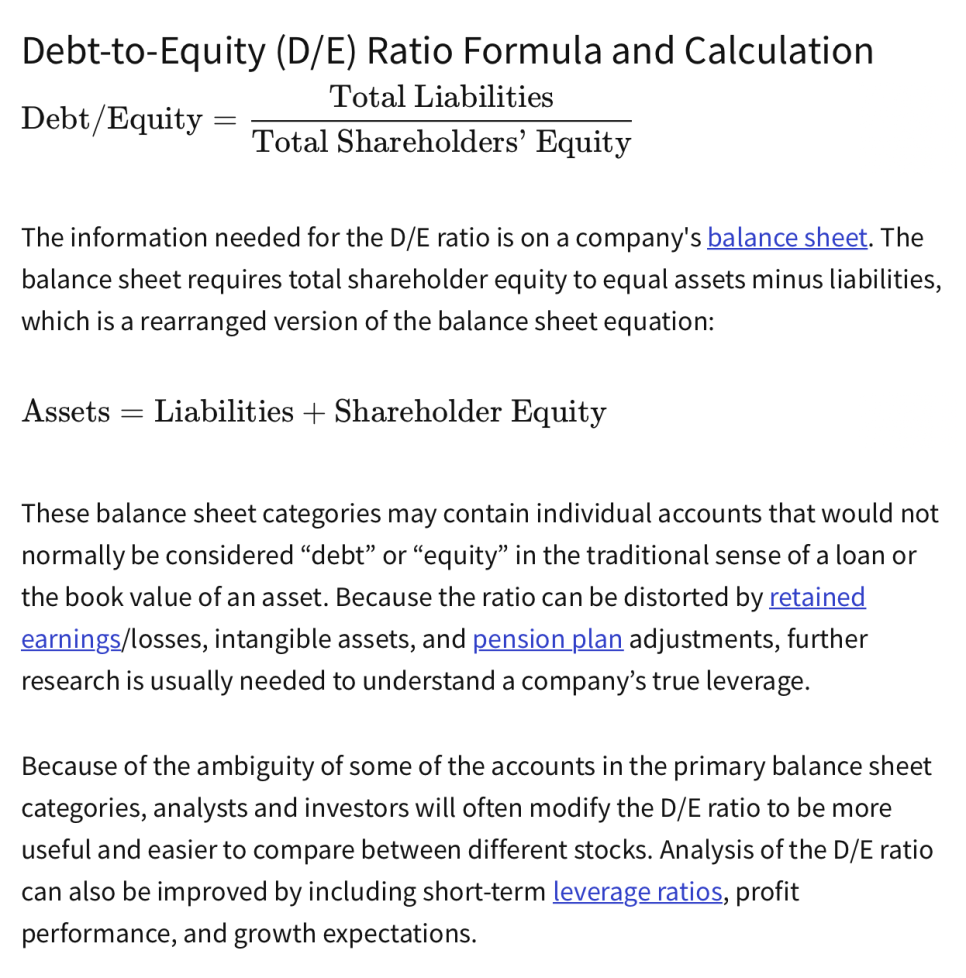
it’s this, and then it goes: it’s ambiguous~ (the true leverage gets distorted by other liability items (Liability, not Debt)), so other values can be used~ That’s roughly how it puts it….
The thing is, these financial ratios aren’t pinned down to one exact value by some standard!!! They’re used at the analyst’s discretion, so I think that’s where this problem comes from. Anyway, let’s just say we’re learning the feel of financial ratios……! heh heh heh
And now — Capital.
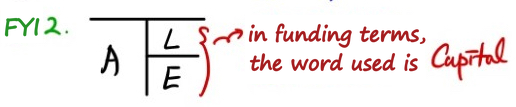
Assets, which we call the company’s rights, are on the left, and the side that explains those assets is the credit side on the right — Liability and Equity, i.e. to creditors / to shareholders — and apparently, when you talk from that side, as the money raised, you call it Capital. heh heh
OK, let me just say one thing and move on.
Imagine we’re not solving exam problems — we’ve got financial statements laid out and we’re checking whether some company is any good.
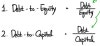
To check the long-term liquidity angle, we want to calculate this value, and say we plug in Liability (total liabilities) instead of Debt and crunch it out.
Would that be a completely wrong number that leads to some absurdly idiotic analysis result?????
It’s a valid different measure — but the difference matters! State which numerator you’re using, and compare companies on the same basis.
The point is, define the ratio consistently, then interpret it in context……
(Of course, for exam-takers who have to get the right answer, whether it’s Debt-to-Equity or Liability-to-Equity is very, very important ^^)
So say there’s some company whose debt ratio (in Korea that’s total liabilities / total equity) came out really, really high.
Is that company a total dud??????
Picture this — you’re raising money to build your own business. If it’s a business where success is practically guaranteed, would you take on debt (Debt) or go find a partner (Equity)??? Of course you’d borrow the money. A partner has to share in the profits too, right? With debt, you just pay the interest, and all the rest of the money is mine!!!! That’s how it goes.
So in the end, what applies to this one too is: “It’s hard to judge anything off this one number alone;;” — that’s the takeaway.
In Korea, a debt ratio over 200% was apparently even one of the tests that could get a listed company’s auditor designated by the regulators. Investors also call a company dangerous once it’s over 200%…. But apparently quite a few scholars ask where on earth that baseless number 200 came from.
(For the record, Apple’s debt ratio is way past 200%. If you guys were listed in Korea, the regulators would have their eye on you lol)
Ooh, I gotta check this one, lol. Just like Korea has the DART electronic disclosure system, the US has a site called EDGAR, and I pulled up the most recent AAPL financial statements there.
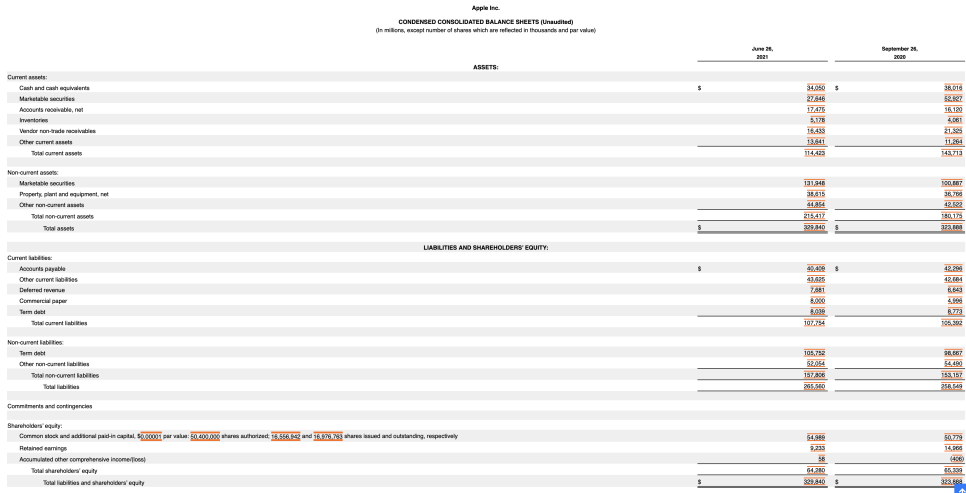
Debt ratio: 413.13%, LOL.
Airlines especially: by the nature of the industry their debt ratios run sky-high, and 400% and up is nothing unusual (can’t just skip that one: I pulled up Korean Air’s financial statements on DART. At the end of 2020, total liabilities were 21,878,337 million won against total equity of 3,311,724 million won.
So the debt ratio comes out to about 660.63%.)
During the Asiana Airlines controversy, people went “the debt ratio was too high~ oh dear~ it was a dangerous company from the start~.” That made me curious about how its accounts compared with Korean Air. But I would need the actual accounting policies and comparable statements before calling either airline more conservative.
A ratio can start the question, heh — it doesn’t settle the credit assessment for us.
Anyway… a high debt ratio alone can’t explain the Asiana situation. Even comparing it with Korean Air requires the same date, accounting basis and other risk measures — one airline’s survival doesn’t establish another’s safety.
In other words — shouldn’t you factor in industry characteristics too~? That was the point. heh heh heh

Number 3 — in Corporate Finance there’s a session where you learn Operating Leverage and Financial Leverage together, and you have to learn these two together for it to really click!!! heh heh heh So let’s deal with it then. And rather than just rattling off the formula like that, learning the logic in Corporate Finance helps more, so #3 is skipped.
4 is ‘Interest Coverage’ — and this one’s really up for debate. First — EBIT means earnings before interest and taxes. In the simplified I/S here it matches operating profit, but they needn’t be identical when non-operating items are present; check the definition your data vendor uses.
What’s debatable about interest payment (interest expense) — it’s “capitalized borrowing costs." When we did P.P.E. in our CFA course, we said that interest incurred while acquiring “construction in progress (CIP)” goes toward adding to that PPE and doesn’t show up as interest expense on the I/S. (Not all CIP works that way — only for assets that count as qualifying assets does the interest incurred get capitalized, following set rules.)
So even if our company actually paid 50,000 won of interest this fiscal year, the I/S might show only 30,000 won, with the other 20,000 won added to CIP under Assets……. So when you look at the interest coverage ratio, you’ve gotta check carefully whether there’s CIP on the financial statements!!! This came up earlier, too — heh heh heh
(One thing I picked up somewhere — apparently the interest coverage ratio is the main thing banks look at when deciding whether to lend you money :-))

With that EBIT definition in mind — what’s EBITDA?
EBITDA is EBIT plus D and A. D is Depreciation and A is Amortization, so you add back depreciation and amortization. To really feel EBITDA, you need to learn the indirect and direct methods of the cash flow statement at the very end, and I’ll talk about it again then — but let me give you a quick version here.
On the way down to EBIT (operating profit), cost of sales goes out as expense~, depreciation goes out~, SG&A goes out~, all sorts of expenses go out, bam! And what’s left in EBIT is Interest, the creditors’ share / Tax, the government’s share / and the rest, the shareholders’ share, right?!
But among those expenses, depreciation isn’t money that actually left as cash this fiscal year…… There’s machinery bought 10 years ago for 1 million won, and straight-line accounting means 10,000 won of it goes out as this year’s expense, and intangible assets bought 5 years ago… things like that, which didn’t actually go out this year but got called this year’s expense to follow the matching principle. So you add back the D and A you deducted -> and you get a rough earnings-based proxy for operating cash-generating capacity. It isn’t CFO: working-capital changes, cash taxes and interest still matter.
Credit analysts often look at Debt-to-EBITDA. The lecture’s ‘over 3x and they smack you’ is a rule-of-thumb joke, not a universal rating cutoff……heh heh heh
Anyway, you get the concept of what we’re looking at now, right?! The idea is debt divided by EBITDA, an earnings-based leverage measure — not cash actually collected this year — and if you can’t even earn 1/3 of your debt, they go, “Hey, are you guys maybe hopeless?” …… heh heh heh
Profitability Ratios
So far we’ve looked at turnover ratios / short-term liquidity / long-term liquidity ratios, I think, and now the last one, the crown jewel of financial ratios! Let’s look at the profitability ratios!!!!! heh heh heh
(Crown jewel, my foot… that’s just a name I made up…..heh heh)
For the profitability ratios, we’re going to look at ratios called XXX Margin. These are simple.

That’s why it isn’t hard. So if I list the various ratios, here they are:
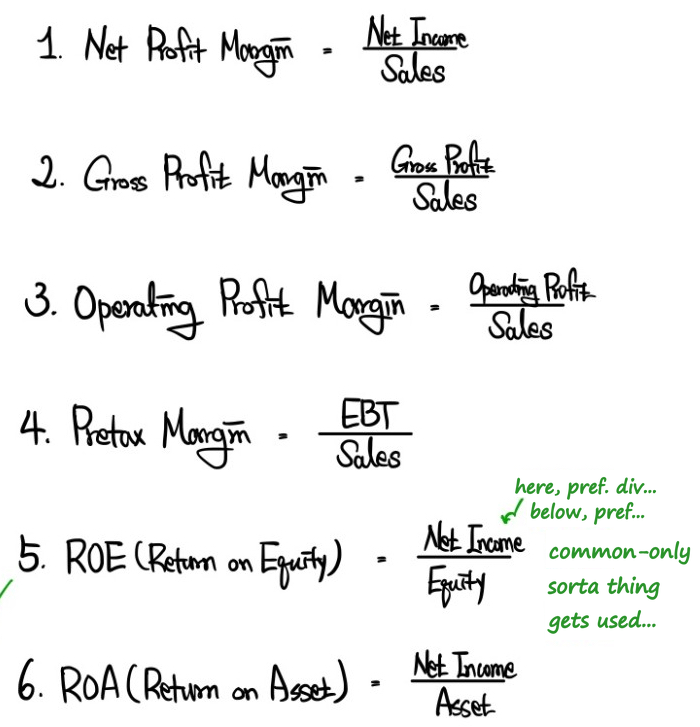
Setting ROE and ROA aside for a sec, through #4, these are all things you can settle on the I/S.
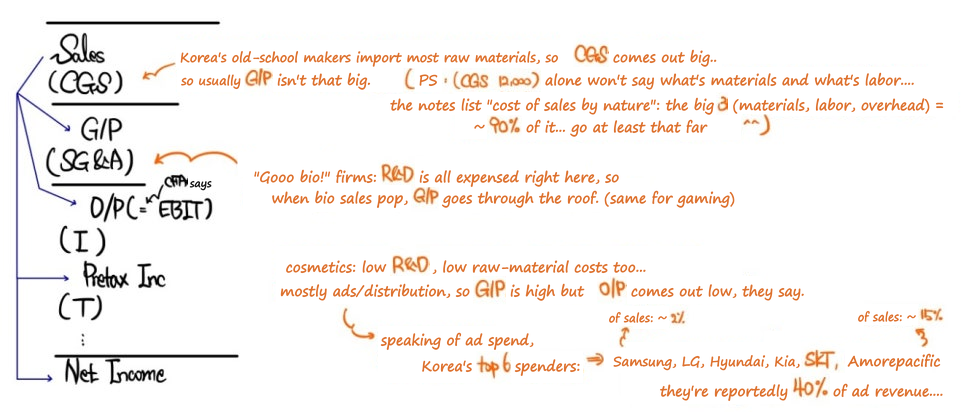
Let me type out the orange writing here a bit.
CGS: For Korea’s traditional manufacturers, raw materials are often imported, so CGS gets booked big, so these manufacturers usually don’t book a particularly large Gross Profit. (Note: if CGS is written as (12,000), it doesn’t show how much of it went to raw materials, how much to labor, and how much to other incidental costs. You have to go to the notes and look at “classification of cost of sales by nature,” where the 3 cost components (raw materials, labor, overhead) explain almost 90%… you’ve gotta do at least that much analysis ^^~)
SG&A: For the “Let’s go! Bio!” companies, this is where R&D costs all get deducted, so if a “let’s go bio” company’s sales explode, G/P in particular explodes big (same for the gaming industry). That is, if you just line up Korean companies by G/P, highest first, with no classification at all, the ones you catch are likely bio or gaming companies whose sales exploded…. it helps to know this kind of thing^^ since you’ll be able to answer “why is your G/P so high?!”
One more — cosmetics companies don’t do big R&D and don’t spend much on raw materials either, but usually advertising and distribution costs make up most of their expenses, so apparently G/P comes out high and O/P (Operating Profit) comes out low.
(Since advertising came up, a quick look at this too: apparently Korea’s top 6 in advertising spend are pretty much fixed. Samsung Electronics, LG Electronics, Hyundai Motor, Kia Motors, SKT, Amorepacific. Apparently these companies account for nearly 40% of the revenue of Korea’s advertising market. See which ads run right before the 9 o’clock news…. And Samsung Electronics apparently keeps its advertising spend at about 2% of sales, like clockwork. They must be hitting it on purpose. And Amorepacific, apparently, is a rising force that only recently joined the top advertising-spend ranks.)
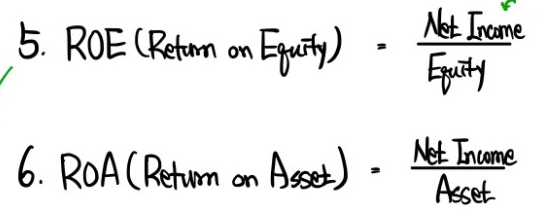
Rambling a bit about ROE and ROA: the concept itself is crystal clear, nothing hard about it. “You’re earning net income: how much net income is that relative to your total assets? Or how much are you earning relative to your own money (equity)?” That’s it.
And for ROE, there’s also one that takes out of the numerator and denominator… the part that goes to preferred stock. Meaning, take what goes to preferred shareholders out of net income, and take the preferred stock part out of equity too, and ask: what’s the ROE that falls to common shareholders only?! There’s that kind of ROE too.
But for ROE, more than that kind of stuff, you need to know this.

Why the simple sustainable-growth model gives retention ratio times ROE. Assume unchanged profitability, payout and leverage, no new external equity, and ROE measured on beginning equity for this example — it isn’t an identity for every year’s reported earnings growth! Here’s why:
Out of net income, the Payout Ratio portion goes out as dividends to shareholders, and the retention ratio portion gets reinvested, right? Say we slapped on 60% dividends and 40% retention, and this company’s ROE was 10%.
What will that reinvested 40% look like the next year?
If the company keeps the same ROE level, that 40% is gonna grow by 10% again, right????
40% × 10% = 0.4 × 0.1 = 0.04 = 4%
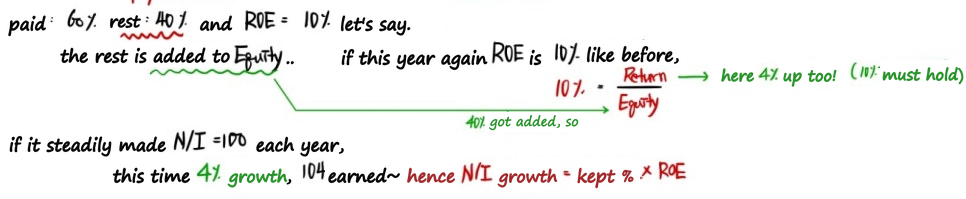
Yesss!!!!! Doesn’t that totally make sense?!?!?!?!? OK~
PS. Now — here’s something you really gotta watch out for.
You might pop open DART and EDGAR without thinking twice and look at the financial items, or of course you could look at the financial items shown on the old platform Finance or Daum Finance. But what they show you is the primary financial statements, and if a company prepares consolidated financial statements, its primary financial statements are the consolidated ones. And consolidated financial statements present the parent and controlled subsidiaries as one economic entity, eliminating intragroup balances and transactions — no legal merger is required……… I think you need to keep this in mind.
Merger, consolidation, equity method -> writing financial statements by lumping several companies into one like this is something you study in advanced accounting, and once you’ve started studying accounting, I think you really have to go at least as far as advanced accounting. More than half of CFA Level 2 accounting is made of advanced-accounting themes…….heh heh heh
Anyway, to look at financial items more closely…… you still need a bit more study :-) Let’s go!!!!!!!!!! All the way~~~~~~
Alright, with that, I’ll wrap up the second story of Financial Analysis Techniques!!!! Next up is a story about DuPont Analysis, and that one’s gonna be really fun too!?!?!?!?!? See you next week!!!!!!!
Heads-up. The figures here are the original notes, slips and all. A few things to watch for:
- In the CFA ratios, capital means total debt plus equity, so the debt-to-capital ratio is debt / (debt + equity); it equals total assets only when every liability is debt. And the curriculum counts the quick ratio’s numerator as cash + short-term marketable investments + receivables, which leaves out prepaid expenses that “current assets minus inventory” would keep.
- Use average equity and assets when matching period earnings to ROE/ROA. The growth example uses beginning equity: NI 100 on equity 1000, retain 40, next equity 1040 and NI 104 at unchanged 10% ROE; the general reported growth rate need not equal retention×ROE.
- The source’s operating-profit = EBIT and EBITDA = cash shortcuts are simplifications. EBITDA excludes neither working-capital investment nor every noncash item, and omits cash interest and income taxes.
- The marketing examples and airline commentary are recollections from the original lecture, not verified current rankings or credit assessments. In particular the top-six advertisers'40% share and Amorepacific 15% figure have not been substantiated here.
- The historical 200% auditor-designation remark is not a current blanket rule and did not mean that ratio alone automatically triggered designation; applicable dates and additional statutory tests matter.
Comments
Discussion happens via GitHub Discussions. You'll need a GitHub account to comment.