Financial Assets and Accounts Receivable
Back to the B/S! We dig into financial assets, break down non-derivative instruments, and learn why the classic maturity-date rule for debt vs. equity doesn't always hold up.
OK, enough talk about financial ratios and line-item analysis — let’s head back to the financial statements.
Quick recap: what account titles have we covered so far? Inventory, PP&E (tangible assets), investment property, intangible assets, bonds payable, lease receivables & assets, pension plan assets… right? Yeah, I think that’s roughly it heh heh heh. And honestly we kept it pretty shallow on all of those!!!! heh heh heh heh
Anyway, the plan is to go back to the B/S and look at the account titles we haven’t seen yet, one by one — but the depth is gonna stay light, so for exam purposes you should be totally fine heh heh heh
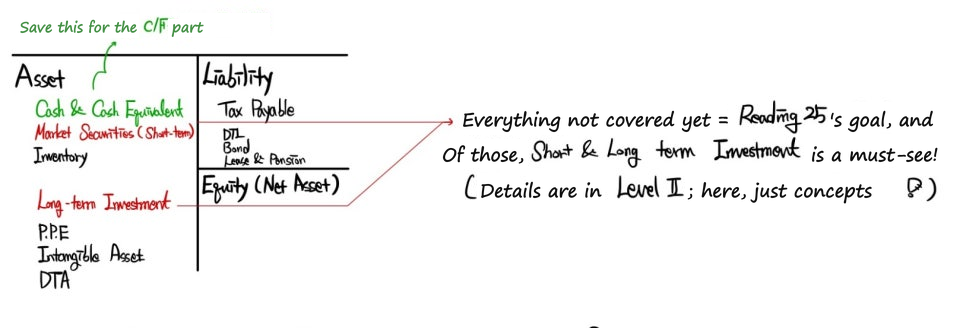
Looks like the idea is a quick tour of financial assets.
What is a financial instrument?
First off, financial instruments split into non-derivative and derivative instruments. Intermediate accounting only covers the non-derivative side (CFA Level 1 maps onto the intermediate accounting chunk), while advanced accounting is where the derivative stuff lives (CFA Level 2’s FRA maps onto advanced accounting :-))
OK, so within non-derivatives, you’ve got financial assets, recognized on the Asset side, and financial liabilities, recognized on the Liability side.
You know how this goes — when a company needs to raise cash, it can either issue corporate bonds to pull in debt capital, or issue shares to pull in equity capital. There’s clearly a side that issues, and a side that buys.
The side issuing the bonds is the side that borrowed money, so they recognize bonds payable as a Liability. (Under IFRS → it gets recognized as an AC financial liability or an FVPL financial liability.) The side issuing ordinary shares has raised equity funding, not borrowed money, so it sits on the credit side too, but it shows up under Equity, and the accounting treatment hits share capital and additional paid-in capital.
(Accounting-cycle aside: since this is a transaction with shareholders, it doesn’t get explained on the I/S side — it goes straight into the equity section. I’ll do a separate post on that one later.)
But!!! What we’re looking at right now is NOT the financial liabilities side. It’s the financial assets side!!!! Fin-assets!!! heh heh heh heh
Please forget fin-liabilities for juuuust a sec heh heh heh. Better for your mental health, trust me lol
(If I slammed financial assets and financial liabilities at you here at the same time, all in the name of my own studying lol…… you’d probably…… just quit…………)
OK, so first thing — we need to think about telling debt instruments (bonds) apart from equity instruments (stocks)…. If you’re coming at this academically, or as a beginner, the rule you probably learned first was: “If there’s a maturity date → Debt / If there’s no maturity date → Equity.”
Well heh heh heh heh — there are redeemable preferred shares that get classified as Debt despite having no maturity date, you know???? heh heh heh (I’ll explain right below.)
So what’s the right criterion for splitting Debt from Equity???
It might not be the textbook formulation, but I think a decent way to put it is:
“If you can’t dodge the obligation to pay → Debt / If you can → Equity.”
The redeemable preferred shares I just mentioned — depending on who holds the right to suddenly redeem them (the Issuer or the Investor), they can land in Debt OR in Equity heh heh heh

In English those rights get split into Call and Put…. In Korean both versions just go by the one name, “redeemable preferred shares,” so… (sigh) (This has actually shown up on past exams :-))
Anyway, now we know how to tell whether a financial asset is a debt instrument or an equity instrument.
Under US-GAAP
It works a bit differently for financial assets (debt) and financial assets (equity instruments), but for now let’s say there are 3 buckets: Held to Maturity / Trading Security / Available for Sale Security.
The classification is based on “Intent & Ability” — the company’s intent, plus whether it actually has the ability to follow through on that intent. And:
- If debt securities are bought principally for near-term sale → Trading Security.
- If there’s a positive intent and ability to hold debt securities to maturity → Held to Maturity.
- If neither fits → Available for Sale Security.
That’s how it goes, apparently.
If the financial asset is in Debt form (we call these investment bonds…),
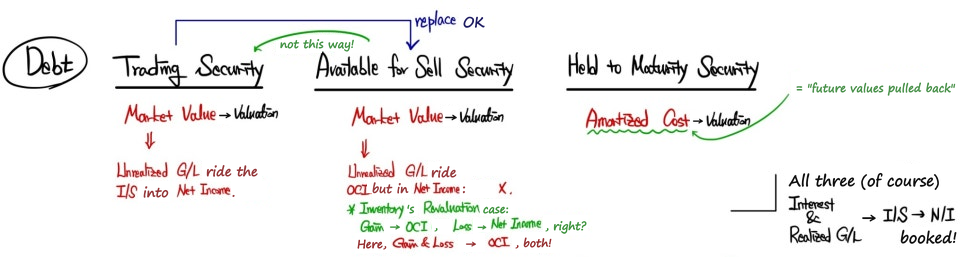
Debt instruments classified as Trading Securities get measured and presented at Market Value on the financial statements. Unrealized gains and losses also get explained on the I/S and flow through Net Income.
Debt instruments classified as Available for Sale Securities are also measured and presented at Market Value, but unrealized gains and losses get routed through OCI and don’t hit Retained Earnings.
(The vibe is: “this bond is valued high right now so the unrealized gain is big, but we might end up holding this thing to maturity, so we’re NOT pushing it into Retained Earnings!!! Just because the bond looks juicy on paper, please do not, I repeat do NOT, demand dividends in that amount, dear investors!!!!” — that’s the spirit of it.)
In what we’ve covered so far, when did we run something through OCI?
Right — under the Revaluation Model for PP&E, the Gain went through OCI, remember?! Normally a PP&E revaluation increase goes through OCI and a decrease through profit or loss — but a reversal of an earlier decrease/increase can go the other way. Whereas with investment bonds, BOTH the unrealized Gain AND the unrealized Loss go through OCI — that’s the difference!!!
Lastly, investment bonds classified as Held to Maturity Securities are measured and presented at Amortized Cost, so it ends up working the same way as when we did bonds payable earlier. That means you don’t remeasure it to each new market price: use the effective-interest amortised-cost schedule, with the required credit-loss allowance. (Because we’re literally just gonna hold it to maturity and that’s that!!!)
Everything above is about how the bond’s current market valuation gets reflected in the books. And since these are bonds, Interest comes in at scheduled times → interest income, and any Realized Gain & Loss from selling the thing midway → disposal gain/loss. These of course don’t need OCI or anything fancy — they just naturally land in Net Income (profit or loss for the period)!!!!!!
Now let’s also look at the case of investment shares.
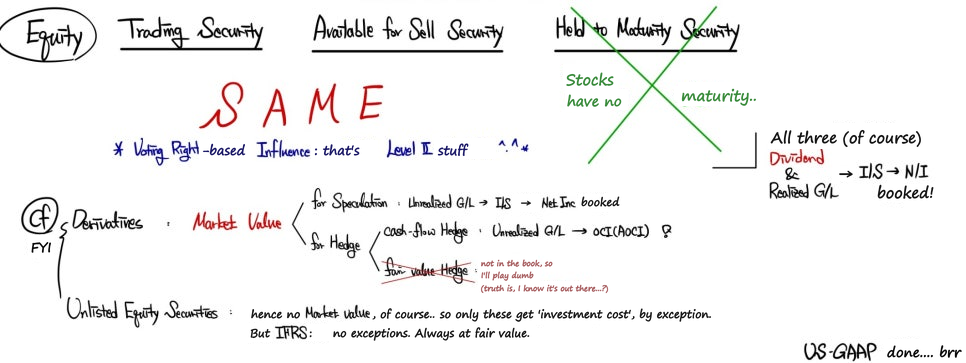
Obviously, with shares there’s no such thing as “Held to Maturity,” so there’s no way they end up in the Amortized Cost bucket, and for the rest of the cases it’s identical to the bond version. (That’s the classic US-GAAP setup, mind you: since 2018, US GAAP generally measures equity securities without control/significant influence at fair value through net income; a measurement alternative exists for eligible investments without a readily determinable fair value. The AFS bucket is for debt securities only.)
(About the Influence-via-Voting-Rights piece — what that’s getting at is: the investment shares we’re talking about right now are the case where you only bought a small chunk of shares. In contrast, if Company A holds more than 50% of Company B’s shares, A can basically control B outright (dominate it). And if A grabs around 30% instead of 50%, A doesn’t fully control B but B is going to be hyper-aware of A. We call this situation “A exercising significant influence over B.”)
(In the situation where A controls B, when A puts together its financial statements, instead of just treating B’s shares as the investment shares we just described, A has to prepare consolidated financial statements……… And if A is exercising significant influence over B, then when A records B’s shares, A has to apply “equity method” accounting — not just slotting them in as investment shares but measuring and presenting them as an investment in associates…. There’s that whole thing — but it lives in ‘advanced accounting’ territory. And since about 80% of CFA Level 2’s FRA is advanced accounting content, the message basically is: we’ll get to that at Level 2~ kind of thing heh heh heh heh)
Sigh… and that little reference blurb on derivatives down there………
If you enter into a derivative just because you went “Gold’s about to SOAR!!!!!!!!! Super Long@@@@@” and signed a gold futures or gold forward contract to profit off the move, THAT kind of derivative gets classified as a financial asset in this current section, gets marked to market every time and put on the financial statements.
BUT — if instead a company goes “Hmm… we’re gonna need gold as a raw material a year from now, so why does it feel like gold prices are about to moon over the next year? (sigh) Let’s lock in a forward to buy gold a year out and hedge that risk!!” and enters into a gold forward contract, then the accounting treatment in that case…… needs the logic of hedge accounting, which is advanced-accounting stuff, so…… we’re not doing it now~ that’s the deal here…heh.heh heh
(And whether that hedge is hedging value fluctuation or hedging the company’s cash flows…. the accounting treatment branches based on that too lol. Being an accountant is NOT a job for just anyone, I’m telling you lol)
Anyway! Let’s wrap up financial assets under US-GAAP and slide into the next thing!!!
Under IFRS
Now — how financial assets are accounted for under IFRS……………… is apparently content that wasn’t originally on Level 1 but got newly added…. heh heh. The detailed treatment lives in Level 2, and on Level 1 it’s basically: just know the high-level concepts? just the terminology??? roughly that level.
So, under IFRS, the first cut is made through this thing called the SPPI test (SPPI; Solely Payments of Principal & Interest).
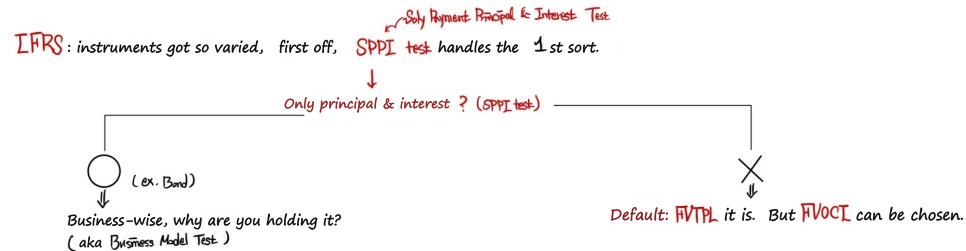
The point being: it’s NOT cleanly split into bonds vs. stocks…..
And once you’ve done that classification,
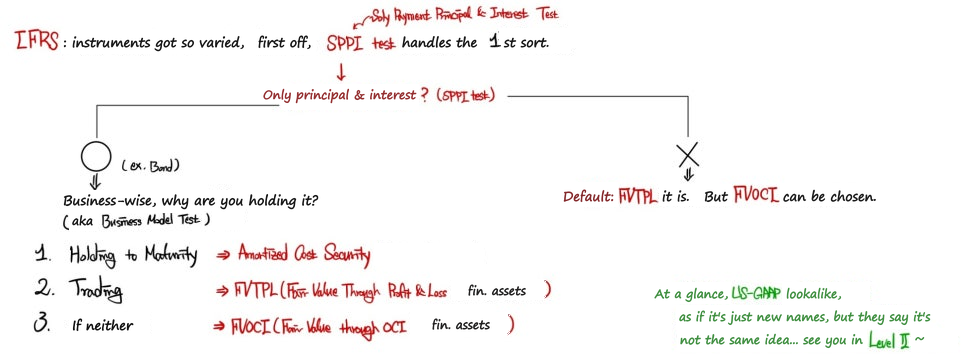
For the ones that landed on the bond side, they get sorted into Amortized Cost Security (financial assets measured at amortized cost) / FVPL (financial assets at fair value through profit or loss) / FVOCI (financial assets at fair value through other comprehensive income) — and since these concepts map pretty cleanly onto US-GAAP’s Held to Maturity / Trading / Available for Sale, let’s just tag this with “yeah, that exists” and keep moving heh heh heh
(For the CPA exam, this single section in an intermediate accounting course is more than 10 lectures long ^^ Honestly feels like winning the lottery to be skating past it at this level heh heh heh)
(If we say juuuust a tiny bit more — the very first step is testing whether the financial asset consists of just principal and interest, and for the purpose of holding it, the diagram above says a Business test happens — the standard phrases this as looking at the “business model.” Within that, you split into: “purpose is to sell” (→ FVPL) / “purpose is to collect cash flows” (→ AC financial assets) / “both — selling and collecting cash flows” (→ FVOCI) :-))
OK let’s wrap up the financial assets section~~~~~~~~~phew~~~~~
Accounts Receivable
Next up: Accounts Receivable…. you know….. Sigh… this one is also originally super~~~~~~~~~~long lol. Don’t worry though — for CFA exam purposes it’s actually super short heh heh heh

What you actually need to know about accounts receivable, set up like this:
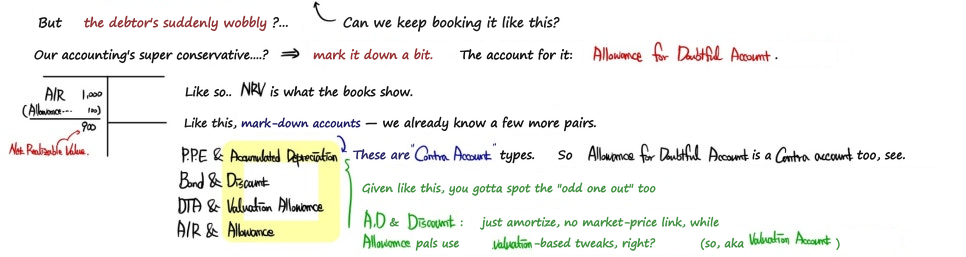
The accounts receivable line represents “hey, we have money coming in~” from selling on credit. We estimate expected credit losses from recognition, not only when a debtor starts looking shaky. If expected losses increase, on your financial statements, what was showing “we’re owed 1,000 won!” gets quietly marked down to “we’re owed 700 won!” via conservative accounting.
And the account title used for that is the “allowance for doubtful accounts”! That’s apparently the whole thing you need to know heh heh heh
Of course, with bonds we hold, when it’s “Oh!!! The bond issuer is looking like they can’t pay!!!!”, there’s also accounting treatment that marks down the bond’s carrying amount a bit. In that case we use the word “impairment” — the impairment loss flows through the I/S, and the account title showing the cumulative impairment on that bond on the B/S is called “loss allowance”.
And honestly, a receivable is a claim to money just like a bond (Korean even uses one word for both), so its impairment treatment is in essence the same thing as bad debt — but by accounting convention, impairment on accounts receivable gets called bad debt (Bad Debt), apparently.
(Bad debt expense flows through the I/S → what accumulates on the B/S is the allowance for doubtful accounts.) (It is often presented as an operating expense; the exact line depends on the reporting framework and presentation.)
There’s also a whole thing about how you actually compute that bad debt expense — estimating expected bad debts using expected credit loss (or recovery rate), and the CPA exam covers it, but looks like we don’t need to go that deep here.
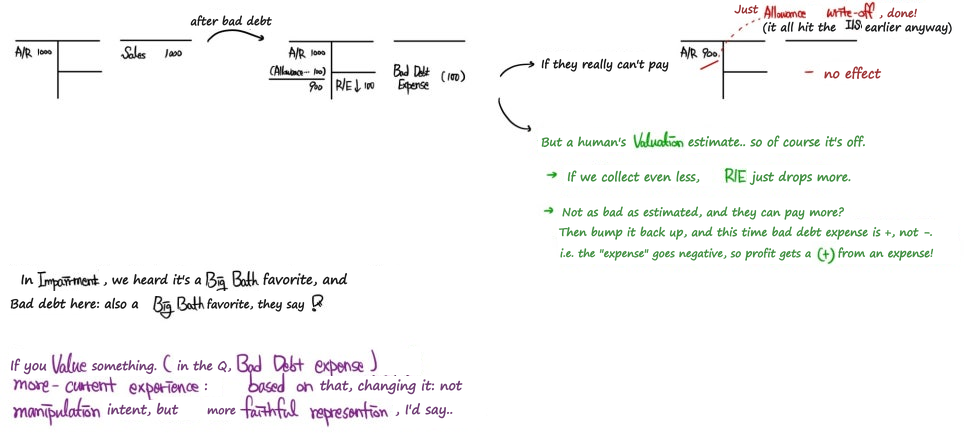
Just this much: the bad-debt accounting treatment is a way of “doing the accounting in advance for losses on stuff that might end up as a loss~” So that later, when the loss is actually confirmed, there’s no new expense if the allowance already covers it, just the write-off against that allowance. Why? Because we already did it ahead of time ^.^ Knowing that much logic and moving on seems like enough heh heh heh
And also, for CFA exam purposes there are some odds-and-ends account titles like Prepaid Expenses, plus this thing called a note (Note Payable) — let’s just hear about those briefly and keep moving!
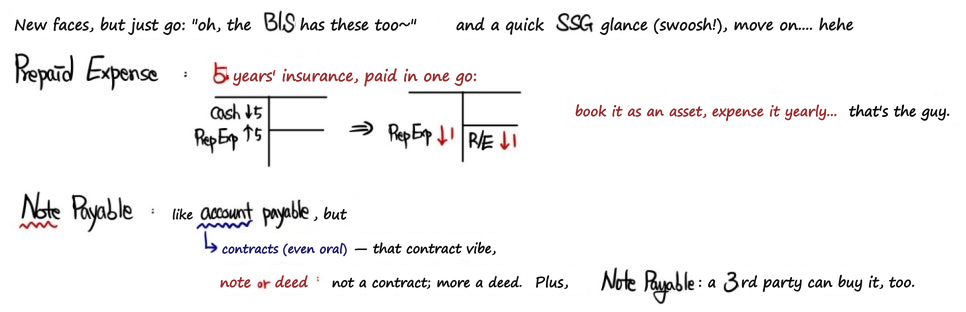
A note…………. What could a note be……… Aren’t you a little curious????
The stuff below this point includes some content that’s actively harmful to your mental health, so let’s just learn enough about notes to stay at “general knowledge” level??? OK??? heh heh heh
Right, so — now please close the window! Great work, everyone!!!!
What is a note?
A note is actually a sub-area of commercial law and gets explained in detail in the law of bills and checks, and I’ve heard this is a notoriously hard topic — to the point that there are people known as “bill-dropouts” (people who give up on the bills section). In the original 2021 lecture I’d heard talk of a revision around 2023–24 — a historical recollection, not a statement about today’s law heh heh heh
OK first, starting with checks — there are lots of types of checks, but the form most of us know is the cashier’s check, right? Bank-issued cashier’s checks, third-party-issued current account checks, third-party-issued personal checks, remittance checks, traveler’s checks, etc….. Anyway, a check instructs a bank to pay on demand — it isn’t guaranteed legal tender. A promissory note is a legally recognised promise to pay under its stated terms.
A note has the following written on it: Maturity amount / Issuer (A) / Payee (rights holder) (B) / Issue date / Maturity date — basically a piece of paper with a promise written on it that “the issuer will give the rights holder the maturity amount on the maturity date,” and since the note represents the right to receive money, whoever holds it puts it on the asset side of their financial statements.
And that note — if it came from selling inventory on credit and receiving the credit amount, it gets recorded as accounts receivable; if it came from selling some non-inventory asset on credit, it gets recorded as other receivables; and if you lent money out and got the note as proof of money to be received, it gets recorded as a loan receivable.
But I think the biggest defining feature of a note is the dishonor process.
First off, a note allows “endorsement to transfer the rights of the note” — Endorser: B’s name and seal / Endorsee: C’s name and seal. If the rights are transferred this way, C can show up at A on the maturity date and go “give me my money!” A goes “one moment please^^ let me just verify the endorsement is in order~” and then hands over the cash.
But — if A can’t pay? Then the note is dishonoured. In Korea, dishonour can trigger bank-clearing restrictions and, for a listed issuer, applicable disclosure obligations — not every unpaid private note automatically creates a public announcement.
So a note is apparently a notch more powerful than plain accounts receivable. Which means: even if inventory gets sold on credit and accounts receivable get recorded, whether those receivables are ’notes receivable’ or just ’trade receivables (credit sales)’ makes a real difference. (With straight credit sales it’s not that there’s NO penalty for late payment, but stuff like having to publicly disclose a dishonor doesn’t apply.)
And to push this just a little further, C — who acquired the rights via endorsement — can also pass those rights on to someone else: B → C → D → E → F, and it can keep getting endorsed all the way down to F. F just has to go collect from A at maturity, but if A defaults, F may exercise recourse against liable prior endorsers, subject to the applicable presentment, protest/notice, timing and endorsement conditions. That’s the basic idea of recourse rights.
Recourse rights mean: if any of the prior endorsers actually have assets, you can go through legal procedures to seize and dispose of those assets to collect, apparently. If F invokes recourse rights against D, then D in turn invokes recourse rights against A, B, C, who came before D…. it works something like that…. For more detail you’d have to dig into commercial law!
But while back in the day notes were issued on paper, these days they’re mostly all electronic notes, apparently…. heh. That was the 2021 lecture’s expectation about legal change heh heh heh
OK so I started writing this just intending to cover notes at general-knowledge level, but now that we’re here…
…aren’t you also a little curious about current accounts?!?!?!? heh heh heh
Let me spin a quick yarn about current accounts too heh heh heh heh
Cash, in accounting terms, doesn’t just mean physical bills and coins — it also includes a category called “demand deposits,” which get treated as cash. And demand deposits, in plain English, are “money the bank will pay you the moment you ask for it” — so the regular bank savings account you have is one type of demand deposit, and another type of demand deposit is precisely the current account.
You deposit cash or checks into the bank, and withdrawals go out via the issuance of checks or notes — and you might be wondering, why on earth would anyone need this????? But back in the day, when you couldn’t just wire money over the internet, sending big sums was kind of awkward — so apparently they’d route it through a bank as middleman, cut a check, and hand it over that way.
For the Korean business checking accounts described in the lecture, banks may require an opening security deposit — the amount and conditions depend on the bank and date, and since this money comes back to you when you close the current account, it gets classified as a “non-current financial asset” (in practice they apparently use the account title “long-term financial assets.”)
Now, while running a current account, there can be moments where the balance briefly goes negative (−), and in that case a dishonor process would normally kick in….. BUT — you can also contract with the bank so that, within a certain limit, the dishonor process doesn’t trigger even if the balance briefly dips negative. This kind of arrangement is called an overdraft agreement, and the negative-balance amount itself is called overdraft.
Overdraft, on the B/S, gets classified as “short-term borrowings” heh heh heh
Heads-up. The figures here are the original notes, slips and all. A few things to watch for:
- In the debt-securities picture, the revaluation model the green note compares with is the one for PP&E (and intangible assets), not inventory, which has no revaluation model. And the one-way arrow between trading and available-for-sale is the old IAS 39 rule; under US GAAP, transfers between the categories are made at fair value, and moves into or out of trading are allowed, though rare.
- For equity securities, the trading / available-for-sale split is the US GAAP rule before 2018: since ASU 2016-01 (fiscal years beginning after 15 December 2017), equity securities are measured at fair value through net income, and available-for-sale is for debt securities only.
- In the IFRS 9 list, FVOCI is for debt assets that pass the SPPI test and are held both to collect cash flows and to sell; the leftover category, for anything that fits neither business model, is FVPL.
- In the IFRS tree, an asset failing SPPI normally goes to FVTPL. The irrevocable FVOCI election is only for eligible equity investments not held for trading, not for every SPPI-failing instrument. Debt instruments at FVOCI must pass SPPI and fit collect-and-sell.
- In the US debt diagram, non-credit fair-value changes of AFS debt go through OCI, but credit losses require separate profit-or-loss treatment. The PP&E comparison also omits reversals of earlier revaluation gains/losses.
- The preferred-share shortcut assumes no other payment obligation: a holder’s redemption right generally creates a liability, while issuer-only redemption discretion does not by itself. Mandatory dividends or other terms can change classification.
- The note-payable example is from the issuer’s perspective; it is a note receivable to the holder who transfers it. ‘Deed, not contract’ is informal wording: a promissory note creates a formal payment obligation under the relevant law.
Comments
Discussion happens via GitHub Discussions. You'll need a GitHub account to comment.