Equity
A casual (expectations: low!) walkthrough of equity on the balance sheet — paid-in capital, par value, share premium, and just enough accounting cycle to get by for the CFA exam.
Unlike inventory and PP&E (tangible assets), which we covered in at least a little detail, we’ve been going through a few of the other line items on the B/S and I/S with the idea of looking at them only rou~ghly. So last time we looked at financial assets and accounts receivable, right??? Continuing in that same spirit, looks like it’s time to knock out a few more line items.
Since this is a “look at it roughly” kind of session, I’d say keep your expectations low — putting that out there first — and now let’s dive in!!!
This time we’re looking at the Equity side. We haven’t really gone deep on Equity up to this point, and the plan here isn’t to go deep either, heh heh heh
(BUT — since we’re going to try to wrap our heads around the “accounting cycle” this time around, focus focus!!!! Most important part!!!!!)
First things first — what’s the definition of Equity?
Asset − Liability. That’s literally the definition heh heh
This can get a little confusing, so let me just say it plainly once. Equity’s value equals Net Asset value, which is Asset − Liability.
Huh?!?!? What does that even mean lol So,
“Equity is something that describes net assets.”
(This is one of those parts where you kind of need the accounting cycle in your head to really get what it’s saying…) Anyway, heh heh
For our CFA exam purposes, we don’t look at every single thing in Equity — apparently 4 things are enough. Here they are.
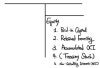
1. Paid-in Capital
OK, first up — number one! Simply put, this is the money shareholders paid into the company. It’s called Contributed Capital.
Paid-in Capital itself splits further into two pieces: Capital stock (share capital), and Additional Paid-in Capital — aka share premium. How are each of these calculated and shown on the B/S?

Capital stock = par value × number of shares issued. That’s what shows up. And when shares get issued above par value, the leftover crumbs pile up in an account called share premium.
For example: 1 share of common stock with par value 5,000 won issued at 7,000 won? Capital stock 5,000 / Share premium 2,000 — like that.
And actually there are cases where a stock with par value 5,000 is issued at 4,000, and in that case, instead of share premium, it gets recorded under a line item called ‘discount on stock issuance’….
No… why bother going through the trouble of splitting it up like this?
And in our country’s stock market, a par value of 5,000 won is pretty much the classic default….. (Not every stock is at 5,000, of course… heh)
So the reason for going to the trouble of splitting it up like this — first reason: if capital stock is shown as par × number of shares, it makes calculating the number of issued shares super convenient.
Second reason: share premium gets classified as capital surplus on the B/S, and the idea is that later, if the company’s financial situation gets really dicey, this is the cushion sitting there to relieve the pain~ — or so the story goes, but it’s not important content, so let’s just leave it at that and move on~ heh heh
Oh and also — about preferred stock capital that shows up in Equity. Issuer-callable preferred shares can be equity if there is no unavoidable payment obligation; holder-puttable or mandatorily redeemable shares generally create a liability. Check every term, including dividends. We mentioned that in a previous post, right? ^^ heh heh
* Fun practical-world story
The “Redeemable” attached form is actually used a lot in things like Pre-IPO, apparently. Before a company goes IPO, you have to attach options like Redeemable to attract investors, they say… heh heh But wait — why do companies want to do Pre-IPO????
1. Could be to grab more funds via pre-IPO before the full IPO, then either start a new business or push sales further so they can get a higher valuation when IPO time comes.
2. To clean up the major shareholder’s stake a bit during pre-IPO — because once you go public, stake disclosures can mess with the stock price and that becomes a burden later.. heh heh
Anyway, the form most often received in pre-IPO situations is apparently RCPS (Redeemable Convertible Preferred Stock). You stack one more right on top of RPS — if we can’t get to IPO, pay us back via Put, and if IPO does happen, the goal is to convert and exit into the market… that’s the pur…pose, heh heh
K-GAAP looks at this RCPS legally and books it as Equity, but when you go IPO you have to switch to IFRS, and under IFRS the contract may create a liability, equity, or separately accounted-for components — not all RCPS is automatically all liability — which creates situations where companies can’t go IPO at all, so… apparently this is a really important issue in practice, heh heh
In school or textbooks, preferred stock gets taught as ‘shares without voting rights,’ but if the articles of incorporation say voting rights are granted, then preferred stock can come with voting rights. (In the US there are tons of cases like this, so people sometimes assume preferred stock naturally comes with voting rights.) Then what does preferred stock give priority to?
1. Priority on dividends.
2. Residual claims on assets — preferred goes ahead of common.
There are also No Par shares, which have no Par Value (face value). In the US, No Par — or a token par like a cent — is actually the norm, and in Korea, No Par isn’t impossible but apparently there just aren’t many companies issuing them.
OK OK, let’s keep going. The number of Issued Shares came up above, and we kind of need to nail down the concept of share counts a bit better. The different types of share counts need to live cleanly in your head by concept.

Authorized Shares. Written into the articles of incorporation as “we plan to issue this many shares going forward.” This is the amount approved by shareholders. Within this authorized count, the board can generally authorise issues within that ceiling, subject to law, the articles and shareholder/pre-emption rights… it’s basically a ceiling, you could say? (Total planned shares to be issued.)
Then within that ceiling, there’s a chunk that’s already been issued, and a remaining chunk up to the ceiling that hasn’t been issued yet. Issued Shares is exactly that — the number of shares issued to date. The remaining chunk up to the ceiling that hasn’t been issued is called Unissued Shares.
Among issued shares (Issued Shares), we further split into “Outstanding Shares,” which are issued shares held by investors, including locked-up or closely held shares — not just those actively traded, and “Treasury Stock,” which is the chunk that was issued but the company itself is holding.
2. Retained Earnings
OK and now the next line item — Retained Earnings. This one is… well… calculated as Beg R/E + Net Income − Dividends declared…. This is easy, so… can we skip??!

Ahh but it feels a little sad to just skip past it, so let me say juuust a tiny bit more about retained earnings haha
(Honestly, recommend just Skipping.)
Retained earnings is actually further broken into 3 subcategories:
Retained earnings ⇒ Unappropriated retained earnings / Legal reserves / Voluntary reserves
We said earlier that Net Income gets reflected in retained earnings, but more precisely, it gets reflected in “unappropriated retained earnings.” It is part of assessing dividend capacity — but not a cash pile or, by itself, the legal distributable amount. Local law, reserves and other restrictions still apply.
Then what are legal reserves and voluntary reserves? Legal reserves are “the portion the law mandates you set aside” (in our country, the line item ‘profit reserve’ is used). It’s mandated by Korea’s Commercial Act, and the rule says: “in the case of cash dividends (including dividends in kind), at least 1/10 of the dividend amount has to be set aside as profit reserve until it reaches 1/2 of capital stock” — meaning, “once the legal reserve reaches 1/2 of share capital, you don’t have to do this mandatory ‘setting aside’ anymore.” Net effect: at least 1/10 of the dividend stays parked in retained earnings before the dividend gets paid.
(I didn’t mention stock dividends. A stock dividend swaps unappropriated retained earnings for capital stock, and since the substance of that transaction isn’t actually distributing wealth to shareholders…. heh heh it’s tricky heh It’s content you don’t really need to know, so I’m just cruising past it too lol If you’re curious, please step into the world of Intermediate Accounting (for CPA)~ Welcome to hell heh heh)
Let me just do one rough pass on voluntary reserves too. These are line items the company sets aside voluntarily — not regulated by law, just decided by the company on its own. (On an actual B/S you’ll see line item names like “business expansion reserve” or “sinking fund reserve.”)
Why would you set anything aside here?!?! If there’s 1 trillion sitting in unappropriated retained earnings, shareholders might start going “stop locking it up in unappropriated and pay us dividends already!!!!!!!!!!!” Isn’t this a move to break that? The company shoves some into voluntary reserves, like —
“Shareholders…. please, please don’t ask for dividends ^.^ The money we made is meant for us to bet on the right investment, or to deploy when a business plan comes together so we can earn even bigger money ^.^ Believe Me!” — something like that, I think, is the intent heh heh
Oh and above I used terms like “set aside, transfer” etc. Basically, when current period net income lands in unappropriated retained earnings, some of that amount can flow to legal reserves, or it can flow to voluntary reserves, right? Sending it whoosh~ over to another retained earnings item like that is called “setting aside.” And from voluntary reserves, you can also send it back to unappropriated retained earnings and just pay it out as dividends. Sending it back from voluntary to unappropriated is called “reversal.” Just terminology….. ^^;;; heh heh
Yes yes, you skipped! Right? That was an excellent choice haha
OK then, next! Number 3 on the list above was AOCI, but instead of doing AOCI, to finish off the shares-side stuff first, we’ll hit number 4 from the list — Treasury Stock — first, and then circle back to Accumulated Other Comprehensive Income.
4. Treasury Stock
The official Korean name is jagi jusik, literally “own shares,” but… heh
Actually, jasaju (“own-company shares”) and jagi jusik are probably different words…. heh heh Everyday Korean often uses both jasaju and jagi jusik for the company’s own repurchased shares. An employee buying shares personally is a different transaction — not treasury stock.
Hmm…. like if I’m working at a listed company and I bought shares in my own company…. But if the financial statements somehow magically went “oh?!?!? Our company’s employee GD Park bought our company’s shares!!!!!!!!!!!!” and reflected that in the financial statements…. the management support team might come for my head lol for making them extra work lol
Anyway — keep the transaction clear: employees’ personal holdings are theirs; shares bought back and held by the issuer are treasury stock heh heh
(No wait… I should fix all the terminology later heh heh)
Anyway — treasury stock. The company can’t exercise voting rights on it. Because the Commercial Act defines it that way.
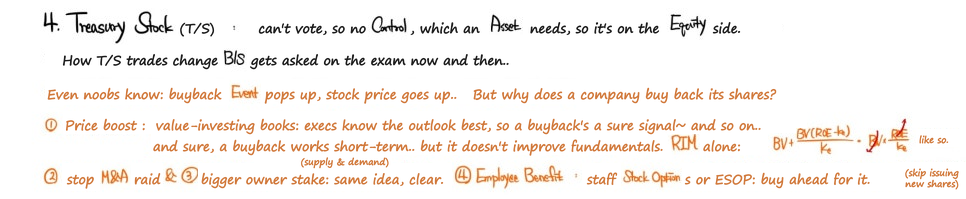
The key point isn’t the voting rights: a claim on the company itself isn’t a separate economic resource for that company. IAS 32 requires reacquired own equity instruments to be deducted from equity.
So treasury stock goes in as a contra-account deducted from equity. That’s exactly what it is, heh heh
But here’s the thing even rookie investors know — when news comes out that a company is buying back its own shares, the stock price goes up, right?????
Why does a company do a share buyback?!?!?!?
1. Stock price support: open up any value investing book and you’ll see this — company insiders know the outlook better than anyone, and their decision to buy back shares is a clear positive signal~ A buyback can be read as a positive signal, but a share-price rise isn’t guaranteed, even in the short term.
BUT — the fact is, share buybacks don’t actually improve a company’s fundamentals!! The model accountants tend to use a lot when valuing a company is something called RIM — Residual Income Model, I think. Anyway, according to that model, share buybacks don’t move the fundamentals so…..
2. Defense against hostile M&A & 3. Strengthening the controlling shareholder’s stake.
4. Employee Benefit: buying in advance to prep for employees exercising stock options or for employee stock ownership plans.
OK that was the fun-story portion, now back to exam mode!
A company can transact in its own shares in 3 ways: Share buyback / Reissuance / Retirement. For each of these, you need to understand the effect on the B/S.
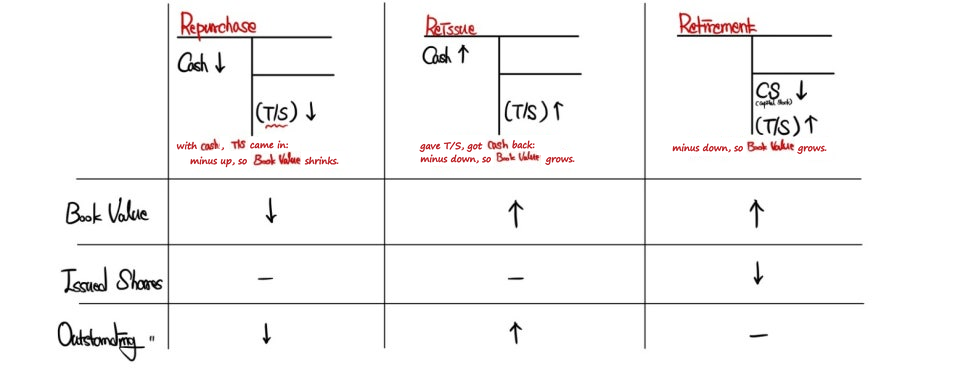
Since this is a contra-account to equity, it can get a little confusing, but since it’s shown up on the exam before, you need this much down!
(Honestly, you just need to nail the logic and re-derive it when solving questions, so it’s not that bad… heh heh)
5. Non-Controlling Interest (NCI)
And among the equity accounts, one more thing you need to know: there’s a thing called non-controlling interest.
This actually wouldn’t show up in intermediate accounting, which deals with the accounting treatment of a single company. Because the non-controlling interest account appears in consolidated financial statements, and consolidated financial statements pull in info from multiple companies including subsidiaries the parent has obtained control over, so this is something studied in advanced accounting…….. And advanced accounting is the domain of CFA Level 2!!!!!!!!
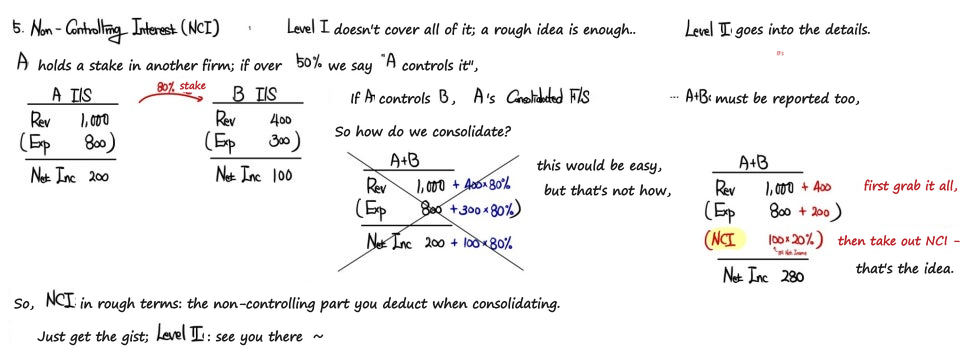
So we don’t need to know it in detail — just know it simply. Um……. The diagram explains it too, but let me say it really simply and roughly. Easier feel if I phrase it in terms of a line item, so let’s use inventory as the example.
Say Company A’s inventory is 1,000, and Company B’s inventory is 100. But A owns 80% of B and controls it. Common-sense reading: A’s consolidated financial statements should record inventory as
1,000 + 100 × 0.8 = 1,080
but — accounting doesn’t do it that way.
In A’s inventory line it includes the full 1,000 + 100 = 1,100, before any intragroup adjustments. NCI isn’t 20% of inventory: it is the outside owners’ interest in the subsidiary’s net assets, including relevant consolidation adjustments. Inventory figures alone can’t tell us NCI or the net assets attributable to A’s shareholders.
Really weird, right???? But, as you study advanced accounting, you’ll start to feel that this method is actually more rational. Details — see you at CFA Lv2!
3. AOCI (Accumulated Other Comprehensive Income)
And finally, the one we jumped over earlier — let’s look at accumulated other comprehensive income.
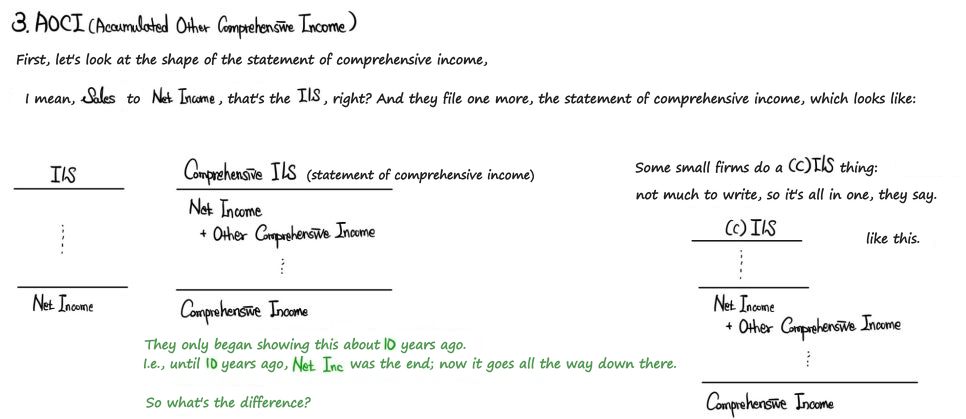
OK now this one……. is content where you really need to grasp the accounting cycle from a big-picture perspective, so let me explain it simply.
First — what shows the main financial info of a company? Of the 5 financial statements, the B/S, which shows the accumulated results since the company was founded, and the I/S, which shows the results of the period being reported on this time — these two are what you’d call important.
And the B/S has the credit side, which shows how the company has been Financing, with the credit side broadly showing how much was financed from creditors and how much from shareholders, and the debit side showing how the money raised that way got invested.
Then there’s the concept of net assets of the company, and what describes those net assets is precisely capital (Equity), they say. The capital accounts that describe net assets — you could call them the core of the B/S, and these capital accounts basically — how do they work —
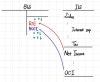
A company gets created and earns money. When money’s earned, it has to be distributed to stakeholders. First it goes to creditors. The government is also a stakeholder. So results get distributed via Tax.
What’s left over is exactly the shareholders’ share, and within this shareholders’ share there’s Net Income, which flows into retained earnings, and OCI, which flows into accumulated OCI or the relevant equity reserves. IFRS specifies which items enter OCI; dividend eligibility is a separate question of local company law, not the definition of OCI.
(Net effect: when a company produces results, those results have to be classified — Net Income or OCI? For example, money earned from selling goods? -> Net Income. A revaluation gain on PP&E the company holds, under the revaluation model? -> OCI. That kind of thing. But the types of gains and losses classified as OCI are 7. CPA students memorize them with a Korean mnemonic. For CFA purposes, we’ll define 5 below.)
But — is the thing that describes net assets necessarily made up only of the company’s results???? No. As we saw above, things like treasury stock move through the company’s own direct transactions, right? Transactions with owners in their capacity as owners, such as share issues and dividends, are separated from comprehensive income. (Prior-period error corrections or accounting-policy changes can also adjust opening equity directly.) and stuff from transactions with shareholders gets “directly reflected” in the Equity account. That was super brief, but this is the big accounting cycle….. heh heh
OK back to CFA, inside the results a company achieved during the reporting period, there’s Net Income and Other Comprehensive Income. Let me bring this back to mind once and continue.
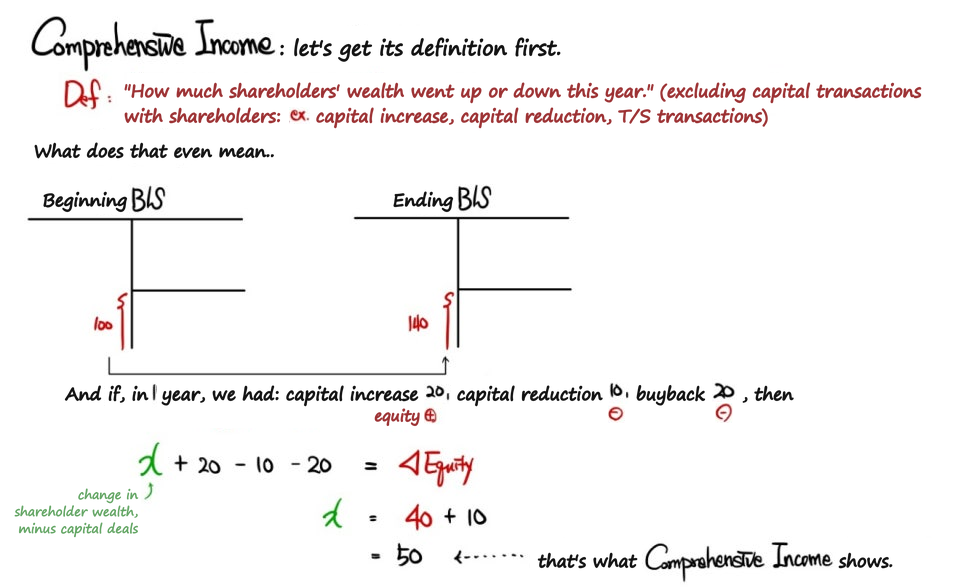
In the changes to net assets, let’s split it into transactions with shareholders, and stuff from results (Net Income + Other Comprehensive Income).
Out of these, the stuff from results is what we call Comprehensive Income!
Please get this once, and ultimately, as I explained above, changes in Equity, which describes net assets —
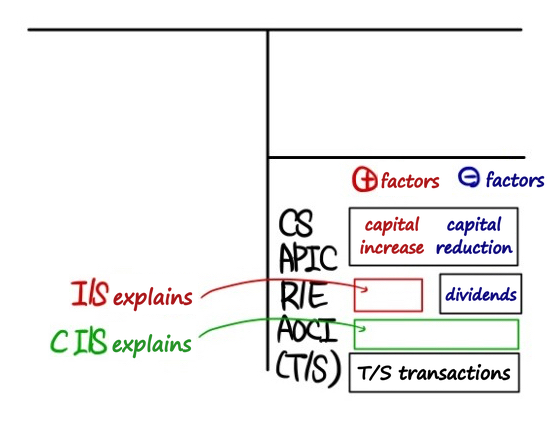
Net Income gets reflected in R/E & OCI gets reflected in AOCI, like this. Wait a second!!!!!!!!
What even is OCI!!!!!!!!
So why do some shareholder-related gains go through OCI rather than net income?????
(This is content we touched on back in the PP&E posts.)
First — among the stuff we’ve studied, what OCI showed up? Let’s get the feel from there. Under IFRS, PP&E can be carried under the Revaluation Model, and under this model, the Unrealized Gain on that asset got classified as OCI and reflected in AOCI (a revaluation loss goes to net income unless it reverses an earlier gain).
Why?!?!?!? 50 years ago the company bought a small plot of land in Seoul to do business on, and continued doing business….. and then 2020 rolls around and that land has gone to the moon….. It was clearly bought for 50,000 won, but now it’s worth 5 billion;; haha
From the shareholder’s perspective? Hey!!! That’s my money!!!!! Everyone knows it went to the moon, so hurry up and pay it out as dividends!!!!!
If that flew, this company would now have to sell the land to pay dividends. Then… it wouldn’t be able to keep doing business either;; this makes a useful intuition for separating a revaluation from operating earnings. But it isn’t the historical origin or legal definition of OCI: standards specify its components, while local law controls distributions…. heh heh
OK so the items classified as other comprehensive income — I said there are 5 to memorize for CFA purposes. What are those 5?!?!??!?
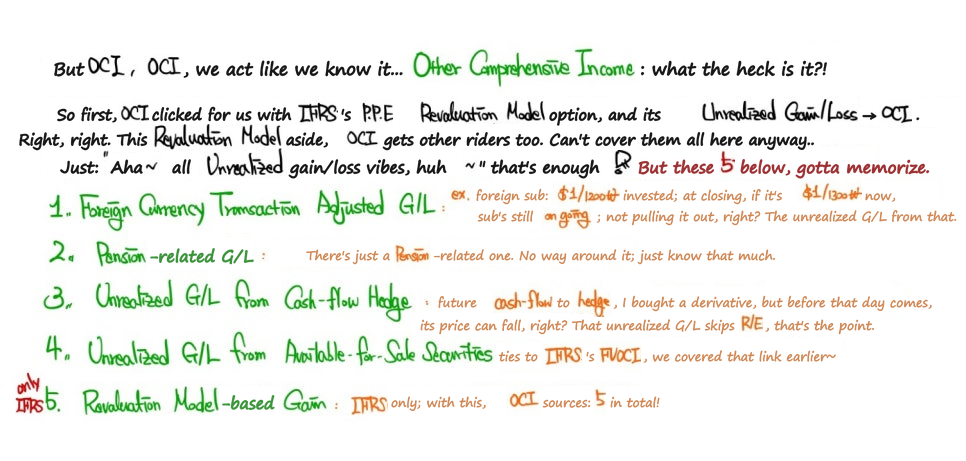
How are you supposed to memorize this (crying)……… Let’s just designate this as a list you skim once right before the exam!!!!!!!! There’s no other way haha I can’t memorize it lol
The vibe is that most of them feel like Unrealized Gain & Loss. (They are absolutely not all unrealized gains/losses.)
And one more fun story to wrap up —
In these 2021 Korean notes, ‘about 10 years’ points to Korea’s 2011 K-IFRS adoption — comprehensive-income reporting existed earlier elsewhere. Why show it separately……?!?!?!
What is accounting again?! I think the definition was something like — a system that provides useful information to information users. What would matter to those information users? Showing the substance of the company well — that’s the obvious first thing, but reflecting financial info into stock prices is also a key point you can mark down. There was apparently a debate among accounting academics on the latter point — about OCI specifically.
“Hey….! What’s so important about how much some piece of land is worth, or unrealized gains/losses from FX rates and stuff… this company isn’t suddenly gonna sell that land, and it’s not like they’re gonna instantly liquidate their overseas investments right now, so why do we have to put this in results…?!!??!”
“No no, it might actually matter — looks like it has a pretty strong effect on stock prices.”
“Oh really!? Wanna run an experiment?!?!”
And they ran experiments on stock markets all over the world, and the result came out…. weirdly…. fifty-fifty, they say…. That’s the lecture-room story I heard, not a verified account of how the standards were adopted. The documented history is earlier: FASB issued Statement 130 in 1997 and IAS 1’s comprehensive-income presentation revision followed in 2007… heh heh
How interesting, how interesting, how interesting hehe
Heads-up. The figures here are the original notes, slips and all. A few things to watch for:
- In the treasury-stock table, retiring treasury shares leaves book value unchanged: share capital (and paid-in capital) goes down by exactly as much as the treasury stock’s minus shrinks, so total equity stays the same (IAS 32.33; ASC 505-30). The arrows for a repurchase (down) and a reissue (up) are right.
- In the consolidation sketch, B’s expenses are 300, so the expense line is 800 + 300; consolidated net income is then 300, and the 280 shown is the parent’s share after the non-controlling interest’s 20. In the actual statements, the 20 is shown as a split of the 300 (attributable to owners of the parent and to NCI), not as an expense.
- In the list of OCI items, item 1 is the foreign currency translation adjustment, from translating a foreign subsidiary’s statements (IAS 21.39(c)); gains and losses on foreign currency transactions go to profit or loss (IAS 21.28).
- The treasury-stock picture’s no-voting-rights explanation is a shortcut, not the accounting reason: reacquired own equity is deducted from equity under IAS 32.33. Nonvoting shares in another entity can still be an asset.
- OCI is defined by reporting standards, not by a universal ban on dividends. The reserve examples discuss Korean law; other jurisdictions’ distribution rules differ. Revaluation increases reversing earlier expense can enter profit or loss; decreases first use any surplus for that asset.
- The paid-in-capital formula assumes par-value shares. Issuing below par is legally restricted in Korea (Commercial Act 330/417); the hypothetical 5000/4000 example does not imply it can be done freely.
- The OCI list is a study selection, not a complete current catalogue. US AFS is debt-only under current rules, foreign-operation translation differs from FX transactions, and qualifying cash-flow hedge treatment covers the effective portion subject to requirements.
Comments
Discussion happens via GitHub Discussions. You'll need a GitHub account to comment.