Statement of Changes in Equity and Non-Recurring Items
A breezy tour of the Statement of Changes in Equity, a quick rundown on bad debt and warranty expense (and the DTAs they quietly create), then the non-recurring items: discontinued operations and unusual or infrequent items.
So far in the financial statements arc we’ve leaned hard on the B/S and I/S, and at the end we’ll do a quick pass on the C/F. And the Statement of Changes in Equity has barely gotten a mention. But honestly? The previous post was basically the Statement of Changes in Equity already. So I’ll just toss a sample in here, say a few words, and keep moving heh heh
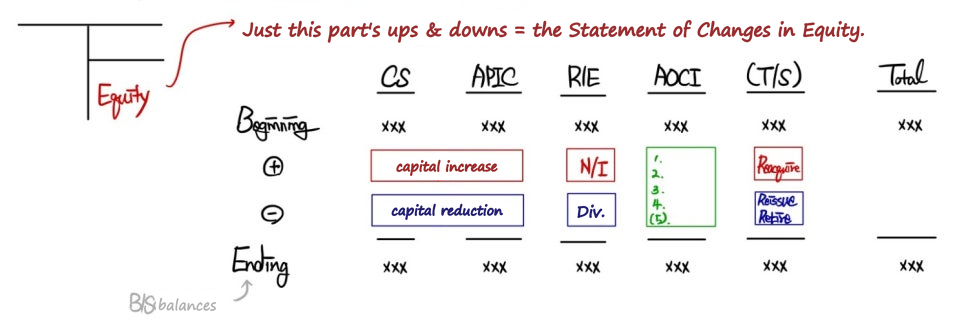
The OCIs that flow into AOCI — only very specific income/expense items get to ride that bus (the ones in that CPA mnemonic from last time). For CFA purposes, you really just need to know about 5 of them as general background, which is why the numbers are written in the way they are.
Hey — wait. Doesn’t this picture look suspiciously familiar??
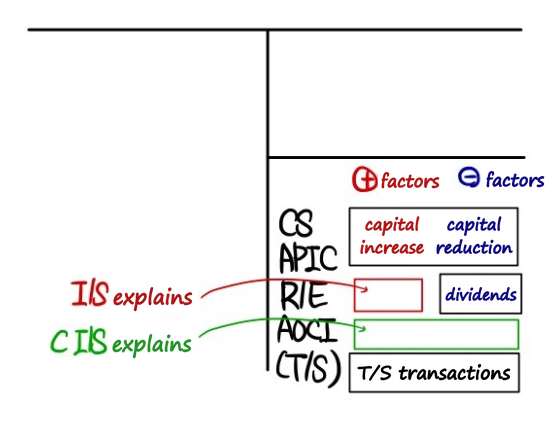
Yeah. It’s literally the picture from the previous post. That’s why I said up top that the previous post was basically us looking at the Statement of Changes in Equity already heh heh
OK so now, on to… how do I put it… the not-so-important stuff? Let’s lightly skim through the small fish and move on.
(Not saying it won’t show up on the exam — it just doesn’t carry much weight on the exam heh heh)
Bad Debt Expense & Warranty Expense
Bad debt got a quick cameo back when we did Accounts Receivable.

We booked it as accounts receivable — money that’s supposed to roll in later from selling inventory on credit. And if the company that owes you suddenly starts looking shaky, you have to recognize an ‘impairment’ on that receivable. By accounting convention, impairment on accounts receivable gets its own special name — ‘bad debt.’ We covered that already.
What we didn’t cover was that this can create a DTA (Deferred Tax Asset) — if the loss is deductible for tax later rather than now, and the recognition conditions are met ^^
OK so what is Warranty Expense??
Throwback Samsung Electronics phones… before the Galaxy there was the Anycall. And back in those days, when you bought a phone, they’d tack on a 1-year free A/S (after-sales service) clause.
Anyway, in cases like that — free A/S, or inventory sold with various services bundled in — even when you book revenue of 1,000, the matching principle says expenses have to match the revenue. So you have to estimate the costs that’ll show up later and book them upfront, right?!?!
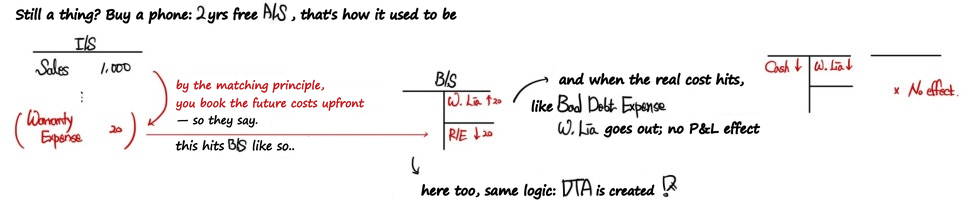
So you “estimate the future costs” and stuff them into the I/S in advance. And then — by the same logic as above — this can create a DTA on the B/S if tax deduction comes later and the DTA recognition conditions are met. When the costs actually show up later as estimated, there’s no impact on the I/S at that future moment. And if the actual cost differs from the estimate, the accounting treatment is to fix it using the prospective method :-)
For CFA purposes you don’t need any of this in detail. Just knowing the concept exists is fine heh heh
(Wanna get a tiny taste of how this part is studied for CPA?? Above I just gave the conceptual overview, but the actual accounting treatment process is absurdly, ridiculously complicated heh heh. I’d actually recommend you not read this part heh heh
First — a “warranty” is a promise, and the accounting standard splits this promise into 2 types: assurance-type warranty / service-type warranty. Assurance-type warranties follow the accounting treatment for “provisions.” Service-type warranties get identified as a performance obligation at the time of revenue recognition, and a portion of the transaction price gets allocated to them.
How do you tell them apart?
Can the customer choose whether or not to buy the warranty? NO → Does it provide additional services on top of the assurance that the product meets the agreed-upon specs? Also NO → Then you’re an assurance-type warranty (i.e., the case where only the assurance that the product meets the agreed-upon specs is given). For CPA purposes, assurance-type warranties only show up via the sales warranty provision :-))
What about service-type? A portion of the transaction price has to be allocated as a performance obligation. The terms “performance obligation” / “transaction price” are actually terms straight out of our country’s accounting standard. So to actually define these properly, I’d need to walk through the whole “Revenue from Contracts with Customers” standard from the beginning, and if I do that this whole thing becomes another full post…. heh heh So I’ll have to leave it… sigh.. heh)
Non-recurring Item
This part feels like a chapter about items that fall outside the company’s ongoing, everyday business — stuff the financial statements display separately.
1. Discontinued Operation:
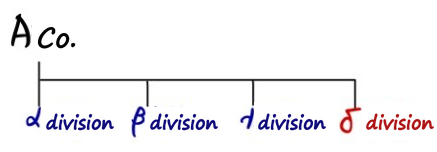
Just take Samsung Electronics. It’s made of multiple business divisions: semiconductors, phones, home appliances, you name it. And it’s totally possible they decide to wind down one of those divisions, right?!
(In reality, it’s less “we went bust, that’s a wrap!!” and more often the business division is doing so well that they spin it out and set it up as its own legal entity. Like how Kakao Games popped out. This is called a spin-off — “a form of splitting one big company into smaller companies to operate them.”)
A separate legal company doesn’t automatically disappear from the group’s results: if the parent keeps control, it stays consolidated. Discontinued-operation presentation needs a qualifying disposal or held-for-sale classification involving a separate major line of business or geographical area (or another qualifying case). Then users get those results separately heh heh
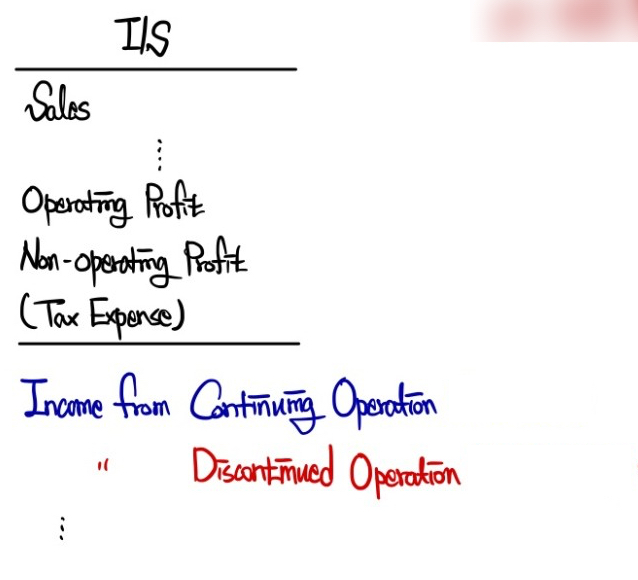
Tax related to this discontinued operation obviously doesn’t get lumped into the Tax line above.
So you also need to know — the discontinued operation itself is written net of tax!!!
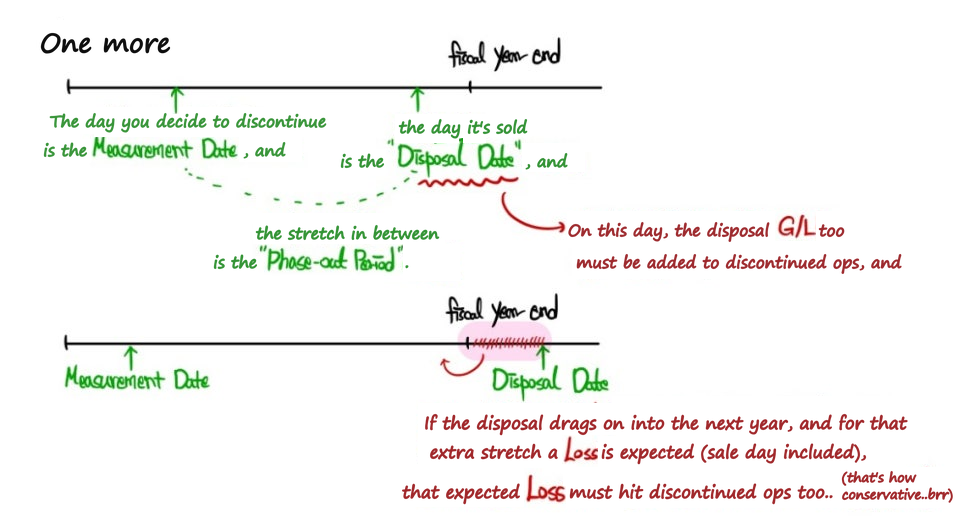
One more thing,
2. Unusual or Infrequent Items (careful with the Korean name “special items”: strictly, that’s the word for extraordinary items — the unusual-and-infrequent kind, which US GAAP scrapped in 2015 and IFRS doesn’t allow)
These still sit inside income from continuing operations, before tax. Being unusual or infrequent doesn’t automatically make an item non-operating: restructuring costs, for example, can be operating expenses. The sketch uses a non-operating gain as its example.
(This is exactly where the gap between operating profit and EBIT comes from!!! For CFA purposes I told you to just treat operating profit and EBIT as the same number — and the reason was a study-purpose assumption that there’s no non-operating income. But in reality, there’s apparently a company, some XX Pharma, whose chairman founded one of Korea’s first-generation securities firms… and with someone like that as chairman — he’s so good at stock investing…. that operating profit is meh, but non-operating income is enormous, so the gap between operating profit and EBIT (earnings before interest expense and corporate tax) is supposedly huge heh heh)
Anyway, the point is — Non-operating Profit includes things like gain/loss on disposition of PPE. And naturally, since it’s before taxes, it’s Before Tax. That much is fine to know heh heh
And the stuff after this is…
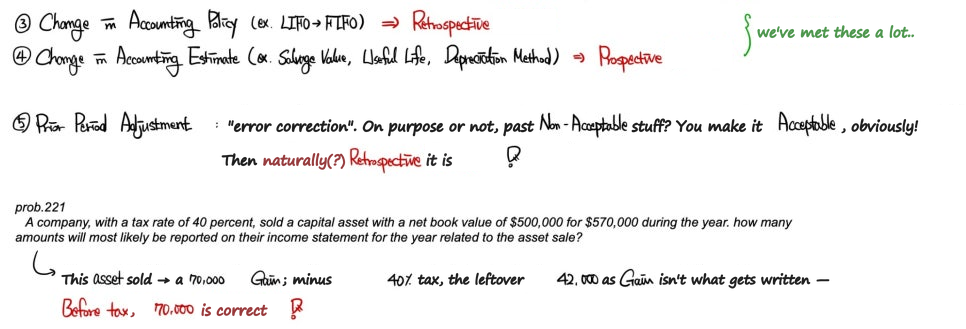
…nothing particularly special…. heh heh. I’ll just slap a photo on it and gloss over it! heh heh
Wow — we’re really almost done with FRA now!!!! After this, only EPS and the cash flow statement are left. Just these two!!!
Once those are done it’s really, really the end!!! Wooooah — let’s fight all the way to the finish line!!!!
Heads-up. The figures here are the original notes, slips and all. A few things to watch for:
- In the timeline note, booking the expected loss up to the disposal date in advance is the old US GAAP rule (APB 30, replaced in 2001). Under IFRS 5 and US GAAP today, a business classified as held for sale is written down to fair value less costs to sell at that point (so an expected loss on the sale shows up early, a gain only when realised), and its operating losses go into discontinued operations as they occur.
- The timeline’s decision date is not by itself the current recognition test: discontinued-operation presentation requires the relevant disposal/held-for-sale and major-component criteria. A business merely moved into a controlled subsidiary remains consolidated. The LIFO-to-FIFO policy-change example is a US-GAAP illustration; IFRS does not permit LIFO.
Comments
Discussion happens via GitHub Discussions. You'll need a GitHub account to comment.