Cash Flow Statement
We finally made it to the cash flow statement — why it exists, why accrual alone isn't enough, how CFO/CFI/CFF each tell a different part of the story, and where taxes, interest and dividends go under US GAAP and IFRS.
Wow, we’re really at the tail end of FRA now!!! To think we’ve actually made it to the Cash Flow Statement!!!!
Quick recap — back when we talked about financial statements, we said financial statements are basically pieces of paper with a bunch of tables on them showing stuff related to the company’s finances. And we said that’s why their Korean name has the character for “several” in it — it’s several statements stitched together.
We roughly walked through the B/S, roughly walked through the I/S, roughly walked through the statement of changes in equity, and the notes we just… couldn’t even touch. Now it’s the last one — the Cash Flow Statement. That’s what we’re doing today.
Why even show this to us??
When you’re recording and presenting stuff about a company’s finances, the basic principle is the Accrual Basis. Which means you literally can’t show how actual cash came in and went out…
But honestly…… is there anyone out there willing to say “nah, the real cash movement doesn’t matter, looking at it on an accrual basis is what’s important!!!”? Like, anyone? (T_T)
Obviously how the cash actually moved matters too. And the financial statements themselves admit it — that’s why they show it in the cash flow statement!
Also — they add that cash flow is a huge deal in Earnings Quality Assessment, i.e., judging the quality of earnings. The earnings with Sustainability? That’s Cash Flow, they say.
The earnings that matter are the ones cash backs up quickly!
(cf. A common thread across the companies behind the big accounting-fraud scandals — Daewoo Shipbuilding & Marine Engineering, Korea Aerospace Industries and the like — was apparently that operating income kept climbing while cash flow from operating activities kept shrinking.)
And it’s not just “here’s how cash moved, cool, done” either.
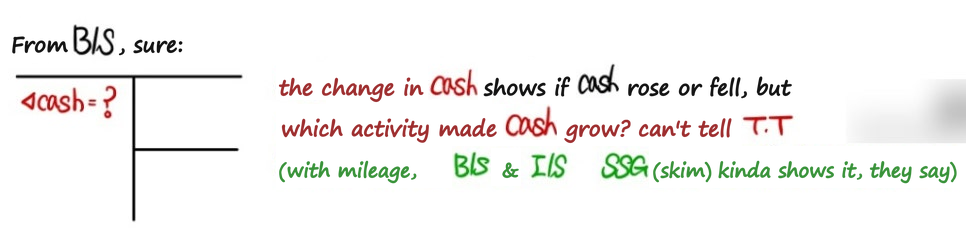
If all we did was eyeball how much Cash changed on the B/S — sure, we’d see how much cash came and went. But did that change come from the company’s main business (operating activities)? Or did the company make an investment, and the cash moved because of it?
(And when I say “company investing,” I don’t just mean buying stocks and bonds like you or me — it covers things like expanding a factory, pushing into a new line of business, funding a Project, all that kind of thing.)
Or maybe the company issued new shares or bonds — raised funds somehow — and that’s what moved Cash around. You have to be able to separate these out for the info to actually mean something!
So the cash flow statement
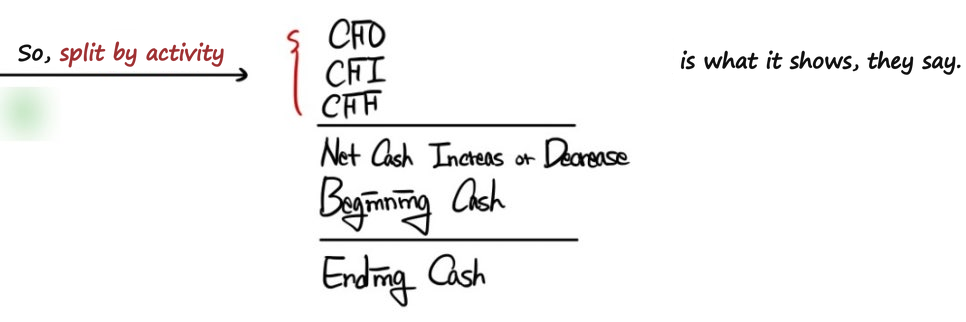
— and each of those is:
- Cash Flow from Operating activities (CFO)
- Cash Flow from Investing activities (CFI)
- Cash Flow from Financing activities (CFF)
Rough feel first
Let’s get a rough feel and move on. What’s CFO, what’s CFI….. Adding just a tiny bit of meat to the bones:

This isn’t the precise definition… And honestly, in reality these concepts do NOT snap into nice clean boxes. At all. Just take this as an intro to the vocabulary, to get a rough feel.
So super roughly, on the B/S, let’s look at which regions each one tends to affect:
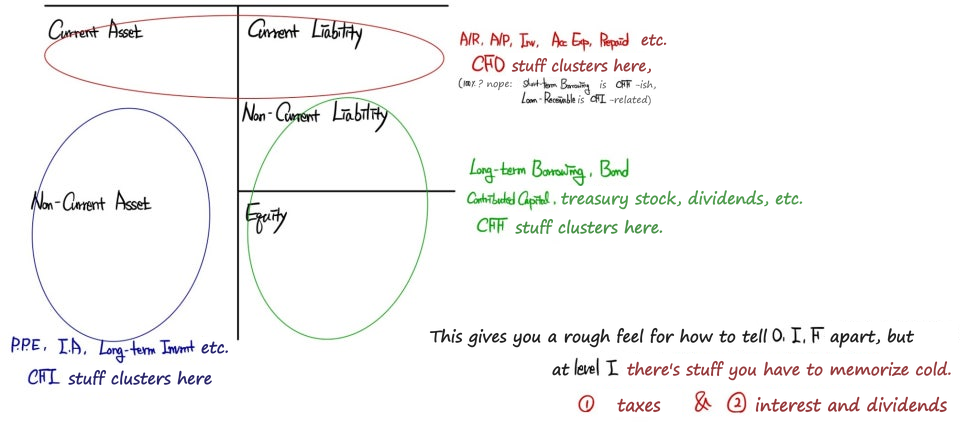
CFO is going to cluster up near the top. Running the business means selling inventory on credit, so A/R shows up, and buying on credit, so A/P shows up.
But it’s absolutely not 100% — Short-term Borrowing, for instance, is about raising funds, so it has to land in Financing. And a long-term Loan Receivable (money the company lent out) lands in Investing.
Over on the non-current liabilities and Equity side, that’s fund-raising territory, so CFF is going to show up a lot. And non-current assets are the things the company buys one by one by investing in Projects, so those go under Investing.
Getting a rough feel like this is enough. BUT — at Level 1, there are a couple of things you just have to memorize cold:
- Some stuff around taxes.
- Some stuff around interest and dividends.
(It gets pretty nasty, so sit up straight and burn it into your brain hard before you walk into that exam room :-0)
Taxes first
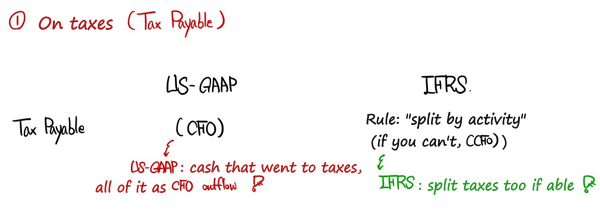
Under US GAAP, cash paid for income taxes goes into CFO outflow. That’s the tax we’re talking about here!
Under IFRS, the rule is: split it by activity if you can. If you can’t, put it in CFO. Because, for example, there are cases where taxes go out not on operating activities but on investing or financing stuff.
Like when KEPCO sold its Samseong-dong land to Hyundai Motor — the book value was about 2 trillion won, and it sold for 10.55 trillion. So the disposal gain is about 8.5 trillion won, and you owe taxes on that 8.5 trillion × the tax rate. Booking that as CFO feels kind of……… weird, right?
(Looking at this, you’d think everything can be split up. In practice, apparently, making this distinction is really hard. So a lot of listed companies just shove Tax Payable straight into CFO.)
Dividends and interest — slight pain incoming
Dividends and interest are a bit nasty and tangled…. heh heh. But it’s not that hard — let’s walk through it!
US GAAP first. Split things into stocks and bonds, and for each there’s an Issuer side and an Investor side.
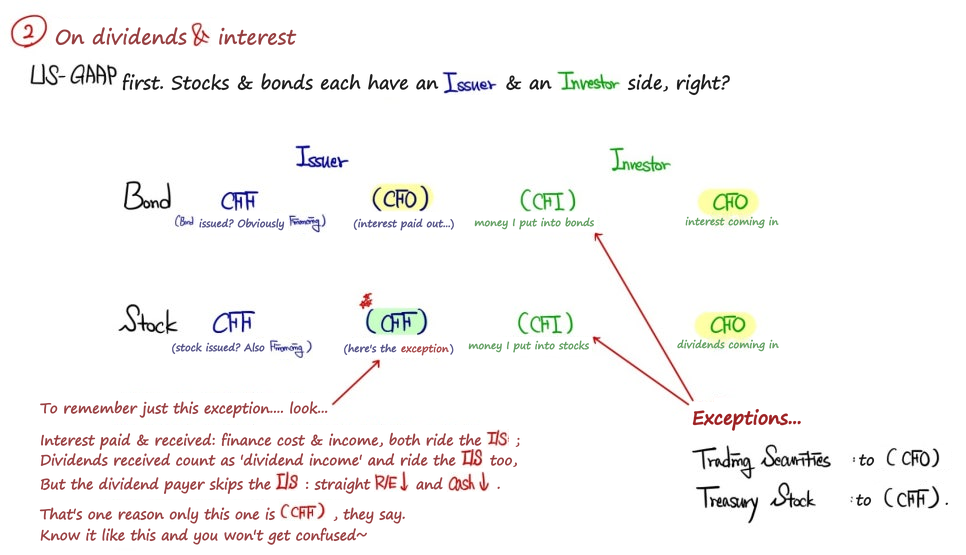
From the issuer’s side, whether you issue bonds or stock, the Cash coming in is CFF. From the investor’s side, whether you buy bonds or stock, the Cash going out is CFI. Makes total sense! Heh heh heh. Not confusing, right?
BUT — bonds or stocks you buy for short-term trading don’t go to CFI, they go to CFO. (This is also totally commonsense heh heh heh. Not hard!!!)
Now — the coupon (interest) or dividends paid in return for the investment, that’s slightly different. For interest and dividends, everything except one thing is classified as CFO.
The one exception: the issuer paying out dividends classifies the cash that goes out as CFF!
Memorize it like that and you won’t get tangled much. The minimum logic for making this stick:
- Interest: the side paying it and the side receiving it both book it as finance income / finance cost — so it’s explained on the I/S.
- Dividends received: called dividend income, so they ride the I/S too.
- But the side paying dividends? That does NOT ride the I/S. It goes straight out of Retained Earnings, paired with Cash, and out the door.
They say that’s one of the reasons why only that one is classified separately as CFF. Remember it that way and you won’t get confused!!!
Same thing, IFRS flavor
Now let’s see how IFRS handles interest and dividends~
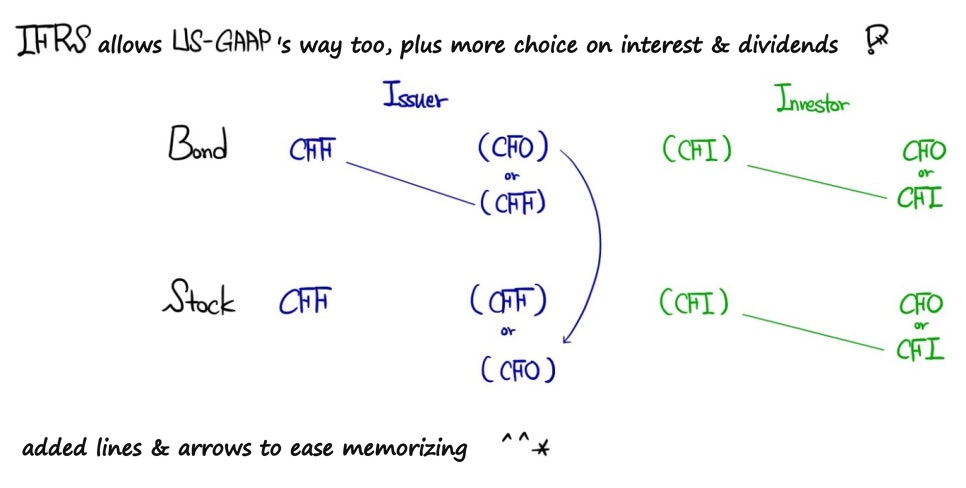
Under the IAS 7 rules used in these 2021 notes, IFRS widens the menu of choices. Pick a permitted classification and apply it consistently from period to period.
And you can spot the pattern — the extra choice lets you match each one to the bucket the original investment or financing went into!
(Here again, just pay attention to the side paying out dividends and remember it as the exception — done!)
Earlier I scared you that this part would be nasty and complicated and confusing, but now that we’ve actually cracked it open, it’s not that bad, right?!?! Heh heh.
One more detour — Non-Cash Transactions
Okay, so given a B/S and I/S, we need to see how to actually build the Cash Flow Statement….. but one more thing before that…. Let’s get Non-Cash Transactions under our belt first.
These are “transactions that have a big effect on the financial position, but literally zero effect on cash.” And the rule is that these go in the notes heh heh heh:
“Non-cash transactions aren’t reported in the C/F, but if they’re significant, they’re reported in a note or supplementary schedule.”
Example: a Debt to Equity swap (pretty much the same effect as converting a CB). The debt and the equity get swapped — the creditor becomes a shareholder — and Cash moves zero. Absolutely zero.
(Normally, Liability↓ reads as “they paid off debt” and CFF↓, and Equity↑ reads as issuing new shares, CFF↑….) Stuff like this — where it looks like Cash changed in a big way, but it actually had no effect at all — gets written up in the notes.
Okay, building the thing
Now, for real — given B/S and I/S, how do we write the Cash Flow Statement?
We need to write each of CFO, CFI, and CFF. About this: “You can write it using the direct method or the indirect method.”
Direct Method: show the major classes of operating cash receipts and payments — cash collected from customers, cash paid to suppliers, and so on.
Indirect Method: start from net income, then adjust non-cash items, accruals and items belonging to investing or financing to reach CFO.

Yeah yeah — this direct vs indirect choice is only for CFO. And under US GAAP, even if you do write CFO with the direct method, you apparently still have to show the indirect-method version in the notes anyway. (So like… who’s going to use the direct method….)
Wait, why ask for that reconciliation too? The direct version shows where operating cash came from and went; the indirect version explains why cash and accrual profit differ. They answer different questions! IAS 7 actually encourages the direct method.
So what does that indirect reconciliation help us see?!?!
Can’t explain that right now. (T_T) Because even if I told you right now, none of it would land. (T_T)
“Only when this training is all over will you know what this is!”
Okay NOW — let’s actually write the Cash Flow Statement!!! There’s an order:
- From the given B/S and I/S, classify every single line item by which bucket it belongs to — CFO, CFI, or CFF.
- Smash through CFI and CFF with the direct method.
- Smash through CFO somehow — direct method, indirect method, whichever!
We’re going to build the cash flow statement in this order, but let’s pause right here!!! Next post — we smash through the whole thing!!!
Heads-up. The figures here are the original notes, slips and all. A few things to watch for:
- In the note on the direct method, having to show the indirect method (a reconciliation of net income to operating cash flow) as well is the US GAAP rule (ASC 230-10-45-30); IFRS encourages the direct method and has no such requirement (IAS 7.18-20).
- In the tax diagram, ’taxes’ means income taxes. Other taxes follow the nature of the underlying cash flow.
- The opening cash bridge is simplified: where relevant, the effect of exchange-rate changes on cash and cash equivalents is shown separately from CFO, CFI and CFF.
- The IFRS interest/dividend choices shown here are the pre-IFRS 18 rules. From annual periods beginning on or after 1 January 2027 (earlier application permitted), most entities classify interest paid and dividends paid as financing, and interest/dividends received as investing; entities with specified investing or financing main businesses have special requirements.
- The last picture’s suggestion that indirect presentation is necessarily more useful is the author’s study-room speculation. Direct presentation and the reconciliation provide complementary information.
Comments
Discussion happens via GitHub Discussions. You'll need a GitHub account to comment.