Earnings Per Share (EPS)
Breaking down EPS the CFA way — weighted average shares, preferred stock deductions, and why dilutive securities make the whole thing a little messy.
Alright, in this post we’re tackling EPS (Earnings Per Share) — CFA exam style. The next post after this one will be the Cash Flow Statement (Statement of Cash Flows), and honestly… these two topics can get a little nasty, so I think we need to buckle up from here on out.
OK, let’s just get into it!!!!
EPS (Earnings Per Share)
You can basically tell from the name what this is —

it’s about figuring out how many shares are splitting up the net income the company earned this period….. and the catch is, this gets a little hairy.
Why? Well, the share count changes over the course of the year. Say they did a paid-in capital increase of 128,930,821 shares on December 30th — when you announce on December 31st, do you just slap that end-of-period share count in?
No wait, what share count are we even supposed to use as the base;;; because there are a bunch of different share-count concepts floating around — authorized shares, issued shares, outstanding shares… etc.?
And what about Convertible Bonds, Stock Options, Bonds with Warrants and so on that the company has issued?
Those things could come barreling in as actual stock at some point, so don’t we have to factor those in too?
Yeah. Stuff like this is what makes it a little messy…..heh
Basic EPS
OK, so let’s start from the most basic case first.
For now, let’s pretend there are zero convertible bonds or bonds with warrants — none of those compound financial instruments. Or even if there are, just assume we’re calculating the kind of EPS that ignores them for now.
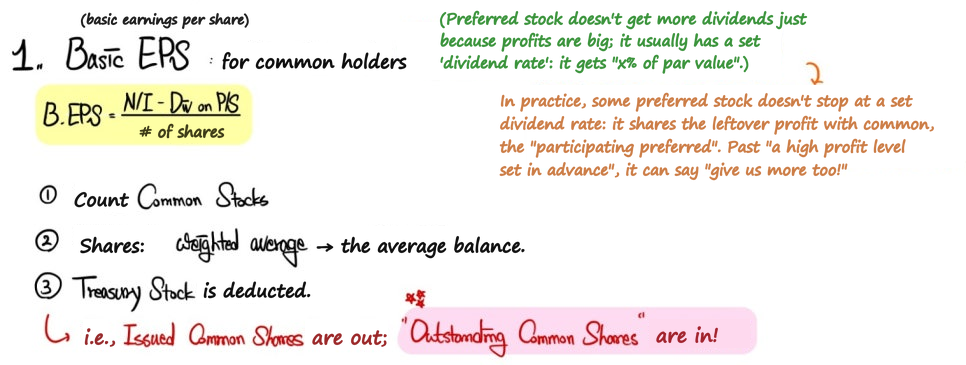
Basic EPS — earnings per share from the common shareholders’ point of view — is calculated like this: take Net Income, peel off the chunk that goes to Preferred Stock first, and then divide the leftover profit by the share count.
For the share count, you take the common shares and run a Weighted Average over the period to get the average balance. And the shares you actually count are Outstanding Shares — i.e., the shares actually circulating out there. That’s your denominator base.
(Preferred stock comes in flavors — participating/non-participating, cumulative/non-cumulative, and so on. CFA doesn’t go super deep into this part, though? Quick rundown anyway:
Cumulative vs. non-cumulative — preferred stock has a dividend rate set in advance, and that preferred dividend gets pulled out of Net Income before anything else. But this can’t always actually happen, right? Some years the company runs a deficit.
So when next year rolls around, if you just shrug off last year’s missed dividend and only deduct this year’s preferred dividend from earnings — that’s non-cumulative preferred. Whereas if next year you go “oh? we can cover what we missed last year and pay this year’s?” and you stack up the unpaid past-period dividends and pay them all out — that’s cumulative preferred stock.
And participating vs. non-participating — written there in orange — is for when profits are absurdly high and somebody pipes up: “hey!!! does it really make sense that the common stock people are each walking off with 10 billion won!!! throw something to the preferred holders too, doesn’t have to be that much but come on!!!” — that’s participating preferred.
So in the end you’ve got 4 flavors of preferred stock. Non-cumulative & non-participating / Non-cumulative & participating / Cumulative & non-participating / Cumulative & participating…… heh)
Anyway, back on track — so what does it actually mean to calculate the share count using the Weighted Average method?
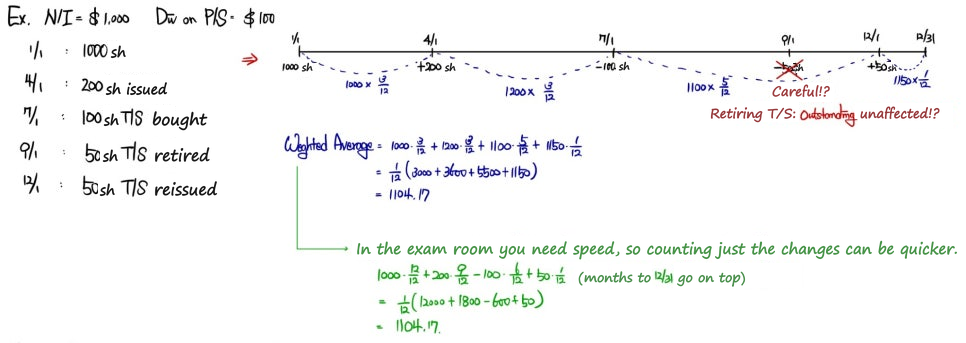
Say you start the year with 1,000 shares on January 1st, issue 200 new shares on April 1st, buy back 100 treasury shares on July 1st, retire 50 treasury shares on September 1st, and reissue 50 treasury shares on December 1st — how do you compute the weighted average share count? The number of common shares outstanding goes:
- 1,000 shares for 3 of the 12 months = 1,000 × (3/12)
- 1,200 shares for 3 of the 12 months = 1,200 × (3/12)
- 1,100 shares for 5 of the 12 months = 1,100 × (5/12)
- 1,150 shares for 1 of the 12 months = 1,150 × (1/12)
(Retiring treasury shares has zero effect on common shares outstanding — careful, that’s a classic trap.) Add it all up and you get 1,104.17. That’s your share count for the period.
There’s also a faster method at the bottom of the picture for crunching this in the exam room when you’re under time pressure, so for share-count math — just learn whichever method clicks with you and roll with it heh heh heh
OK so above we did Weighted Average for a case with treasury stock transactions.
But for cases with a Stock Dividend, Stock Split, or reverse split….. you’ve got to apply those retroactively…..
(Whether stock dividend or stock split, none of these are actually handing wealth out to current shareholders. On the B/S, a stock dividend just shifts retained earnings into paid-in capital, and a stock split or reverse split…..just changes the share count;;;)
This can get confusing fast, so probably easiest to just walk through a simple example.

Say you split 1,000 shares into 2,000 shares on July 1st. If we don’t apply that retroactively and just compute the usual way, the share count is:
- 1,000 × 6/12 = 500 shares
- 2,000 × 6/12 = 1,000 shares ⇒ total of 1,500 shares.
If net income is $1,000, then Basic EPS = 1,000 / 1,500 = 0.67;;; (this is obviously wrong. Nothing fundamentally has chaaaanged about that company!!!)
So if instead we apply that 2,000-share event retroactively: 2,000 × 12/12 = 2,000 shares, the weighted average share count = 2,000 shares, and EPS = $1,000 / 2,000 = 0.5 [$/share]. That is the right way to do it!!!
If there had been no stock split, it would’ve been $1,000 / 1,000 = 1 [$/share]. But because of the split, 1 share became 2, so someone who originally held 1 share now holds 2 shares at 0.5 [$/share], and the earnings on those 2 shares come out to 0.5 [$/share] × 2 [shares] = $1. So that all checks out!!!
Now let’s try the share count with a slightly chunkier example!
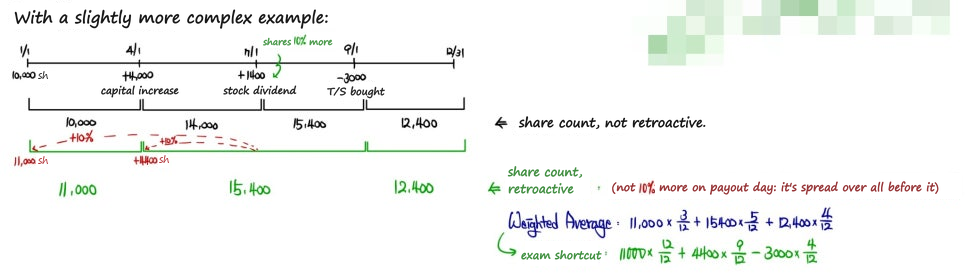
The capital increase on April 1st does not get retroactive treatment, but the stock dividend on July 1st does, so for that event you have to compute as if the share count had been running that way from January 1st all along. Meaning the calculation shouldn’t start from 10,000 shares — it should start from 11,000 shares. That’s how you get a share count without any weird discrepancies!!
OK so do you have a feel for Basic EPS at this point!!?!?!
Diluted EPS
Then let’s move on and study Diluted EPS (diluted earnings per share). This is, like I mentioned at the top — we’re looking at cases where the company has issued, alongside its regular stocks/bonds, securities that could turn into common stock (potentially dilutive securities)!!! Stuff like this:
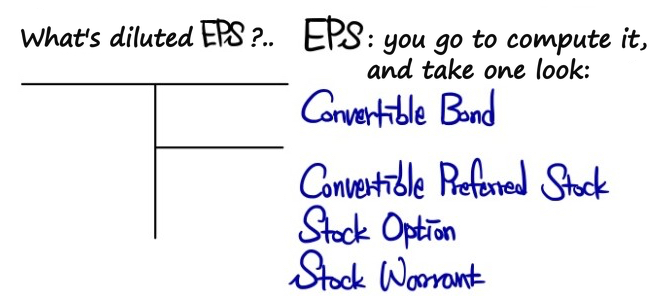
When a company has these kinds of securities on its books, based on what we’ve been doing so far, these guys aren’t Common Stock, so they get cut from the share count. Which means if EPS comes out to $1, and accounting tells the users “hey, your stock is earning $1 per share~”….
Is that really fair? There could be a ton of people who might become common shareholders down the line….
So we re-run the math from the perspective that these potential common shareholders are also going to share in the income. The EPS you get from that calculation is called Diluted EPS (diluted earnings per share).
Of course, there are also companies that have never issued anything like that (this is called a Simple Capital Structure) — in that case, basic and diluted EPS are equal. Under IAS 33 you may present them on one line labelled Basic and diluted EPS. But companies that do have those things (called a Complex Capital Structure) have to disclose both Basic EPS and Diluted EPS….
Hmm… so how do you compute Diluted EPS?
This…….. also has two methods……..

Why two? Because things that get “converted” involve “no cash” when you assume the conversion happens, while warrants or options do involve “cash” when they turn into common stock. That fundamental difference is why we have two methods: the If-Converted Method and the Treasury Stock Method.
(Put simply — someone holding a convertible bond can just hand the bond over and go “here, take this, give me common stock^.^”, whereas an investor holding a bond with warrants says “I have the right to subscribe to new shares at this set price, ok? Here’s my money, give me common stock^.^” — on one side, common stock comes in with no cash changing hands, on the other side cash actually moves in the transaction…. that’s the difference.)
Convertible bonds
OK so first let’s look at how to compute diluted EPS under the If-Converted Method. We’re going to look at a case where the company has issued convertible bonds.
For now, this company has net income of $1,000 for the period, 1,000 common shares issued, and the convertible bond terms are: face value $500 / interest rate (coupon rate) 10% / number of shares issued upon exercising the conversion right is 500 / and let’s set the tax rate at 20%.
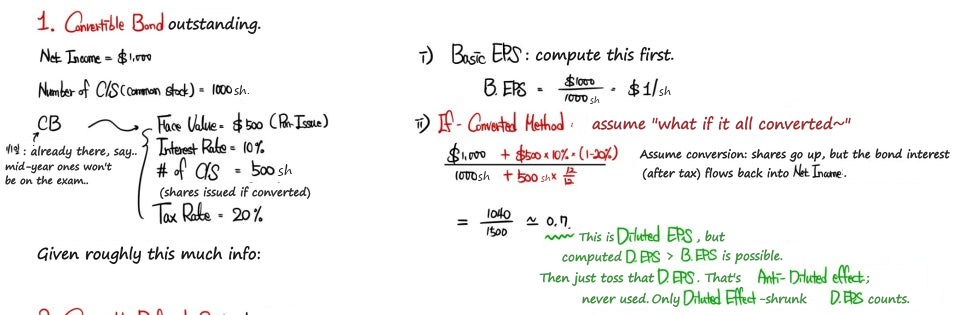
So step 1 is to compute Basic EPS first. Net income $1,000, 1,000 common shares — so Basic EPS comes out to a clean 1 [$/share] for now.
Step 2. Computing Diluted EPS via the If-Converted Method!!!! What in the world is the actual method here?
You compute it by assuming the convertible bond is fully converted~~~ and counting up the shares.
So thinking about the denominator first — 500 extra shares get issued and tacked onto the common share count. (Simply put — since this is a convertible bond that existed from January 1st, you just pretend it all converted on January 1st.)
But here’s the thing — if the convertible bond converted on January 1st, then Net Income would have changed too. Because the interest expense going out as $500 × 10% would no longer flow out as an expense, and that amount would come back into Net Income.
For this example, assume the interest is fully tax-deductible and the tax benefit can be recognised. So this comes back as profit? → tax goes up by however much profit came back → × the tax rate portion goes out as taxes, “money that came in − money that came in × tax rate = money that came in × (1 − tax rate)” — so the amount that ultimately ends up flowing into Net Income is that.
(Tax deductible: recognized as an expense under tax law. Non-tax-deductible: not recognized as an expense under tax law. In tax law — the corporate tax section in particular — they don’t actually use “revenue/expense”; they use different terms for taxable income and deductible expense. Adding to the deductible-expense bucket means recognizing it as an expense for tax purposes — basically “treated as an expense~”, roughly.)
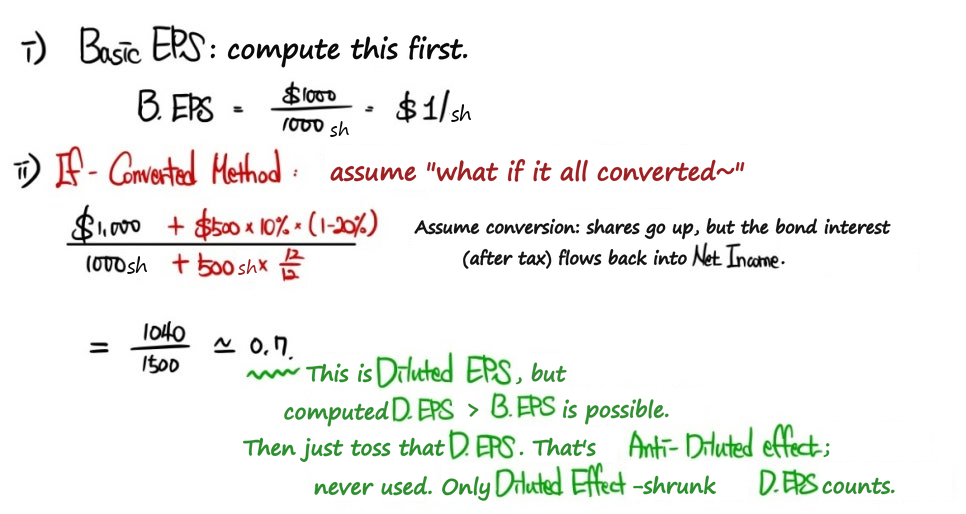
That image is a written-out version of this calculation — you’re following, right!?!?
Hey, mister, isn’t this example waaay too easy?! I mean, the convertible bond could have been issued in April, and what happens when the terms change midway, “AAAAAHHHH!!! Please, no!!!” hahaha
Because CFA isn’t out here testing the gory details of accounting treatment.
(They don’t even ask that much for CPA heh heh heh — I think being able to use the Method without getting tripped up on a simple example like this is plenty heh heh.)
Convertible preferred stock
OK now this time, let’s also look at the case where Convertible Preferred Stock has been issued! Preferred stock, preferred stock!!!! Above for convertible bonds, we had a Coupon Rate. This time, instead of a coupon rate, we’ll have a fixed dividend rate riding along!!!!
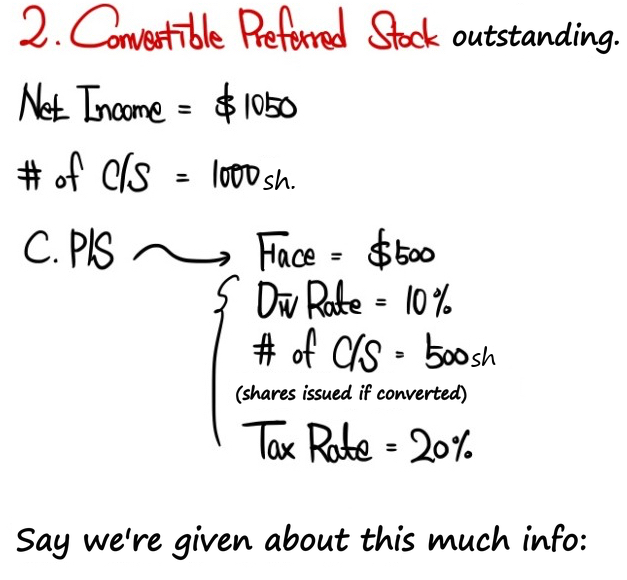
But with convertible preferred stock, the parts that look starkly different from convertible bonds are — first, when computing Basic EPS,
- you have to consider the preferred dividend that’s deducted off the top to the preferred side, and
- the “tax rate application” part when applying the If-Converted Method.
Before, we had this thing where “the Interest Expense that would’ve gone out, if conversion hadn’t happened, comes back into Net Income, and since that interest had originally flowed out without paying taxes on it, when it comes back it gets the tax rate applied to it” — but here,
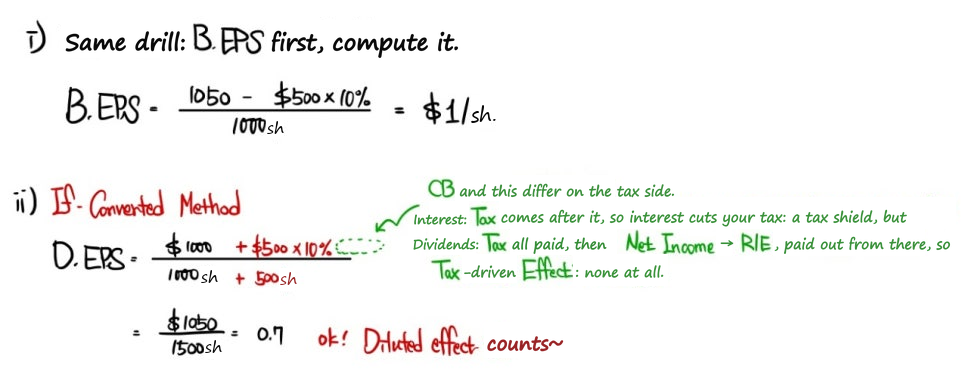
So… the calculation…….. shifts a little like this. You’re tracking the logic, right!?!?
It’s just one of those things where you need a lot of practice to crank through the calculation quickly without getting tangled up when you’re solving problems ^^? So personally I think this is a section that needs a lot of Mock practice.
Stock options and warrants
OK let’s keep pushing. For the case where the company has issued Stock Options, Stock Warrants and that sort of thing ~ (what everyone casually calls “stock options”… the accounting standards actually call “share options”:-)))
For these, the If-Converted Method doesn’t apply. Because for these guys it’s not really a “conversion” question. For these guys, the question is fundamentally “exercise or not.”
With bonds with warrants, when someone walks up and goes “I’d like to exercise!”, you have to issue new shares at the pre-agreed exercise price and hand them over???
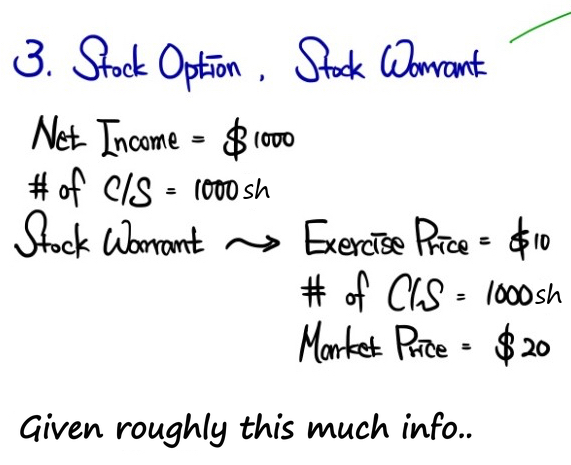
Let’s say we’re given this much info.
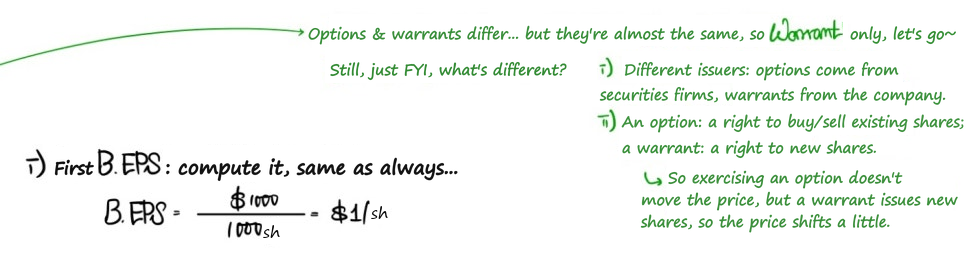
Yeah and here too, same deal — you’ve gotta compute Basic EPS first before you go in.
So instead of the If-Converted Method, what method do we use here for Diluted EPS?!
What if, what if, what if — using a similar idea to the If-Converted Method we used before, what if we made a method that just assumes “everything got exercised” — let’s call it the If-Exercised Method, or something like that.
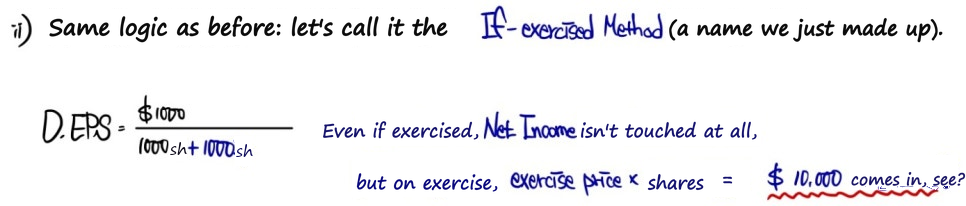
If you treat it as exercised, the investor holding the option hands over the corresponding amount of cash, and all you have to do is issue and hand over the promised number of shares…. the transaction closes out clean.
And if you think about it — that cash that came in has absolutely no effect on Net Income. Which means even assuming exercise, there’s no Net Income that needs adjusting. So what we do here is —
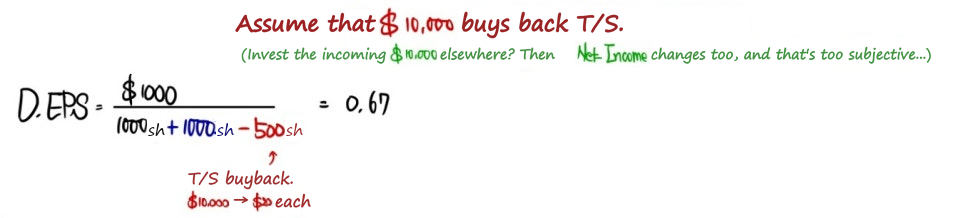
Yep…. we assume treasury stock is bought back.
So then…….. the method of computing Diluted EPS this way isn’t called the If-Exercised Method, instead it goes by the name Treasury Stock Method :-).
Bottom line — for options and warrants, when Exercise Price < Market Price (the average market price over the period) holds, the cash that comes in at the exercise price can’t buy back as much common stock from the market as the amount of common stock that just got created, so the assumed exercise adds incremental shares. With positive earnings in these simple examples, that dilutes EPS. But with a loss from continuing operations it can be anti-dilutive, so those shares are excluded.
In other words, when you’re working a problem, whether or not there’s a dilutive effect is something you can already eyeball just from reading the problem, and if the market price is in a range where no dilutive effect would occur, exclude that instrument from diluted EPS — you still report the required diluted EPS figure, which may equal basic EPS. That’s how you use it :-).
Whew, this is really the end now. After this, once we knock out the Cash Flow Statement, we’re truly done heh heh heh
Whoaaaaaaa — the crown jewel of the financial statements!!! Let’s hit the Cash Flow Statement!!! Let’s gooooo!!!
Heads-up. The figures here are the original notes, slips and all. A few things to watch for:
- The green note on options vs warrants describes exchange-traded options. The stock options that count in diluted EPS are the ones the company itself grants (like employee stock options): just like warrants, they are issued by the company, create new shares when exercised, and go through the treasury stock method (IAS 33.45-46; ASC 260-10-45).
- For basic EPS, deduct the current period’s cumulative preferred dividend whether declared or not; deduct non-cumulative dividends declared for that period. Paying cumulative arrears from earlier years does not mean deducting them again this year. Participating securities may require an earnings allocation as well.
- Dilution testing uses profit or loss from continuing operations attributable to ordinary holders as its control number. Instruments increasing EPS or reducing loss per share are excluded; when several instruments exist, test them in the required dilutive order.
- The worked convertible bond assumes interest expense equals its coupon and a full tax benefit. In a less simplified case, use the actual after-tax interest and other income effects that conversion would avoid.
Comments
Discussion happens via GitHub Discussions. You'll need a GitHub account to comment.