Cash Flow Statement and EBITDA
Building a Cash Flow Statement from a real B/S and I/S — tagging every line O, I or F, smashing out CFI, CFF and CFO the direct way, getting the same CFO the indirect way, and what EBITDA leaves out.
Picking up right where I left off in the previous post, Cash Flow Statement. At the very end of that post, I laid out the recipe for putting together a Cash Flow Statement:
- From the given B/S and I/S, take every line item and tag it as O, I, or F.
- Smash out CFI and CFF using the direct method.
- Smash out CFO using either the direct method or the indirect method.
So now we need a B/S and an I/S to actually work with, and I’m about to throw one at you!
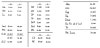
Given a B/S and I/S that look like this, and assuming we’re under US GAAP — step 1, if we tag each item as O, I, or F,
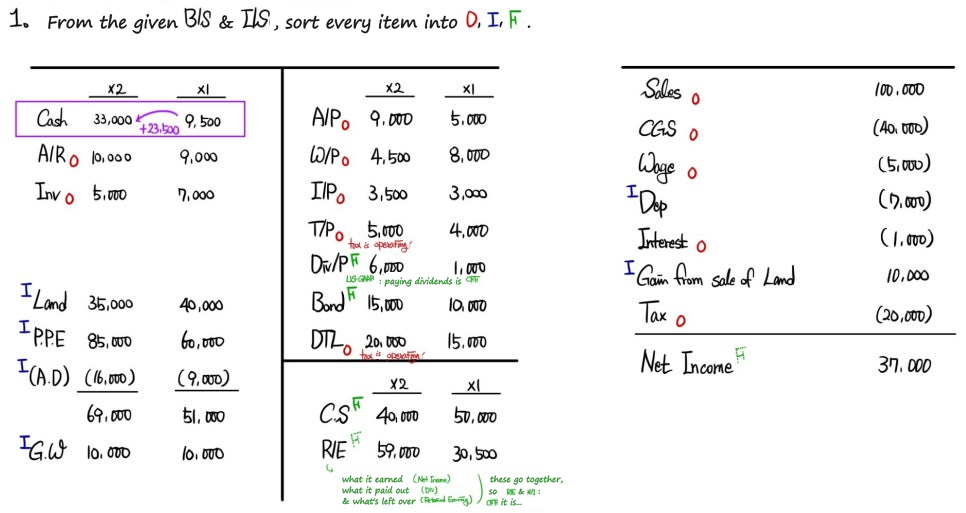
For now, the stuff highlighted in purple is the conclusion we’re heading toward. Cash went from 9,500 to 33,000, and we’re going to figure out exactly what made it move~
On the long-term asset side — Land, P.P.E, (A.D), G.W — those guys all belong to Investing activities…… This is one of those things that… no matter what… you just have to memorize… but since these financial statements are so simple, it doesn’t really feel hard…. heh heh
- AD: Accumulated Depreciation
- GW: Goodwill <- Looks like they acquired something. And that’s the intangible asset that landed on the books~
Over on the Financing side, Dividend Payable under US GAAP is an F activity, and the bond and stock issuance pieces are obviously F activities, but Retained Earnings is a little ambiguous.
The R/E side requires you to look at all of it together — how much the company earned this period (Net Income), how much got distributed as dividends (Dividend), and what the ending Retained Earnings ends up being….. R/E already has its own dedicated little template for analysis, you see…. So for now, the point is — I just dumped it under F anyway!!! (Not important!)
OK so step 1 said classify everything, and since everything’s classified, let’s roll into step 2!
2. Smash out CFI and CFF using the direct method!
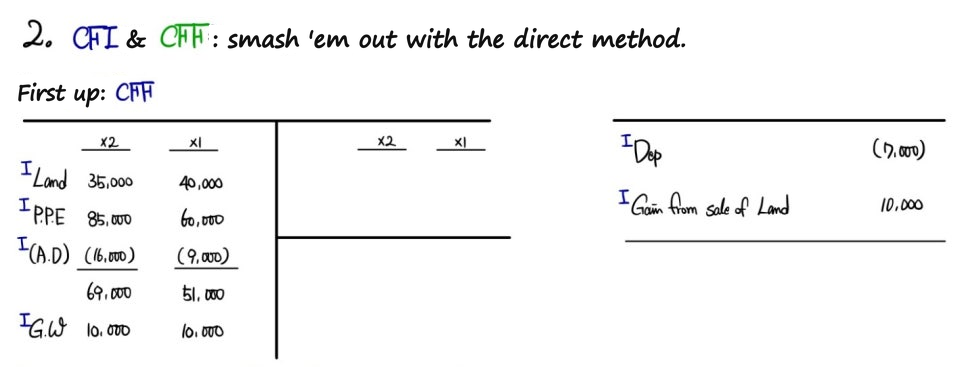
Alright, let’s start smashing them one by one — kicking off with the most representative one, P.P.E, using the direct method!
(Instead of writing out in words how to smash with the direct method first and then doing it, just watch how it unfolds and you’ll get what “smash with the direct method” means!? For now, I think one look at it should be enough!)
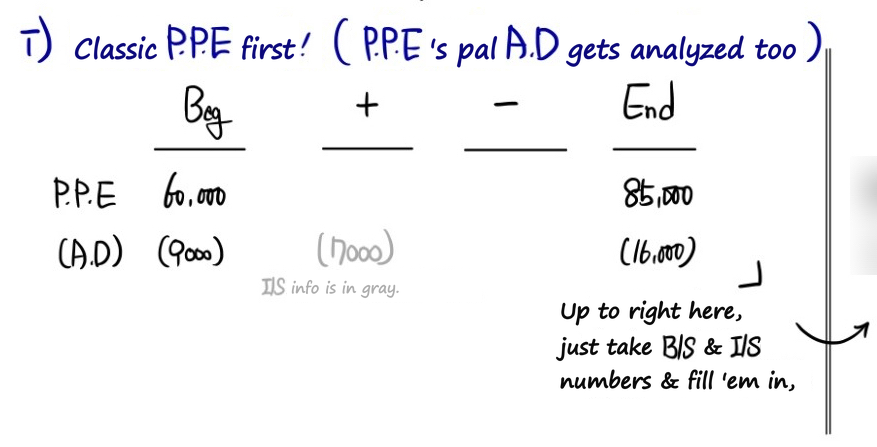
So the basic analysis template looks like this! What was at the beginning, what went in, what went out, what we ended up with at the end.
The beginning (last year’s ending B/S) and the ending values come straight from the B/S — written in black — and since this year’s depreciation expense from the I/S gets piled onto accumulated depreciation on the B/S, the I/S info is written in gray. From here, we just trace through the remaining empty cells one by one and the entire P.P.E story falls into place, so let’s trace it out!
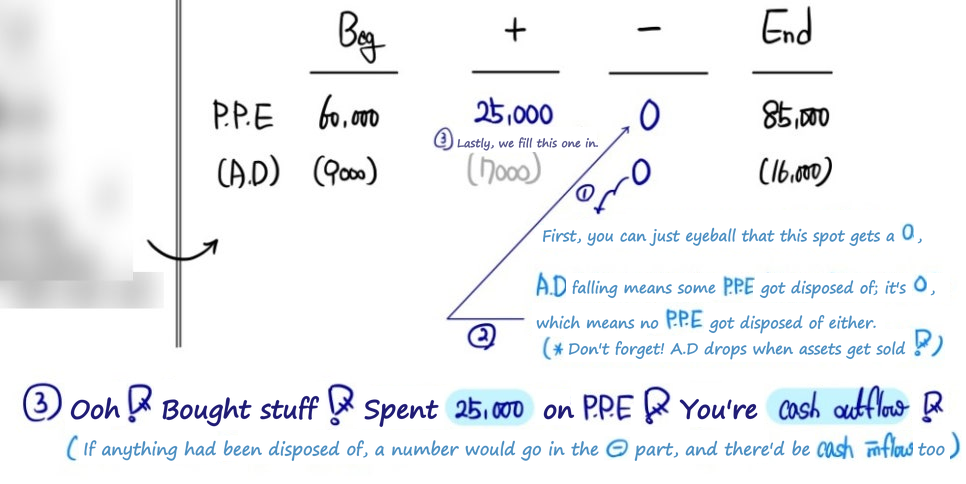
- For now, there was no event that would have decreased accumulated depreciation. (There could be one if a fixed asset got disposed of.)
- For this simplified example, assume no disposals or other unreported adjustments, so nothing goes into P.P.E’s(−) column either. In real statements, an asset with no accumulated depreciation could still have been sold!
- Wait WHAT?!?! The ending fixed asset value is 85,000?!? Ohhh, so we can confirm 25,000 of PPE got picked up this year!!!!
(There’s a chance it was bought on credit… then there’d be a non-trade payable for it, an “other payables” account… phew,,, there isn’t one, there isn’t. lol But — would the CFA exam even ask something this granular…? It wouldn’t, right…?!)

The remaining 2 don’t have account items that need to be looked at as a pair, so they wrap up nice and clean. And just like that, all CFI analysis is done.
Cash inflow from Investing activities is 15,000, cash outflow is 25,000. So our cash flow from investing activities lands at (10,000)!!
OK now let’s hop over to Financing activities!
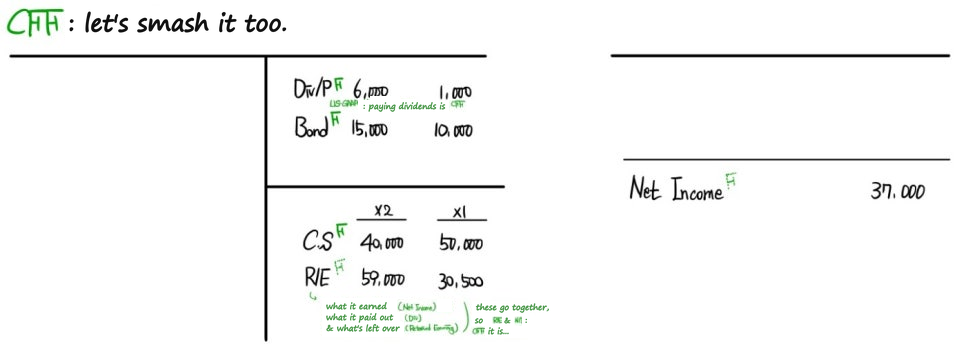
This is the chunk we said we’d look at! Let’s hit them one by one!

For bonds — sure, they could go up via new issuances, but if a discount bond was issued, the amortized cost would also be slowly, slowly creeping up too, right?!?! I went into truly painful detail on the effective interest method back here: Effective Interest Rate Method: A Complete Accounting Guide!
But — apparently there’s never been an exam question that actually makes you factor in Bond BV creeping up from the effective interest method…. For this example, assume the change comes entirely from a new issue at par. In any question, use the facts given — amortisation, repayments and non-cash conversions can also change the carrying amount!
And we need to look at Dividend Payable, and the dividend piece needs to be looked at jointly with Net Income and Retained Earnings, and the way to look at it is,
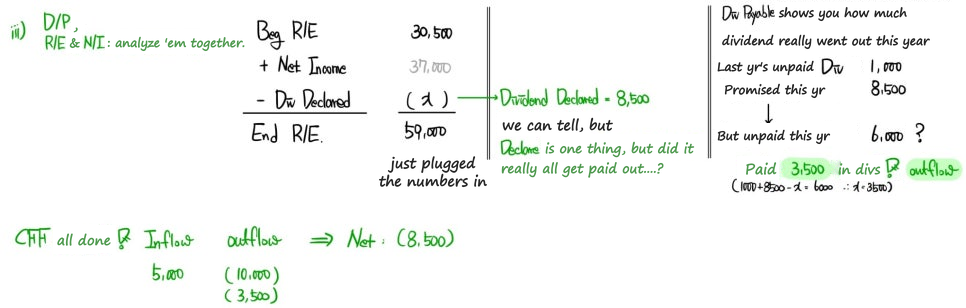
Pretty simple, right. Net Income gets added to beginning retained earnings, and however much dividend was declared gets logged as Dividend Payable, so it’s basically a solve-for-x game with a first-degree equation.
But there’s also the question of whether the amount logged as Dividend Payable actually went out as cash — and that’s a piece we have to think about too. Once we understand the situation where D/P — meaning “money promised to be paid as dividend” — has changed, we can work out that the actual cash that went out as dividends this year is 3,500.
Getting THIS part really, really, really, really nailed down right now is going to make life way easier when we tackle the indirect method later!! But — even if you get it here and still find it a bit fuzzy, that’s fine. Once you study the indirect method, you’ll get all of it anyway ^.^
Anyway, CFF analysis — also done. Step 2 is officially complete. Now I guess it’s time to head into the long-awaited step 3.
3. Smash out CFO, the direct way first
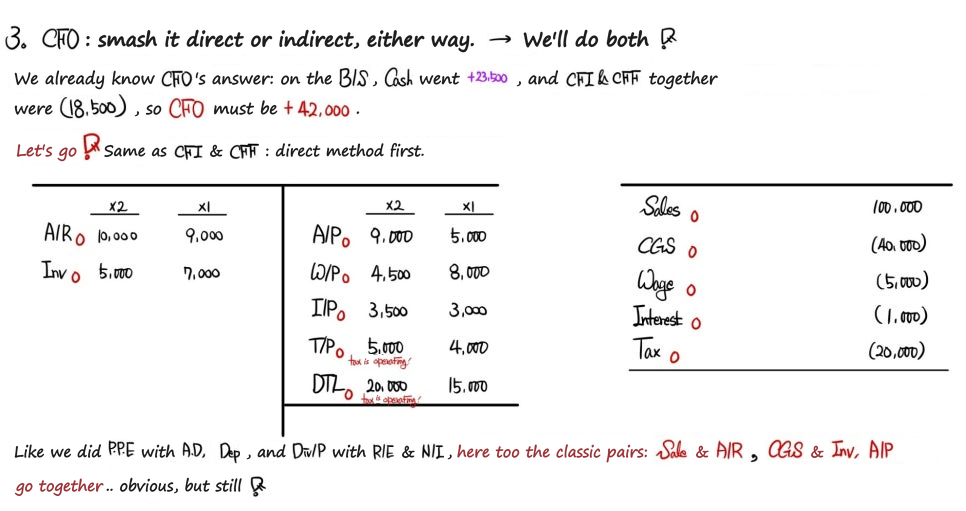
The conclusion so far was a cash outflow of (18,500), and at the very start we already peeked at the answer key: we knew there’d be a cash inflow of 23,500.
So the CFO conclusion absolutely has to be a cash inflow of 42,000!!!!
For now, we’ll try this with the direct method first, and the direct method is what we’ve been doing all along, so it won’t be hard!!!!! Just do exactly what we did before.

Wouldn’t it be magical if the sales number on the I/S could just represent the entire amount that came in as cash. But since companies typically transact on credit way more often, to figure out how much of sales actually came in as cash, you have no choice but to back it out using the credit sales info.
So we wrote the formula as Cash = Sales − ∆A/R. (This part you really need to internalize! It carries straight through to the indirect method :-))

Since the amount that left as expense for CGS would be the amount that flowed out as cash, we’re saying — OK, let’s analyze this part. CGS is something that gets recognized under the matching principle only for “inventory that actually got sold,” so it has to be analyzed together with inventory.
And when securing that inventory, we may have bought it on credit, right? In other words, there’s inventory that increased without using cash, so to factor that in too, Accounts Payable also has to be considered.
So in the end, we wrote the formula as Cash = −CGS − ∆Inventories + ∆AccountPayable, and ideally you understand it logically, but…………. as a way to just memorize it easily….

(But blind formula memorization without principle is always dangerous, so it really matters that you feel in your gut why that formula makes sense. T_T)
(Sorry, that was a comment from a nerdy physics major. T_T lol The trait that all physics people share is…. they will absolutely never memorize a formula…. lol)
Anyway, since we’ve got the principle down, the rest should wrap up easily.
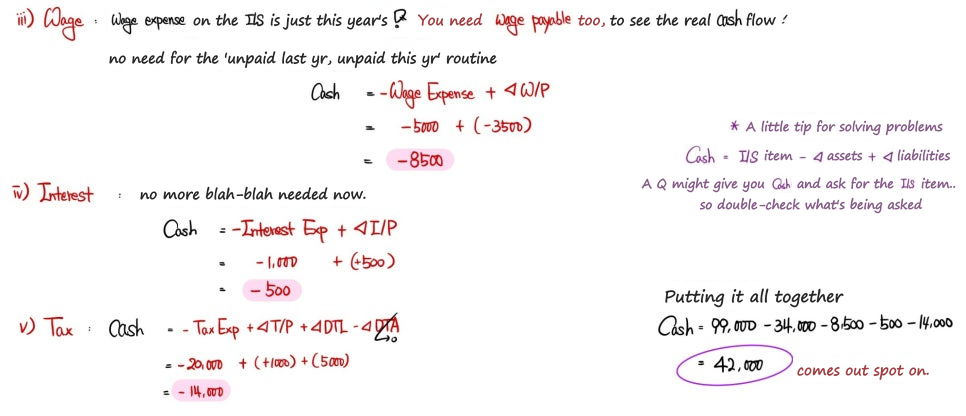
Cash = (I/S item adjustments) + (changes in related Liability accounts) − (changes in related Asset accounts)
Computing with this formula is super convenient, and as long as you correctly identify which related accounts you’ve been handed, calculating cash inflow/outflow honestly doesn’t seem hard anymore.
CFO, the indirect way
But hold on — looking at the CFO side, every CFO-related account item runs through this one formula:
Cash = (I/S item adjustments) + (changes in related Liability accounts) − (changes in related Asset accounts)
Doesn’t that mean we could just do all of it in one shot?!?! Can’t we just blast through it in a single move??
Yep. Exactly. The thing that processes it all in one shot is — drumroll — the indirect method CFO cash flow statement.
For now, just pretend Net Income is entirely CFO.
What kind of nonsense is THAT!?!? Net income clearly has stuff mixed into it that affects CFI and CFF too, doesn’t it?!?!
Yes yes yes yes yes yes, you’re right. So the things buried in net income that belong to CFI or CFF (like the gain on the land sale), along with non-cash charges like depreciation — we offset them back out.
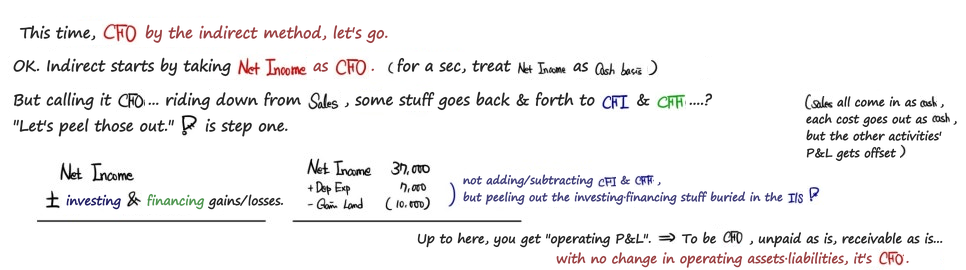
That gives a subtotal before the operating cash-timing adjustments — not the I/S operating-profit figure.
And we already learned this when we did the direct method earlier: the amount the period’s profit and loss moves things by doesn’t all come in or go out as cash. Whether it’s because of credit transactions, or because the cash inflow or outflow gets delayed or sped up for other reasons, by exactly that amount an asset or liability item on the B/S gets created, and we have to factor that in too to actually know how much cash came and went.
So if we factor in changes in operating-related assets and liabilities on top of that, that’s our cash flow from operating activities.
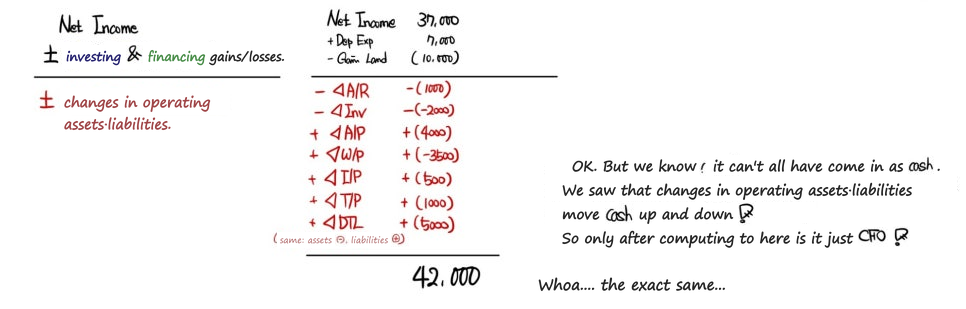
Goooooooosebumps!!!! — nope, no goosebumps lol, it’s an obvious result lol
Why?
Because there’s literally no reason the calculation above should differ from the direct method we just did. heh heh
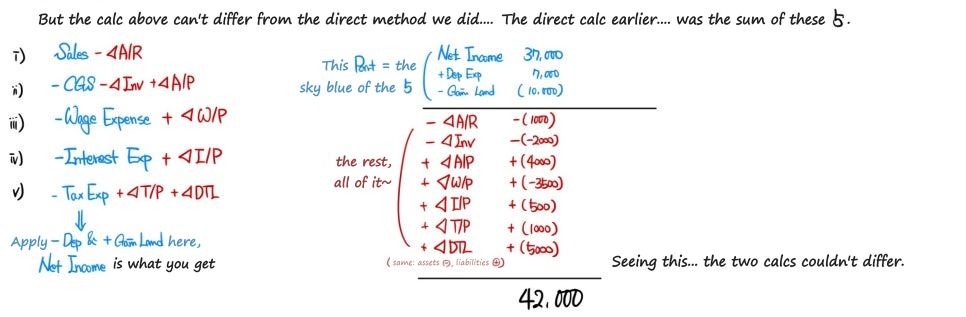
There’s no way they’d differ…….heh heh heh
Wrapping up the cash flow statement
Alright then, let’s wrap up the cash flow statement.
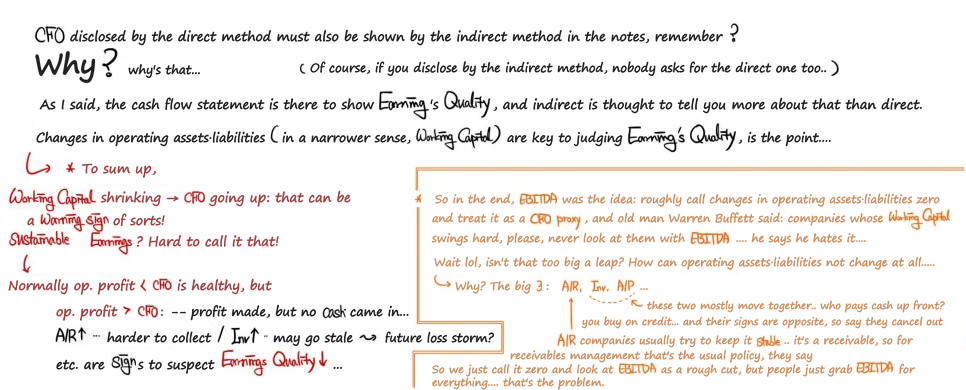
We said that under US GAAP, if CFO is disclosed using the direct method, you ALSO have to write it out in the notes using the indirect method, right??? (Of course, folks who disclosed via the indirect method don’t need to add a direct-method version in the notes.)
Why….. do they make you do that?
As I mentioned earlier, the cash flow statement was meant to show the quality of earnings, and the reconciliation makes the gap between accrual profit and operating cash visible. The direct version answers a different question: where the cash came from and went. They complement each other.
Changes in operating-related assets and liabilities (in a narrower sense, Working Capital) are the core of what “quality of earnings” means. A decrease in Working Capital pushing CFO up can be a kind of warning flare, because it’s hard to see that as sustainable earnings!
One useful check is whether net income persistently outruns CFO. That can flag aggressive accruals, but growth, seasonality and ordinary payment timing can also explain a gap — it isn’t an automatic failure!
A/R ↑ … the chance of not collecting it goes up / Inv ↑ … it might get obsolete.. ☞ These could come back as a storm of future losses — stuff like this is also a suspicious sign that drags down earnings quality!!!
On EBITDA
Now now now now. Now we can finally talk a little about EBITDA.
For this simplified I/S, EBIT matches operating profit; in other statements non-operating items can make them differ. Inside it sits Depreciation & Amortization, which isn’t actually an expense that left as cash. Since it’s an amount that didn’t actually leave the building, but already pulled operating profit down, let’s add D&A back to EBIT.

Not much different, right???? (Well, apart from interest and taxes: EBITDA comes before them, and the line up there comes after them.)
EBITDA is an earnings-based rough cash-generation proxy. To reach CFO here, we still need cash interest, cash income taxes, working-capital changes and any other non-cash adjustments. Zero change in working capital alone isn’t enough!
(The history of cash flow statements being included in financial statements isn’t actually that long, and apparently in the truly distant past, people used EBITDA to roughly estimate CFO.)
The lecture attributed a working-capital warning to Buffett. His documented 2002 letter makes another sharp point: depreciation represents a real cash outlay paid earlier. Adding it back doesn’t make the economic cost of maintaining assets disappear.
But hold on — how can you just roughly assume changes in operating-related assets and liabilities are zero and use that as a CFO proxy???? Isn’t that way too big a leap!?!?
Fair question. The big three of operating-related asset and liability changes are A/R, Inv, and A/P. Since companies basically never just walk in and pay cash on the spot for inventory, Inv and A/P generally move in similar directions, and since one’s an asset and one’s a liability they cancel in opposite directions — but their changes needn’t be equal: purchases, payment terms and inventory holding periods differ. Don’t simply cancel them!
The key one left is A/R, and for A/R, companies normally try to keep it in a stable state — apparently companies run this kind of company policy of maintaining it through receivables management. But a stable collection policy doesn’t mean an unchanged receivables balance — sales growth alone can raise it. Only use a zero-working-capital-change assumption when the facts support it, and still allow for interest and taxes….
And once you study Level 2, you’ll also hear that in practice EBITDA actually gets used a LOT for Valuation…… heh heh heh
Whoa, the cash flow statement is DONE! Wooooooo!
After this, the plan is to actually wrap up FRA in about one more post’s worth!!!! FRA — you’ve worked hard all this time~
What subject should I tackle next……? What would be fun?????? The remaining subjects are also ridiculously fun lol heh heh
lol finance is fuuuuuuuun~~~
Heads-up. The figures here are the original notes, slips and all. A few things to watch for:
- In the heading of step 2, the first part worked out is CFI, not CFF: the table under “First up” (Land, P.P.E, accumulated depreciation and goodwill) is the investing side, and CFF comes after it.
- In the wrap-up note on earnings quality, the usual check compares net income with CFO, not operating profit: operating profit comes before interest and taxes, which CFO has already paid (interest under US GAAP), so operating profit above CFO is not a warning sign by itself. In this example, operating profit is 48,000 and CFO 42,000, while net income,37,000, sits below CFO in this example. Neither ordering is a universal test; investigate persistent gaps in context.
- Having to show the indirect method as well (a reconciliation of net income to operating cash flow) when CFO is disclosed with the direct method is the US GAAP rule (ASC 230-10-45-30); IFRS encourages the direct method and has no such requirement (IAS 7.18-20).
- The O/I/F marks sort the example’s analysis, not every line’s cash classification: depreciation and goodwill impairment are non-cash; retained earnings combines operating earnings and dividends. Changes in a balance-sheet account need not equal cash flows.
- The example assumes no acquisitions, FX effects, write-offs, non-cash asset purchases, debt conversions or other unreported changes. In practice, beginning/end B/S and I/S alone may not determine every gross receipt and payment.
- Picture 021’s earnings-quality/EBITDA discussion is simplified: a temporary working-capital release is not recurring earnings, but can be healthy efficiency; inventory and payables do not automaticallyoffset, and receivables management does not establishzeroΔAR. EBITDA also differs from CFO through cash interest/taxes and other noncash items.
Comments
Discussion happens via GitHub Discussions. You'll need a GitHub account to comment.