Free Cash Flow and FRA Wrap-Up
Putting a period on FRA: FCFF and FCFE built up from net income (discounted at WACC or at the cost of equity), cash flows across a company's life cycle, cash-flow ratios, who sets the standards and who enforces them, SEC filings, what makes information useful, reporting quality, the fraud triangle and the four audit opinions.
Alright — time to put a period on FRA!!!!!! The important stuff is all done, so this part you can honestly study lightly. Think of it as sweeping up the leftover bits.
Free Cash Flow to the Firm (FCFF) & Free Cash Flow to Equity (FCFE)
Can I really call these “leftover bits”??? These Free Cash Flows are the core variables in Valuation, aren’t they?
Hmm… well…… the thing is, at the Level 1 standard, FCFF and FCFE get covered way more thoroughly in other subjects — corporate finance, Equity…… That’s my excuse.
Anyway, when it comes to valuing a company, FCFF and FCFE are absolutely the main characters! But since FRA introduces them lightly too, let’s take a rough pass here as well!
1. Free Cash Flow to the Firm (FCFF): cash available to debt and equity capital providers after operating needs and reinvestment. ‘Free’ doesn’t mean exempt from debt covenants or other restrictions.
Formula first:
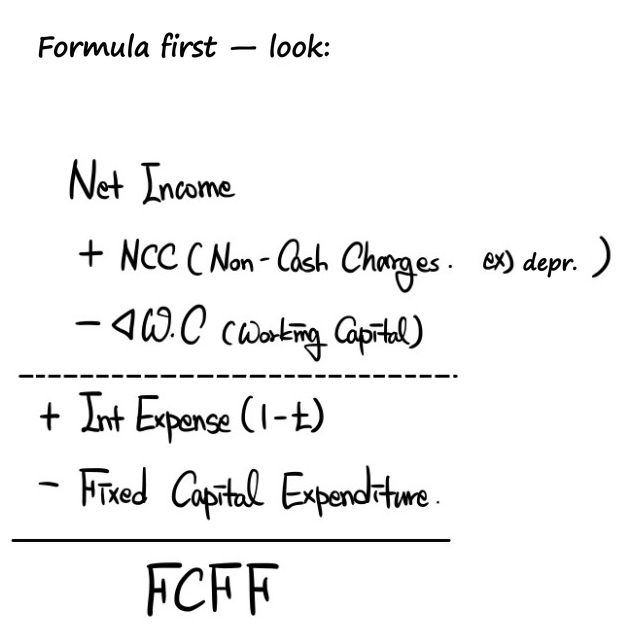
That’s the textbook definition of FCFF. But we actually need to understand it, so let me unpack it a bit:
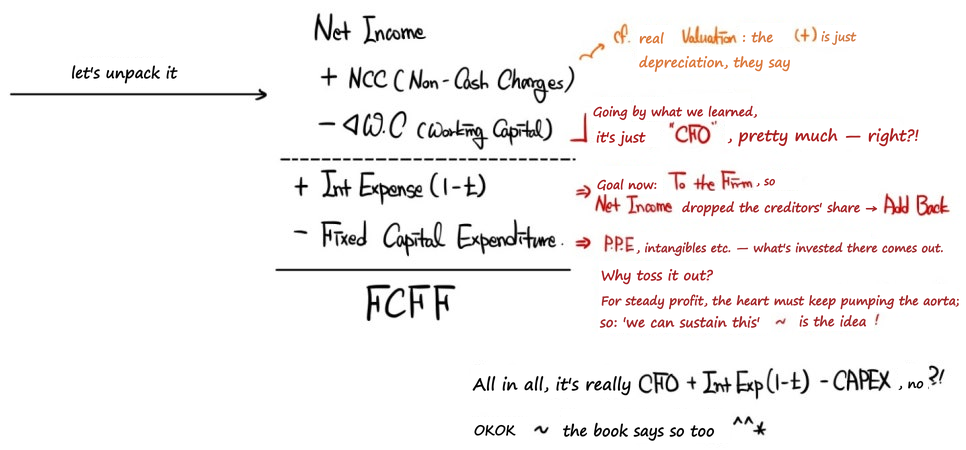
To actually do a Valuation, we need to put future Cash Flows on a timeline — and it’s a stretch to just slap the company’s Net Income from the I/S onto that timeline… Back in the day, a 10-billion-won machine got bought to start the business, and the 10 billion was actually paid out at that moment. But because of the matching principle, it keeps showing up as an expense getting charged off even now…
So we add back those kinds of non-cash expenses. And then subtracting investment in non-cash operating working capital gives the simplified CFO bridge used here. Exclude cash and interest-bearing debt, and include any other required non-cash adjustments.
But right now we’re not trying to calculate CFO. We’re trying to sum up all the free cash flows coming into the Firm. So — “creditors” are part of the company too, right? So we add back the chunk that went out to them.
And then what we subtract is Fixed Capital Expenditure. That is, investments in tangible assets, intangible assets, etc. have to be deducted. Because — in order for current earnings to keep going, that level of fixed capital spending has to keep flowing out continuously. It’s kind of like a cost being sacrificed for the current revenues?
For the CFO convention used here — cash interest classified as operating — add back after-tax interest and subtract net fixed-capital investment. If reported CFO classifies interest differently, adjust the bridge consistently.
So that’s how we calculate FCFF for one period. And then —

you crank out all the FCFFᵢ’s one by one, and you all know this Valuation Method —
$$V = \sum_i \frac{FCFF_i}{(1+r)^i}$$take the discounted sum of all expected future FCFFs to value the operating business!!!! If the explicit forecast stops at yeark, include a terminal value for later cashflows; add non-operating assets separately when appropriate. FCFF is one of the most commonly used things to put in the numerator here.
So the thing that matters is: what value of $r$ do we use to discount with?
Since FCFF is “To the Firm,” it has to get discounted at a rate that represents both creditors and shareholders — and the concept that matches this is WACC (Weighted Average Cost of Capital).
I’ll explain the WACC concept later for CFA purposes, but I actually studied it back in my uni corporate finance class, so for now I’ll just link that post lol: Cost of Capital
2. FCFE (Free Cash Flow to Equity): rather than looking at the company as a whole, let’s look at the Free Cash Flow purely from the shareholders’ perspective. So this is the concept you use when you want to value the stock rather than the company :-) Since we already went through FCFF, this should go pretty quick.
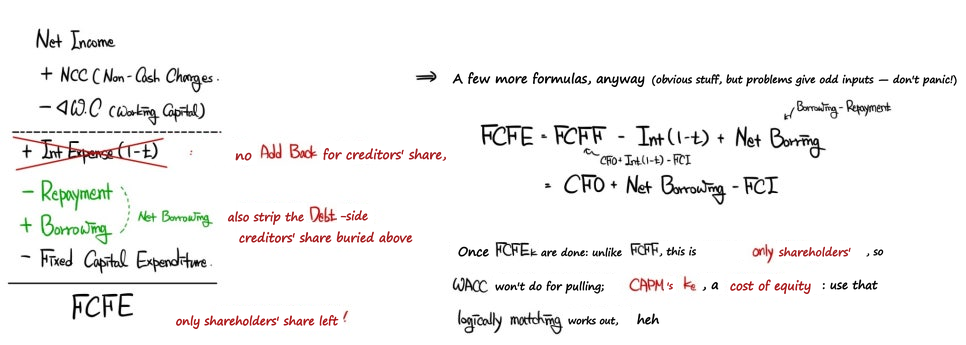
Strip the creditor-related part completely out of FCFF → that’s FCFE. Heh. And since this is cash that belongs only to shareholders, if you use a Valuation Method like this one,
$$V = \sum_i \frac{FCFE_i}{(1+r)^i}$$the $r$ here logically should not be WACC, but instead the required return on equity — keep that in mind!
There’s a bunch of stuff to learn about how to compute the required return on equity. The most representative tool is CAPM: CAPM (Capital Asset Pricing Model) Oh my god… it’s a corporate finance party in here…..
And there’s more to learn. If CAPM defines and derives one factor, you can also use the Fama-French Model (3-Factor Model) which uses 3 factors. Or a simpler estimate, with its own limitations — Bond Yield + Risk Premium: take the long-term bond YTM of that company, then tack on the premium that attaches for being equity.
Why is this arguably more reliable?
The bond yield contains information about that issuer’s credit risk, but also liquidity and market conditions. Adding a judgemental equity-risk premium gives an estimate — not all risks are automatically captured and no method is always more reliable.
You’ll learn this in more detail in corporate finance!!! Don’t worry!!! …wait. Was this Equity?!?! That’s how blurry the boundaries between subjects are in CFA. Understanding it all holistically really is important……… lol. Moving on!
Cash Flow patterns by stage
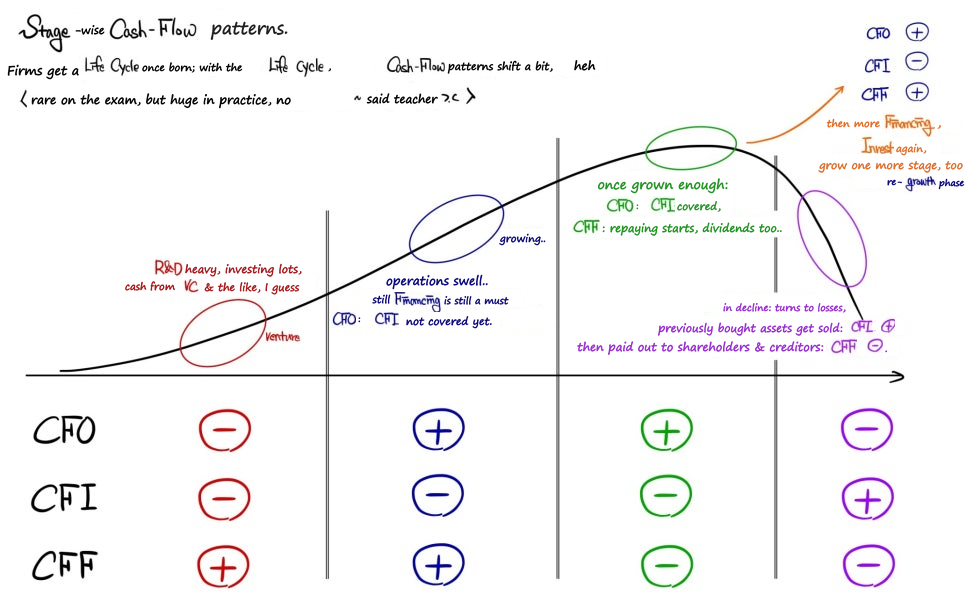
For this……… well……… it’s all written right there (crying)… Nothing particularly extra to say, it’s just the rough logic laid out — and since this can show up as a multiple-choice question and you have to memorize it precisely…. no matter how well you get the logic, memorizing it is….. a different domain entirely….. Hang in there everyone (crying) heh hahaha
Other Cash Flow Ratios
Earlier when we did the various financial ratios — Financial Ratios (1) and Financial Ratios (2) — that was all before we learned Cash Flow. So the financial ratios involving cash flow from operating activities didn’t get covered there.
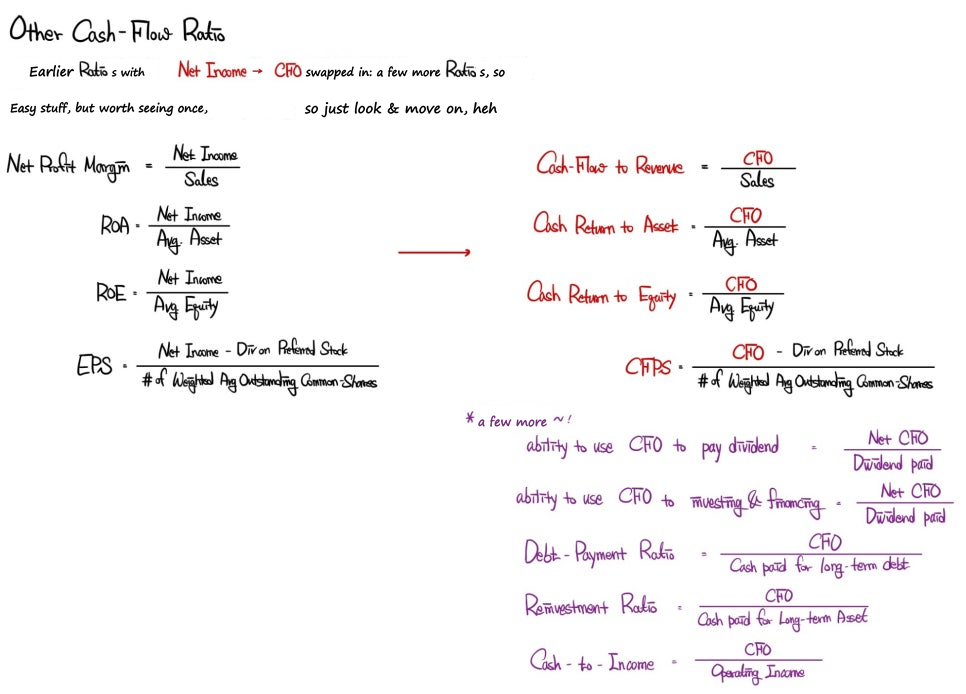
But honestly, nothing especially hard about it…. basically Net Income just gets swapped for Cash Flow from Operations. Doesn’t seem too bad.
But lol — the concept isn’t hard, sure, but whether you’ve memorized this accurately? That’s, again……. a different domain…… All I can say is hang in there…. heh. heh. Han…..ging….. in…… there……… lol
Standard-setting bodies and regulators
Wow, we really have to know even this stuff…. lol. But it does seem like exactly one question about this tends to show up. Better know it…..

First thing: the place that creates accounting standards and the place that regulates them are different.
For our country: accounting standards are handled theoretically by the Korea Accounting Institute, but direct regulation is done by the FSS (Financial Supervisory Service) — although the FSS is a subordinate of the Financial Services Commission and basically runs as a delegated arm of it…. Either way, the top authority for financial regulation is the Financial Services Commission…..
Of course this kind of content doesn’t show up as a CFA question — just general background. What shows up on the exam are the US and European cases. But for exam purposes, simple memorization shouldn’t be too bad. Heh.
The standard-setting bodies create the accounting standards, and the side that adopts and enforces them is the SEC in the US and the FCA in the UK.
(Having studied some finance, the SEC is super familiar — but the FCA is new to me lol haha. And you also need to know IOSCO~)
Filing names and EDGAR
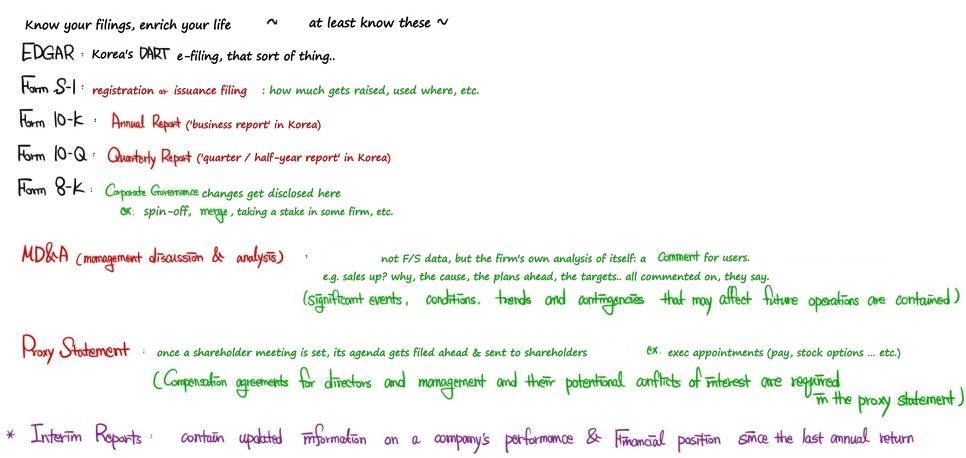
It’s worth knowing the document names as general-knowledge stuff too. Just like in Korea you can look up companies’ financial statements on DART, for foreign stocks there’s a thing called EDGAR — basically the US version of DART.
If you actually go to the site and search for Apple (ticker AAPL) —
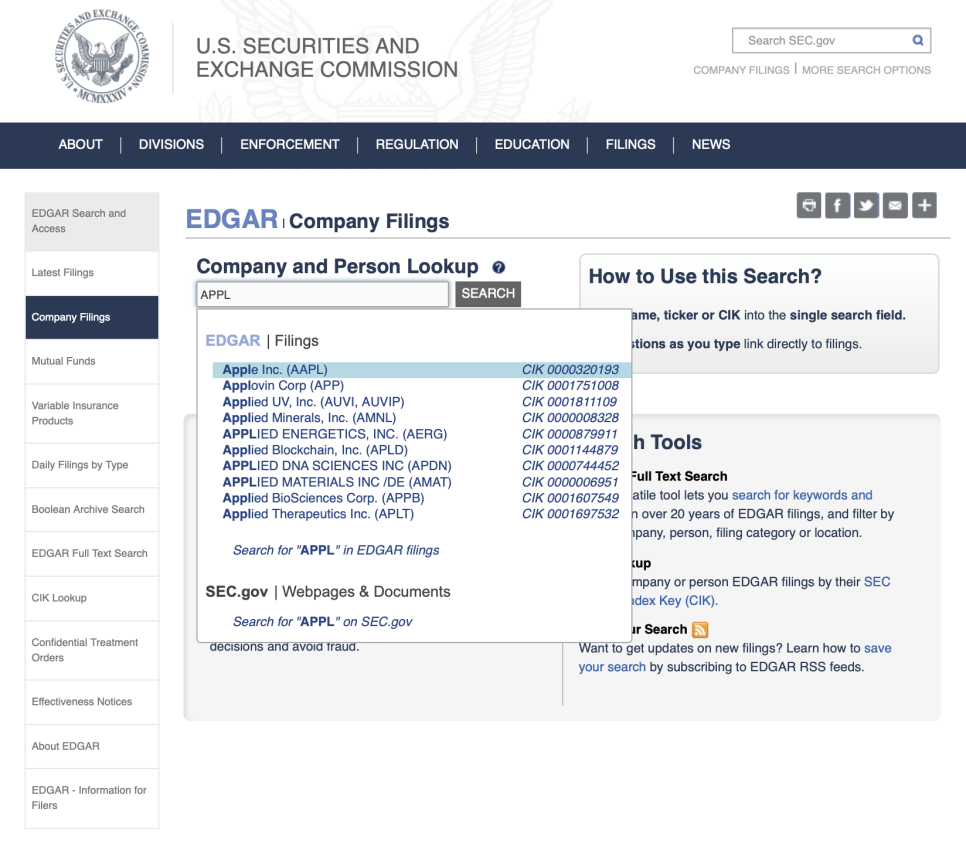
Apple’s financial statements come right up,
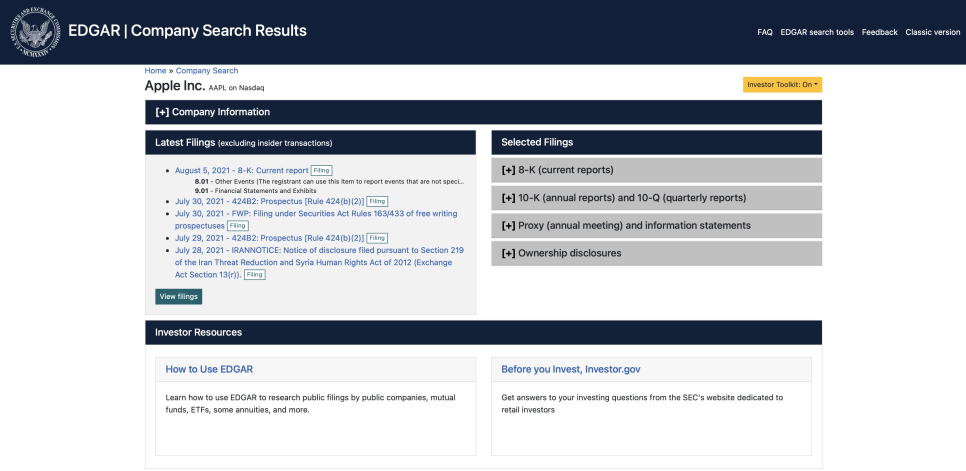
and it shows them organized by document name… heh.
You should probably know which one to click for the annual report vs. the quarterly report. So knowing just 10-K and 10-Q might be enough — but for exam purposes, looks like we’ll need to know a few more types too… heh.
Useful information
Now truly the last part —

This is content that honestly probably should’ve appeared near the beginning. But I think it’s actually better to hear this after knowing accounting to some degree — so it seems the teacher kindly stuck it at the very end of the course. Heh.
What requirements does information need to meet to be called Useful Information?
(Seriously, this feels like content you’d only study if you actually went into an accounting department at university, lol)
Anyway, two things have to hold:
- Fundamental Quality has to be satisfied first,
- Enhancing qualities improve useful information as far as possible, with trade-offs and a cost constraint — they aren’t four absolute pass/fail gates.
1. Fundamental Quality is —
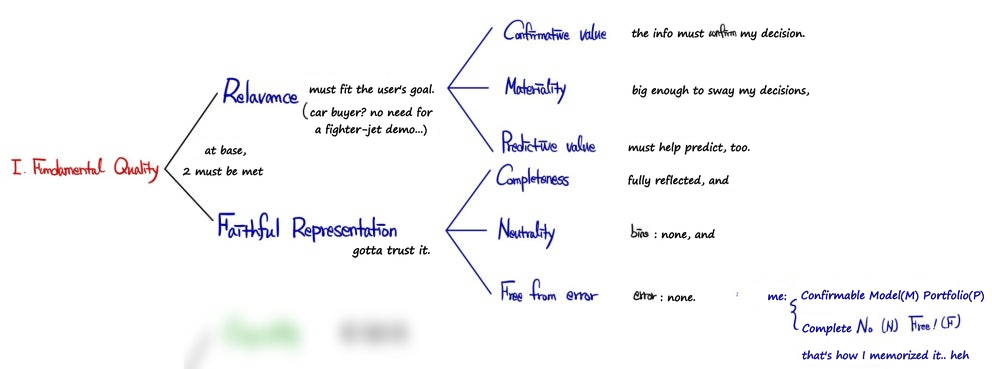
For exam purposes, we need to memorize CMP CNF:
- CMP: there’s a Confirmable (confirmatory value) Model (M) Portfolio (P), everyone!
- CNF: Completely (completeness) No! Free! It’s not Free (F)!!!
That’s how I memorized it….
(Side note: to operate something, you’d build a strategy as an MP (Model Portfolio), and when you actually operate it, it inevitably drifts off the MP a little. The actually-running portfolio is called the AP (Actual Portfolio), and good management means the MP and AP don’t drift too far apart. Anyway MP/AP are commonly-used terms. Heh.)
2. Enhancing Quality
This one you also need to nail down so you don’t trip on the exam. Don’t worry — the king of clever mnemonics is here!!!

We need to memorize CTVU lol. Here’s my mnemonic:
“Selling a TV inside a CU (convenience store)?!?!” lol
Why would a convenience store sell a TV…… lol. But once you see it you literally can’t forget it. Got it, everyone? lol.
Oh, but you can’t just memorize CTVU and walk in~ You also have to memorize what each letter stands for: Comparability, Timeliness, Verifiability, Understandability. ^^ Heh.
Recognition and measurement
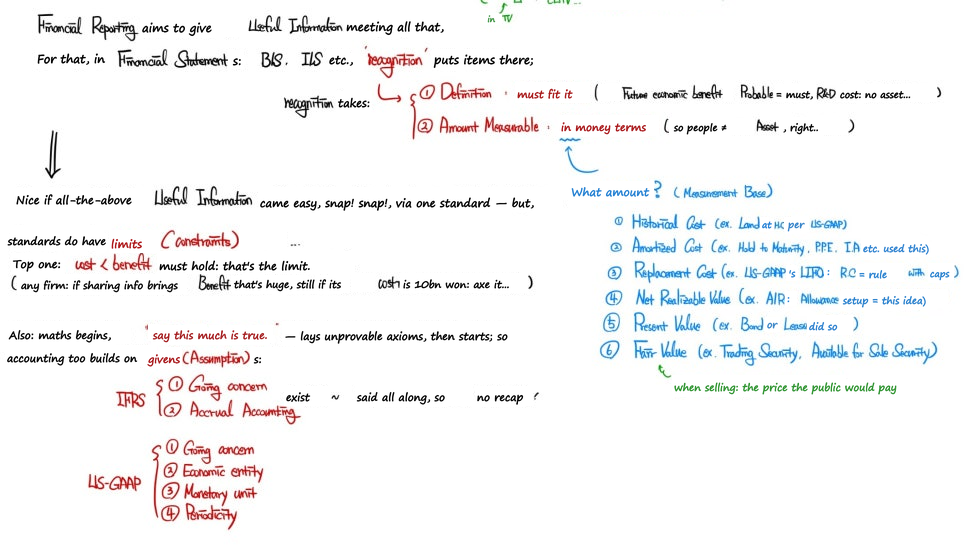
And let’s also revisit the definition of “recognizing” something in financial statements. For Recognition:
- The Definition must be met (we already beat this into the ground earlier, so no sweat), and
- The Amount must be Measurable. This one too!
A recognised item is depicted by a monetary amount. But BTS members themselves aren’t Big Hit’s assets: the company doesn’t control people as economic resources. Separately identifiable contractual rights may be a different question. Heh. (Just like GD Park can’t be placed on his own current company’s financial statements. ^^ So sorry, so sorry~)
But even if something is recognizable in monetary terms — at what amount?
That part gets a bit trickier…. It’s a little hard to explain, because — while CFA Level 1 FRA is in the range of intermediate accounting content, compared to the CPA standard, we’ve studied roughly 1/10 of what a CPA intermediate accounting course covers. We really have studied only a tiny slice.
The definitional side regarding amounts…. is basically what’s written in the sky-blue text over there. It can be defined using various prices. This part also shows up in the conceptual framework section of intro accounting….. I think we just have to pass over this with a vague sense that “these things exist”!!!
(Simple example: last-generation Galaxy S10 inventory piled up at Samsung Electronics — what price do we use to measure it and put it on the B/S?
- Do we use the acquisition cost from when the unit was originally made, ignoring its current economic value? → that’s the historical cost concept.
- Or do we use the price Samsung Electronics could actually realize if they rolled up their sleeves and sold it? → that’s the Realizable Value concept.
- Or do we just use whatever price it’s currently trading at in the market? → that’s the Fair Value concept.
So it’s a conceptual enumeration of which prices can be used. And — for inventories, the lower-of-cost-or-NRV method used the NRV concept to set the value; for tangible assets under the Revaluation Model, the standard picked Fair Value. I think you can understand it as: for a given asset in a given situation, use a given price concept. That’s how it’s set up. Heh.)
Barriers between US GAAP and IFRS
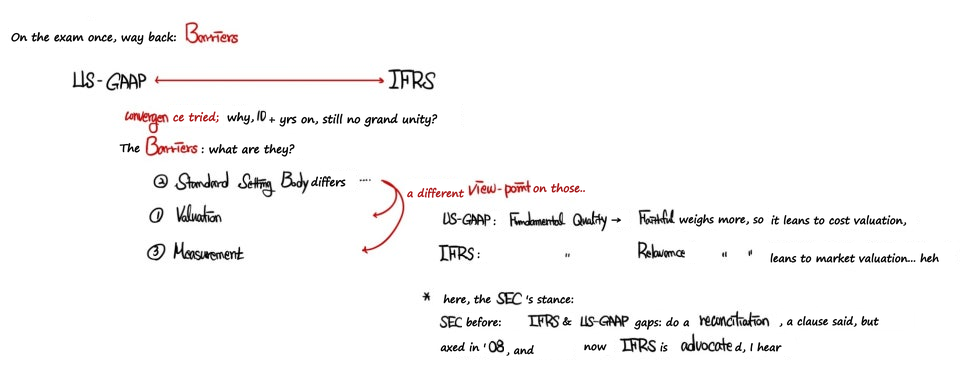
Despite everyone always chanting “let’s integrate, let’s integrate,” the accounting standards that have absolutely not been integrating — US-GAAP and IFRS — are not converging at the broad level. And what are the factors preventing that convergence………
(Isn’t it the pride of developed countries…;;; I mean;;; lol.)
One concrete change: the SEC’s 2007 rule, effective in 2008, allowed foreign private issuers using IFRS as issued by the IASB to file without a US GAAP reconciliation. That wasn’t a switch of domestic US issuers to IFRS.
Financial reporting quality
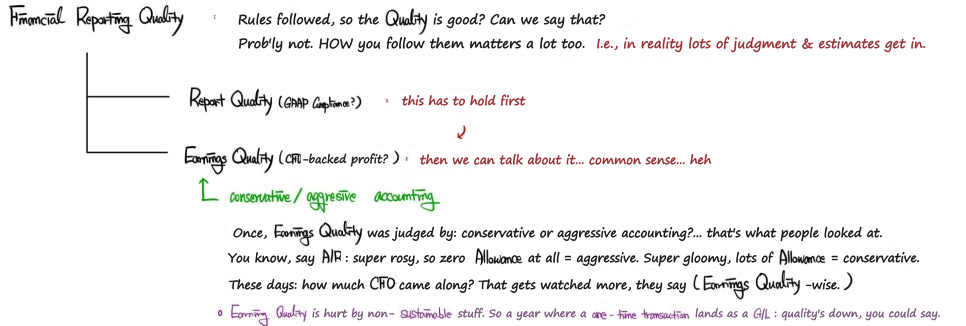
Wow… this is really theoretical stuff lol. Oof… lol. I think this one’s okay to just skim and move on….. (Still wrote it out as thoroughly as I could……… lol)
Fraud and audit opinions
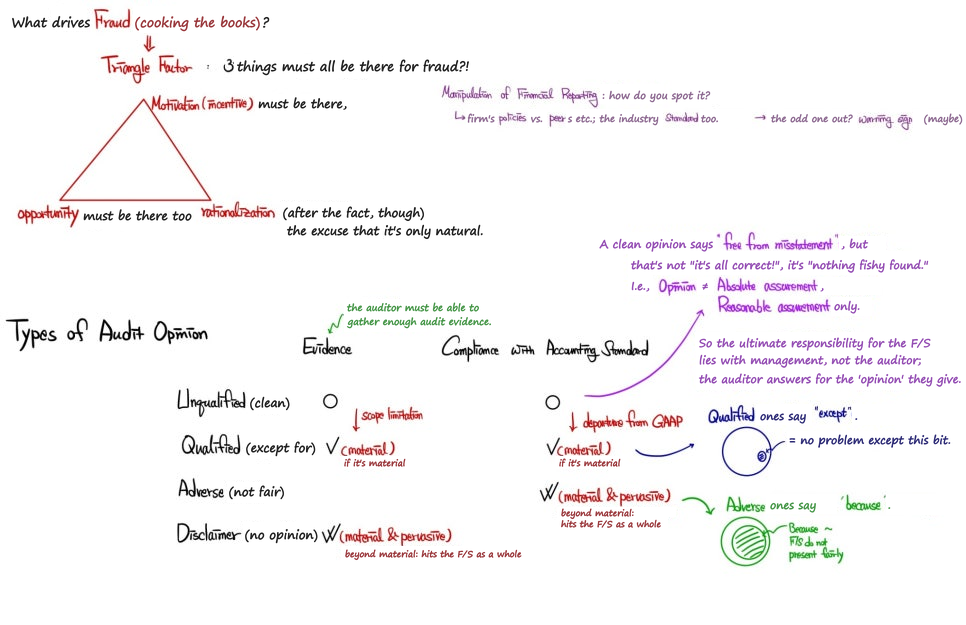
Are financial statements written by accountants (CPAs)????
Nobody should still be saying “yes” to that question by now, right?!
Financial statements are written by a company’s management!!!
The job of auditing whether they wrote them well — the government has branded it “only people the government has given a license to may do this ^.^” — and that’s the CPA. (Please also designate one thing that only CFAs can do T_T I’ll do it well T_T)
Anyway — this last part also doesn’t feel like something you can just skim and pass. Types of Audit Opinion is something you need to know.
Do you know this — in the CPA exam, the “Auditing” section is tested in the second stage after you pass the first stage. And the person who overwhelmingly dominates as the top instructor for the “Auditing” subject in the CPA world is none other than — Teacher Kwon Oh-sang!!! lol. After I finish the CFA I’m sprinting straight over to take that course!!! lol.
I love you, Teacher Kwon Oh-sang. Thanks to you, right after finishing my CFA exam, I ended up taking about 200 lectures of Intermediate Accounting and Advanced Accounting for CPA….. and spent about 6 months pouring blood, sweat, and tears over it. lol. But still…. a physics person like me who originally knew absolutely zero about accounting…. has been forged into someone who knows accounting to a decent level, all in one stretch. Truly a shining light………… Thank you~~
With this, I’m wrapping up all the CFA FRA postings.
But — everyone…… While I was writing these notes, the subject I was overwhelmingly least confident in, the one I knew almost nothing about out of all 10 CFA subjects, was precisely FRA. And it somehow ended alright, so I’m relieved…. Which means — the remaining 9 subjects are……… genuinely GD Park’s strengths. lol.
From the next post onward — everyone, bring popcorn. I’m predicting super fun times ahead. See you in the next posting~
Heads-up. The figures here are the original notes, slips and all. A few things to watch for:
- In the list of extra cash flow ratios, the investing and financing ratio is CFO divided by the cash outflows for investing and financing activities; the picture repeats dividends paid in its denominator, which belongs to the dividend payment ratio on the line above.
- Two terms in the pictures: relevance comes with predictive value and confirmatory value (not “confirmative”), and the second barrier to a single set of standards is the standard-setting approach (principles-based, rules-based or objectives-oriented), not the standard-setting body; valuation and measurement are right.
- In the audit opinion note, an audit gives reasonable assurance, not absolute assurance, that the financial statements are free from material misstatement; the picture writes “free from misstatement” and “assurement”.
- The FCFF/FCFE drawings use simplified operating-working-capital and interest/tax assumptions. FCInv includes growth as well as maintenance investment, with asset disposals handled consistently; depreciation is not the only possible non-cash adjustment.
- The standard-setter diagram’s IASB is global, not a European regulator. UK enforcement roles are also shared: the FCA handles listing/market obligations, while the FRC has corporate-reporting review and audit oversight responsibilities.
- The recognition diagram is an introductory shortcut. Meeting an element definition is necessary, but recognition must also provide relevant information and faithful representation under the current Conceptual Framework; a measurable amount alone isn’t sufficient.
- Both US GAAP and IFRS aim at relevance and faithful representation and use mixed measurement bases. The last diagram’s cost-versus-market and representation-versus-relevance split overstates the difference.
- Life-cycle cashflow signs are common illustrative patterns, not rules for every firm. A cashflow-per-share ratio may be used analytically, but US GAAP’s cashflow statement guidance prohibits reporting CFO per share as a substitute for EPS.
Comments
Discussion happens via GitHub Discussions. You'll need a GitHub account to comment.