What Is a Bond? The Fundamental Difference from Equity
Kicking off Fixed Income for CFA Level 1 — what a bond actually is, why interest is called a coupon, and how it's fundamentally different from a stock.
Wow — we’re finally onto the second subject!
If you asked anyone to name the kings of CFA Level 1, they’d say FRA (Financial Reporting Analysis) and Fixed Income. Hands down.
So — second subject up, let’s go with Fixed Income!
I do work that has absolutely zero to do with bonds, so this whole series is purely for study purposes, which means it probably won’t get too long lololololol.
Anyway, enough preamble — let’s just dive in!
So, this first post… actually no, the meat of bonds is going to be Fixed Income Valuation, and until we get to that part of the curriculum, we’re going to be picking up scattered concepts piece by piece. It’s not one of those nice clean “follow the logic in one continuous flow” deals — it might get a little confusing — so grab the rail and let’s go!!!
(Don’t bail on me here (crying)!!)
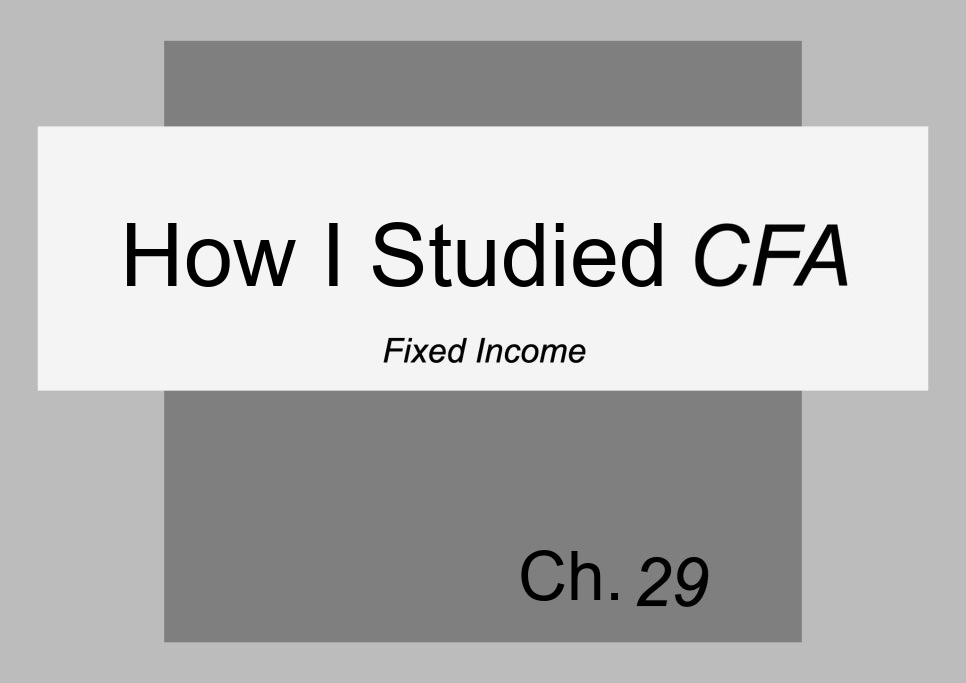
So what’s a bond?
Like a stock, it’s also basically a scrap of paper — but a scrap of paper with a money promise written on it.
It’s a certificate that says: over a defined period (T, the maturity), the issuer will pay you interest (the Coupon) based on the face value (F, the principal), and at maturity they’ll hand the principal back too.
(Why is the interest called a “coupon”? Apparently, back in the day, bonds literally had little coupons attached down the side. When the time came — end of month, end of half — you’d tear off a coupon, hand it to the borrower (the debtor), and the lender (the creditor) would collect the interest. Once all the coupons had been torn off, you’d go back and demand your principal too. Or so the story goes.)
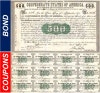
That does NOT look like something you can rip off by hand lol — they must’ve been carrying scissors around everywhere.
Oh wait, I think I’ve actually seen this in a movie? The whole tearing-off-the-coupon-to-claim-interest thing? Anyway lol.
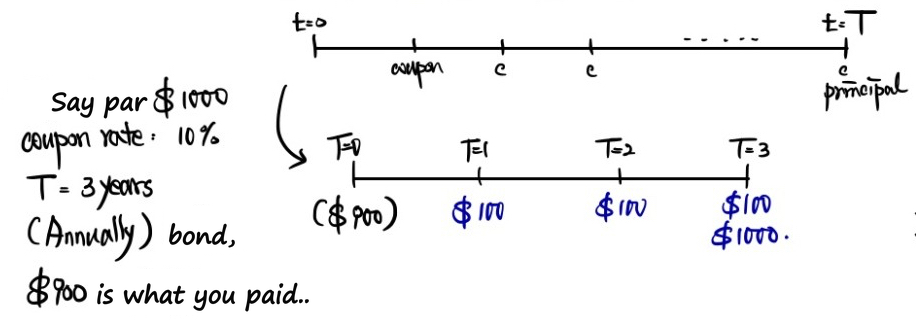
OK example time. Face value $1,000 / coupon rate 10% / maturity 3 years (interest paid at year-end — in arrears).
Say you bought a bond like this for $900.
(So here’s what’s actually going on:
Some businessman walks up and goes, “I’ll sell you a scrap of paper that promises I’ll pay you $1,000 at maturity, AND every year until then I’ll also pay you interest equal to 10% of the face value (the price written on the paper)!!!!!!!!”
and there might be a buyer going, “ohhhh oh oh OHHH sir!??!?!? Then I’ll buy that paper off you for $1,100!!!!” — that’s one kind of trade.
Or there might be a buyer going, “uhhh, who even are you? You sure you’re not a scammer? You know what, fine — I’ll treat it as throwing money in the trash, $500 and we’re done.” That’s another kind of trade.
I just blurted out something that was supposed to come up later under discount bonds / premium bonds (crying))
If you bought it for $900, then you — the one who paid the $900, i.e. the creditor — get $100 every year at year-end as promised, and at the end of year 3 you also get the $100 of interest plus the $1,000 of principal back (assuming the borrower keeps the promise).
So compared to “dividends on stocks,” what’s the biggest difference?
With stock dividends, until they actually hit your account, you have absolutely no clue how much you’re getting, right!?!?!? If you put dividends on a timeline, those dividends are Expected Cash Flow.
But put a bond’s interest and principal on a timeline, and that coupon stream + principal is Promised Cash Flow.
This is supposedly the essential difference between bonds and stocks.
(That’s also why income from stocks is called a return, while income from bonds is called a Yield — even the terminology reflects that essential difference.)
Quick aside on Valuation
(We’re going to be droning on and on about bond valuation later,)
but for now — stocks, bonds, whatever — how do you value any asset?
“By pulling future cash flows back to the present.” That’s how valuation works.
(This will keep coming up forever and ever… so just nail it down deep in your brain right now!)
For stocks, the hard part is: estimate those future cash flows better.
For bonds, the hard part is: figure out the right discount rate to pull them back at.
But hold on — even though it’s a bond, can you really count on 100% of the Promised Cash Flow showing up in the future?
If you could, risk = 0, which… well, maybe the U.S. government can pull that off (which is exactly why the yield on U.S. Treasuries gets used as the risk-free rate). But short of that, the issuer could absolutely go bankrupt down the line and fail to pay interest or principal. (Apparently even the city of Seongnam went bankrupt that one time…)
So: risk-free rate + “the chance they go bankrupt down the line and skip on payments” (☜ that part is called the Credit Spread) — wouldn’t that be a sensible discount rate to use for valuing the bond????
But we’ll save the rest of that thread for the actual Fixed Income content later!
Bond Indenture
Just like signing a contract when you take out a bank loan, when you borrow money by issuing bonds there’s also a contract. That contract is what’s called the Indenture.
Inside it are the things the borrower has to abide by — these are called Provisions — and they split into two flavors:
- Affirmative (compliance covenants): e.g. “These funds may only be used for xxx project!” — i.e. you must do it this way.
- Negative (prohibition covenants): e.g. “Don’t raise any more capital!” — i.e. don’t do this thing.
Bond Quoting
For stocks, quoting a price is simple — just say “the dollar amount it takes to buy one.” But if you tried to quote bonds the same way, things would get weird.
Here are two Zero-Coupon Bonds.
(Zero-Coupon Bond: a bond issued at a discount, no coupon payments, just repays the principal at maturity.)
These two bonds should really be considered the same price, right?? But if you do it the stock way — “what does it cost to acquire” — chaos.
So there are roughly two ways people quote bonds:
- Both are at 90% of face value, so just write “90”! — that’s one method.
- Write the yield you’d earn if you held it to maturity, which here is 11.11%! — that’s the other method.
(Apparently the quote screens show both.)
(That yield from method 2? As I said up top — it’s not a Return, it’s a Yield!!! It’s the expected rate of return assuming you hold to maturity. Because, well, you have to wait and see whether the borrower actually keeps the promise at maturity or not. Anyway, this kind of yield is called YTM.)
(If this is your first time touching bonds, YTM is going to confuse the hell out of you…. mostly because people start thinking about scenarios where you buy a bond and then sell it midway at a different price.
For now, just operate from the perspective of “I bought this bond and I am holding it to maturity, end of story.” Do that and you won’t get confused yet. The case where you sell midway at a different price gets covered in obscene detail later, so let’s worry about it when we get there :-) I’ll guarantee you complete understanding :-))))))))))
How the Coupon is Displayed
Let’s nail this one down here too.
The coupon is always expressed the same way: interest received over one year, divided by face value.
Doesn’t matter if you actually receive it once a year or semi-annually — it’s always expressed this way!!!!!!
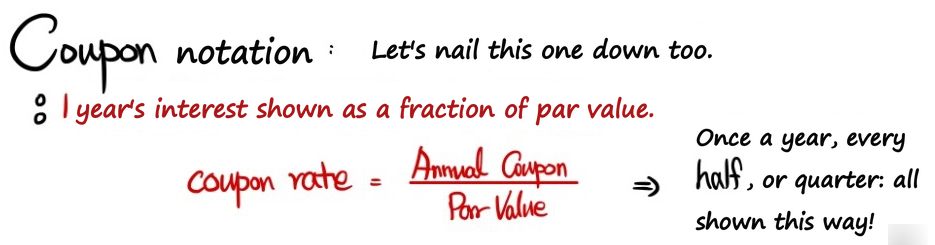
What this means is…
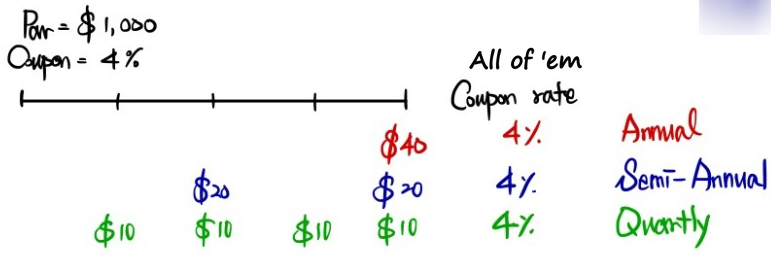
Both of these are written as 4%.
So: check the Coupon rate, and then — hey!!! — also check how many times a year and when it gets paid!!!
Misc terms that don’t really fit anywhere — quick dump
Remaining maturity: also called Tenor or Term to Maturity.
Where does the interest on government bonds come from? Right — taxes.
(Sovereign Bond: yes, this can be issued in a foreign currency — so saying “it isn’t issued in a foreign currency” is wrong! It’s issued by the central government & taxing authority.)
Related — municipal bonds split into Revenue Bonds and General Obligation Bonds.
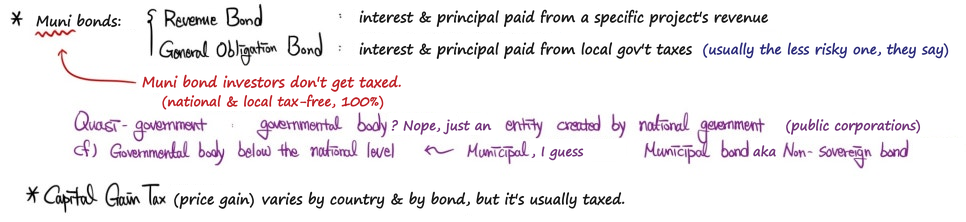
This is basically the question “where’s the interest coming from on a local-government bond?” — pairing back with the fact that for sovereign bonds, the interest source is taxes. And the actual punchline for Municipal Bonds is that they tend to come with a tax benefit….
Indirect vs Direct Finance
Going through a bank to borrow = indirect finance. Issuing/trading bonds = direct finance. What that actually means:
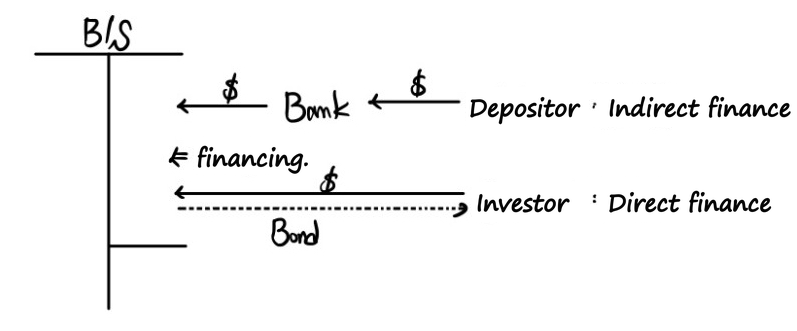
Whether you’re a corporation or a person, when you need to raise the money that ends up sitting on the Liability side of the B/S, you can either go through a bank, or you can find a direct investor and borrow from them by issuing bonds yourself.
Which is why even within Liabilities, the accounts are split — borrowings vs. corporate bonds… heh heh heh.
Domestic Bond / Foreign Bond / Eurobond
Oh man, this terminology — gets me confused EVERY single time I study it lol seriously lol.
Let’s lock it down once and for all this time!!! No more confusion.
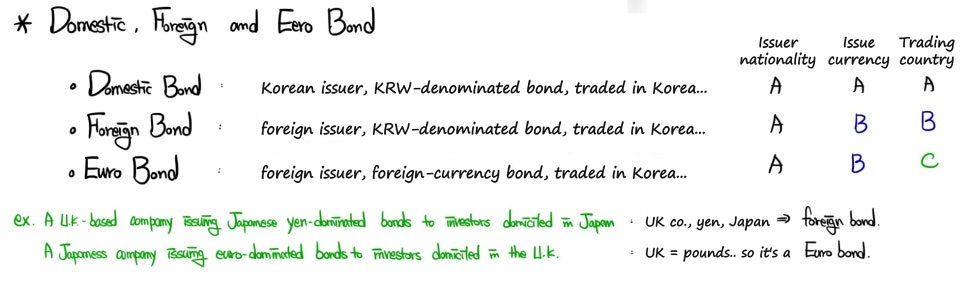
Yeahhh…… can’t really blame anyone for getting this confused, look at how it’s set up lololololol.
Just make sure you glance at this one more time before walking into the exam room lol.
How interest and principal get paid back
As long as you’re holding a bond, what comes out of it = interest and principal. The whole zoo of bond types basically comes from the pattern in which those cash flows come back at you….
First — there are several ways the principal can come back.
Bullet Structure: the standard bond cash flow shape we all know. You just keep collecting interest, then the entire principal lands in one lump at the end.
(That lump at maturity is called the Balloon Payment.)
Amortizing Bond: interest is still paid at the same %, but instead of returning all the principal in one bullet at maturity, the principal gets paid back in installments (Amortizing).
It can be Fully Amortizing (a typical bank mortgage is Fully Amortizing, no?) or Partially Amortizing.
Now — once you’re paying back in installments, the outstanding balance shrinks each period, so the interest portion shrinks along with it, right?!?!?! Because interest is “% × outstanding balance” by definition…
If you really got the effective interest rate method from the FRA section earlier, this just falls right out of it.
Complete Understanding of Effective Interest Rate Method Accounting
OK but — isn’t getting paid back in installments unconditionally better for the investor?!?!?!
Less risk on principal repayment, sure — so in that sense yes, it’s good. Credit risk definitely drops.
But Reinvestment Risk goes up….. when?!?!?! When interest rates fall!
Think about it: instead of not getting your principal back and just collecting that nice 10% interest every year, the principal is now trickling back to you in pieces — and you’ve got to reinvest those pieces somewhere, right?
Except there’s nowhere great to reinvest, and the cash is just piling up in your pocket……
And on top of that, if interest rates have also fallen, finding somewhere that pays 10% or better is only going to get harder. That’s the gist.
Sinking Fund Provision
There’s a thing called a sinking fund provision that can only be attached to Amortizing Bonds. It’s a clause that says: “the issuer is obligated to separately set aside the installment principal in order to actually make those installment repayments.”
So from the bondholder’s side, it’s basically: “hey, I’m a little nervous you won’t actually be able to repay the principal — so open a separate account, drip a bit in each period for the principal portion, and prove it to us.” That kind of account.
Banks apparently recommend or require opening a savings account alongside a mortgage too — I think it’s the same idea.
Different ways interest gets paid
We can also slice up bonds by how the interest is paid — and “slicing by how interest is paid” is basically the same as “slicing by bond type.”
For example: Floating Rate Note (Floater, FRN) / Inverse Floater / Step-up Coupon Bond / Index-Linked Bond / Callable Bond / Convertible Bond, etc. That’s what I mean — how the interest gets paid = what kind of bond it is.
You see what I mean, right…..!?!?!?!
Heh heh, there are a few more than what I just listed, so volume-wise I think it makes more sense to cover all of that in the next post.
Let’s take a breather here!
P.S.
In my view, CFA bonds are…..
a subject all about the geometric mean yield, basically…..
So before you go in, you really need to fully understand the geometric mean yield first.
But I just kinda assumed everyone already knew it~ and skipped past it~ and ended up circling back and writing about it later……
Understanding Geometric Mean Yield
Rather than plowing into the next posts first, I really recommend you go fully and completely lock down the geometric mean yield over there, and then come back!!!! heh heh heh.
Comments
Discussion happens via GitHub Discussions. You'll need a GitHub account to comment.