Types of Bonds
A quick rundown of bond types by how they pay interest — floaters, inverse floaters, step-ups, PIK and index-linked bonds — plus the options baked right in: callable, putable and convertible bonds.
Alright, let’s keep rolling, straight on from What Is a Bond? The Fundamental Difference from Equity!
Last time we said we’d classify bonds by how they pay interest — and that this basically just means classifying the types of bonds out there. So… what kinds of bonds are there!
1. Floating Rate Note (FRN, aka Floater)
A bond with a floating interest rate.
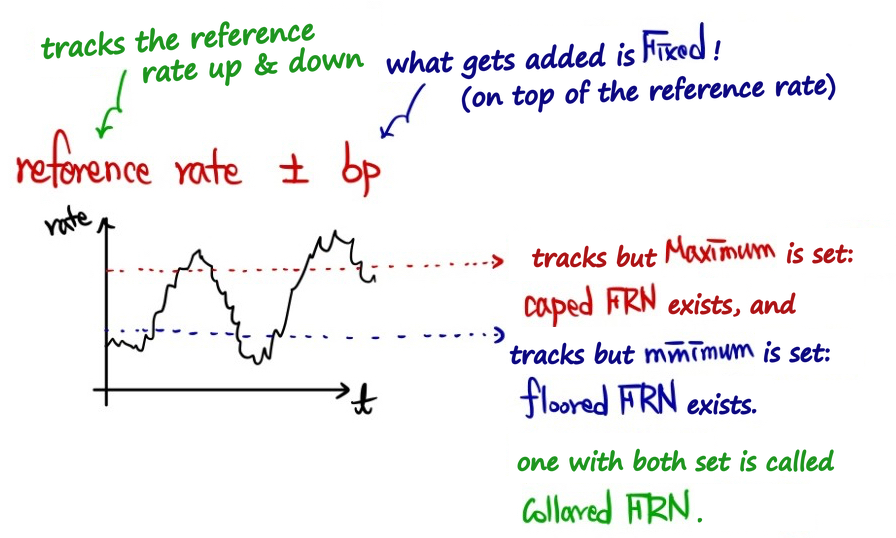
2. Inverse Floater
Inverse floating rate bond (?) This one’s pretty much what the word “inverse” says — it must reflect changes in the reference rate the other way around! Reference rate goes up, coupon goes down, and vice versa.
3. Step-up Coupon Bond
You can pretty much tell what this is just from the name — the coupon rate steps up in stages as time goes on. So it can protect you against rising-rate risk to some extent — totally doable~ (Apparently it usually comes with a callable feature attached.)

4. Credit-Linked Coupon Bond
The coupon rate is tied to the issuer’s creditworthiness going up and down — credit gets worse, coupon goes up, and vice versa…. heh.
5. PIK (Payment-in-Kind) Bond
This one’s different in how the interest gets paid! Interest is paid in more of the same thing — bonds, “in kind.” Then at maturity, the principal and all the interest you’ve been getting as bonds are paid out together, in cash.
From the investor’s side, that’s going to be a bond with seriously big credit risk. (Apparently this one’s also used when a company is still at an early stage and isn’t expected to generate cash flow yet.)
6. Index-Linked Bond
Just like the name says — it’s linked to some particular index,,…. and since the one linked to the inflation rate came up here, let’s think it through together.

So suppose we link only the interest to it, and the old 3% coupon becomes 3.3%, with π baked in. ⇒ The Face Value (par) doesn’t have the inflation rate baked in…. so you’re not fully protected against inflation….
So how do we get inflation reflected cleanly in both the Face Value and the Coupon (interest)?
⇒ Link the Face Value to π, and just leave the coupon rate alone!
Then Face Value = 1,100 dollars, and paying 3% on that gives 33 dollars — exactly the same as paying 3.3% on 1,000 dollars!
* But wait — what if deflation hits? Couldn’t you end up not even getting your principal back?!?…..
- Some get made Principal Protected,
- and some are built as a plain interest-indexed bond, where only the coupon tracks the index. That’s what they say, anyway…
Contingency Provision
“When some specific event happens, this thing kicks in~” — that’s what’s written right into the Bond Indenture. It’s also called an Embedded Option, in the sense that it’s built in — an all-in-one piece you can’t split off.
In plain terms, it just means the bond has one of these riding inside: 1. Callable / 2. Putable / 3. Convertible. So a bond with no Contingency Provision attached is called a straight bond, or option-free bond!!!!
Hold on!!!!
- Callable = the issuer’s right (good for the issuer / bad for the investor)
- Putable = the investor’s right (bad for the issuer / good for the investor)
Now — since you’ve roughly picked up what an option is from Derivatives…
(and if you didn’t, totally fine — we’ll learn all of it la~~~ter ^.^, and it’ll be covered properly when we hit Fixed Income Valuation, so for now this is just a vocab-sorting pass!!!!)
…let’s assume you know it and just blitz through Callable Bonds, vocab-list style:
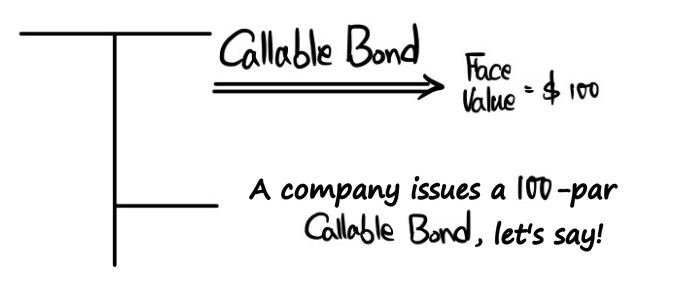
If it’s a Callable Bond, the style splits into three flavors, depending on how the right can be exercised.
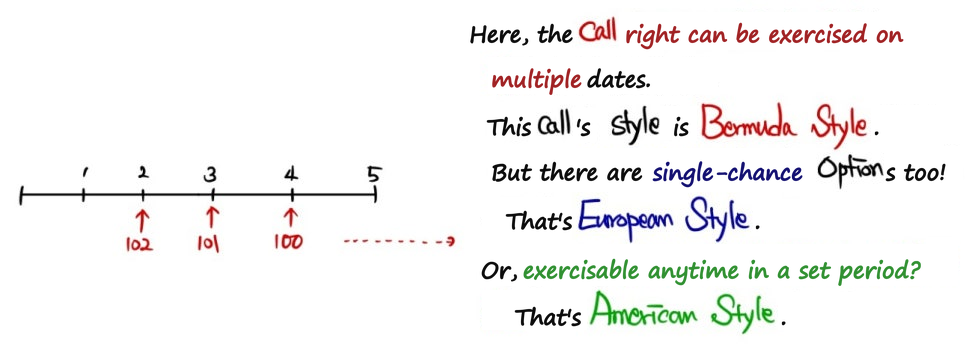
If you can exercise it only on one specific date, at a set price (exercise price, strike price), it’s called European Style; if there are several dates, each with its own exercise price, it’s called Bermuda Style; and if it’s none of those — you can just exercise it any time during a set period — it’s called American Style!! heh heh.
(Totally fine if none of this makes any sense yet! The goal, in the end, is to digest every CFA subject, and once you’ve digested them all, it’ll a~~~ll click!)
Also, some more terms to sort out around option exercise:
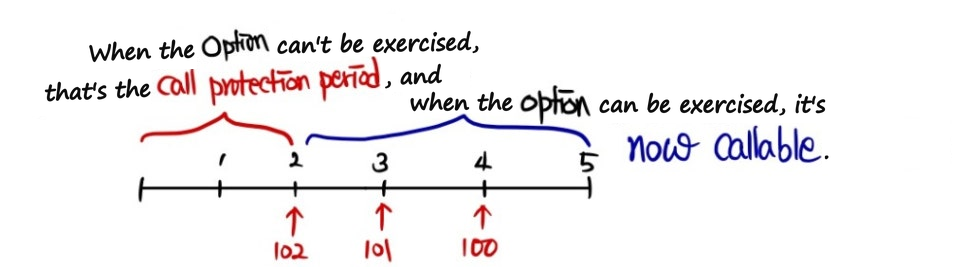
Take the terms call protection period and now callable with you!
When and why does it get exercised?!
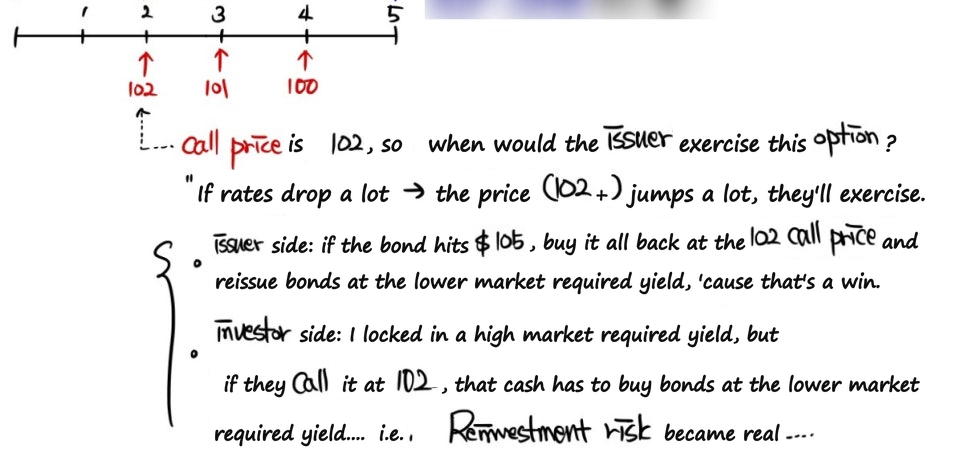
A fall in interest rates means bond prices go up (you’ll really feel this once you’ve studied Valuation), but think about it the simple way — the issuer (the one who borrowed the money) borrowed at 10%, and now the market would lend to them again at 5%?
In that situation, if there’s a clause that lets them just pay everything back right now, of course they’re paying it all back. Pay it all off, then borrow that money again at 5%, heh heh.
So the moment an option like this gets attached, it’s ab-so-lute-ly a given that it’s worth something to the issuer. (How much it’s worth depends on how sweet the terms are.)
And flipping it around — for the investor on the other side of a bond the issuer can just call away like that, “Ugh… past a certain level, exercising is always the better move for them, so my benefit can never go beyond this…” that kind of
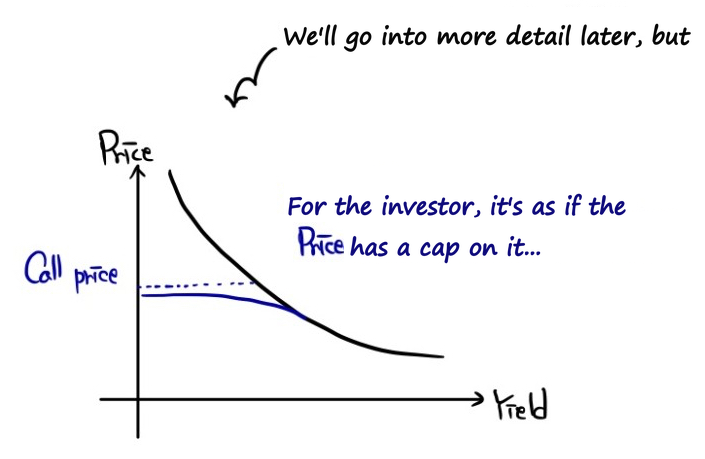
picture!! heh heh.
Don’t worry! We’ll do this in real detail later, lol — so much detail it’ll be a problem!
So — for a Callable Bond like this, which from the investor’s standpoint (the one lending the money) looks like nothing but a raw deal…… are there actually investors who’d buy it?!
⇒ Of course, of course. Because investors will demand a higher Yield to make up for exactly that disadvantage (a higher yield → a cheaper price).
So between the exact! same bond with Callable attached and without, there’s a price gap — and that very price gap can be read as “the value of the Option,” right?!
(Which means you’ve already figured out one whole methodology for pricing options.)
Make-Whole Call Provision
A common make-whole formula is the greater of par and the present value of remaining scheduled payments (excluding accrued interest), plus accrued interest in either case. The discount rate is a benchmark Treasury yield plus the contractual spread. That’s not the bond’s actual market price, and it doesn’t guarantee no investment loss — read the precise indenture.
Then why does this kind of Call even exist??
It lets the issuer retire debt early while compensating holders under that formula. A change-of-control put, sometimes called a poison put, is a different clause that may make a takeover more costly.
(So the takeover-defence skit belongs to the change-of-control put: “Take us over and holders may be able to demand repayment under the clause — can you fund that too?!” A make-whole call remains the issuer’s optional redemption right.)
Anyway, the Fixed Price Call we covered above is the issuer’s right, and the one who benefits is the issuer!!
On the other hand, there are also bonds with a Put attached — and since that one’s the investor’s right, it’s the investor who benefits.
So when would the investor exercise that right??
The mirror image of Call — when market rates rise (bond prices fall), you exercise the Put, pull your money back, and put it into newly issued bonds at the higher market rates, right???
(If talking in bonds makes it confusing, here’s a looser version: I lent money at 5%, but everyone borrowing now is going to borrow at 10%. If I have the right to tell the folks I already lent to, “pay back a~~~ll my money now,” I just go “pay it all back right now!”, get all the money back, and lend it out again at 10%. heh heh)
Convertible Bond (CB)
A bond with the right to convert into stock attached. So when a CB is issued, these things are set at issuance!
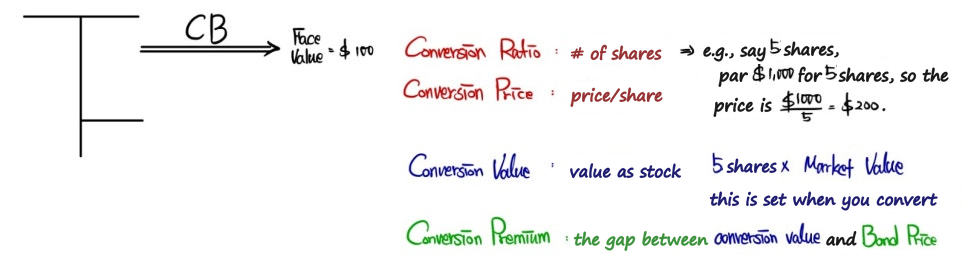
What to keep in mind: conversion is basically a “barter.” You give up the bond, you get the stock. In this plain-vanilla example conversion delivers newly issued shares. Actual contracts may permit treasury shares, cash or a mix — check the settlement terms!
There’s usually a period set during which you can’t convert, but anyway, compared with holding the stock itself, a CB doesn’t ride the stock price all the way down — i.e., the straight-bond value is a theoretical floor…. but that floor itself falls when credit worsens or yields rise. It isn’t a fixed principal guarantee. Because it’s that good, it’s apparently way more expensive, too.
Warrant — this one’s similar to a Call option: a “right to subscribe to new shares” riding on the bond. So a CB was a straight barter, bond for stock, whereas a Bond with Warrant (BW) needs a cash transaction to get the shares.
(See? Coming straight off FRA, CB and BW are basically vocab-level stuff, right!?)
Contingent Convertible Bond (aka CoCo Bond)
It does convert — but its loss-absorption clause activates on a specified trigger: conversion into equity or a principal write-down, depending on the terms. (e.g. “If the bank’s BIS capital ratio drops below a set level, it converts into stock~”)
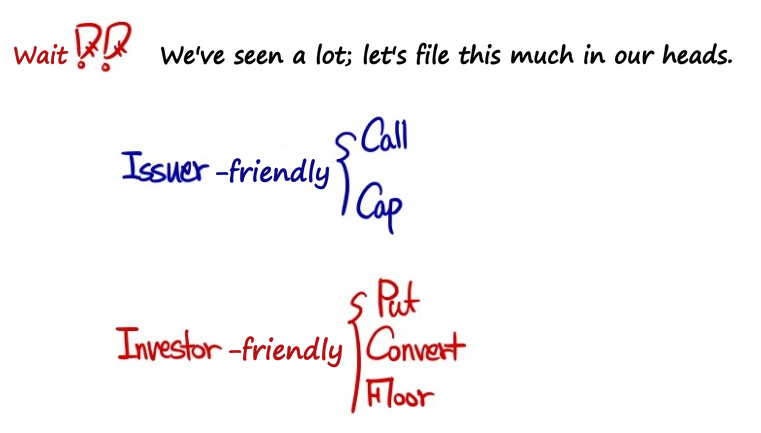
Phew…. so many bond types, right…. We haven’t studied Fixed Income Valuation yet, so this isn’t the main event, and it’s not the fun part either.
Let’s hang in there just a little longer until the fun part shows up!!
Heads-up. The figures here are the original notes, slips and all. A few things to watch for:
- In the convertible bond sketch, the face value is 1,000 dollars, as in the example beside it (1,000 dollars converts into 5 shares, so the conversion price is 200 dollars per share); the 100 in the sketch was carried over from the callable bond before it.
- A step-up coupon follows a predetermined schedule, not current market rates: it can soften a rate rise but does not eliminate price risk; an issuer call may prevent the holder receiving later higher coupons.
- The fixed-price-call curve is an illustration. Call protection, exercise dates, notice periods and transaction costs affect actual exercise and pricing; no blanket immediate-price cap applies before the bond can be called.
Comments
Discussion happens via GitHub Discussions. You'll need a GitHub account to comment.