Key Fixed Income Terminology
A casual rundown of fixed income exam keywords: LIBOR, how bonds get issued (underwritten vs. best efforts offerings, auctions, shelf registration), on-the-run issues, MTNs and CP, structured instruments like CLNs and ELBs, and repos with their haircuts.
Picking up right where I left off. Even in my own notes, this part just kinda… starts like this:
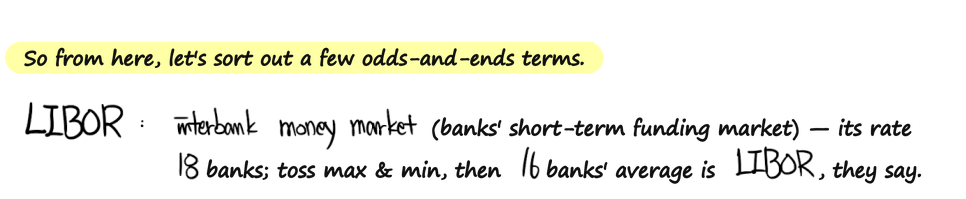
Heh — I was about to wave the starting flag, and the first of the odds-and-ends terms, LIBOR, just walked right in.
Anyway, in these 2021 notes, LIBOR was a widely used floating-rate benchmark, including swaps. It has since ceased; new USD contracts commonly reference SOFR.
But hey — did you know?
Korea has one too.
It’s called KORIBOR: Korea’s own interbank offered rate, built just like LIBOR. In practice the CD rate used to be the go-to benchmark, but CDs have been disappearing lately, so apparently they cooked this thing up. (The rate Korea actually pushes as the private sector’s risk-free benchmark is a different one, though: KOFR, an overnight repo rate launched in 2021.)
Wait, then does the US use Britain’s LIBOR??
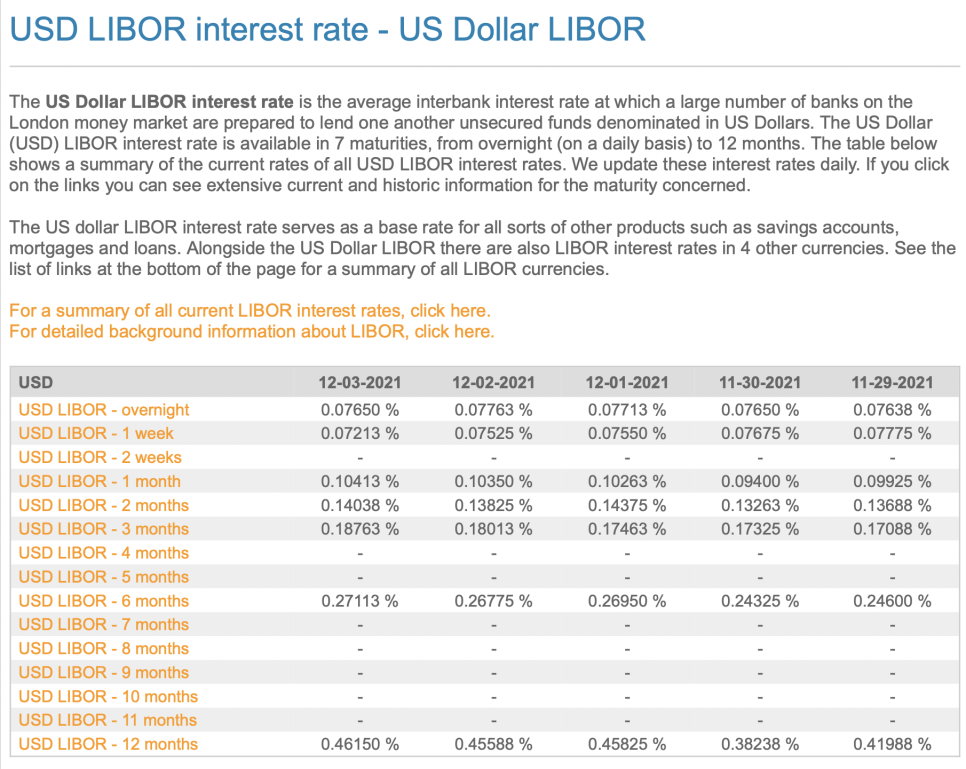
At the time, USD contracts commonly used USD LIBOR, not a sterling rate. Today’s USD risk-free-rate benchmark is SOFR.
This kind of random trivia just sort of… piles up on you when you work in the industry. (sob) Sorry for rambling about weird stuff, lol. OK, let’s keep moving!!! heh heh
Since this whole part is “a few odds-and-ends terms…..”, it’s not about studying one concept that flows logically into the next; it’s more about studying keywords for the exam…… so, out of nowhere…
Bond issuance methods
Bond issuance methods first split into 2 big buckets: public offering / private placement. But for exam purposes, what we need to know is how a public offering works, right.
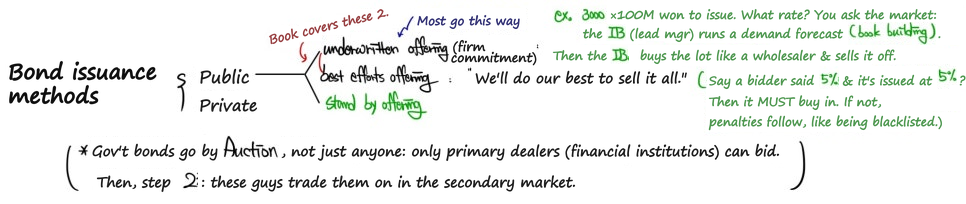
The writing’s way too small… let me type some of it out! The book introduces 2 kinds of public offering:
-
Underwritten offering (firm commitment). Say you’re trying to issue 300 billion won. You’d have to ask the market what rate to set, and the IB (lead manager) runs that under the name of a demand forecast (Book Building). Then the IB works like a wholesaler: it takes the whole lot and works through the volume itself.
(Though: say an institution in the demand forecast said 5%, and the bond really gets issued at 5%, right? Then it has to come in, no matter what. If it doesn’t, penalties follow, like getting added to a blacklist.)
- I’m a bit far from bond issuance in my own work, so I don’t know this side well, but stock issuance works similarly..
- What they watch out for, though, is going in more than the other asset managers, rather than less. Because getting wrecked alone is seen as the bigger risk…heh
-
Best Efforts Offering: the IB goes, “We’ll do our best to work through the volume.”
That’s the corporate bond story. Government bonds often go through an auction, with access rules differing by country. Primary dealers are important participants, but US Treasury auctions also admit other institutions and individuals, directly or through intermediaries.
Shelf registration
Shelf Registration is the kind of thing that’s important to know for the exam…..;;
OK, say you’re going to issue 300 billion won in total. But you’re not gonna issue it in one shot and bang!!! pull in the whole 300 billion; you want to issue bonds bit by bit. In that case, you just file the paperwork for the full 300 billion upfront, so you can issue bonds whenever you need to…. that’s the system.
(The name supposedly comes from the image of all the filing papers put up on a shelf.)
On/Off-the-run issue
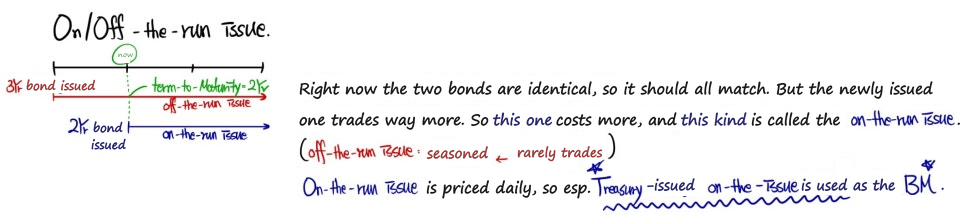
Say there’s a government bond issued last year with a 3-year maturity (so its remaining maturity is 2 years, heh), and another government bond issued just now with a 2-year maturity. They have the same remaining maturity, but their coupons and exact cashflows may differ. Even after allowing for those differences, but apparently the one that was just issued trades way more. It’s a touch pricier, too.
That one’s called the On-the-run Issue. (Off-the-run Issue: an older issue, generally less liquid than the comparable on-the-run issue)
The on-the-run issue has a price every single day, so
in particular, the on-the-run issue from the Treasury is used as the BM!!!!!
The underlined bit is mentioned because it matters!!!!
When the word “benchmark?” comes up and nothing else is said, just think: it’s a government bond, and the most recently issued one is the benchmark~ heh
Serial bonds, MTNs and CP
Serial Bond: issuing bonds with different maturities, spaced at regular intervals. For the issuer, this has the same effect as paying off the debt in installments.
Medium Term Note (MTN): the name doesn’t impose a fixed ‘medium’ maturity band: MTN programmes can issue across a wide range of maturities. You file a shelf registration all at once, and what you then issue piece by piece whenever you need to is called an MTN. (The shortest ones apparently overlap with CP territory.)
CP (commercial paper) is short-term debt. In the usual US registration-exempt market it matures in 270 days or less. Traditional corporate CP is unsecured; asset-backed CP also exists, and other countries’ rules differ. It can be rolled over at maturity (pay off the existing one in full, then issue again).
Reasons a rollover might not work (rollover risk):
- The company is wobbling.
- The market itself seizes up. (Because of a flight to quality….)
Structured financial instruments
When people hear “structured bonds,” they usually picture stuff like ABS or CDOs, but that part shows up at the very end of Fixed Income Level 1, you know??
(Man, that part is crazy fun~)
We’ll learn that part at the very end, and since this part is “a few odds-and-ends terms,” we won’t go deep into the other kinds of structured financial instruments; this is just a quick, intro-level?? look at a few more of them. For the exam, you basically need to be able to tell which structured instrument a “blah blah~” description is talking about, more or less? So I think organizing them by characteristic is the way to go.
1. Yield Enhancement Instrument: structured to chase higher returns by taking on extra risk.. Classic example:
CLN (Credit Linked Note) = Long Straight Bond & Short CDS (credit default swap)
Aside)
Whoa…. what even is a CDS!?
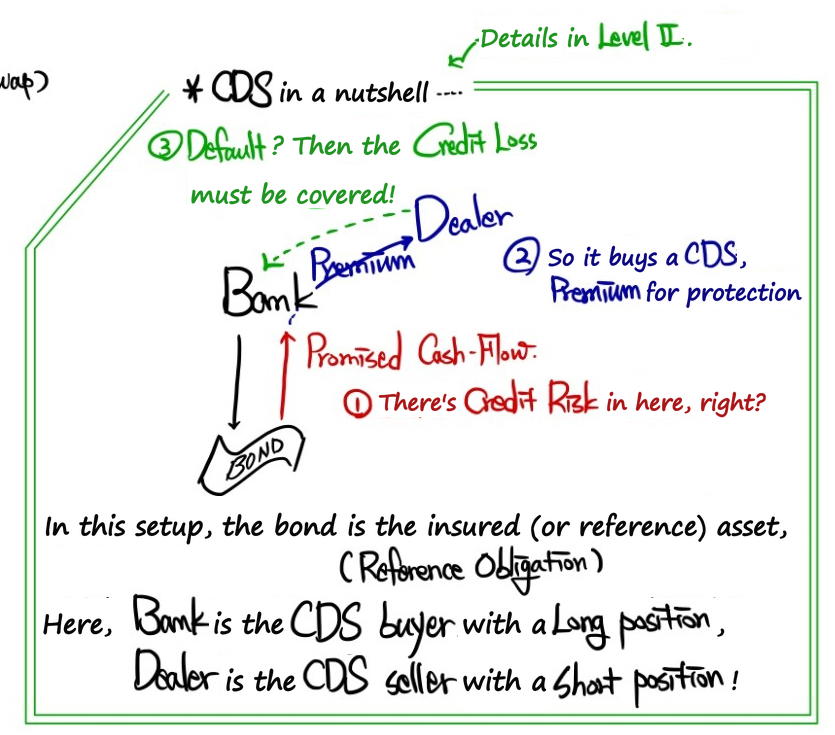
Banks are usually the ones trading CDS, so let’s say Bank.
-
Bank buys some Bond. It pays money along the black line, and gets promised the future Promised Cash Flow along the red line. This cash flow has two kinds of risk mixed in:
- the risk that the risk-free rate, which moves every bond, changes,
- and the credit risk that belongs to that bond’s issuer alone (Samsung issuing it / GD park issuing it).
-
So this Bank goes to another Dealer (usually another bank) and says:
“Hey, I’ll pay you a Premium, regular as clockwork. / In exchange, if a Credit Event happens on that bond, you cover all of it.”
Economically it’s insurance-like credit protection, but legally a CDS is a derivative, with its own credit-event and settlement terms.
This whole trade structure is called a CDS. In this structure, the bond is called the insured asset (or reference asset, reference obligation), and in this trade, the Bank is the CDS buyer (Long CDS) / the Dealer is the CDS seller (Short CDS).
CDS gets covered in Level 2, and as of writing this post I’ve finished all the Fixed Income Level 2 lectures, so haaa………. CDS………. my mouth is itching to talk about it, lol. I’ll hold it in and move on.
Anyway!!!!
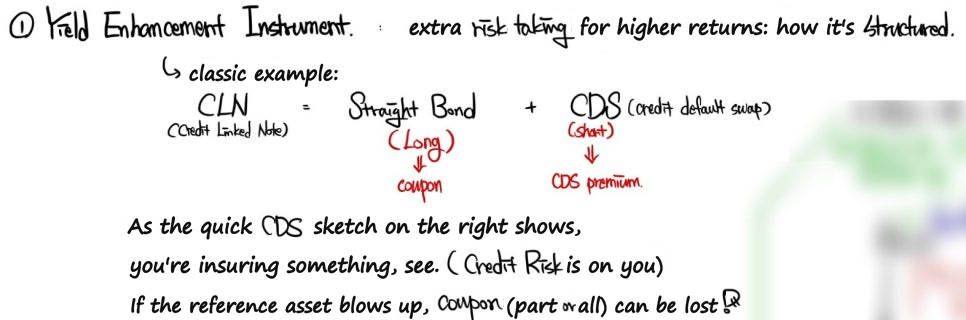
So that’s Yield Enhancement Instrument, done!!! (The point isn’t that Yield Enhancement Instrument = CLN; it’s that one example of it is something like a CLN~ so don’t forget that!)
2. Capital Protected Instrument
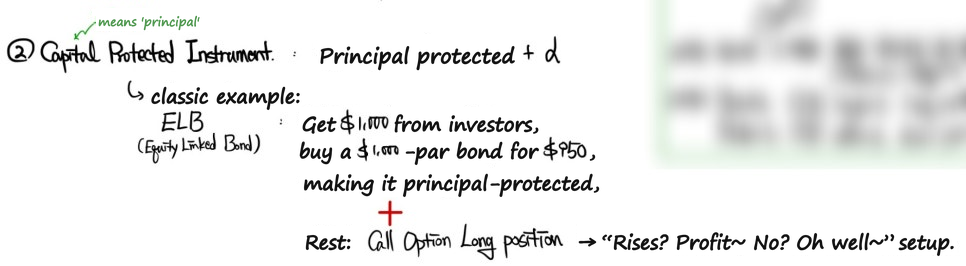
One example introduced for it is the ELB (Equity Linked Bond). You raise 1000 in money and buy a bond so that this principal comes back even after n years (not counting what the risk-free rate would have earned you as part of the principal…. isn’t that kinda mocking investors?!), then you have a bit of money left over, and with that leftover money you go Long Call. So the structure goes: stock jumps, jackpot, sweet~ if not, oh well~
(Not bad, huh? Maybe I should buy lottery tickets every week with my leftover money? lol)
(But even better than the lottery, wouldn’t a Long Put beat a Long Call? lol In finance things go up slowly and come down fast, and nobody knows when a stock will suddenly, out of the blue… literally Unexpectedly take a correction lol)
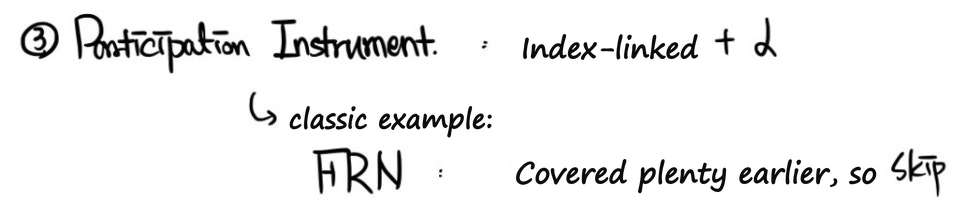
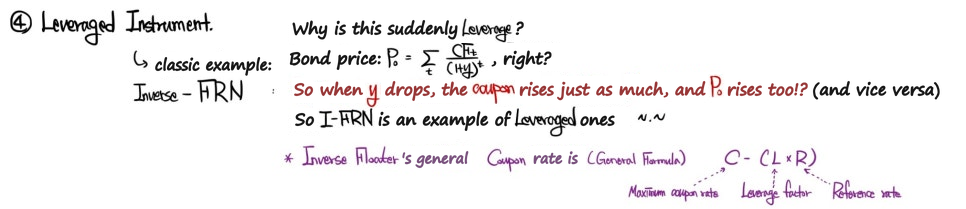
Leverage and inverse X2 weren’t only a stock-market thing, lol. They exist in bonds toooo, lol.
Of course, they weren’t made for “LET’S GOOOO!!! DOUBLE IT!!! TEN-BAGGER, LET’S GOOOO!!!” — the upside of having 2x or 3x around is that when I hedge, I can take on as much exposure as I want / hedge with less money, so the range of choices gets wider, which is probably why things like that got made in the first place. But let’s be honest, they knew there’d be demand from the “LET’S GOOOO!!!” crowd too, so those products got made as well……heh heh
Repo
Hang in there, everyone, we’re almost done. The last one: 5. Repo (Repurchase Agreement) — this guy called repo, you can think of it as exactly the same as a pawnshop!
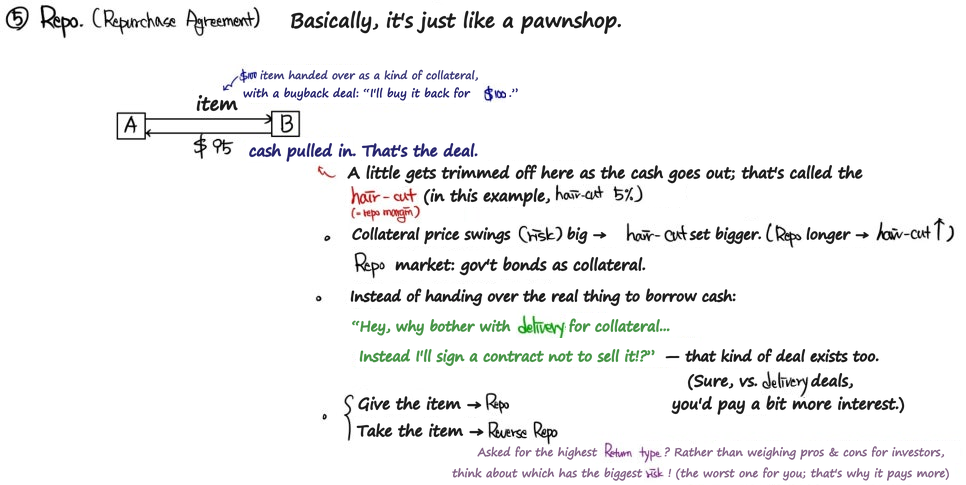
You transfer securities worth 100 dollars and receive 95 dollars, agreeing to repurchase them later for 95 dollars plus the agreed repo interest. If you default, the lender may realise the collateral under the contract. The collateral value 100 isn’t automatically the repayment amount!
Okay okay okay, so now there are a few terms used in repo trades we need to know.
You handed over the 100-dollar item and pulled in 95 dollars, right. Lending money with a little bit trimmed off like this is called the haircut. In this example, the haircut was 5%.
If the collateral’s risk (price volatility and such) is big, they’ll set a bigger hair-cut / and if the repo period is long, they’ll take a bigger hair cut too. Anyway, money gets lent like this, and in the usual repo market, government bonds are the collateral.
(When the monetary policy committee announces a rate move, bang!, employees on a certain floor of the Bank of Korea go bababak and start firing off repo trades. I heard that from a professor who came from the BOK, lol)
But actually…… apparently it isn’t always about really handing over the actual thing to borrow money. There’s a kind of trade that goes: “Dude, why bother doing the whole delivery for collateral….. Instead, I’ll sign a contract saying I won’t dispose of it anywhere!” (That hold-in-custody structure adds custody/operational risk. Most repos use delivery or third-party custody, often by book entry rather than physical certificates.)
Oh, and: giving the item = Repo / taking the item = Reverse Repo.
For the exam you also need to know which repo it’s called depending on which side you’re on!
Phew………. The odds-and-ends terms are done….
From the next part on, Fixed Income really begins. Because that’s when Valuation starts….. It’s the kind of part that, if you understand it really really really well, will keep helping you over and over and over, so I’ll bring it in the next post!!!
Heads-up. The figures here are the original notes, slips and all. A few things to watch for:
- LIBOR was a trimmed mean: with an 18-bank panel, the 4 highest and 4 lowest submissions were dropped and the middle 10 averaged, not just the single highest and lowest. LIBOR has since been retired (the US dollar panel rates ended on 30 June 2023), and floating rates now reference risk-free rates such as SOFR.
- In a credit-linked note, a credit event on the reference asset hits the principal too: the note is repaid below par, cut by the loss on the reference asset, and its coupons stop, so it is more than part or all of the coupon that is at risk.
- In the on/off-the-run picture, the benchmark is the on-the-run issue (the last line writes “on-the-Issue”).
- In the repo picture, 100 of collateral for 95 cash gives a 5% haircut: (100−95)/100. Initial margin under the collateral/cash convention is 100/95=105.263%, not 5%; the repo interest is set separately.
- The auction note is country-specific, not a universal primary-dealer-only rule. Book-building commitments and penalties also depend on the relevant market’s rules and allocation terms.
- The principal-protected note’s protection usually applies at contractual maturity and depends on issuer solvency. It is not risk-free and may sell below principal before maturity.
- The CDS sketch covers contractual credit-event losses, not every market-price loss. Reference obligation, deliverable obligations, recovery valuation and counterparty risk affect actual protection.
Comments
Discussion happens via GitHub Discussions. You'll need a GitHub account to comment.