Bond Valuation
Bond valuation is just the PV of future cash flows: why the price moves until you earn exactly the required return, why the price-yield curve is convex, accrued interest and day counts, and matrix pricing. heh heh!!
Now the real Fixed Income content kicks off!!!!! Get this….. Bond Valuation is only now getting started!!!
I said “Bond Valuation” like it’s some big deal, but honestly, we already know this one. Bonds, stocks, derivatives, land, buildings — whatever the asset, valuation is always the same thing: “the present value of future cash flows.” That’s it.
So say we’ve got these 3 bonds up on the board. We can line all of them up as present values.

Let’s say there’s a bond with a face value of 1,000 dollars, a coupon rate of 10%, and a maturity of 10 years. Then the future Promised Cash Flows are already locked in. All we have to do is drag those cash flows back with a discount factor to get the present value, and if we discount at 8% / 10% / 12% respectively, each bond’s present value pops out differently.
So what does that difference actually mean??
If the Required Rate of Return is 8%, that means the market is asking for 8% interest, but a 10% coupon is handing over more than what market participants are demanding, right???? So is this bond secretly tossing market participants an extra 2% on top???
Nope nope nope, it’s not. lol The price just shakes itself out to deliver exactly 8%, on the nose.

The bond’s price simply forms that much higher, so that what you earn comes out to exactly the market participants’ required rate of return.
(And to be clear — it’s not the issuer sitting there setting the price. It’s market participants trading the thing, going “whoa, a bond paying 10% for 1,000 dollars? I’m in, even at 1,050!” and the guy next to him goes hey, I’m in at 1,100! and then boom, the price gets pushed up to 1,134, converging to the equilibrium price.)
So summing it all up, here’s the picture.

When the market’s required return equals the coupon rate, the bond trades at face value; when the coupon rate is higher the price goes above face / when the coupon rate is lower it drops below face — you really have to lock this principle in. That way the bond stuff that just keeps coming after this / even into Level 2, your mental health will not be in a constant state of decay! heh heh heh
I strongly, strongly recommend doing the discount-and-sum on those Cash Flows by hand at least once. heh heh!!
Price Yield Curve
OK so — in a market where the required rate of return was 10%, a bond with a 10% coupon was trading at Par Value, and then suddenly the required rate in the market jumps to 12% —
(like, ugh, hey, looks like the economy’s about to get worse, you know? If you want me to take this trade, you’ll have to price in a higher return for me — that’s the kind of thing that forms the bond price)
anyway, if the required rate suddenly moves, it’s going to show up in the bond price, right!? Let’s study that.
First up, for a bond with coupon = 10%, let’s draw a graph as a function — how the price shakes out for every possible required rate — and drawn out, it looks like this.
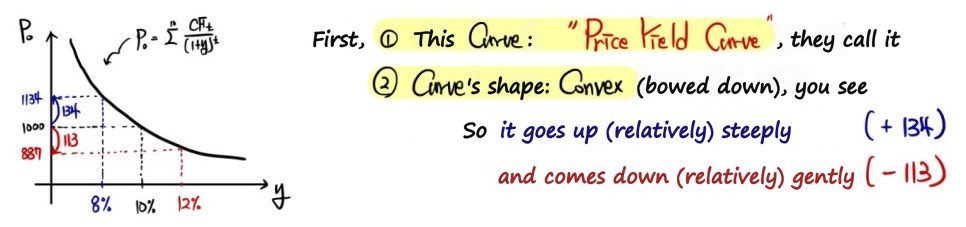
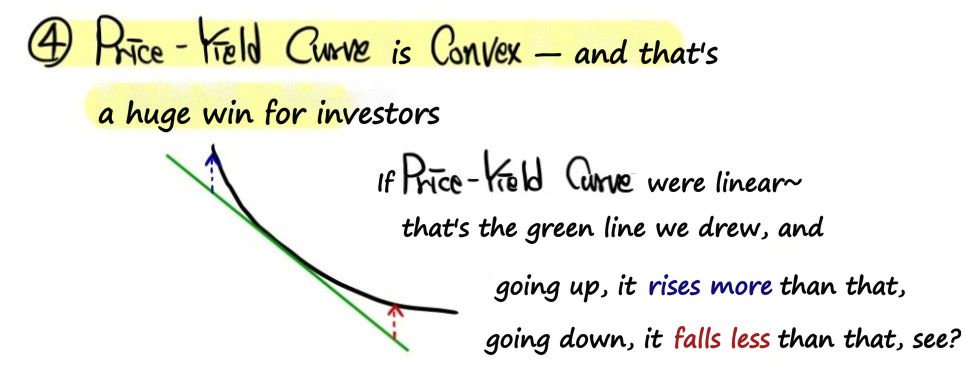
First, this kind of curve is called the “Price Yield Curve” (y-axis is price, x-axis is yield, so I guess they just named it the obvious thing). But look at the shape of this curve — it’s convex, curving upward (positive second derivative), see that?
So bond prices have this characteristic: when the price goes up, it goes up (relatively) more than it goes down, and when the bond price goes down, it goes down (relatively) more gently than it goes up.
But why does that convex function show up like that??
Precisely because of the principle that valuation of financial assets is “the present value of cash flows that will occur in the future” —
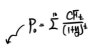
it’s because the calculation shakes out like this!!!!!
In other words, the factors that create the degree of convexity are the same ones sitting there — the y in the denominator, the CF in the numerator, whether t runs from 1 to 10 or 1 to 20. These factors mean that depending on what kind of bond you’re looking at, some bonds are crazy convex and some bonds are barely convex at all. And the same factors that deepen the bow also make the bond price respond more sensitively to changes in y, and how each factor plays out goes like this:
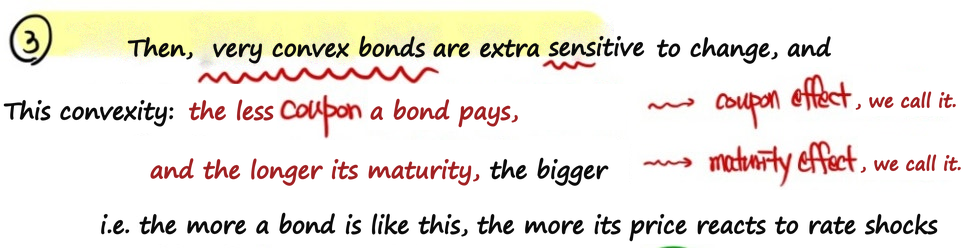
Ugh… but who the hell is going to memorize all of these one by one……. I’m definitely going to forget, so when studying bonds, it’s way better to lay the Promised Cash Flows out on a timeline and picture it in your head.
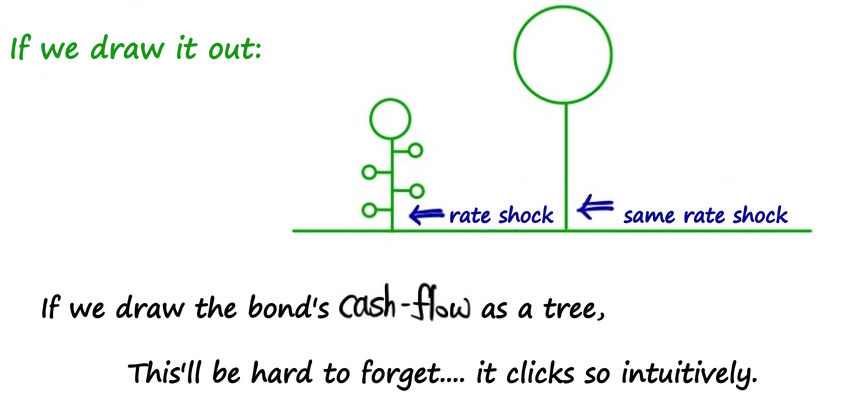
Think of it like: when you shake the trees from down at the bottom — WHACK!!! — which one sways more and reacts more sensitively~~? Burn that picture into your head, and then:
“Ah, the more cash flows there are in between (the higher the coupon), the less price sensitive it is.”
“If maturity is long (the tree is tall), it whips around more easily. Price sensitivity climbs as maturity stretches out.”
You’ll remember it with zero confusion, right!?!? heh heh heh
Anyway, the fact that the price yield curve is convex is a huge win from us-the-investor’s point of view.
But some bonds out there have a Call option attached, where if the issuer decides things aren’t going their way, they can just pull the whole thing back and redeem it. A bond like that, favorable to the issuer — that’s NOT going to have the convex shape that’s favorable to investors, is it!?!?
Yep yep yep, exactly. lol The Price-Yield curve of a bond with a Call option attached, when the call is about to get exercised, doesn’t give you a convex curve — it actually draws a concave one. heh heh heh I’m guessing this content shows up later!!! :-)
Looking at the Price-yield Curve, can you feel it? Gain / Loss on bond price is something that happens when the market’s required rate of return changes?!
Let’s chew on this a little more.
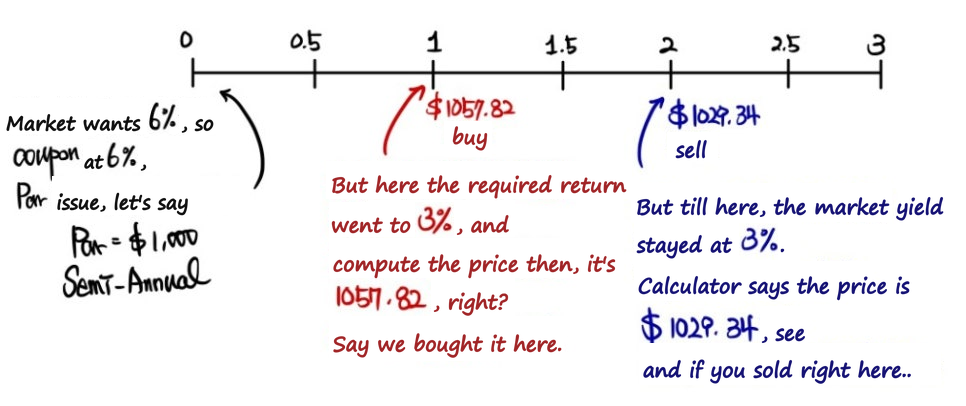
At t=0 the market’s required rate of return was 6%, so some bond with a 6% coupon would’ve been issued at Par — but instead of buying it at Par, at t=1 they bought it at 1,057.82 dollars. Because the market required rate of return had dropped to 3%, the price had climbed up there.
And they waited until t=2 — at this point the market’s required rate of return hadn’t moved from 3%, and if you punch it into the calculator for the bond price right here, it comes out to 1,029.34 dollars. They sold at this point, so they unloaded the bond at that price — so I bought at 1,057.82 / sold at 1,029.34, I took a loss, right?!?! — you might think.
But did this person actually take a loss??
Nope — the total return is positive, but the price did fall by about 28.48 dollars. That’s the expected pull-to-par of a premium bond, offset by two 30-dollar coupons. There is no extra gain or loss relative to the unchanged-yield price path; that isn’t the same as saying the sale price equals the purchase price!
If you punch it into the calculator like this:
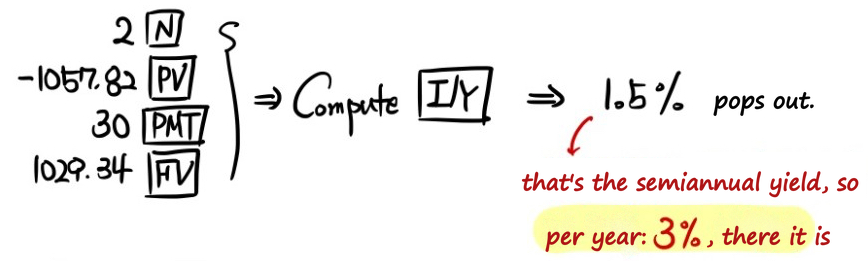
the cash-flow IRR comes out to 1.5% per half-year, or 3% nominal annually (3.0225% effective if the interim coupon is reinvested at 1.5%) :-))) heh heh heh
With a constant yield and the stated cashflows, the bond follows its constant-yield price path. Premium amortisation or discount accretion can change the price even without a yield change; a yield change adds a gain or loss relative to that path. Realised compound return also depends on holding period and coupon reinvestment.
(Also — if you don’t bail in the middle and just hold all the way to maturity, you just collect the Promised Cash Flows as promised, and you end up with exactly the required rate of return as of when you bought it, as long as the coupons get reinvested at that same rate, and that’s that~)
And the content that comes next is originally about the Spot rate, but I’ll do it all in one go in an upcoming post, when we hit the Yield Curve. Skipping it here:
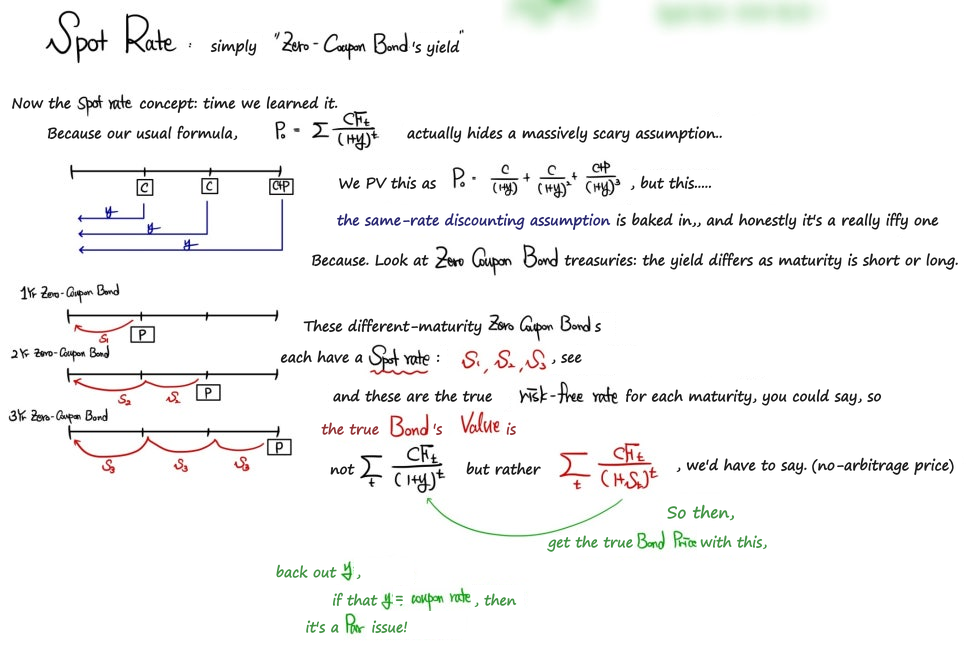
Skip, skip!! Don’t stress, it’ll all~~~~ click when we get to the Yield Curve. heh heh heh
Accrued Interest
OK here, let me just quickly wrap up with a little more on bond pricing. Bond trades don’t always conveniently happen at t=0 (issuance) or right on the dot at t=1, t=2 when a Cash Flow lands.

If a bond trade happens at some awkward in-between timing like this, then of the Cash Flow coming in at t=1, the 1/2 that A was holding before the trade should by rights belong to A, and half of the Cash Flow at t=1 that accrued during the green interval belongs to B, right??
So the price at T = 1/2 is:
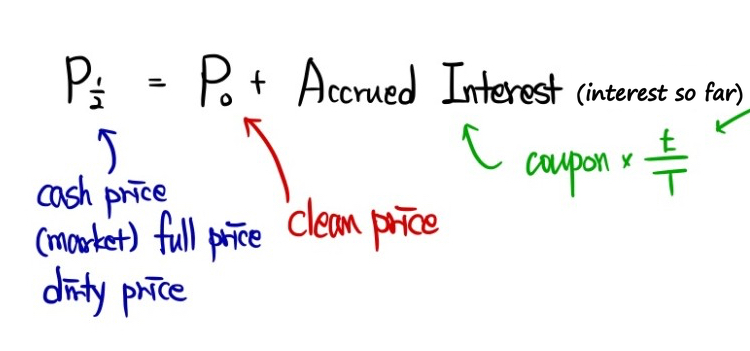
Take the clean price — the price with no accrued interest in it — as the base, and add on top of it the interest that has built up, A’s share. Since B is going to collect the full coupon at t=1 after taking over the bond, rather than doing the weird dance where B gets all of it at t=1 and then has to hand half back to A:
“hey B, you’re getting all of it at t=1 anyway — so when we do the bond trade now, just stack my share on top of the price and we’re square, cool?!”
That’s how the bond transaction goes, with the accrued amount bundled into the price. A price like this — the actual price the bond is trading at right now — is called the Cash Price / Full Price / Dirty Price.
But then, how should we actually calculate the accrued interest…….
Do we assume interest grew daily-compounded during that stretch of time / or do we assume it accrued on a simple daily basis…. On this, the assumption is that interest accrued on a simple daily basis, calculated as coupon × (t / T), as shown in the figure above.
And counting the days also needs a standard. There are a bunch of day count conventions, but when you’re studying for the CFA they say knowing just these two will carry you through the material without any trouble:
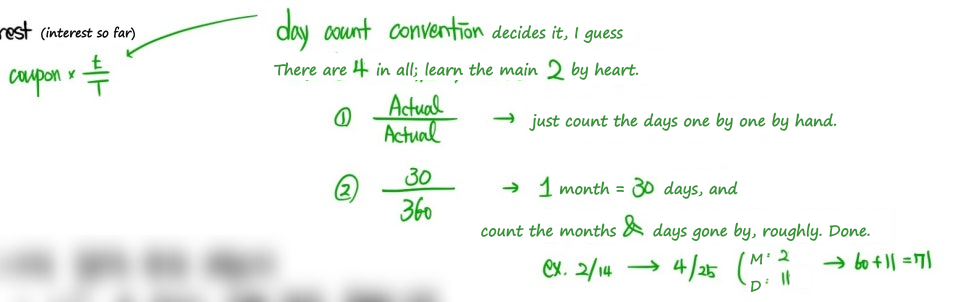
So the day count convention is actually different for each financial product, apparently. For example, historical USD LIBOR floating payments usually used Actual/360, while GBP LIBOR commonly used Actual/365; a swap’s fixed leg can use another convention. Read the contract. heh heh heh
(But at Level 1, they don’t seem to be grilling you on which day count convention each financial asset uses :-))
Theoretical Price
The coupon’s accrued interest is normally calculated using the contract’s simple accrual convention. That does not mean the bond’s full price grows linearly.
With a constant periodic yield, let $P_0$ be the full value just after the last coupon and let $t/T$ be the elapsed fraction of a coupon period. Then the theoretical full price is $P_0(1+r)^{t/T}$, with $r$ the yield per coupon period. The clean price is that full price minus conventionally calculated accrued interest.

So fractional-period discounting and simple accrued interest do different jobs — valuing the whole bond, and splitting the quoted clean price from the settlement amount.
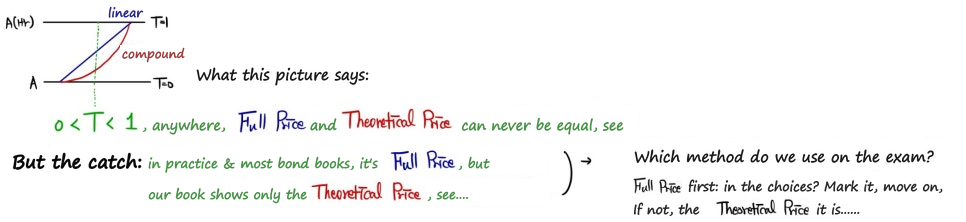
For an exam, use the specified yield, settlement date, day count and price definition. Don’t select a method just because its answer happens to appear among the choices!
Matrix Pricing
Last thing — let me quickly hit Matrix Pricing and wrap it up. Matrix Pricing is, when you’re valuing a bond that doesn’t trade much or hasn’t even been issued yet, “inferring it from the YTM of other bonds with similar characteristics and using that for valuation” — that’s the idea.
A simple example goes like this: I need to value a bond with a 3-year maturity right now, but the only bonds in the market with similar characteristics are 2-year and 5-year. In that case, we just use “Linear Interpolation” to roughly guess the YTM for the 3-year bond and roll with that.
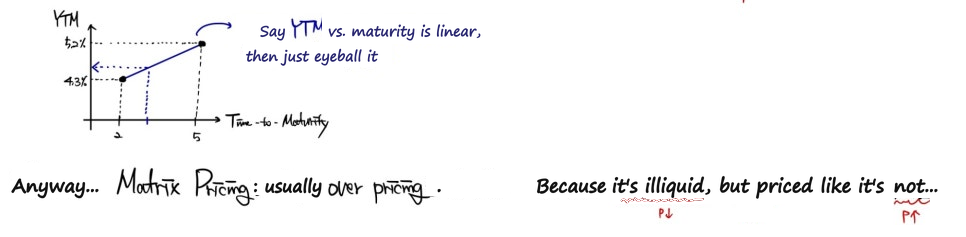
Doing it this way needs a comparable-risk and liquidity check……
Normally when you’re doing valuation, if there’s Liquidity Risk, you fold that into the discount factor so the present value gets knocked down harder. But just mashing numbers together like this means you’re slapping onto a bond of unknown (or nonexistent) liquidity the yield information of a bond that actually has liquidity — so if the target is less liquid and you make no adjustment, you may overvalue it. Proper matrix pricing can include that adjustment; overpricing isn’t inevitable!!! heh heh heh
Heads-up. The figures here are the original notes, slips and all. A few things to watch for:
- In the theoretical-price picture, the full price grows at the market discount rate per period, not at the coupon rate: $PV^{full} = P_0(1 + r)^{t/T}$, with $P_0$ the bond’s value on the last coupon date. (In the accrued-interest picture, $P_0$ is the clean price on the trade date, a different number.)
- The spot-rate sketch overstates a premise: YTM is the single IRR summarising a bond’s price and cashflows; quoting it does not assume a flat market spot curve. Matching each cashflow with a spot discount factor is the no-arbitrage valuation approach.
- Convexity is curvature, while modified duration measures first-order percentage yield sensitivity. Coupon/maturity effects hold with other terms matched, with qualifications for very long deep-discount bonds; more convexity alone doesn’t establish greater first-order sensitivity.
- The source pictures 013–016 use P0 for two different numbers. Trade-date full price=trade-date clean price+AI, whereas the fractional-yield formula starts with the last-coupon-date full value. These are consistent identities, not competing pricing methods.
Comments
Discussion happens via GitHub Discussions. You'll need a GitHub account to comment.