Yield Measures
Breaking down why coupon rate isn't your bond's 'true' yield, and how payment frequency changes everything when you're comparing bonds apple to apple.
I’m about to dig into the Yield Curve, and since that’s all about bond yields, let me pause for a second and think a bit harder about “bond yields” before going there…..
(With stocks we just call it a “return,” but with bonds it’s called Yield, right? Why? I’ve talked my mouth off about this already T_T T_T so — skip!)
So why even study bond yields? Well, we want to compare this bond against that bond, and the whole point of comparing is that the two things you’re comparing have to be on equal footing!!!
This is called the Apple to Apple Approach, and let’s take a look!!!
First though, you need a tiny bit of background on yields.
I went into extreme detail about geometric returns in another note, but…..heh
Let me just touch it briefly once more!
(I’m a little hesitant to bring this up because it might muddy things up more than help,
but strictly speaking, bond returns aren’t structured so that you get interest on interest.
So when you’re computing the “real” yield, using compounded yield wouldn’t really be appropriate.
But in the Fixed Income world here, we assume reinvestment. So just know that compound interest is what gets used!!!
If that’s confusing, honestly for your mental health you should just skip this heh
I deliberately didn’t even mention it in my Fixed Income summary notes heh)
OK, first — as I mentioned back in Fixed Income #1, the coupon rate is always quoted as “what % of face value, per year.”
So even if two bonds both have a coupon rate = 4%, you have to understand that the yield is different depending on whether that 4% is paid Annually as 4%, or Quarterly as 1% × 4 times,
i.e., the yield changes with the payment frequency.
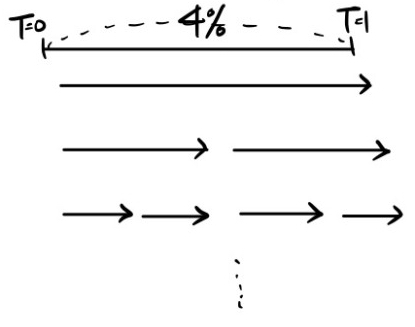
Let me walk through how the yield shifts depending on whether you pay 4% once a year, (4%/2) twice a year, or (4%/4) four times a year.
First, pay 4% once a year —
it just calculates like this.
But if you pay 2% twice a year, once every six months, you start earning interest on interest (the classic interest-on-interest thing),
so let me show how the yield changes.
Depending on what frequency the 4% gets paid at,
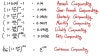
it ends up looking something like this.
So the coupon rate isn’t really the “true” yield of the bond. The only way to actually compare is to look at the Effective Annual Yield, which folds in payment frequency, like we just did.
What does that mean? One quick example will make it click heh
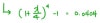
Q: “Another bond has an Effective Annual Yield of 4.04%, and I want to pay Quarterly….. What coupon % do I need to quote for it to be equivalent?”
A:
Current Yield — actually, this is a concept I hadn’t even written down in my notes the first time I summarized all this. I only added it here after I got wrecked by a Mock question and went “wait what the heck;; what even is this?”
Not important, but it’d be frustrating to miss a problem just because you’d never seen the term before, so let’s go over it as “a thing that exists” and move on.
What is it? It’s “compute a bond’s yield like it’s a stock dividend.”

The reason I can flat-out declare that — for a discount bond — Current Yield is less than YTM: YTM also bakes in the fact that you get “Par” back at the end (which is more than the discounted price you paid), so the numerator of Current Yield is definitely smaller than or equal to that!!!!
Callable Bond
Callable bonds are super super super super important!!!
They show up on the exam a lot. And honestly — it’s the CFA, they’re not going to only ask about straight bonds hahaha
I’ve heard Callables come up constantly.
Anyway: a callable bond, compared to a straight bond, makes you take on the extra risk of being called before maturity. So it should be cheaper than a straight bond with equivalent conditions.
Now, when we do the usual YTM calculation, we just naively compute YTM assuming we hold the thing all the way to maturity, right?
Applying that same calculation to a callable would be… not appropriate.
So let me introduce a few terms:
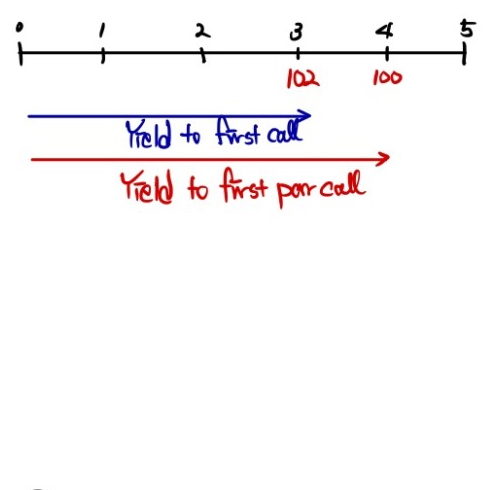
First, Yield to First Call — the Yield you get if you assume you’ll be called on the earliest date you could possibly be called.
Yield to First Par Call — the Yield you get if you assume you’ll be called at Par on the first date you could be called at Par.
And in reality there’d be formulas for second, third, … right?
As you crunch the Yield to Call for every possible call date, one of those dates gives you the smallest Yield. That Yield is called Yield to Worst. → There are practice problems on this, so knowing the terms alone should be enough.
Option Adjusted Yield
If the last section was “assume you get called,” the idea here is “let’s adjust this thing so it’s equivalent to a Straight Bond, then compare.”
Say there’s a straight bond and a callable bond with the same cash flows.

Then you can lay out the risks each bond carries like this.
Because of this, the callable ends up a little cheaper than the straight, and
(cheaper price = bigger YTM)
and the price difference is exactly the value of the Call option — the call right itself.
So if you take a callable bond’s traded price and add the option value on top, you get something equivalent to a straight bond,
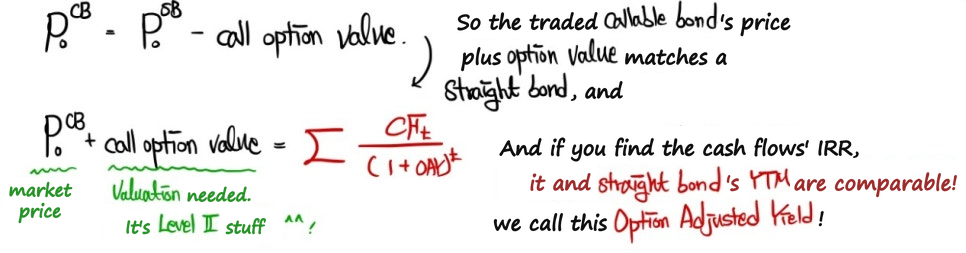
and once you’ve adjusted the price like that, the discount rate that matches that adjusted price (that’s the number that comes out as YTM)
is what we call Option Adjusted Yield (OAY) :-)
Floating Rate Notes (FRN)
Now I want to cover Floating Rate Notes (FRN), but first let me remind you of one foundational thing.
Why does “bond prices swing like crazy when the required interest rate on a bond goes up or down”?????
(Ah — Shuka-sensei explained this one so well hahahaha)
This is the video heh
He used a loan as an analogy to explain bond price movement, in a way that made even people with zero finance background get it in one shot……..
(I heard Shuka-sensei is looking for co-authors for a book aimed at total finance beginners T_T T_T please me me me me me me please me me me me me me me me me please please I want in!!!! me me me me me me me me me me me me me me me me me me me !!!!!!!!!!!!!!!!!!!! — ok I went full goblin there hahahaha sorry hahahahahahaha)
Anyway, the reason bond prices move is specifically because “the Coupon Rate is fixed and doesn’t change.”
Which means — if there were a bond that said “I’m not going to fix the Coupon Rate; I’ll keep shifting it to whatever the market wants^^” — the price of that bond wouldn’t move heh
FRN Yield
Oh, so that means FRN prices don’t change!!!!!!
Nope — T_T. Because even though they link it to a floating rate, the actual act of updating that rate happens only once every 3–6 months.
So there’s a stretch where the rate is still locked in, which means there will be some price change — it’s just small.
OK, let’s walk through the “price doesn’t change” intuition!!!
Hmm… if I draw this out assuming resets happen once a year,
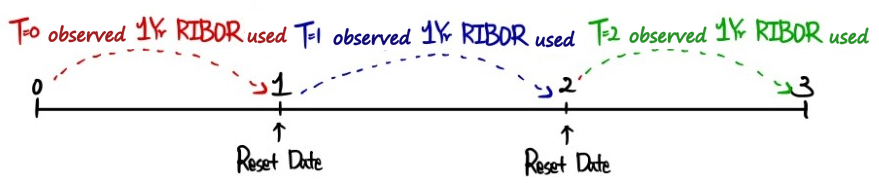
And if the issuer of this FRN is a company, you also need to add a variable called Spread. Because the issuer’s credit risk has to get priced in somewhere.
So on the Reset Date, the issuer turns to the market and goes: “Hey guys. What spread do you need? I’ll hand you a Coupon that matches it, so come buy this at Par.”
If they do that, it trades at Par, right?
You see it, right!?!?
One year out, set the coupon with the spread you guys asked for, stick it on as a payment one year from now — if you offer it at Par, deal’s done, right?
And if the same promise stretches further into the future,
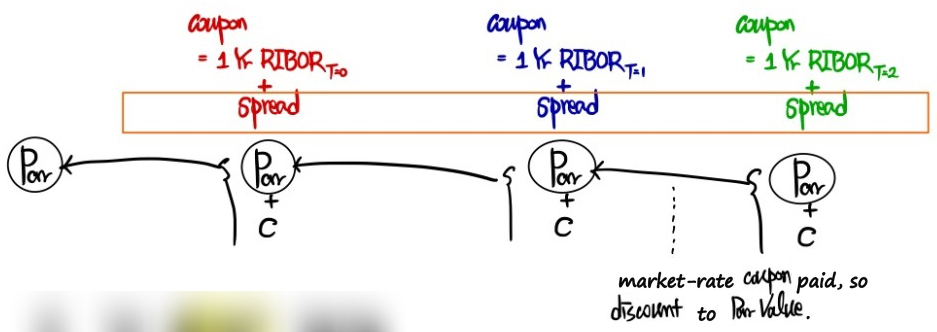
this price just keeps trading at Par.
Now — the spread marked in orange is the one negotiated with the market at each reset date.
That’s what we call the Quoted Spread. And the quoted spread is a contract term that gets fixed at T=0 and doesn’t change afterward.
But investors’ views keep shifting, moment to moment, right?
The spread that’s continuously changing in their heads — that one is called the required margin :-)))
OK, let’s do a final summary:
-
If the coupon is paid by updating the rate to whatever the market wants, the bond price doesn’t move.
-
But FRNs get issued with a fixed Quoted Margin.
-
Meanwhile, the Required Margin people actually demand keeps shifting.
-
So,
If Quoted Margin = Required Margin, it trades at Par.
If Quoted Margin < Required Margin, it’ll trade at a slight Discount.
If Quoted Margin > Required Margin, it’ll trade at a slight Premium.
Money Market Instrument
Come to think of it….. there isn’t just one way to express yield.
The yield we usually think about — the Add-on style, “what % has my principal grown by?” — is not the only way to talk about yield. There’s also a way of expressing yield by showing how big the discount was.
In the case of T-Bills (Zero Coupon Bonds),
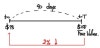
but this actually isn’t a Yield…. it needs to be phrased in the sense of “subtracting off,” so people say Discount rate = 2%, though strictly speaking that’s not quite accurate.
Technically it’d be more correct to call it a Deduction rate, but the convention of saying “discount” has just locked in.
Oh, and since you need to specify whether that 2% is over 10 days or 10 years, you’ve also got to annualize it.
Annualized (90-day) discount rate = (2%/90) × 360 = 8%
Annualized like this heh
(No compounding! Just slammed in on a simple interest basis.)
But apparently not all bonds get quoted using a Discount Rate like that.
For the ones that don’t,
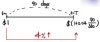
instead of “earning the yield by discounting,” the yield gets expressed as “adding it on top” — and in that case it’s called “Add-on Yield,”
and that 4% figure is already annualized, so
it’s called the Annualized (90-day) Add-on Yield.
(A classic Add-on Yield is apparently LIBOR…heh)
OK so now let’s think about this.
Discount Rate vs. Add-on Yield
They’re showing totally different numbers, which means they are different numbers — but you’ve got to know how to convert between them as equivalents, otherwise comparing them is hopeless.
An example is the easiest way to see it.
ZCB (zero coupon bond): Face Value = $100, 90-day maturity, annual Discount Rate = 8%.
→ Oh? Over 90 days that’s 2%, right?!
→ So I can buy it at $98 right now!
→ Then what’s my Yield?
→
→ Aha@! x = 0.08163 = 8.163%!
<Apparently, both of these — Discount Rate / Add-on Yield — usually get shown together.>
Comments
Discussion happens via GitHub Discussions. You'll need a GitHub account to comment.