Yield Curve
Finally cracking open the yield curve — spot rates and the zero curve, the YTM curve, and the implied forward rates hiding inside, plus why discounting everything at one single yield is kinda ridiculous.
Alright, the time has finally come — we’re talking about the Yield Curve!!! (And since we already mastered geometric mean returns last time, this is gonna be a piece of cake.)
The Yield Curve is a huge deal! Part of the reason is that this stuff can trip you up even in Level 2, but like — we’re not studying just to get the little piece of paper, right!??!? This matters in finance for real. Gotta actually know it.
There are 4 things introduced here, but 2 of them are basically the same thing, so at the end of the day we only need to nail down exactly 3. :-)
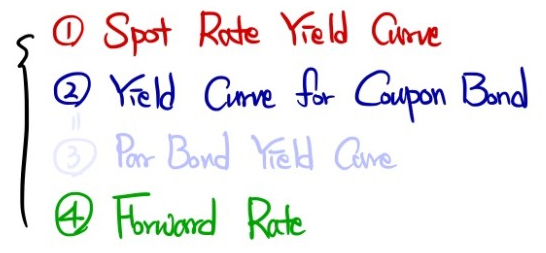
I’m gonna hammer through these one by one. A par curve is a particular coupon-bond yield curve — the coupons are chosen so each bond trades at par. It isn’t identical to every possible coupon-bond YTM curve.
Spot Rates
Aaaah — there’s one thing I skipped back in the Bond Valuation post, saying I’d do it once we got to the Yield Curve. heh heh. So let me do Spot Rates first, real quick, before moving on.
What’s a Spot Rate? It’s "the yield of a Zero Coupon Bond."
Hmm…. So this formula. The one we used without a second thought back when we were doing bond Valuation — (I mean, I don’t think you were really using it without a second thought, of course ^^)
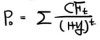
— if we use a required yield to price a bond, we compress the cash-flow discounting into one number. If instead we solve that yield from the observed price, that’s YTM, the bond’s internal rate of return.
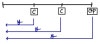
Using one yield doesn’t mean the market spot curve is flat. It simply hides the different maturity-specific discount rates inside one summary number. For no-arbitrage pricing of fixed default-free cash flows, we can use the spot rate for each payment date instead.
Because the second you walk into the bond market and go to buy a 1-year, 2-year, 10-year, 30-year…. bond, the yield is fundamentally different depending on which one you pick up. “You want me to park my money for THIRTY YEARS?!?! Then you’d better pay me more!!!” Unless the economy is in some super dark place, most people are gonna say this.
(Flip side — if more investors think the economy is about to go really bad, you get: “Yo!!! I’ll park for 30 years!!! I’ll put my money in right now even if you only give me 10%!!” “The guy next to you is quoting 10%? I’ll take 9%, sell it to me!!” — and that’s how the long–short rate spread ends up inverted. heh.)
Anyway — look at government bonds that are Zero Coupon Bonds, and because the yield depends on whether the maturity is short or long,
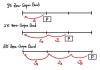
zero coupon bonds at different maturities each have their own Spot Rate — $s_1, s_2, s_3$, like that. And since these can be called the true risk-free rate for each specific number of years, the true Value of a Bond is not this
but this
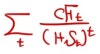
right? (Bond price with no arbitrage opportunity.) And so
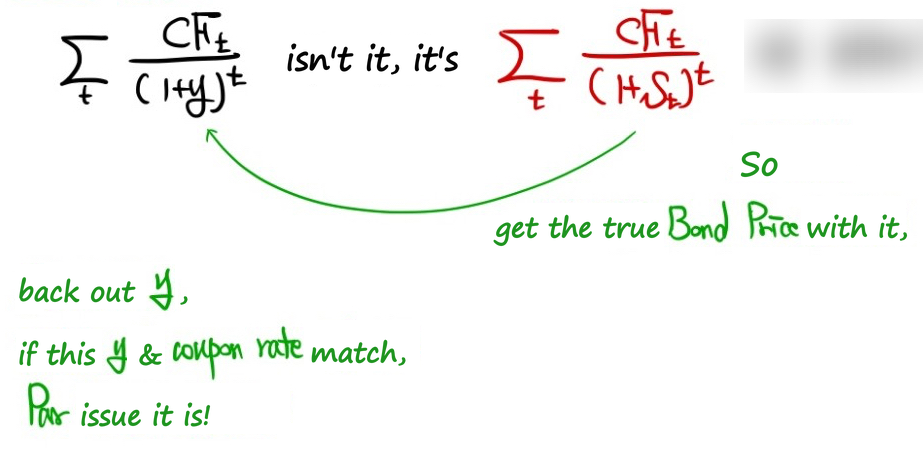
YTM is back-solved out of this thing, they say. :-) (However you crank it out, $y_n$ is gonna come out smaller than $s_n$ — as long as the spot rates climb with maturity. The coupons that come in along the way get pulled back at the shorter, lower spot rates, and YTM squashes all of that into one single rate — so that one rate ends up below $s_n$. ^^)
So the true Value of a Bond needs to be discounted like this:
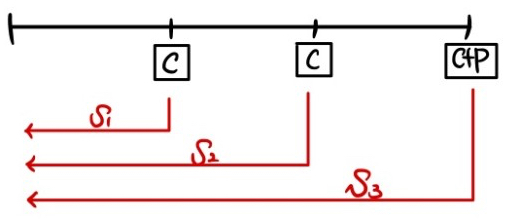
For the Cash Flow coming in 1 year, we should pull it back using the 1-year rate from the benchmark (on-the-run issue) curve; for the Cash Flow coming in 2 years, using the 2-year rate from that benchmark curve; and for the Cash Flow coming in 3 years, using the 3-year rate from that benchmark curve. Right?!
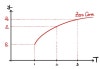
Every $s_n$ here is for a zero coupon bond, and they’re called spot rates. Plot these on $T$(maturity) vs. Yield axes and you get the Spot Rate Yield Curve (a.k.a. the Zero Curve).
Now you get why it’s named that. heh heh.
The YTM Curve
But — there’s also the YTM of a 1-year Coupon Bond ($y_1$), the YTM of a 2-year ($y_2$), … and so on. And the YTM of a 1-year bond is the same as $s_1$. Plotting those $y_n$’s gives you what’s called the Coupon Bond Yield Curve (a.k.a. the YTM curve).
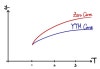
But wait — why does the YTM Curve sit below the Zero Curve??
If the bond is priced correctly,
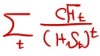
it trades at this price. But because we forcibly calculate YTM by smashing everything down to the same $y$, what happens is
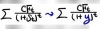
YTM ends up being a kind of average across $s_1$ through $s_3$, and if $s_1 \lt s_2 \lt s_3$, then you end up with $y_3 \lt s_3$ — so yeah, that’s why it sits below!!!
(And if the Spot Curve is downward sloping, the YTM curve sits above the Spot Curve!)
The Forward Rate
OK, last one — there’s also this thing called the Forward Rate. What is this…. it’s the forward rate…. Instead of a rate “for 1 year from now, 2 years from now, … $n$ years from now” — it’s the rate “for $n$ years, starting $m$ years from now.” We’re in derivatives territory! heh heh.
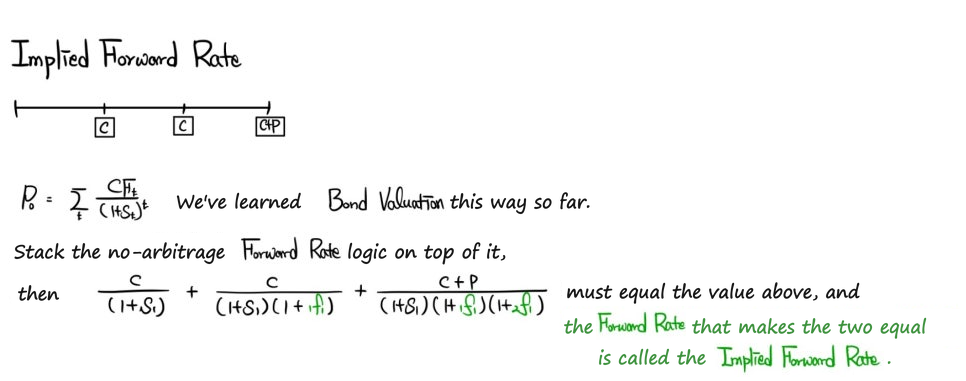
The theoretical forward rate works like this:
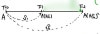
In this setup — what does the rate for “1 year, starting 1 year from now” have to be so that there’s no arbitrage opportunity?
Pin it like this and no arbitrage opportunity shows up. That forward rate is called the Implied Forward Rate.
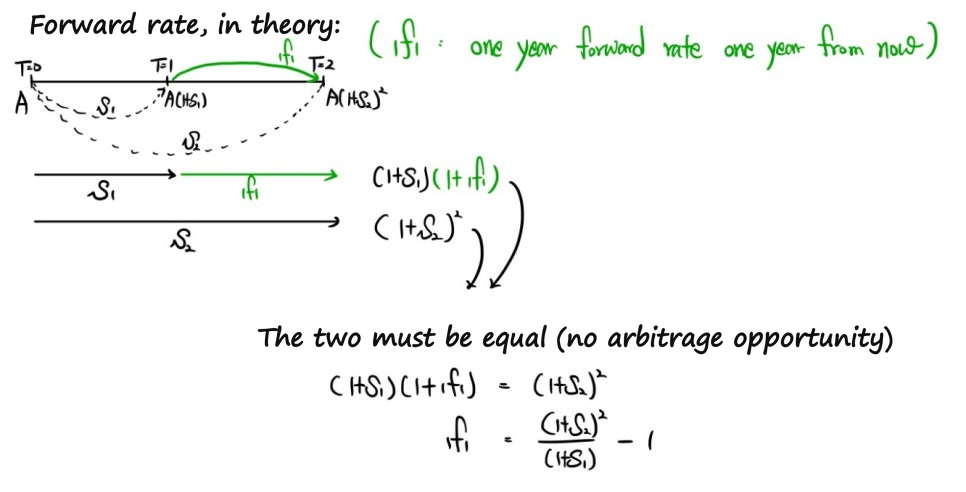
Because earning $s_1$ for 1 year and then the rate for the 1 year starting 1 year from now has to equal earning $s_2$ a year for 2 years — otherwise arbitrage pops up — that’s how the forward rate falls out theoretically.
Honestly at this point, “I can calculate the rate for $n$ years starting $m$ years from now too!” is not a bluff. In fact — if someone hands you a whole pile of Spot Rates, you can crank out every single Implied Forward Rate hidden inside them, brrrrrrrt, one after another.
Now — someone who trades to lock in the rate for 1 year starting 1 year from now: what are they expecting, that they made that ${}_1f_1$ forward trade?
Because — if they’re the one who’ll be borrowing for that year — they think that when that year actually arrives, the $s_1$ at that moment is gonna be higher than ${}_1f_1$. i.e. they think rates are going up, so they want to lock in right now.
That can be one trader’s view, but someone may also lock a rate simply to hedge a future payment. Forward rates reflect today’s no-arbitrage prices and risk/term premiums, not a guaranteed forecast of future spot rates.
And since being handed Spot Rates means you can compute every Implied Forward Rate, Spot Rates themselves actually carry a ton of information inside them already!!!?!
That’s how important an indicator they are.
Now now now now — but that forward rate we just cranked out uses the geometric mean principle, right?
Since $s_2$ is in a geometric-mean relationship with $s_1$ and ${}_1f_1$,
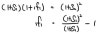
if you stare at this formula for a sec, since $s_2$ is already bigger than $s_1$,
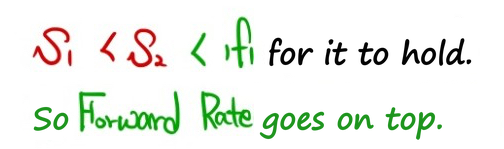
${}_1f_1$ has to be bigger than both of them for the thing to hold,
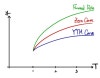
and what I’m trying to say is — for the upward-sloping spot curve shown here, the one-year Forward Rate ends up drawing the highest curve on the plot. heh heh. Easy, right?!
Oh — and one more thing.
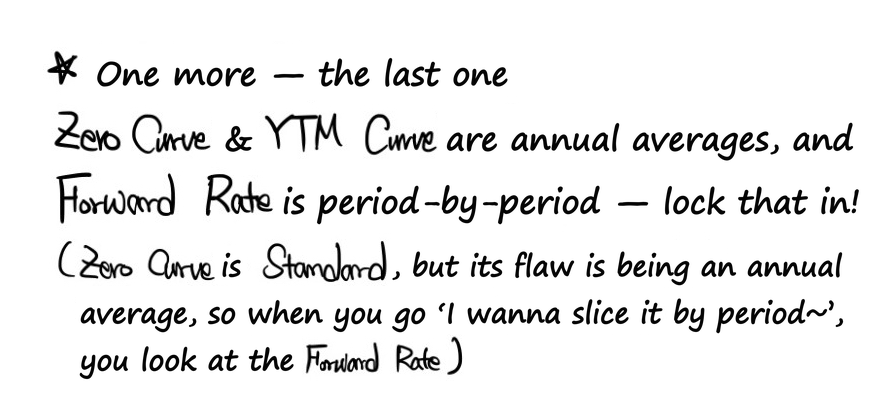
Actually, $s_2$, $s_3$, $y_4$ — whichever — these are all average concepts. “Roughly, what % return per year does this give on average?” — that’s what gets calculated as a YTM or a Spot Rate.
Our one-year Forward Rate covers that particular future year, rather than averaging from today. More generally, a forward covering several years is still quoted using an annualized-rate convention; it isn’t automatically the total return over the entire interval.
Let’s take that much with us!!!
I already covered all of this above,
so I’m just skipping straight past this one!!! heh heh.
What comes next is Yield Spread, and if I try to fit all of that in here too, it’s gonna be bad for my mental health.
So Spread is getting its own post, since it can get pretty confusing…. I’ll suit up and come back for Spread!!!
Alright everyone — Merry Christmas!!!! heh heh.
Heads-up. The figures here are the original notes, slips and all. A few things to watch for:
- The ‘not this, but this’ valuation sketch contrasts ways to obtain a price, not unequal prices: the correctly back-solved YTM reproduces the same price as spot-rate discounting. The forward-above-spot ordering shown assumes an upward spot curve; it reverses for a downward curve.
Comments
Discussion happens via GitHub Discussions. You'll need a GitHub account to comment.