Price Risk, Reinvestment Risk, and Duration
YTM is a cash-flow IRR; earning it as a realised compound return also depends on coupon reinvestment. From there: price risk vs reinvestment risk, Macaulay duration as the balance point, modified and money duration, convexity, yield volatility and the duration gap.
Here’s the thing to watch: YTM is the cashflow IRR; calculating it needs no reinvestment assumption. To turn it into the same realised compound return through maturity, coupons must be reinvested at that yield and payments must arrive as promised.
I begged you over and over not to forget that, right? Let me go over it just one more time before we start this section.
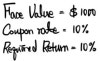
Say a bond is issued under these conditions. First of all, the coupon rate equals the required rate of return, so this would’ve been a par issue. And let’s say the maturity is 2 years, OK?
Then let’s think about this first. For 1,000 dollars to earn 10% a year on average,
$$1{,}000\left(1+0.10\right)^2 = 1{,}210$$my principal has to grow to 1,210 dollars before I can say I earned 10% a year on average, but
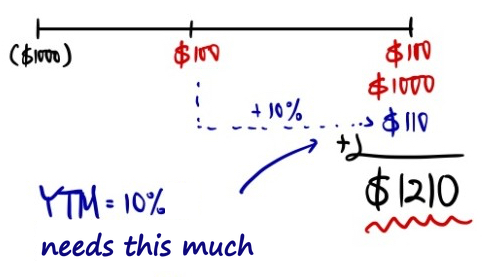
the cash flows marked in red, the ones I get if I just hold the bond and do absolutely nothing, fall short of 10% a year. Only when interest on interest gets counted in do you get to 10% a year.
So the bond’s IRR is 10% either way, but getting terminal wealth 1210 and a 10% compound return requires reinvesting the first 100 at 10%. It needn’t be the exact same bond — the reinvestment rate is what matters. Getting the feel for it????
So the yield measured beforehand (ex-ante), the YTM, and the annualized holding period return measured afterwards (ex-post), looking at the money in my account once everything has run to maturity, may not be the same….. That’s the point.
(I used to wonder why we calculate it this way….. YTM answers one question: what discount rate matches the price to the scheduled cash flows? My final account balance answers another — and that one depends on what I do with the coupons along the way……. heh heh)
Price risk and reinvestment risk
OK OK OK OK OK. So then, what are price risk and reinvestment risk?
They’re the risks tied to exactly what I just talked about. You receive a cash flow along the way, and there may be no bond around that pays you the same return anymore. That kind of risk!!! In other words, the risk that rates drop, whoosh!, while you’re on your way to maturity.
Huh? If rates drop whoosh!, doesn’t my bond price go up, so I could even make a capital gain?
Oh ho, let me visualize this trade-off.
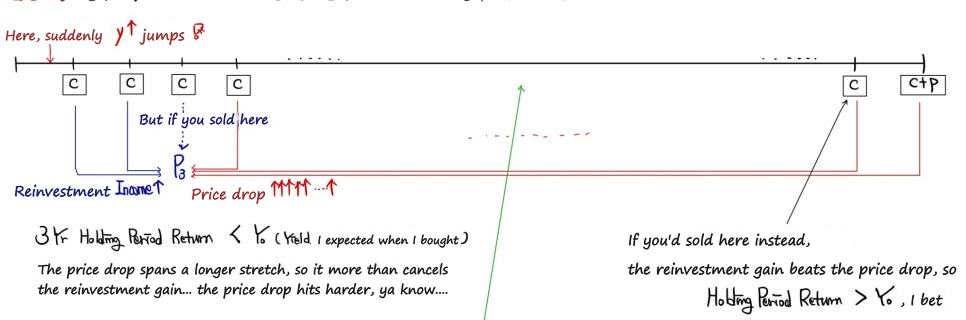
If market rates suddenly go up right after you buy the bond, you get to take the coupons and reinvest them at the higher rate, so reinvestment income goes up, but all the cash flows waaaaay out at the back get discounted at that higher rate too, so the hit from the bond price falling is much bigger.
In that situation, if you sold at T=3, the price drop has the bigger effect, so it more than wipes out the rise in reinvestment income. But if you had sold later, it flips: reinvestment income has the bigger effect and more than makes up for the price drop…..
On this side this one dominates, on that side that one dominates, and STEM nerds love this kind of thing:
“Right, so when exactly!!!! do they come out equal?”
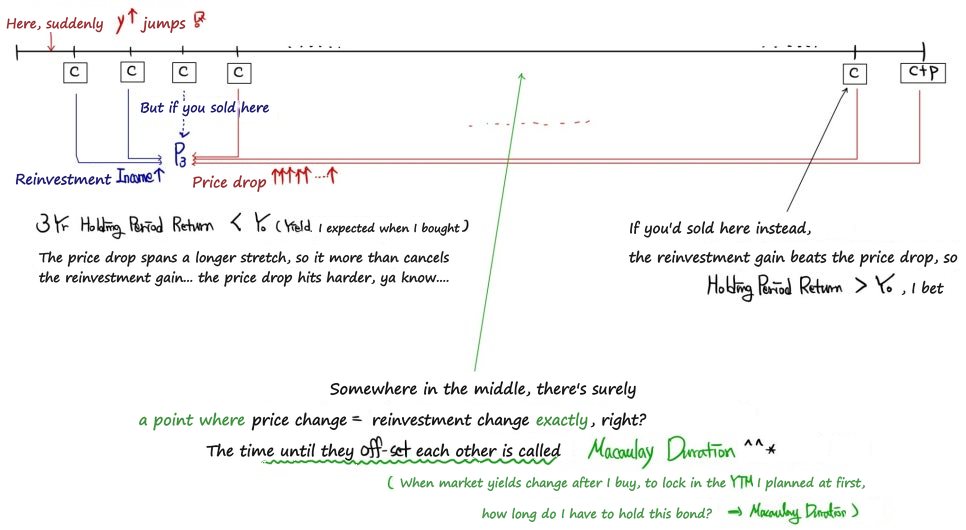
For a small, one-time parallel yield shift, that first-order balance point is the Macaulay duration. It isn’t exact protection against every finite or non-parallel rate move.
(I think this is a so so so so good explanation. In undergrad I learned Macaulay duration as a “time average” kind of concept, and here it’s more like looking at it as a center of gravity. The center of gravity gets explained once more right below.)
(That’s the duration I met back in undergrad, in my note Duration and Modified Duration (Basic Investing I Studied #16).)
Macaulay duration
OK, now let’s really tear into duration.
Up there we saw Macaulay duration as “the holding period at which the changes from price risk and reinvestment risk become equal.” If you visualize it, it’s the center of gravity of the present values of the bond’s cash flows.
(Because duration is a weighted average of the times of the cash flows, each weighted by its share of the total present value, and those weights work just like probabilities. See the undergrad-level duration note.) (An “average” is really a sum of values times their weights, and geometrically that means the center of gravity.)
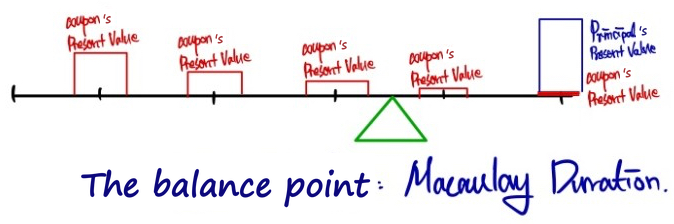
That’s also why, by the way, the Macaulay duration of a zero-coupon bond equals its maturity. When each present value shifts ever so sliiightly with a tiny move in $y$, if the fulcrum sits at the Macaulay duration, it’ll keep its balance without much wobbling through that little bit of change.

But why only give you the concept and not the formula? So I made one for you! For the annual-payment bond here, withythe annual yield in decimals, Macaulay duration in years is calculated with this formula. (The derivation is in that undergrad note.) For an annualised nominal yield withmcoupons per year, the year-based relation becomesMacDur=(1+y/m)ModDur.
$$\text{Macaulay Dur} = \left|\left(1+y\right)\frac{\frac{dP}{dy}}{P}\right|$$Modified duration and money duration
But as you all know, Macaulay duration isn’t the only duration out there; there are other kinds of duration too, so let me rattle through all of them. Let me change the question like this:
“When the market’s $y$ moves a tiny bit, by what % does the bond price change?”
How sensitively does the bond price move when market rates change? The answer to that question is modified duration. Let me introduce the formula first:
$$\text{Modified Dur} = \left|\frac{dP}{dy}\cdot \frac{1}{P}\right|$$What, this expression is hiding inside Macaulay duration too???
$$\begin{aligned} \text{Macaulay Dur} &= \left|\left(1+y\right)\frac{\frac{dP}{dy}}{P}\right| = \left|\left(1+y\right)\textcolor{#ff0010}{\frac{dP}{dy}\cdot \frac{1}{P}}\right| \\ \text{Mac Dur} &= \left(1+y\right)\cdot \text{Mod Dur} \end{aligned}$$They’re both absolute values, so the signs match as (+), whatever.
Anyone from a science or engineering background usually just does $dp/dy$, so why make it complicated with $(dp/p)/dy$….. is what I thought too at first, but the numerator being $(dp/p)$ just means the % change.
When something that costs 1,000 won moves by 100 won, $100/1000 = 10\%$, and we say “it moved 10%~”. Just like that, we’ve actually been using $\Delta x / x$ all the time in everyday life. How big a % change in $x$ happens for a tiny change in some other factor $y$, written plainly as a formula, is $(\Delta x/x)/\Delta y$, and the change after taking the log means exactly this % change.
$$\frac{d}{dx}\ln x = \frac{1}{x}$$Using this relation and writing it with $\Delta$:
$$\Delta \ln x \approx \frac{\Delta x}{x}$$That’s also why derivatives of logs are such a big deal.
Yeah yeah, forget it, % change, schmercent change, I just want to know how much “the bond price itself” changes! You can write that as a formula too!!!!! The duration made for those people is called money duration.
$$\text{Money Dur} = \left|\frac{dP}{dy}\right|$$A whole lot just landed on you at once, right?! Let me sort it out by visualizing it.
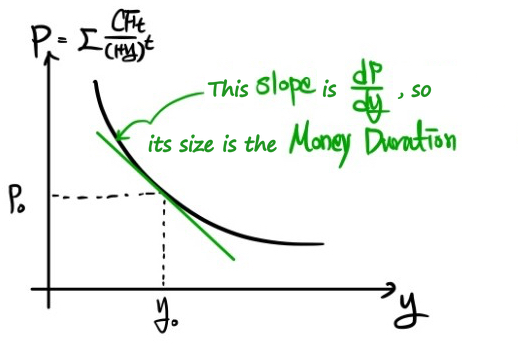
This derivative, the one you can easily accept from high-school calculus, is (sign aside) the money duration, and turning it into a % change gives the modified duration, so visually you can understand it like this.
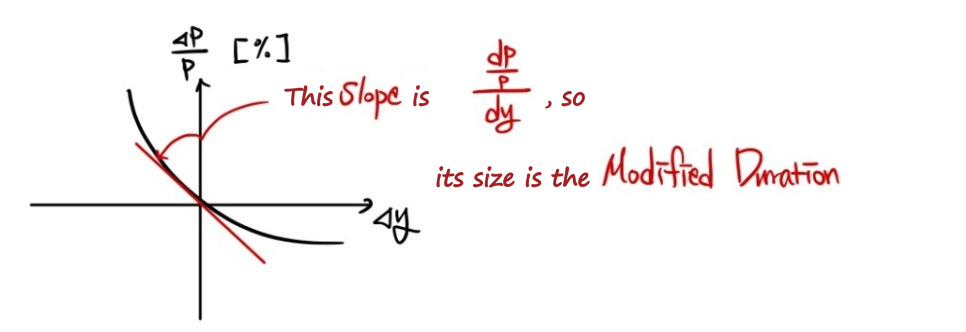
Strictly speaking it’s not quite right, but please forgive me for cutting a few corners for intuition’s sake :-)
Approximate modified duration
One last thing: since the bond price follows a convex curve, for the same $\Delta y$, the $\Delta P$ on the way up and the $\Delta P$ on the way down will be different.
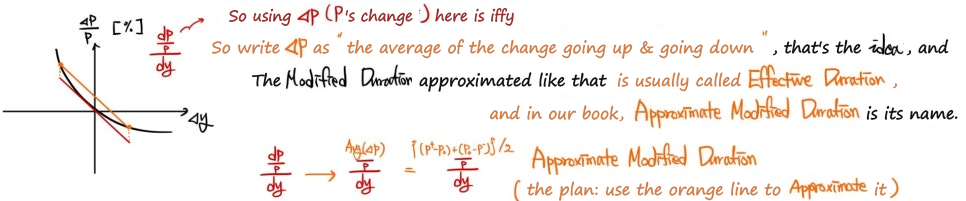
You can take the derivative forward or backward (forward difference, backward difference), and with the idea of “don’t do either! Take the average of the forward and the backward derivative (central difference)”, the book introduces one more: approximate modified duration.
The central-difference shape looks similar to effective duration, but the input shock is different: approximate modified duration shocks the bond’s own yield with fixed cashflows; effective duration shocks a benchmark curve and reprices any rate-dependent cashflows.
Looking at the price change caused by a change in YTM for every bond works when you’re only considering straight bonds, but once callables or structured bonds like ABS are in the mix, thinking in terms of $\Delta\text{YTM}$ is a stretch. In that situation it makes sense to look at how sensitively the price moves with a change in the risk-free rate rather than in YTM, so the book introduces calculating $\Delta\text{risk-free rate} \to \Delta P/P$ as effective duration.
(Same-looking formula, different question — that’s why the labels matter!!!!!)
But the reason we pull this whole stunt of finding approximate modified duration is presumably an effort to shrink the gap between the number we calculate and the real one, and even so, even so, there’s always going to be a gap between an estimate and reality, right?
But!!!!! For a callable, use a model that reprices the call under benchmark-curve shocks — effective duration. A wider shock spans more curvature and can give a different estimate; it isn’t automatically more accurate just because the shock is large.
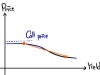
This stuff feels like it’ll show up as an answer choice?!?!?!?!? Definitely something to lock in before moving on!!! heh heh heh
Between the formula and reality
Honestly, while writing all this I’ve been mixing $dx$ and $\Delta x$….. because mathematically writing $dx$ is the right thing, but in the real world, what $dx$….. it’s not even possible, so really every one of these should be written as $\Delta x$. In finance things actually move discretely, in bp steps! So between the formula and reality a gap is unavoidable.
There’s a trick statement about that difference that shows up on exams:
“For a positive-convexity option-free bond, the tangent-line duration estimate lies below the actual price after a yield move” ☞ true under that fixed-cashflow model! It isn’t universal for callable or other negative-convexity regions.
“If you estimate the change in the bond price with modified duration, you always over-estimate it compared with the true change” ☞ false!
It’s easy to see once you look at the picture. (✓Careful! The y-axis unit is %! It’s a rate of change, a rate!)
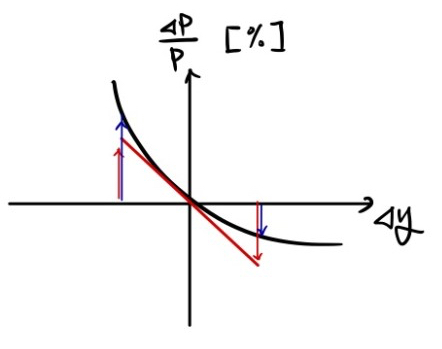
The estimate from modified duration is the red arrow, the actual rate of change is the blue arrow, and at a glance, the estimate

And the formula that estimate comes from is

Let me pick up just one term here before moving on. There’s a term called PVBP (price value of a basis point). Just file it as: it’s the $\Delta P$ you get when you pin $\Delta y$ at 1bp!

I was debating whether to cut it here, but I’ll just keep going….. This is a long one….. heh heh anyway, keep going!
The duration of a bond portfolio
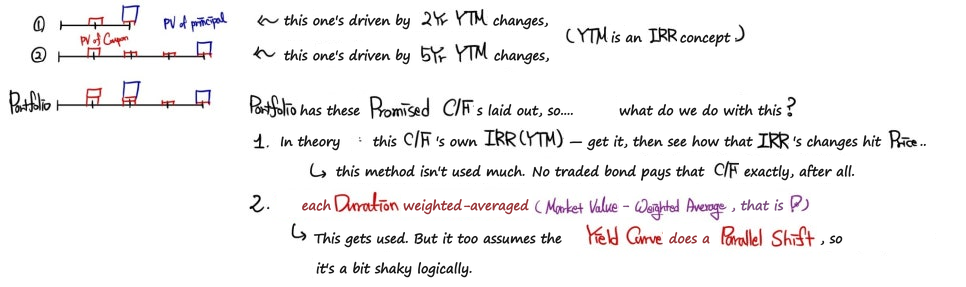
So far we’ve looked at a bunch of durations, but actually duration is appropriate for measuring bond price risk on the premise that the yield curve makes a parallel shift…… The baseline assumption is “what if every YTM goes up by the same 1%?????”, right?
But no one managing money is going to hold bonds with just one remaining maturity in a portfolio; they’ll have bonds of lots and lots of different remaining maturities in one portfolio….. And inside it, the YTMs at 1Y, 2Y, 3Y,….. will all move differently, meaning the sensitivity will be different depending on the remaining maturity, so the duration of a bond portfolio…… how do you handle this one………….
For this kind of thing, we use something called key rate duration. Let’s just understand it as thinking about “when one particular rate moves, how does my bond portfolio react….” and move on.
(The rule for what the key rates of my bond portfolio are is covered in Level 2.)
At our level for now, the limitation of portfolio duration can be summed up about like this. Say there’s a portfolio made of 2 bonds,
What drives modified duration
Now now, the real last one!
- When two bonds being compared are identical in every other way, there are 3 arguments of a bond that affect interest rate risk.
As the yardstick for measuring interest rate risk we learned modified duration above, so the point is to sum up the 3 things that affect modified duration.
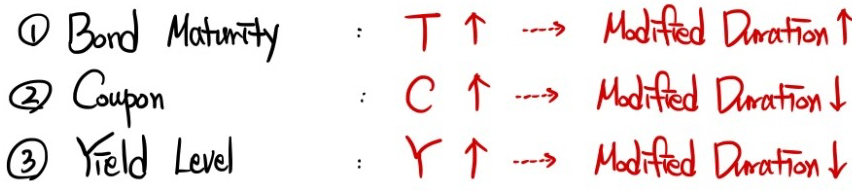
- If the maturity is long, the stretch over which rates can change is naturally longer, so you’re more exposed to the risk. That’s the idea.
- If a bond pays a lot of coupon, cash drips into your hands along the way, so you get your money back faster. That’s the way to see it.
- Just look at the price-yield curve: at low $y$ the slope is super steep, right???? That’s what this one says.
And if you visualize all of this in one picture, it was this picture, remember!?!?

Think of a rate shock as kicking that tree from below, BAM!!!, once, and ask: “which tree (which bond, with which promised cash flows) will sway harder (have the bigger modified duration)?” Like that!
Convexity
But if a STEM nerd reads this, here’s what they’ll think. Excuse me, mister, you say “duration” like it’s something fancy, but really that’s “just the first derivative, isn’t it?” Then you could take the second derivative and see the rate of change of the slope itself, and the third, the fourth, you can see them all?
Why is there only the once-differentiated duration? Don’t you at least do it twice by default????
That’s exactly convexity.
Convexity is affected by exactly the same things as duration, so let me lump it all together in one go and move on.
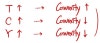
So computing the change in the bond price with only the first derivative

and bringing in the second derivative too

gives this, but really this is just the approximation of the change you get by extending the Taylor series one more layer, to second order, isn’t it…..? We’re just using it as is…. and since I think explaining all of that again is a waste…. I’ll leave it at this much and move on! heh heh
If convexity shows up on a problem, let’s just plug it into the formula carefully and not mess up the arithmetic! heh heh heh
We said a price-yield curve drawn convex is a shape that favors the investor, right? Because the price goes up steeply / and comes down gently?
Then if you add a put, which they say favors the investor, does that advantage show up in the convexity too??????
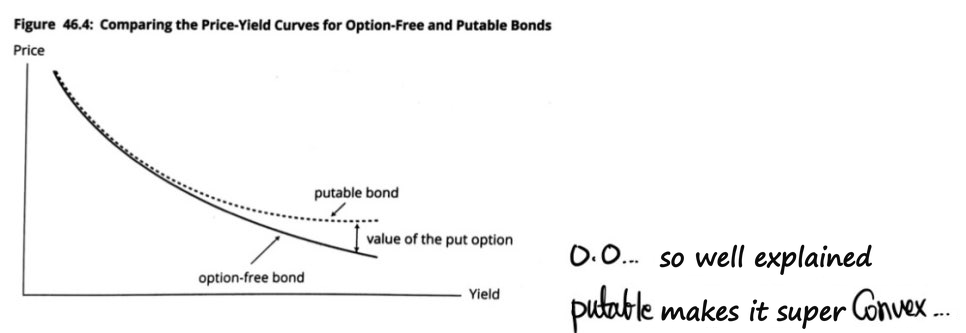
Calls, puts and duration
Since we’re on the subject, how should we sum up what happens to duration when a call or a put is attached????? It’s actually not a hard concept. A callable puts a cap on price increases in the issuer’s favor, and a putable sets a floor under the price in the investor’s favor, so

Let me sort out just 2 more little things before moving on.
Yield volatility
To estimate the rate of price change, we’ve
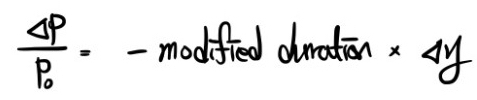
really only been studying this formula, but there’s actually volatility in here too…
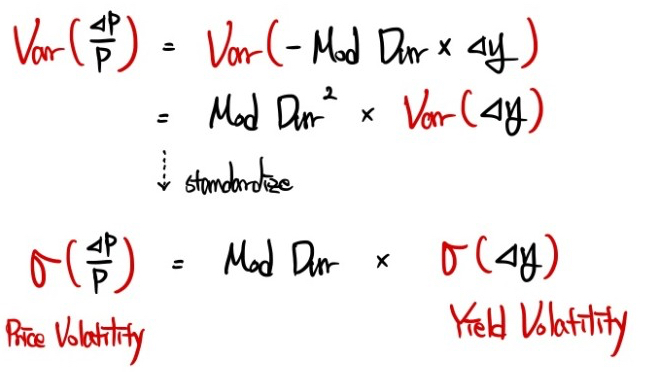
What that means is…. there’s actually a term structure in the volatility of rate changes too… What we in Korea call the base rate is the Bank of Korea’s 7-day repo rate, and when that base rate gets touched, a rate shock is usually seen to spread short-term ⇒ medium-term ⇒ long-term, a spillover effect.
The sketch shows one common pattern: short yields more volatile than long yields. Actual volatility curves depend on the market and period; they needn’t always slope down.
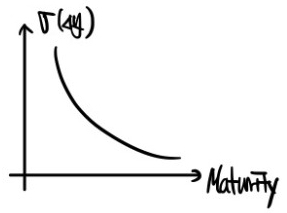
Let’s remember just one more picture like this one before we go!
Duration gap
The difference between a bond’s Macaulay duration and the investor’s investment horizon is called the duration gap, and how you set this gap tells you whether you’re playing defense / or playing offense, they say.
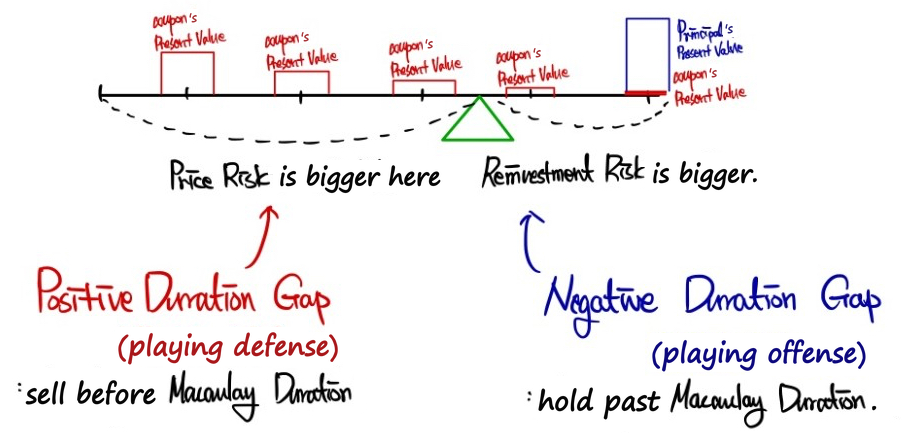
Heads-up. The figures here are the original notes, slips and all. A few things to watch for:
- In the check of $\Delta P = -P_0 \times \text{modified duration} \times \Delta y$, the modified duration is $-\frac{\Delta P/P_0}{\Delta y}$, with a minus sign (prices fall when yields rise); without it the check comes out as $-\Delta P$.
- On the duration-gap picture, the two labels look swapped. With a positive gap (Macaulay duration longer than the horizon), price risk dominates, so the holder gains if rates fall and loses if they rise: a bet on falling rates. With a negative gap, reinvestment risk dominates, so a rise in rates helps: the side that guards against rising rates. A zero gap gives first-order horizon immunisation under the stated small parallel-shift assumptions; ongoing changes and non-parallel shifts can leave risk.
- The first YTM illustration compares terminal compound returns, not the definition of IRR. Without reinvesting the first coupon, terminal wealth is 1200 and compound growth is about 9.5445%, while the scheduled-cashflow IRR remains 10%.
- In the Taylor-series picture, −modified duration×Δyield+½convexity×Δyield² is the fractional change ΔP/P, not the currency changeΔP. Multiply by the starting full price to obtain a currency amount, or by 100 to express percent.
- The source’s numerical derivative and effective-duration sketches use price-up/price-down labels. To avoid sign ambiguity: positiveeffective duration=(price after a down-curve shock−price after an up-curve shock)/(2×initialprice×shocksize). The pricing model must allow option-dependent cashflows to change.
- The percentage-variance relation is a first-order approximation with duration treated as constant. Policy announcements can affect many maturities immediately; the illustrated short-to-long volatility pattern isn’t a universal transmission timeline.
- The maturity/coupon/yield tendencies refer to comparable conventional bonds; a very long deep-discount bond can be an exception to a simple maturity-duration rule. A put’s extra convexity is local to where its value changes, not uniformly larger curvature at every yield.
Comments
Discussion happens via GitHub Discussions. You'll need a GitHub account to comment.