Credit Analysis and Credit Ratings
A breezy skim through credit analysis — cash flow, bond indentures, and why credit loss is basically just lottery math but for money you might lose.
OK so — Valuation in Fixed Income? Done. Wrapped. Finished.
Fixed Income is mostly about Valuation, but there’s also this thing called ABS that comes after — sort of a sub-main topic.
Before we get there though, let’s talk about bonds for a sec.
Whether it’s government bonds or corporate bonds, here’s the thing that makes them different from stocks: credit rating agencies actually rate the things, right???
So I think we’re about to cover that — but, like, very briefly???????
It really doesn’t feel like we’re going deep at all. More of a “skim and move on” situation heh heh heh
OK so. If I’m gonna buy a corporate bond… what should I be looking at to figure out whether the company can actually deliver the Promised Cash Flow or not….
Should I be staring at the financial statements? The things that show the company’s financial condition and performance???
The thing is… financial statements are written on an accrual basis, so
it’s kinda a stretch to say they’re showing economic intrinsic value……
But fine. Fine fine fine. Making a hundred concessions and just looking at them anyway…. at least… apparently you look at “cash flow” to see “default risk.”
Just cash flow alone makes it hard to see default risk properly,
but if you crack open the Bond Indenture too and look at stuff like how much the investors are protected, then maybe you can recognize the risk a bit better…
So in the end — cash flow + Bond Indenture,
and as part of measuring Credit Risk (the risk that the promised cash flow doesn’t show up), you do calculate ‘default probability’,
but THAT — that’s a Level 2 thing…..
Wait. So then what are we even gonna look at here…..
“Taking default probability as given” (since the actual computation lives in Lv2)
We study this thing called Credit Loss, which expresses Credit Risk in dollar terms heh heh heh
To get a feel for it, let’s first wrap our heads around the Expected Cash Flow from winning the lottery, just commonsense-style,
think it through, and then run the calc.
Lottery prize: 10 billion won / win probability 1% / tax rate 30% — given those,
to call it Expected Cash Flow,
“Expected value of the prize money I’m exposed to” = 10 billion * 1%
And if we further account for the expected cash that actually lands in my pocket after taxes,
10 billion * 1% (1-30%)
Looks like we can stack it up like that, right?

The principle is so simple it’s almost embarrassing,
and since the principle behind Credit Loss is literally exactly the same,
the only twist is that here we’re not talking about cash flow I might gain — it’s “money that gets eaten up and I might lose (Expected Negative Cash Flow)”
Let me build it up once.
Loan: 10 billion / default probability: 1% / recovery rate 30% — given those, from here
Money exposed and possibly lost = 10 billion * 1%, and then
since it’s not like you lose everything — some chunk gets recovered —

Right?? Same shape as the lottery,
and if we just swap in the Credit Loss vocabulary,

Putting it all together,
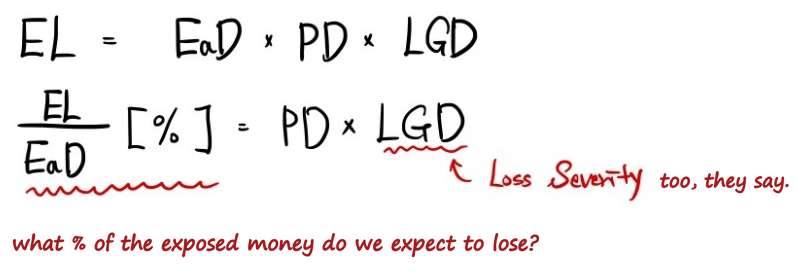
And that’s the end T_T T_T T_T T_T T_T T_T T_T
But before we move on, let’s knock out one problem.
Prob. 139
For a high-quality debt issuer with a large amount of publicly traded debt, bond investors tend to devote most effort to assessing the issuer’s :
A. Default Risk
B. Loss severity
C. Market liquidity Risk
The answer is A, and what it’s really getting at is —
if it’s a high-quality company, are we really gonna sit there mashing the calculator computing Loss given default… is what they’re asking.
That whole calculation presupposes default has already happened. So for that kind of company, worrying about Default Risk itself is the more appropriate move out of the three.
That’s about the depth of it heh heh heh heh
Oh — since Market liquidity risk popped up,
what’s “Spread Risk”….?!?! It’s the situation where the spread can rise. The two are different beasts.
-
(Simply) the credit rating drops ☞ individual company Risk
-
Market Liquidity Risk ☞ market Risk — about whether investors are even willing to step into risky bonds
Oh wait, credit ratings?!?!?!??!?!?!?!
Wow — does that mean we finally get to learn how the S&P and Moody’s of the world actually set credit ratings?!?!?!?!?!?!
Nope lol lol lol lol lol
Feels more like a vocabulary-list section than anything else.
Let’s just skim it, get the gist, and move on! heh heh heh heh
Credit Rating
First things first — bonds with the same credit risk get the same rating,
and there are two flavors here.
-
Issuer’s rating (Issuer Rating) — called corporate family ratings (CFR)
-
Issue-specific rating (Issue-specific Rating) — called corporate credit ratings (CCR)
Who hands out these ratings?!?!??!
Three big Global Credit Rating Agencies. The names: S&P, Moody’s, Fitch!!!!
And how do they actually assign the Credit Ratings?!?!?!
They lay out Credit Categories. (The three agencies differ a little, but the meanings all line up — let’s just go with S&P.)
First, vertically!
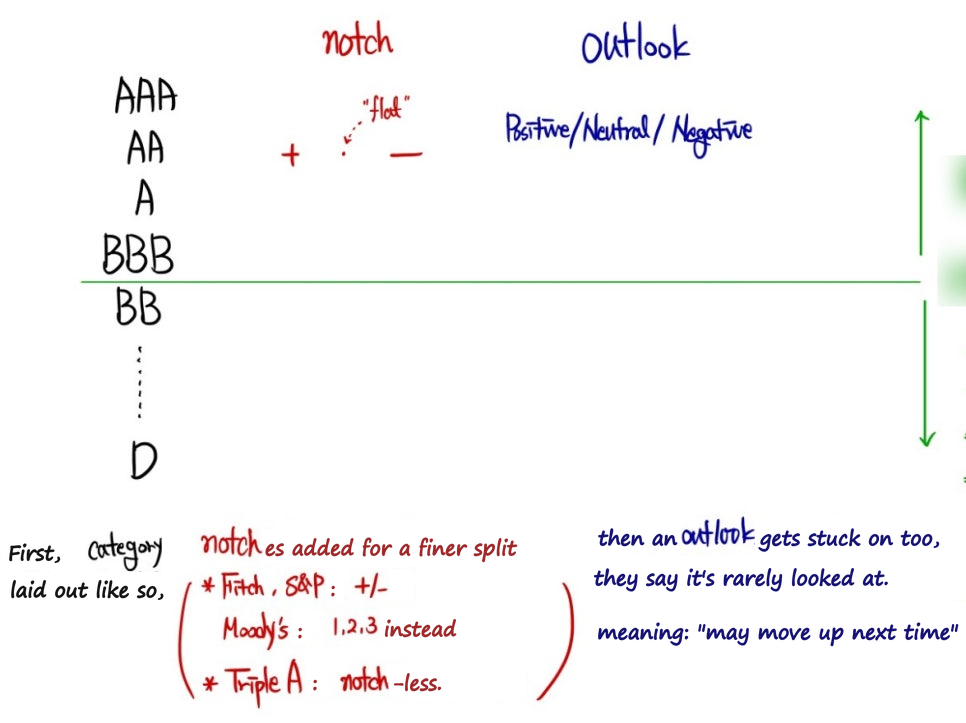
They lay out Categories from triple-A down to D, then subdivide further by tacking on + / . / - as Notches behind them.
(Moody’s uses 1, 2, 3 instead of plus/minus, and triple-A just stays triple-A — no notches above!)
Then they also slap on outlooks like Positive/Neutral/Negative, but that’s not something that materially affects creditworthiness —
apparently — just think of it as a hint about whether the rating might tick up or down next time.
And that line drawn between BBB and BB in the figure?
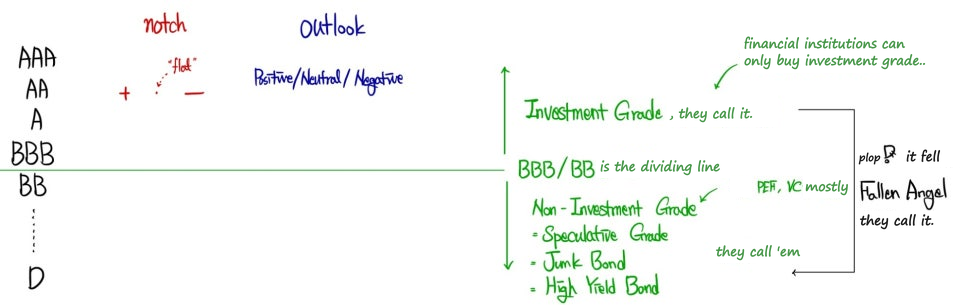
That’s the dividing line for IG (Investment Grade) vs. Junk Bonds heh heh heh heh
(call them junk bonds, speculative grade, or high-yield bonds — whatever)
OK cool, so we just trust whatever Credit Rating those guys publish~~~~
A few reasons that’s actually kinda iffy.
-
Credit ratings are valid for 1 year.
-
No evaluation model is gonna be perfect,
-
There’s no way to model unforeseeable stuff (M&A and the like)……
-
Credit ratings only get reflected once a rumor becomes confirmed fact and fully shows up in the financial statements. But the market price — that reflects it immediately…..
Not much content here, huh T_T T_T T_T T_T T_T T_T
Let’s just bang out a couple of terminology summaries and move on heh heh heh
Cross Default Provision — a clause you might see written into the bond indenture.
Say a company issued Bond A and Bond B, and I’m holding B.
Bond A’s interest payment date hits before B’s,
and then — boom — Default on Bond A….
If at that point Bond B also gets treated as in default, that’s cross default.
So there’s a clause where I can demand my principal back right then and there.
Now — when a credit evaluation is being done, does whether a Covenant like this is included show up in the Rating????
If a company’s rating is A, the senior bonds of that company get A,
but if they’re subordinated bonds, apparently they get bumped down by one notch.
In other words — the + / - on the notch is decided purely by senior vs. subordinated,
and the essential Credit gets locked in upfront… heh heh heh
What is Structural Subordination?
This shows up in parent company / subsidiary setups,
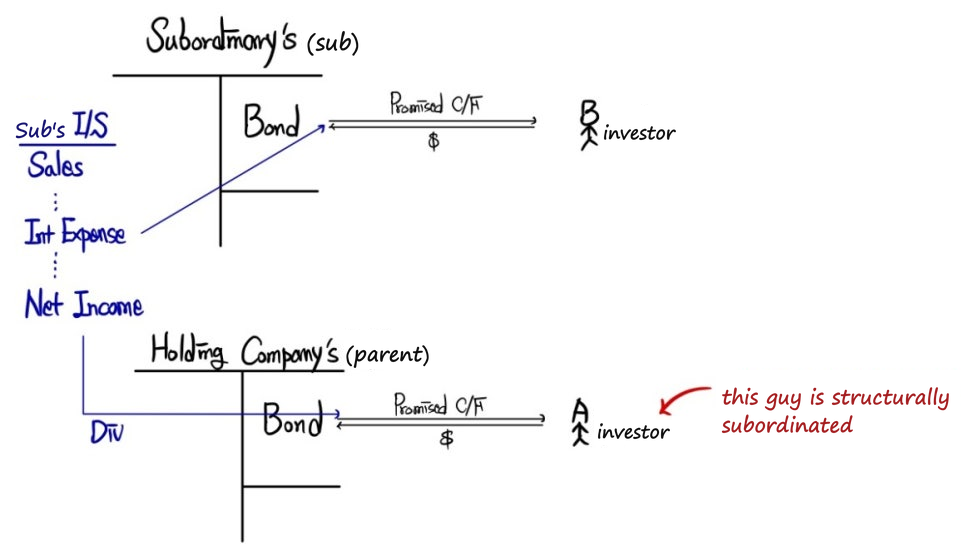
It just means that structurally, the bond investors of the parent company are sitting in a subordinated position like that.
Phew!
Alright — next post, let’s organize the ABS stuff!!!!!!!!!!!!!!!!!!!
Comments
Discussion happens via GitHub Discussions. You'll need a GitHub account to comment.