Asset-Backed Securities (ABS) and the Global Financial Crisis
ABS, MBS, maturity mismatches, and yes — the full 2008 meltdown with AIG and everything. Buckle up, it's the grand finale of the Fixed Income series!
OK OK OK OK — this is truly, genuinely, for-real the last Fixed Income post.
It’s gonna be fun, so buckle up tight and let’s gooooo!!!!!!
(And at the very bottom, the 2008 global financial crisis story that always tags along whenever ABS comes up — yes, AIG and all — is making an appearance too. So do NOT unbuckle that seatbelt early!! lol)
So. ABS = Asset-Backed Securities. Securities, with Assets, Backed into them.
And depending on what the Asset is… if the Asset that’s been Backed in is a Mortgage, we call it MBS.
ABS is just the umbrella term for the whole family.
(And the Asset doesn’t have to be bank loans either — a pool of credit card receivables, auto loan installments, whatever — anything that throws off cash month after month can get rolled up and structured into a product like this.)
Anyway, we’re starting with MBS heh heh heh heh heh.
Welcome to the world of mortgages!! heh heh heh
Where MBS comes from
The starting point is the Bank.
Banks basically eat off the spread, right? Interest paid on deposits coming in, interest charged on loans going out. The gap is the meal.
Quick check: when a bank takes a deposit, is that an asset or a liability for the bank?? ☞ Liability. Liability. The bank owes you that money back.
And when the bank turns around and lends that money to someone who needs it — asset or liability??? ☞ Asset. It’s the bank’s right to say “that’s my money, give it back.”
But here’s the thing. A huge chunk of a bank’s loan book isn’t unsecured stuff — it’s home mortgages. Big balances. Long, long maturities.
If a fresh-faced new hire walks into the bank on day one and a mortgage gets booked that morning?
There’s a real chance that new hire will retire before that mortgage matures. lol lol lol lol
So the bank is stuck with this fundamental thing: the maturity of its assets and the maturity of its liabilities are wildly different. Maturity mismatch.
Now now now now now now —
What the bank lent out sits on the asset side of the balance sheet as Loan.
Among the many many many Loans, some are Conforming Loans — super low credit risk.
Others are Non-Conforming Loans — riskier stuff.
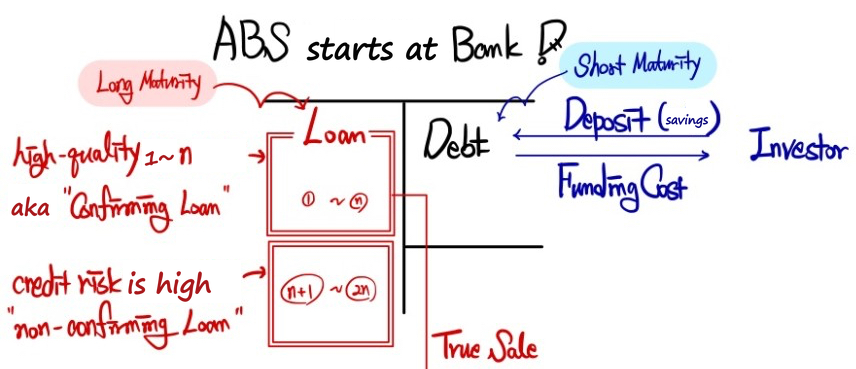
There they are, sitting on the books.
And then someone shows up and says:
“Hey! Bank! Sell me that right to receive money!!!!!!!!”
You sell it to me, take the cash, go do whatever else you wanna do with it,
and I’ll hold the rights to those promised cash flows from the loans!!!!!
For the bank, this is basically a thank-you note in proposal form, no?
The maturity is past your retirement, no matter how many mortgages you push out as your “performance,”
you can’t squeeze a bonus out of them before maturity hits,
but if you can offload them as a True Sale right now? Then it’s “look at my numbers!! gimme my bonus!!” lol
But — if the buyer is something on the level of a GSE (Government Sponsored Entity), they don’t want any of that Non-Conforming stuff. It has to be safe. Like super super super super super super super safe.
The GSE buying these up — in Korean terms it’d be something like the Korea Housing Finance Corporation —
takes the cash flows coming off those loans, rolls them up into securities, and spreads them out,
passing the cash through to investors evenly — no differentiation, no tranching, everyone gets the same slice.
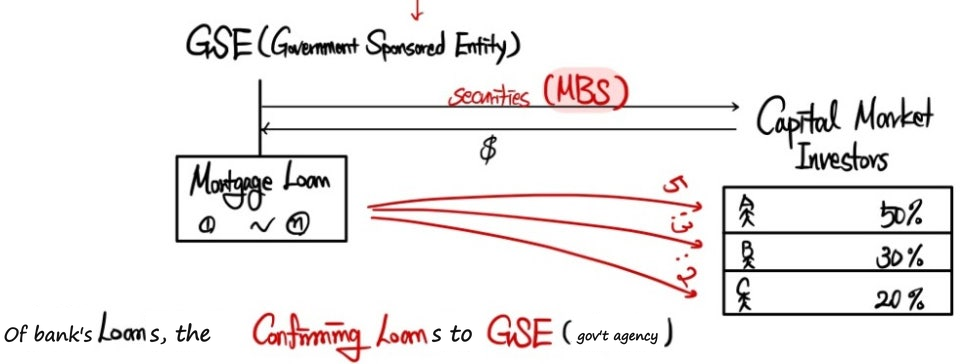
This kind of security is called a Pass-Through MBS.
Cash flow comes in → cash flow goes out. No carving it up.
But hold on, let’s think for a sec.
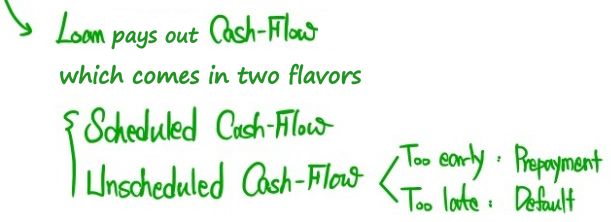
You can sort the cash flow coming off these loans by behavior.
Scheduled Cash Flow = the money shows up when it’s supposed to. Beautiful.
Unscheduled Cash Flow = something’s off. And it splits into two flavors: too early and too late.
Yep. Too early — meaning prepayment. Also a problem.
(Bro just pay it on the schedule, why are you paying me back early!!! Why’s the borrower paying early? Because rates dropped, naturally -_- … and now my reinvestment yield is also low… that’s the risk!)
And the late one is the famous one — Default.
So so so — among the bank’s loans we just talked about,
the main risk on Conforming Loans is precisely Prepayment Risk.
So in the end, the bank punts Prepayment Risk over to the GSE,
frees up its balance sheet to write more loans, and MBS is a massive win for the bank.
Now the IBs get involved
Now now now now — here’s where it gets interesting. IBs scoop up these freshly-issued MBS
and roll them up again into another structured product.

This re-rolled thing is called a CMO (Collateralized Mortgage Obligation).
And as the diagram shows, the cash flow gets carved into a Cash Flow Waterfall structure,
so an order of principal repayment is created.
CMOs split into two types: ① Sequential CMO and ② PAC (Planned Amortization Class) CMO —
but we’ll get to those in a sec!!!!!! Let’s poke at a couple other things first and circle back!
The takeaway here:
CMO has a Time Tranching structure. Because there’s now an order to who gets paid principal first.
OK, above we were looking at —
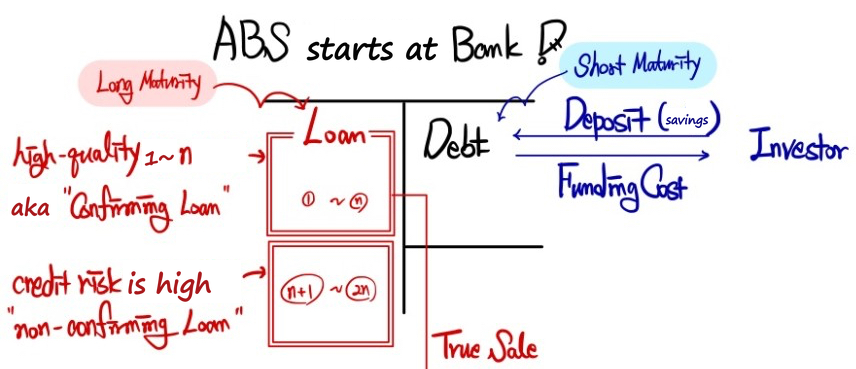
Conforming Loans.
But banks aren’t gonna let the Non-Conforming loans just sit there either.
Like I mentioned — if the main risk on Conforming was prepayment,
the main risk on Non-Conforming is Default risk!! heh heh heh
These also get sold off to a special purpose vehicle.
The product structured out of these is called a CDO (Collateralized Debt Obligation).
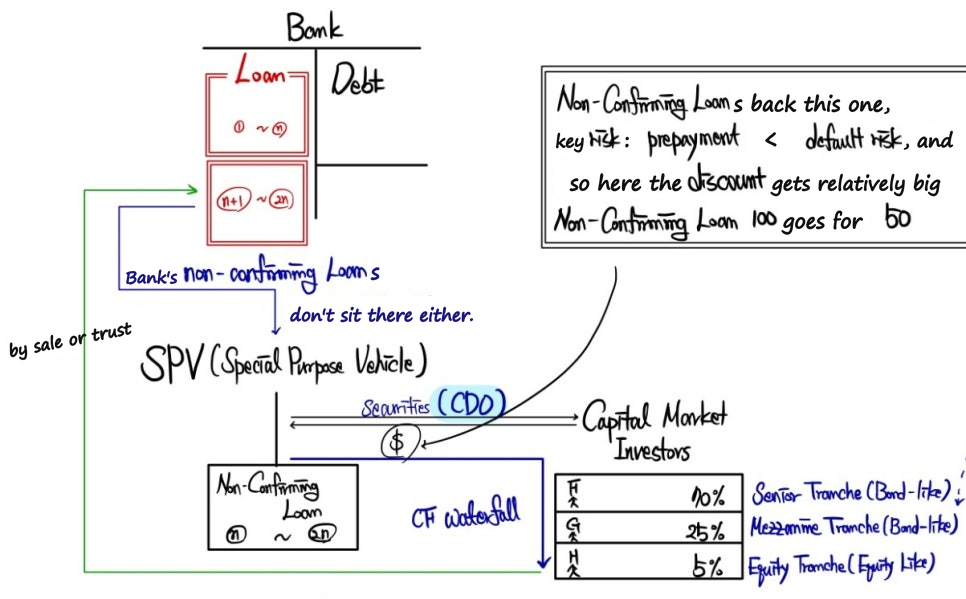
After the transfer, you build a structure on top and ship it off to capital market investors,
and because the underlying risk here has way more default risk baked in, the discount rate is gonna be larger?!?!?!?! (that’s what the half-cut-off speech bubble was getting at)
Now now now now — main risk here is default. And if defaults actually start cooking,
the investors at the very bottom of the waterfall — the Equity Tranche — get vaporized first.
But if Default does NOT happen????? This is where the huge gains start, all the way up from the H-investors on down.
Because they bought in at a fat discount!
(Imagine paying 5 billion won for something with a face value of 10 billion, no default happens, and the full 10 billion comes through… that’s a throw-a-party situation lol)
But still — who on earth lines up to buy that absolutely cursed-looking Equity Tranche????????????
Then again… if nobody buys it, the CDO doesn’t form in the first place, right?????
So~~~~ (well, it’s not just market love — there’s regulation behind it too) the way it works is the bank itself buys back the Equity Tranche heh heh.
And now the world is just flooded with CDOs, far and wide.
But — look at any one CDO. The Senior Tranche almost always pulls AAA… so it’s vanilla, demand is meh.
And the Equity Tranche, well, that’s the haunted house.
But this Mezzanine Tranche in the middle? Hmm. That one looks really attractive — risk-vs-return-wise.
So the structuring teams scoop up a whoooooole lot of just the Mezzanine tranches and pile them up.
Then they take the Mezzanine tranches from a bunch of different CDOs and build another CDO out of them. That’s called CDO squared.
Hm???? CDO² … which means CDO³ should also be possible, right???? → Yeah it seems like nth-power is on the table lol lol lol
Yep. Heh heh heh. It just keeps going~~~
So while CMO was based on time tranching, CDO is based on credit tranching. Slightly different game.
(And of course not every Mortgage is Conforming^^ You know where this is going… right? I’m talking about 2008… heh heh)
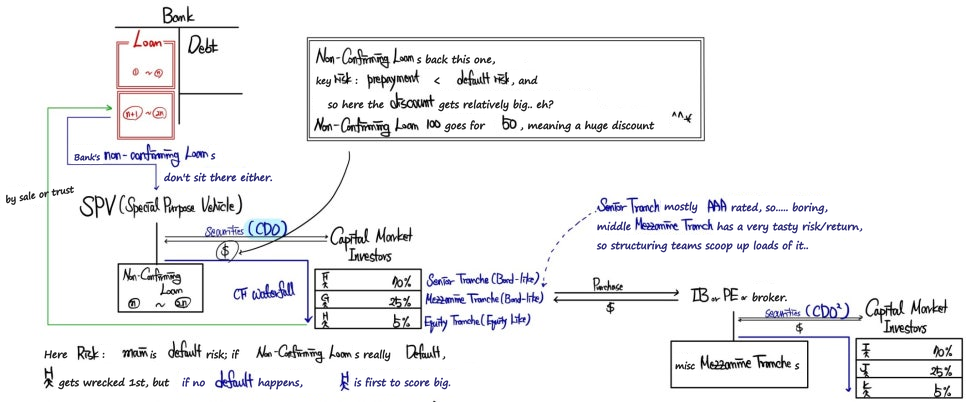
The diagram up there is drawn simple to fit on one page,
but from CDO² onward, this is a more honest picture:

Cranking out thousands, tens of thousands of these things…………..
No wonder Lehman blew up…….
Wait — let’s take a small detour
Aaaaaaaaaaaa……….. let me briefly talk about Lehman and then wrap.
That’s from an old class note of mine on the Lehman crisis, from back when I applied for a finance program and got to take classes on this stuff.
If you keep playing this structured-finance game, the problem is —
every single round, you get Senior / Mezzanine / Equity tranches popping out;;
And most Senior Tranches get stamped AAA….
(At the time, apparently 85% of all AAA-rated bonds were products that had been securitized this way.)
Around 2008, US house prices start to flatten??????
The very first Senior Tranche — that one’s fine.
But —
the Senior Tranche of a CMO-to-the-nth-power….. defaults start hitting……………..
and on top of that —
you can’t even trace the cash flow of the thing you invested in lol lol lol lol
Meaning: when a default happens, how much capital you actually recover is basically unknowable… apparently…
But isn’t it kinda hilarious… how does something like that get AAA, even just as a Senior tranche?
Apparently they had “credit enhancement measures” in place….
OK and now AIG enters the chat. We already did CDS earlier in the series, so we know what this product does.
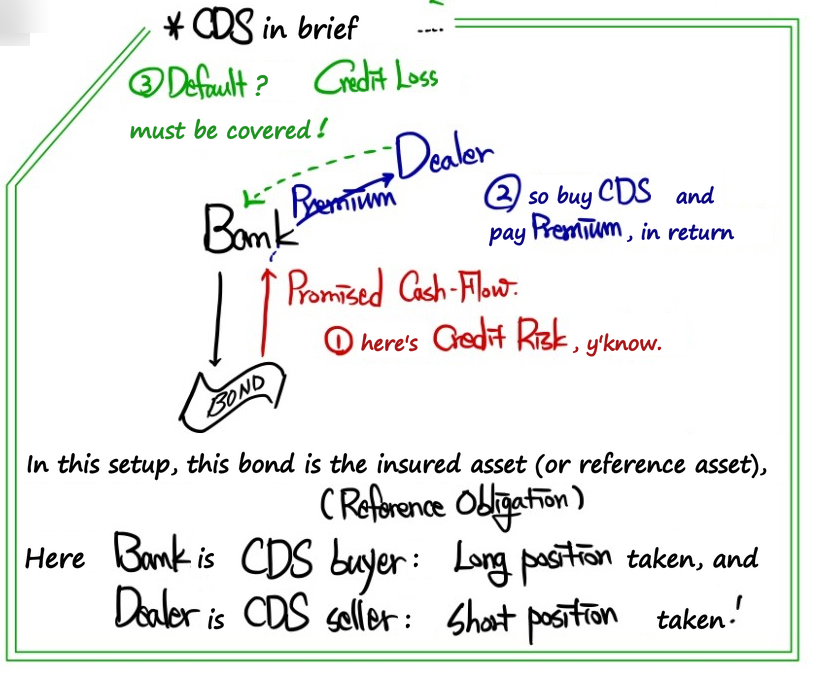
At the time, AIG in particular had been writing a lot of this product, apparently.
Goldman, Morgan Stanley, Credit Suisse, Deutsche Bank — all of them — were paying insurance premiums to AIG.
But, as mentioned, defaults started piling up one by one and insurance claims came crashing crashing crashing crashing into AIG!!!!!!!
The payout on insurance is structurally way bigger than the premium, right???? And huge claims hit all at once…. there was no money to pay them out.
That payment chain gets jammed → investors (a big chunk being IBs and pension funds) start to topple,
and the dominoes cascade all the way down until even the first-tier commercial banks are on the verge of total collapse,
and commercial banks collapsing (in Korea that’d be Shinhan, KB, Woori, Hana, that level of bank)…. that has to be prevented at all costs,
because from there, millions upon millions of regular people are all wired into it.
In other words, the entire US economy going Blackout (shutdown) — that…. had to be stopped somehow.
So a bailout went to AIG. Money put on the table on the spot: $170 billion… wow…. in Korean won that’s something like 190–200 trillion won…. insane.
But the funny part… AIG itself, and the IBs that collected the insurance money….
they threw bonus parties, apparently…..
on the grounds that hey, they had hedged risk well…….
preserved client returns nicely;;;;;;;
I wasn’t even gonna touch the 2008 crisis today,
ended up taking a whole detour anyway.
Studying is fun, right!?!??!?!?!?!?!
OK then — picking up the next story in the next post!!!
Bye bye!
Comments
Discussion happens via GitHub Discussions. You'll need a GitHub account to comment.