Fixed Income Wrap-Up
Wrapping up the whole Fixed Income series with a keyword-by-keyword tour of securitization, covered bonds, RMBS vs. CMBS, and call protection mechanics.
Last time we got the big-picture framework of ABS down — like, the whole skeleton.
So this posting
is going to be us slowly bolting flesh onto that skeleton, one piece at a time.
And I’m wrapping the whole Fixed Income series here!!!!
(Oh yeahhhh!!! It’s finally OVER!!!!!! lol)
Aaaaaaa fair warning — this one’s gonna be kinda messy. T_T T_T T_T T_T
The content doesn’t flow as one clean story —
it’s more like patching meat onto bones bit by bit, so honestly, just treat it as a keyword-by-keyword study session!!!!! heh heh heh heh heh
Just hang in there a little longer — we’re almost done!!!!
Securitization lowers the cost of capital.
Yep! True. Conforming loans get an AA rating,
so if a bank that’s only rated A securitizes them, boom — they can fund themselves cheaper, right???
Plus, illiquid loans get instantly converted into super liquid stuff (cash),
and from the investor’s side too,
the old setup carried two flavors of risk — the loan defaults / OR the bank defaults —
but securitization wipes out the bank-default piece,
so investors come out ahead too!!!!
While we’re on this — let me throw in a thing called a covered bond.
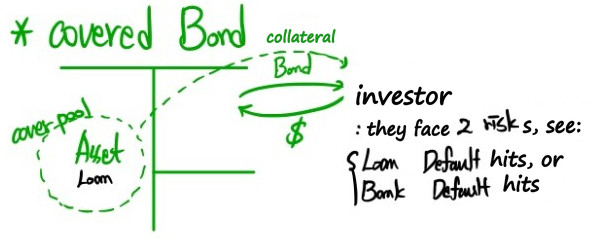
The thing that separates a covered bond from a regular collateral bond is:
if something in the cover pool goes bad,
the issuer yanks it out and swaps in a healthy one. That’s the difference, apparently.
(If the C/F can’t be paid, that’s “non-performing,” they say.)
This is basically trivia, so I think it’s totally fine to go “huh, neat, that exists???” and keep moving.
Heh.
Up till now we’ve just been calling Mortgages “Mortgages,”
but actually you can split Mortgages into two buckets depending on what kind of real estate is involved.
They go by different names depending on whether it’s residential property or income-producing property,
and MBS itself also splits up based on which type of Mortgage got securitized — the breakdown apparently looks like this…

(The biggest gap between RMBS and CMBS is that CMBS is usually a Balloon-style structure… no Amortization… just one BIG hit at the end!!! type of deal, and Call protection gets slapped on a lot….. but that’s getting too in-the-weeds, so please just skim it once and keep going….. I’m begging. T_T)
*Call protection is the umbrella term for all the things you set up to minimize damage when Prepayment happens,
and the ways to build those things look like:
- At loan origination, just write a Prepayment Lockout period into the contract
- Defeasance: Take the prepaid money and use it to buy securities that throw off the same interest the original loan would have (apparently they buy stuff like government bonds)
- Slap on Prepayment Penalty Points
- Yield Maintenance Charges: Take all the future losses you’d eat from the prepayment, drag them back to present value, and charge that as a fee.
A few more real-estate-flavored terms get tossed in here,
stuff that feels like it really belongs over in Alternative Investments….
Anyway, since we’re here…….
LTV (Loan-to-Value):
Let me just go straight to an example —
Say you’re trying to buy a 1-billion-won building by borrowing some cash from a bank.
If the LTV is 40%, that means only 40% — i.e. 400 million won — actually gets loaned out… that kind of term.
DSC (Debt to Service Coverage ratio):
For CMBS, unlike RMBS, the focus isn’t really on “who’s borrowing?”
It’s more like “where is this property?” or “how’s the commercial district around it?” — that’s where the eyes go,

and apparently they look at this thing too,
and as you can see, it’s basically the same idea as the “interest coverage ratio,” so it doesn’t seem hard….
(Honestly, Level 2’s Alternative Investment has LTV plus a bunch of other ratios — debt-to-income, debt-to-(income+assets), and so on….
but here only LTV shows up, kinda half-heartedly..heh.heh. Save the rest for the real estate chapter under Alternatives! heh heh)
ARM (Adjustable Rate Mortgage):
This is one of the floating-rate flavors used in mortgage loans,
where the contract gives you a low fixed rate for the first 2–3 years and then after that switches to market rate + x bp — that kind of mortgage.
For a low-income borrower, this structure is super dangerous!!
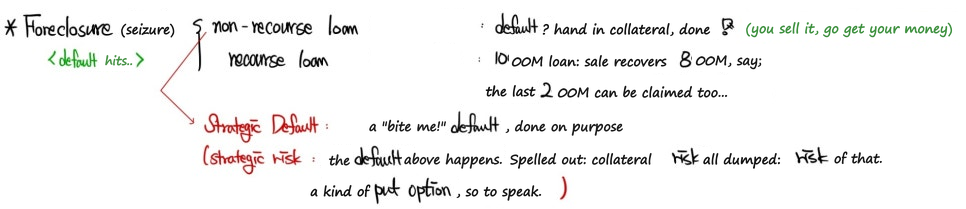
Foreclosure (seizure)
When a Default actually happens, here’s what the recovery rights look like —
We already mentioned that Prepayment is also a flavor of risk from the bank’s side,
and yeah, the bank does expect a certain amount of prepayment to happen,
and using that expectation as the baseline,
the risk that prepayment comes in higher than expected is called contraction risk — the maturity gets shorter (this is what MBS made from conforming loans has to worry about)
the risk that prepayment comes in lower than expected is called extension risk — the maturity gets longer. (totally different beast from default!!!!)
A bunch of tools have been invented to handle “how do you actually form that expectation,”
but the one that gets introduced here is a number called CPR (Conditional Prepayment Rate).
CPR: “If 1% of the outstanding amount gets repaid in one month, what % does that come out to on an annualized basis” — it’s a number you keep computing month after month….
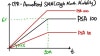
It climbs by 0.2% every month until it hits 6%, then it stops, and prepayment just keeps happening at that level~
The baseline model built on that assumption is called “PSA 100 standard,” apparently.
(※Side note: The first month’s prepayment — what does that come out to as an annualized prepayment %?
There’s a separate method for converting it to an annual number, and apparently we don’t need to know that here T_T,
so let’s just conceptually go “okay, you do the same thing for month 2, month 3, etc., plot the dots, done” and move on T_T T_T T_T
Fixed Income has a bunch of spots where stuff just gets glossed over, which is a bummer. T_T T_T T_T CFA should… actually demand we properly understand the knowledge it’s quizzing us on….)
- The numbers above can be twisted in different ways to get PSA 200, PSA 50, etc.
- PSA stands for Public Securities Association, which is apparently the old name of something like “a trade association for bond dealers.”
Weighted Average Life:
In an MBS, where bundled-up Mortgages have been securitized, obviously you’ve got individual Mortgages inside,
taking the weighted average maturity of those Mortgages without factoring in prepayment is called ☞ Weighted Average Maturity
and if you DO factor in prepayment, it’ll naturally come out a bit shorter,
so the version that bakes in prepayment AND the speed of prepayment is called ☞ Weighted Average Life, apparently.
- Measure of the percentage of the outstanding mortgage balance prepaid
- is used to assess the sensitivity of the securitized bond to interest rate movement. It’s average time to receipt of all principal payment.
CMO was a Time-tranching structure, like we saw earlier,
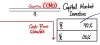
So who’s investor D?
D is on the short-maturity side, right?
Probably the type who wants their money back fast,
and to put it differently,
they’re the type going “Contraction risk — fine by me / Extension risk — absolutely hate it”
and the type betting “rates are gonna rise from here.”
E at the bottom, on the other hand, is relatively long maturity,
so they’re the type going “Contraction risk — absolutely hate it / Extension risk — fine by me”
and the type betting “rates are gonna fall from here.”
So in other words, CMO built on the time-tranching principle is a structure where you pick between contraction / extension risk,
while credit tranching is the one where you pick between Senior and Subordinate —
that’s the point being driven home one more time..heh.heh
Last posting we mentioned that there are two types of CMO and we’d look at them later,
so let’s look at them now!
The two are called Sequential CMO and PAC (Planned Amortization Class) CMO,
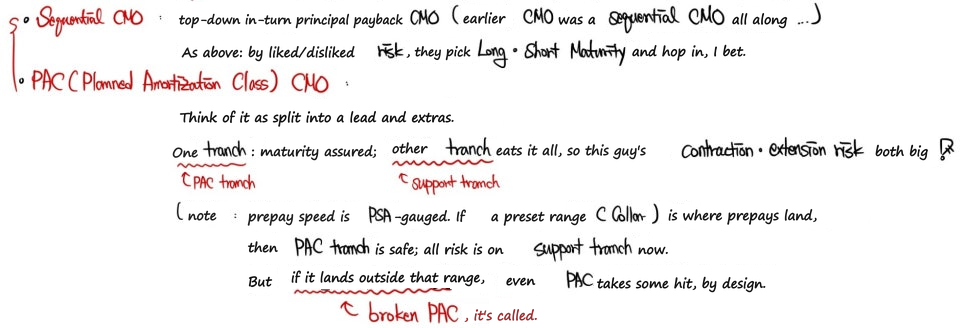
Non-agency RMBS: This is MBS issued by an SPV that’s NOT a GSE, using non-conforming loans,
and for these, the headline issue becomes default risk,
and to defend against that somehow,
“credit enhancement” measures get slapped on, and we can break those out into a few flavors.
(Credit enhancement is mostly designed to either reinforce the senior tranche, or reinforce all the tranches….)

A handful of examples are listed here, and if you skim through them you’ll get a quick feel for how they’re sorted :-)
Internal 1. Over collateralization: Basically like selling something with a $105 face value for $100…. This one protects all tranches.
Internal 2. Cash reserve fund: A setup where money is squirreled away in the SPV’s account separately, just in case Default happens.
(Kinda like how when you take out a bank loan, sometimes they make you open this savings-product thing — it’s like making you set aside a reserve account on the side…
“Hey y’all, set some money aside^^” — that’s the easy way to think about it)
Internal 3. Excess spread account: A setup where the coupon doesn’t get fully paid out and instead some of it gets stashed in the SPV’s account separately (same idea as the one above T_T)
Internal 4. Shifting interest mechanism: A system that temporarily cuts off the coupons going to Mezzanine and reroutes them to Senior for a while
External 1. Safety Bond: A contract where insurance companies cover you via insurance…. (In Korea you’ve got companies like Seoul Guarantee SGI, Korea Credit Guarantee Fund, Korea Technology Finance Corporation, etc… easiest way to think about their role: they take a premium and provide a guarantee, which lets a loan go through that otherwise wouldn’t have been issued~)
Auto Loan ABS: Nothing fancy — just instead of a Mortgage, the underlying is auto loan installments…
Credit Card ABS: ABS where every month, as the credit card loan gets repaid, you keep refilling the pool with loans of equivalent quality~ refilling~ refilling~ on and on (this is called a revolving structure).
Basically, an ABS that just keeps spinning and maintains a long maturity.
Synthetic CDO:
What’s called a synthetic CDO is… instead of the SPV actually buying the assets,
you end up with a structure that starts purely from a CDS trade between the SPV and the Bank, and gets built out from there CDO-style,
(The Loan stays sitting on the bank’s books)
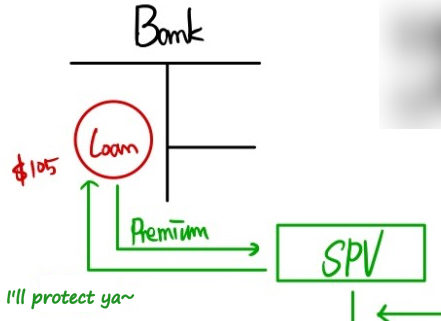
OK OK OK OK OK OK, look closely.
So a structure gets built where premiums roll in every month as protection on a $105 Loan,
but when they say they’re protecting that whole $105, does the SPV have to brace for the possibility that ALL $105 defaults…..?
That’s way too doom-and-gloom, and some smart STEM dudes work it out probabilistically or whatever, and come back with
“Yo!!!! You’re gonna be totally fine with like $15 in reserve!!!!!!” — and let’s say the math actually does shake out that way,
so they raise that $15 from outside, buy solid assets like government bonds, and……
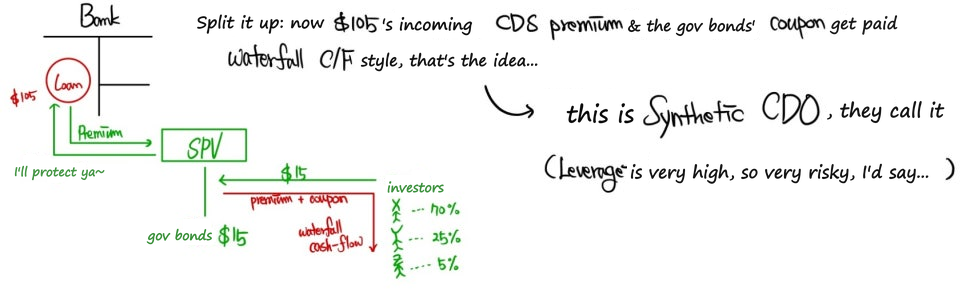
Oh wow oh wow oh wow oh wow oh wow lol so slick lol lol lol lol lol you really CAN put it together like this lol lol lol lol lol lol lol lol
One more thing about SPVs and we’re good….
When a company wants to securitize its receivables,
it goes ahead and transfers full ownership of all of them over to the SPV — like, why on earth would it do that…..?!?!
Because if the company itself goes belly-up later, recovery would be a nightmare….
So it shoves everything over to the SPV up front,
and then securities get issued out of the pool sitting in there….
That’s why this kind of SPV is called a “bankruptcy-remote entity."
Wow!!!!!
Fixed Income is DONE!!!!!!!!!!!!!
This last posting was kinda… the content was messy too,
and it feels like I glanced over a bunch of stuff…… I’m sorry. T_T T_T T_T T_T T_T
What subject should I tackle next!!!!
Comments
Discussion happens via GitHub Discussions. You'll need a GitHub account to comment.