Valuing Bonds with Embedded Options, Part 1
We finally put the Binomial Tree Framework to work pricing callable and putable bonds, walking through how cash flows shift at every node as rates move.
Now we can finally do what we learned the Binomial Tree Framework for, since we’re assuming a call and a put!
We do the valuation by plugging in whether the call/put gets exercised as interest rates jiggle up and down in the future:
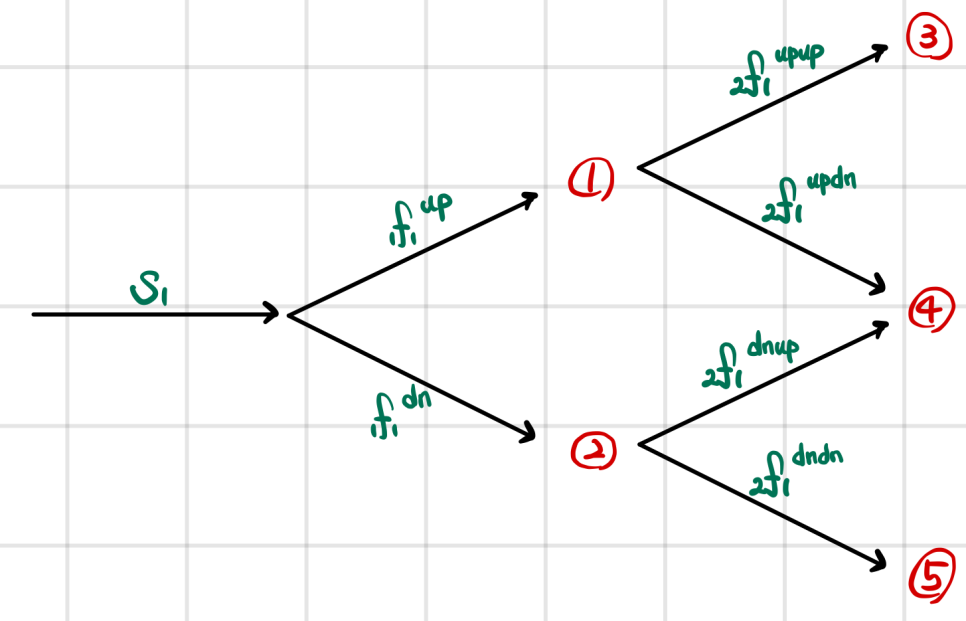
The trick is to work backwards. At a node, find what the remaining payments are worth, apply any exercise right available there, and then move one step towards today. The exercise decision changes the value we carry back.
Since the cash flow is going to be different at every node, let’s see how we plug in the numbers and calculate.
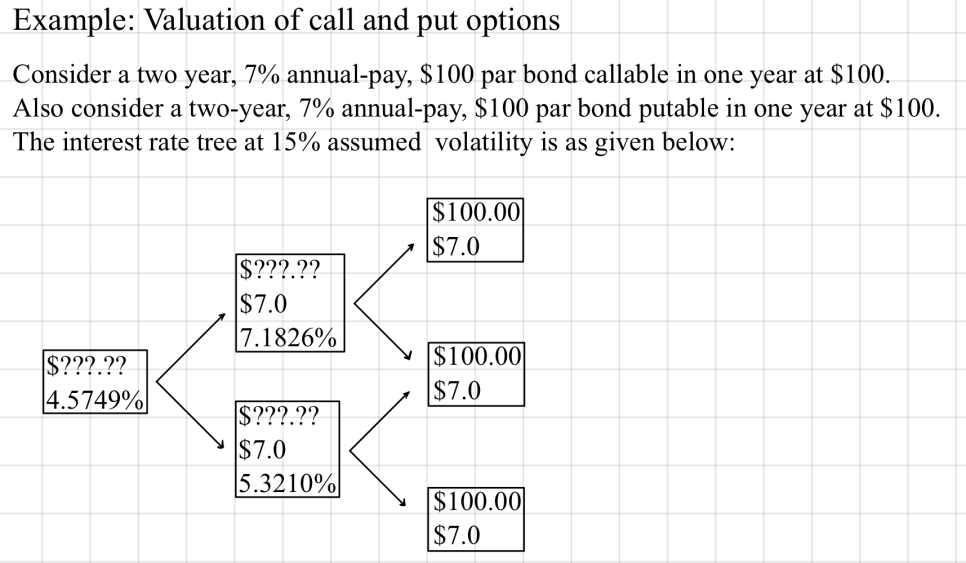
Each bond pays a coupon of 7 at the end of each year and repays 100 at maturity. The call or put can be exercised at 100 after one year. In this example we treat the year-one coupon separately from the exercise price.
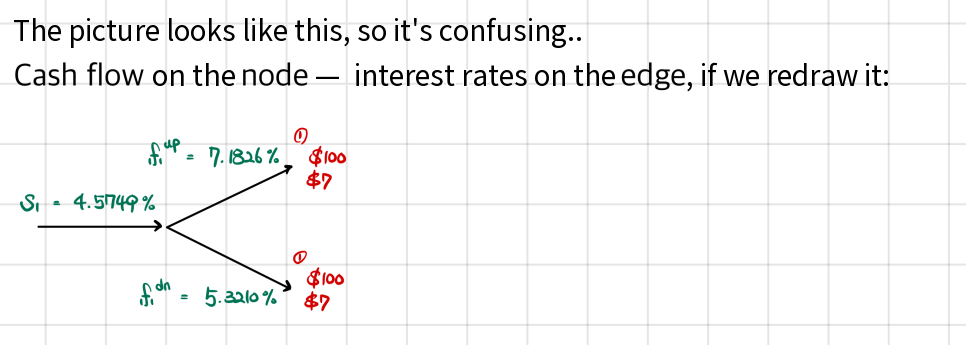
Start at maturity: the payment is $100+7=107$ in either state. One year earlier, the values excluding the coupon payable at that node are
$$V_1^{up}=\frac{107}{1.071826}=99.8296,\qquad V_1^{dn}=\frac{107}{1.053210}=101.5942.$$Higher rates, lower bond value. OK, that part feels familiar. Use the lower node’s own rate, 5.3210%, in the second denominator; the next picture accidentally writes today’s rate there.
Callable: the issuer gets the choice
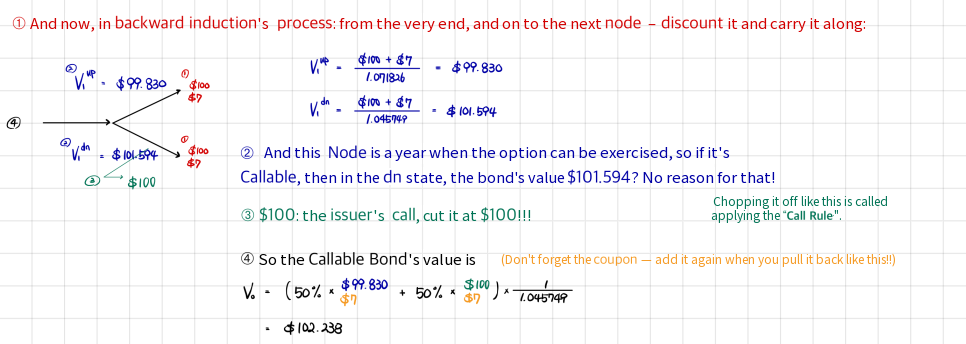
If keeping the bond alive costs the issuer 101.5942, why leave it alive when it can be called for 100?
That’s the call rule: use the smaller of continuation value and call price. The up node stays at 99.8296; the down node is capped at 100. Then add the coupon of 7 at each node and discount the average back to today:
$$V_{callable}=\frac{0.5(99.8296+7)+0.5(100+7)}{1.045749} \approx102.2376.$$The 50/50 weights are the tree’s risk-neutral valuation probabilities, not a prediction that actual rates must have equal odds of rising and falling.
Putable: now the investor gets the choice
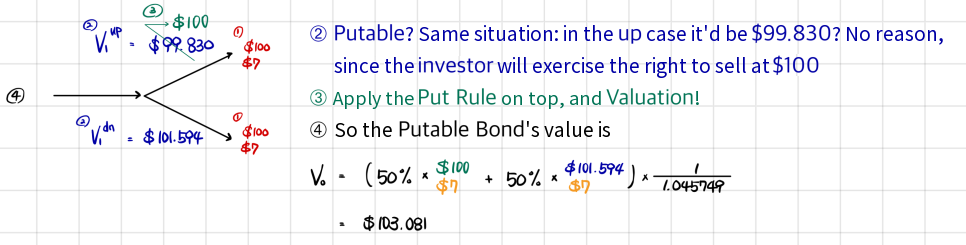
Flip the logic. If the bond is worth only 99.8296, the investor would rather put it back for 100. So the put rule takes the larger value. The up node is lifted to 100; the down node stays at 101.5942:
$$V_{putable}=\frac{0.5(100+7)+0.5(101.5942+7)}{1.045749} \approx103.0812.$$The coupon is still added once. The floor or cap applies to the bond value after that coupon, not to a total that silently swallows it.
Strip out the options and compare

For a straight bond, neither node gets clipped. Carry both continuation values back in exactly the same way:
$$V_{straight}=\frac{0.5(99.8296+7)+0.5(101.5942+7)}{1.045749} \approx102.9998.$$
Now the differences tell us what the rights are worth. The issuer’s call takes value away from the investor: $V_{straight}-V_{callable}\approx0.7622$. The investor’s put adds value: $V_{putable}-V_{straight}\approx0.0815$.
The notes subtract already rounded prices and get 0.082 for the put; keeping precision gives about 0.0815. More useful than that last decimal is the ordering: callable < straight < putable, when the other terms are the same. Who gets the choice? That’s what changes the price.
Heads-up. The figures here are the original notes, slips and all. A few things to watch for:
- In the backward-induction picture, $V_1^{dn}$ is discounted at the lower node’s rate, so it should read $V_1^{dn} = (100 + 7)/1.053210 = 101.594$ dollars; the picture writes $1.045749$ (today’s rate) in the denominator, though its result is right.
Comments
Discussion happens via GitHub Discussions. You'll need a GitHub account to comment.