Credit Default Swaps (CDS) and CDS Premium
CDS isn't your typical derivative — it's basically bond insurance, and this post breaks down the structure, settlement types, and why you don't even need to own the bond.
Chapter 5. Credit Default Swap.
OK so CDS is technically a derivative… But it’s a different beast from the derivatives you deal with in the Derivatives section. Those are what we call market derivatives — you start with an underlying asset and bet on which way it goes. The underlying (stock price, interest rate, FX rate, whatever) moves around in the market, we can’t control it, so we study market derivatives as a way to hedge against those moves.
CDS isn’t that. CDS is a credit derivative. And credit derivatives actually come in a bunch of flavors — Total Return Swap, Credit Spread Option, Credit Spread Forward, all sorts. But apparently in the CFA we only touch CDS, and even then just a tiny sliver of it. heh (Thanks, CFA~)
Credit Default Swap (CDS)
CDS is essentially an insurance contract
Think insurance-like credit protection: “Hey, if a credit event hits my asset, please cover the credit loss for me.” That’s the basic idea of a CDS.
So what does the structure actually look like?
We saw a version back in Level 1, but this chapter goes deeper, so let’s redraw the CDS structure, Level 2 style.
Banks are major CDS counterparties. So picture this: a bank buys a bond, but it’s a risky bond — default is on the table. So the bank goes to a dealer and says, “I’ll pay you a premium, and if a credit event hits this bond, you cover the credit loss.” That contract is the CDS.
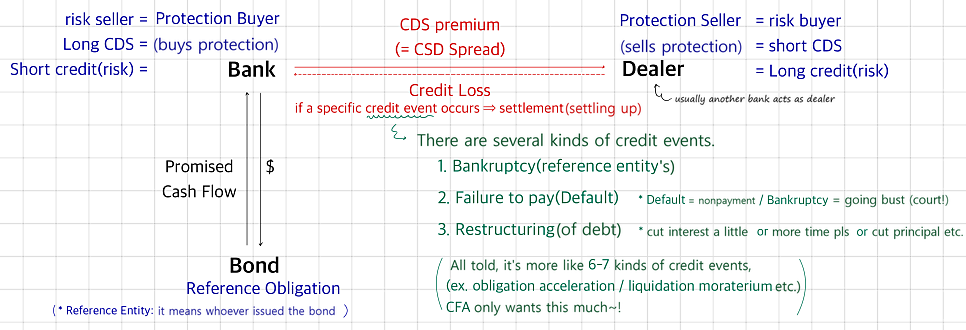
Settlement protocol: once a contractual credit event is confirmed, the dealer and the bank have to settle up. In other words — the “insurance company” has to actually pay out the insurance money! That settling-up process is called settlement, and how you do the settlement has to be decided in advance. Apparently it’s spelled out in the contract.
- Hand an eligible bond to the dealer, and the dealer pays the agreed face amount to the bank → Physical Delivery
- Transfer cash equal to that face amount minus the bond’s settlement recovery value → Cash Settlement
How much cash, though?
It’s face value minus recovery value, with both amounts in money terms. If RR is the recovery rate for that face amount, that’s notional × (1 − RR). A fixed-recovery contract can lock in RR = 40% from the start; otherwise, the contract can use a market poll or auction to determine a settlement recovery value — basically, ask the market.
There are more variations, but in CFA it stops about there! lol
Anyway — first things first, nail the terminology!
Now here’s where CDS differs from real insurance. Say you want to buy fire insurance and you tell them, “If that building across the street from my house burns down, pay me out.” They won’t sell it to you. There’s no insurable interest — you need to stand to suffer a loss if that building burns down. Owning it is one way of having that stake.
But CDS? Nope. You don’t have to own the bond to buy a CDS on it.
It’s not like only a bank holding the bond can enter a CDS contract. Which means some pretty interesting stuff can happen.
You think Company A’s bond is gonna blow up. You don’t hold it, but you go ahead and buy a CDS on it, with physical delivery. And boom — you were right! Company A’s bond crashes and you hit the jackpot.
But wait — to get paid, you have to buy an eligible bond and deliver it. If other buyers are scrambling for deliverable bonds too, their price can rise, shrinking your jackpot. That kind of thing can happen. (Literally the same setup as a short squeeze. heh)
How is the CDS premium determined?
It tracks the creditworthiness of whatever’s being insured. High credit quality → small premium. Low credit quality → big premium.
But if you had to recompute every premium from scratch for every contract, you’d never get a deal done fast enough. So apparently this gets somewhat standardized —
Even though the CDS spread should be based on the underlying credit risk of the reference obligation, standardization in the market has led to a fixed coupon on CDS products: 1% for investment-grade securities and 5% for high-yield securities.
Those are customary standardized coupons, not a rule that every IG name has a fair CDS spread of 1% and every HY name 5%. Obviously — within IG alone, a AAA and a BBB should look totally different.
The present value of the difference between the standardized coupon rate and the credit spread on the reference obligation is paid upfront by one of the parties to the contract.
So they patch the gap with an upfront payment, and the snippet above tells you how that amount is set. In the sketch below, the fair CDS spread is 3% and the standard coupon is 1%, so the buyer pays the seller up front for the 2-percentage-point gap. Its present value accounts for a credit event ending the future premium payments; they aren’t three guaranteed payments.
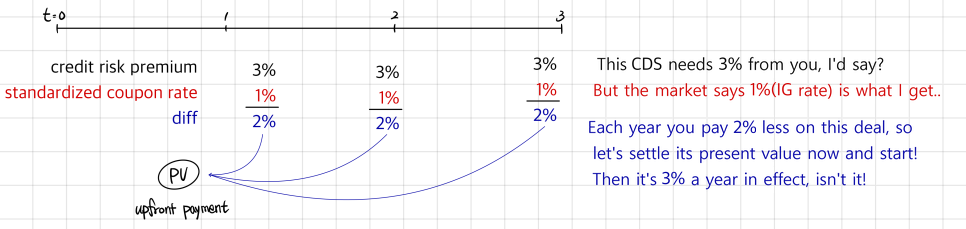
Paying that gap in advance, to make the values match — that’s the upfront payment.
It’s the same idea as those car rental / leasing contracts. lol No free lunch in this world~
The protection buyer (the bank) is kind of like being long a put option. Not exactly, though — it doesn’t cover just any drop in the bond price, it hedges the price drop from a credit event, so… eh, yeah yeah, close enough.
The International Swaps and Derivatives Association (ISDA). They publish standardized documentation, including the ISDA Master Agreement and credit derivatives definitions. Apparently they’ve put together a standard framework, and people customize the trade terms within it.
Heads-up. The figures here are the original notes, slips and all. A few things to watch for:
- In the first picture, “CSD Spread” means CDS spread. The credit-event label “liquidation moraterium” should read repudiation/moratorium.
Comments
Discussion happens via GitHub Discussions. You'll need a GitHub account to comment.