Credit Default Swaps (CDS), Part 2
A casual breakdown of single-name vs. index CDS, how credit correlation drives pricing, and why expected loss is the number that really matters.
Single-Name CDS
When there’s one reference entity — one company or borrower — that’s a single-name CDS. It can cover eligible obligations of that entity, not just one particular bond. Instead of just one, you can also bundle bonds from several different companies together like a basket — that’s a multi-name or basket CDS. A first-to-default basket says, “If one of the bunch defaults, pay me~”; other baskets can have different triggers. But CFA skips the baskets: it sticks with single-name CDS (and the index CDS coming up below). (I’m liking CFA more lately heh)
The bond that becomes the reference obligation is usually a Senior Bond, and in that case it’s also called a Senior CDS.
The CDS pays off not only when the reference entity defaults on the reference obligation BUT ALSO when the reference entity defaults on any other issue.
So a payoff needn’t wait for the particular bond I’m holding to default. A qualifying credit event involving the same entity’s eligible obligations can trigger it; the contract specifies the event, obligation category and thresholds.
(Apparently this kind of clause is buried in our regular loan agreements too.. we just never read them lol. It’s called the “obligation acceleration” clause.)
So in the end, the credit event is determined based on the reference entity, not the reference obligation.
The CDS payoff is based on the market value of the cheapest-to-deliver (CTD) bond that has the same seniority as the reference obligation.
So you get the loss settled against the CTD bond of the same seniority — remember that bit too! (Seniority matters, but the contract’s other deliverability requirements matter too — such as currency, maturity and transferability.)
Index CDS
There’s also a thing where they bundle around 125 reference entities together into an index.
An index CDS covers multiple issuers, allowing market participants to take on an exposure to the credit risk of several companies simultaneously.

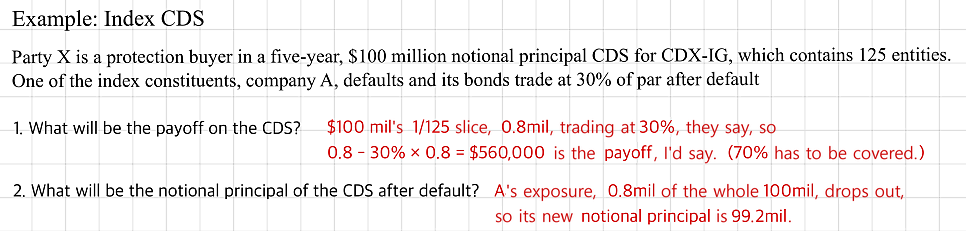
Correlation of default matters a lot for basket and tranche products, where payment depends on how losses cluster. But the ordinary, untranched index here is a weighted bundle of single-name CDS cash flows: with each name’s default/recovery and discount inputs fixed, changing default correlation alone doesn’t raise its fair premium. It changes how the portfolio’s losses bunch together.
Factors Affecting CDS Pricing
Computing the value of a swap is called swap valuation. So pricing and valuation — don’t mix them up.
OK so, CDS pricing — figuring out the appropriate premium is CDS pricing, and the things that feed into it are Probability of Default and Loss Given Default, that sort of stuff.
But the thing that combines both? That’s Expected Loss (EL), right?
For a rough single-period, no-discount estimate, that’s the amount you collect as premium. Full CDS pricing matches expected discounted premium and protection legs, including survival and payment timing.
The basic principle behind pricing is

Simple example — 100 people want life insurance, and the insurance company expects 10 of them to die each year over 3 years.
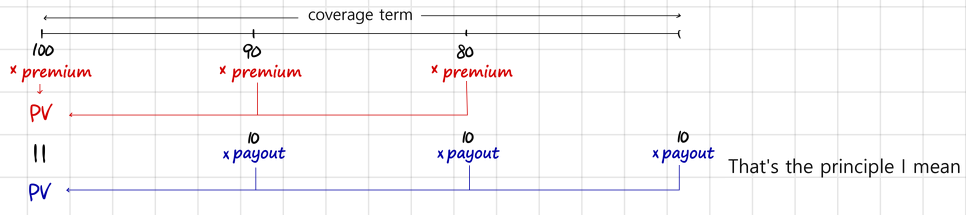
For a single-period CDS, ignoring the time value of money, we can estimate the CDS premium as

Ignore time value, collect this much premium — that’s just the principle of equivalence really.. (At inception the fair premium plus any upfront payment balances the protection value. A standardized fixed-coupon contract can need an upfront amount!)
And then, depending on which way default probability moves, the value drifts in the (+) or (−) direction. A derivative contract is zero-sum, so if I’m (+), the counterparty is (−). From the Protection Buyer’s side, a widening spread is a gain. From the seller’s side, a narrowing spread is a gain.
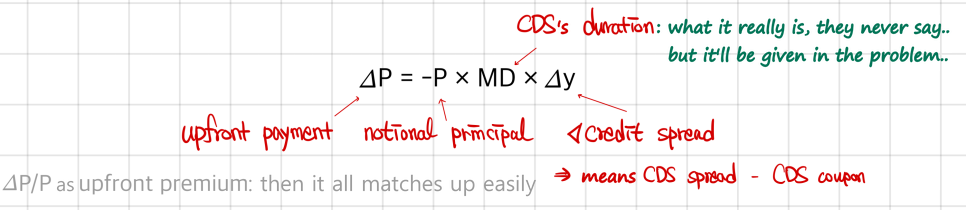
One last thing.. sometimes the first-order sensitivity formula for CDS is written as

What on earth does this even mean…
Remember this one? $\Delta P = -P \times MD \times \Delta y$ — that’s the formula saying as $y$ moves up or down, the bond price moves with sensitivity proportional to duration.
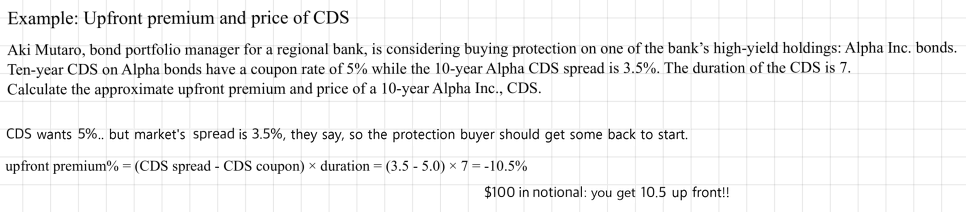
If you think of that movement as the credit spread, then the gap between the credit spread and the CDS coupon — times the duration, times the notional — is what has to be paid as an upfront payment.
Price of CDS (per $100 notional) = $100 − upfront premium [$]
Normally a CDS price is quoted as a percentage of Notional Principal, but there’s also this way of expressing it like a bond.
CDS Usage
Putting CDS to use… the material gives a quick intro to ways of making money with it.
The credit curve is the relationship between credit spreads for different bonds issued by an entity.
A company has issued bonds, and if you plot the credit spread the market demands across maturities, that’s the credit curve. Normally, longer maturity → wider spread, so the curve slopes upward. (Though in something like a financial crisis, the short end can actually blow out wider than the long end.)
Let me just jot the situations down briefly first, then we’ll knock them out one by one below.
➀ CDS can be used to manage credit exposures of a bond portfolio
➁ A curve trade is a type of long/short trade where the investor is buying and selling protection on the same reference entity but with different maturities
➂ A basis trade is an attempt to exploit the difference in credit spread between the bond market and the CDS market
➃ In a leveraged buyout (LBO), the firm will issue a great amount of debt in order to repurchase all of the company’s publicly traded equity
➄ In the case of an Index CDS, the value of the index should be equal to the sum of the values of the index components
➅ Collateralized Debt Obligations (CDOs) are claims against a portfolio of debt securities.
➀ In anticipation of declining (increasing) credit spreads, a manager may increase (decrease) credit exposure in the portfolio by being a protection seller (buyer)
⇒ If it looks like premiums in the market are going to shrink, you become the insurance company so the premium keeps rolling in! That sort of move. And since a CDS contract can be set up without even owning the underlying asset (naked CDS), basically anything goes! heh
In a Long/Short trade, an investor purchases protection on one reference entity while simultaneously selling protection on another (often related) reference entity.
➁ What’s a Curve trade? Under normal conditions, the spread curve slopes upward, like I said.
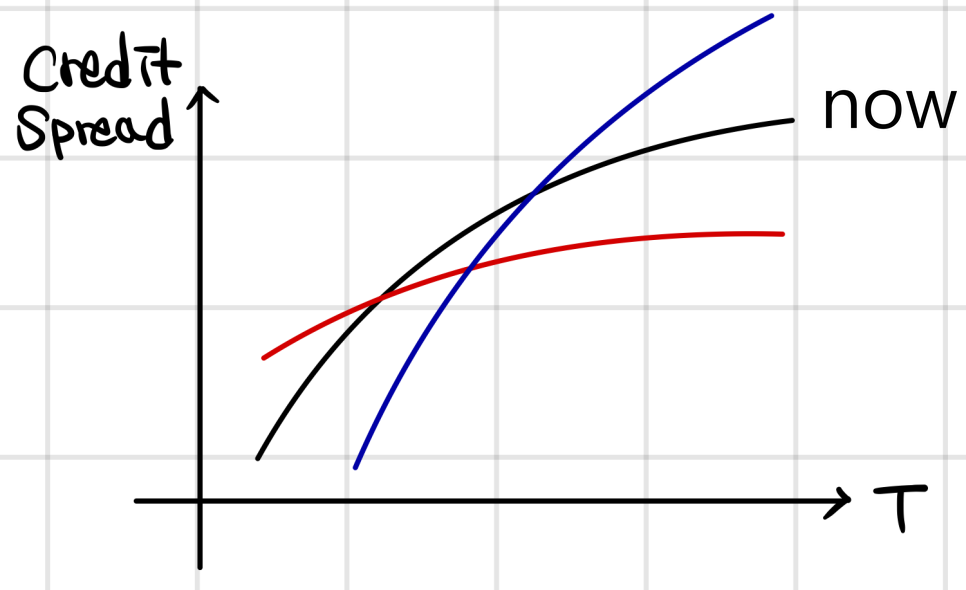
If you’re expecting it to flatten (meaning: “if it gets through the short term in one piece, the long term should be fine~”), then you buy CDS on the short end and sell protection on the long end. If your expectation plays out, you close the position by selling short-term protection and buying long-term protection.
⇒ Curve Flatten Trading
Expecting a steepener? Just do the opposite… heh ⇒ Curve Steepen Trading
➂ What’s a Basis Trade! For any given bond, there’s both a bond market and a CDS market.
Say a bank picks up a bond, and in the bond market that bond pays a fixed coupon at risk-free + 3% spread.
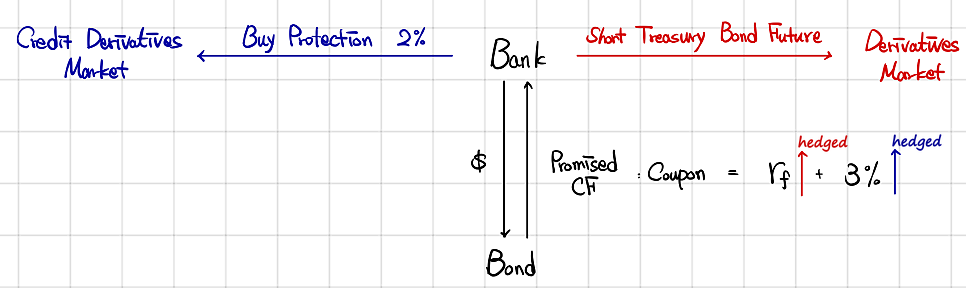
The bond price could fall because the risk-free rate rises, so you can hop over to the derivatives market and short government bonds to hedge that piece. The spread might also widen and pull the bond price down — so to defend against that, you head over to the credit derivatives market to buy protection… and you find they’re only asking 2%?? Oh interesting.
In the idealized matching-cash-flow example, hedging the interest-rate exposure and paying 2% for protection leaves a 1% gross spread. In a real basis trade, funding, liquidity, hedge mismatch, delivery and counterparty risks can eat that spread or create losses — it isn’t automatically a risk-free 1%, and efficiency doesn’t force the two quoted spreads to be identical.
(In reality, market spread reflects more than just default risk — liquidity risk, etc. — so they’re not exactly the same thing.)
Anyway, trading that bond-versus-CDS spread gap is called a Basis Trade!!
➃ An LBO is when you acquire a company by borrowing money using that company’s own assets as collateral, and using that borrowed money to do the acquisition.
The firm will issue a great amount of debt in order to repurchase all of the company’s publicly traded equity.
A company issuing bonds to buy back its own shares is essentially a recapitalization.. it’s restructuring the capital structure. The moment news like this drops — this additional debt will increase the CDS spread because default is now more likely. Leverage shoots up, default risk creeps closer — while the share price may benefit from a buyout premium or buyback — though more debt can also hurt it.
So, if you see this scenario coming, what do you do?
The illustrated equity-versus-credit trade is to buy protection and buy the stock. It profits on both legs only if the expected spread widening and stock-price rise actually occur; either leg can lose.
* This move where stocks and CDS work hand-in-hand is called an equity-versus-credit trade.
➄ The price of the bundled thing should equal the sum of the prices of the parts. So if the index traded as a whole and the sum of its individual components don’t line up, an arbitrage opportunity has popped up somewhere.
It’s introduced pretty briefly — just as a concept that exists.
An arbitrage transaction is possible if the credit risk of the index constituents is priced differently than the index CDS spread.
(In practice there’s a lot more to actually pulling this off and it gets messy.. but since the material doesn’t go there.. let’s just leave it at this.)
ex) A matched untranched index and its weighted single-name basket have the same underlying credit cash flows. Differences in traded prices can reflect liquidity, funding and other market frictions. Don’t confuse that index basis with the correlation-sensitive pricing of tranches or first-to-default baskets.
➅ There are two flavors of CDOs — Cash CDO and Synthetic CDO — we saw these back in Level 1.
A synthetic CDO has similar credit risk exposure to that of a cash CDO but is assembled using CDS rather than debt securities. If the synthetic CDO can be created at a cost lower than that of the cash CDO, investors can buy the synthetic CDO and sell the cash CDO, engaging in a profitable arbitrage.
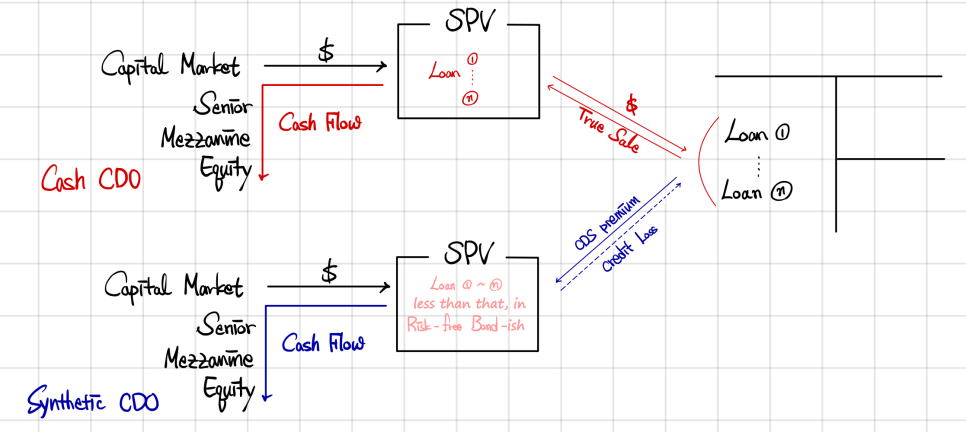
A Cash CDO actually holds the loans, while a Synthetic CDO is built out of derivative contracts — and their credit exposure can be made similar if the names, seniority, maturity and loss waterfall match. A synthetic structure needn’t buy the loans, but it isn’t inherently cheaper or identical in every risk: funding, collateral and counterparty terms still matter.
So thanks to that price gap between the two: Buy the relatively cheaper Synthetic / Sell the Cash CDO, and you might catch an arbitrage opportunity.. understanding it to about this level should do.
(The idea is to match and hedge the credit cash flows; actual funding, collateral and counterparty risks still need checking~)
Heads-up. The figures here are the original notes, slips and all. A few things to watch for:
- In the duration picture, $\Delta P = -P \times MD \times \Delta y$ is the change in the CDS price, so the upfront payment is that change with the sign flipped: upfront payment $= (\text{CDS spread} - \text{CDS coupon}) \times \text{duration} \times \text{notional}$, paid by the protection buyer when the spread is above the coupon (as in the formula just before it).
Comments
Discussion happens via GitHub Discussions. You'll need a GitHub account to comment.