Equity Method Accounting: Fundamentals
A breakdown of why associate stocks skip fair-value measurement and how the equity method pipes A's share of B's net income straight into A's books to close the dividend-manipulation loophole.
Investment in Associates
That’s associate stock — the case where significant influence exists. Usually 20%–50%. But even below 20%, if some special right is in play, it can still count.
OK so. Remember the financial assets we looked at earlier? Pretty much all of them — except the Amortized Cost ones (AC financial assets) — got measured at FV. FV means recording the asset at a market-participant exit price on the measurement date — it doesn’t mean I’m actually planning to sell it.
But associate stocks? Here the key is significant influence, so the usual treatment is the equity method rather than just following the market price. A plan to sell does not, by itself, remove that influence; specific held-for-sale rules and fair-value exceptions are separate.
So — these don’t get measured at fair value!! The accounting treatment we use here is the Equity Method.
Let’s get the logic of the equity method down first.
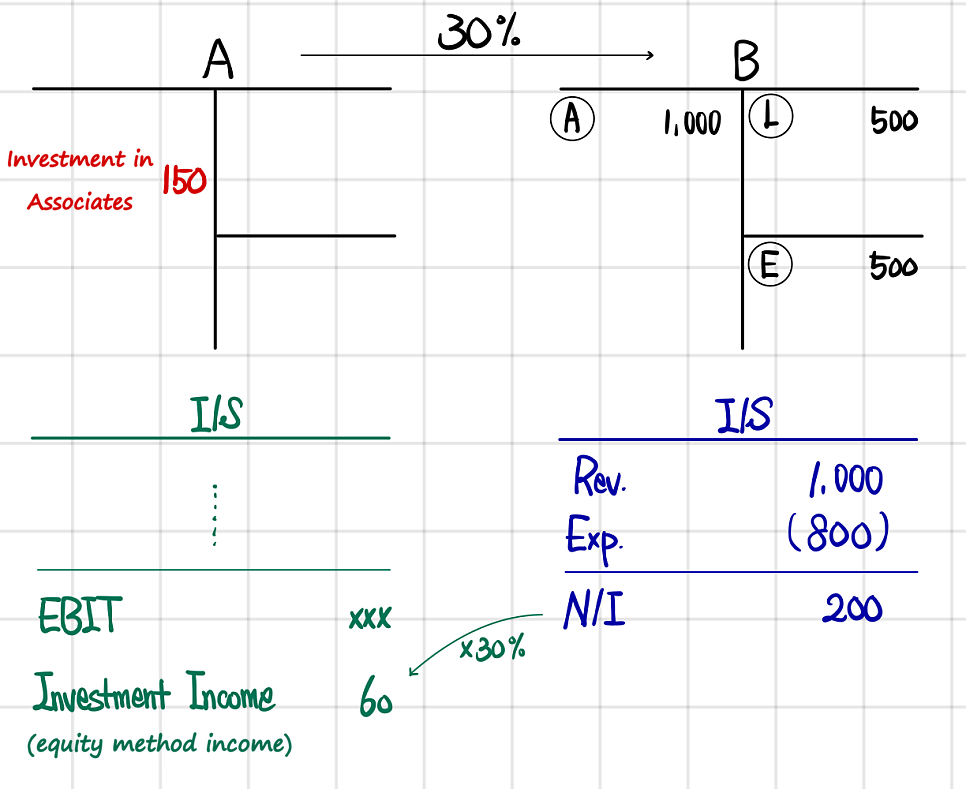
Say A buys a 30% stake in B for 150. On A’s B/S, Investment in Associates pops up at 150. Now if B’s performance that year comes in at Net Income of 200, an amount equal to A’s ownership share gets linked into A’s performance.
Now hold on — if this had been one of the regular financial assets we studied earlier, how would B’s performance have shown up on A? That 200 wouldn’t have flowed directly into A’s I/S. Instead, B’s good year would push B’s stock price up, and that’s how it would have moved A’s financial asset. And of course, if B paid a dividend, A would record it as dividend income on its I/S.
So why do we treat associates differently?
Because A is in a situation where it exercises significant influence over B. A can participate in B’s dividend-policy decisions, though it can’t simply order dividends whenever it likes. If income depended only on dividends, that influence could create room to shift income between periods: our year looks good? Push to postpone B’s dividend. Our year looks bad? Push for an earlier payout.
So you can read the accounting rule as A being told, “Whatever’s piling up inside B, book your ownership share of it as your own performance” — and with that, the door to massaging the financial statements is shut.
But wait — does actual money come into A right now?!?!
→ Nope, nope, nope. It’s purely accounting profit. To get a closer feel for how this accounting profit ends up on the books,
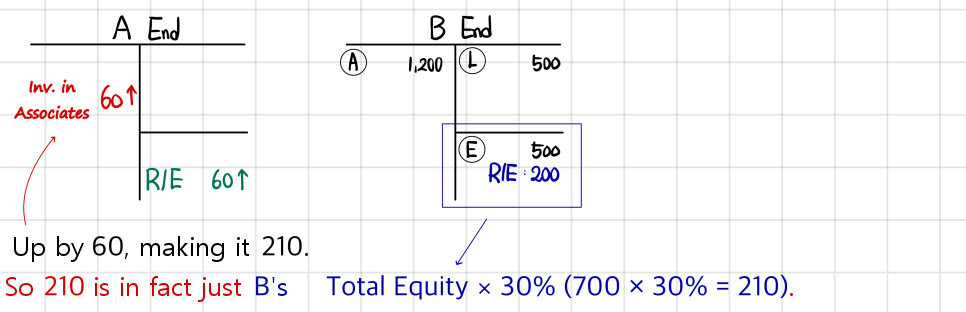
it basically comes down to this: the moment I invest in an associate, my straw goes straight into the net assets on the associate’s B/S.
If those net assets go up, my Investment in Associates goes up. If they go down, mine goes down. That’s the equity method!!
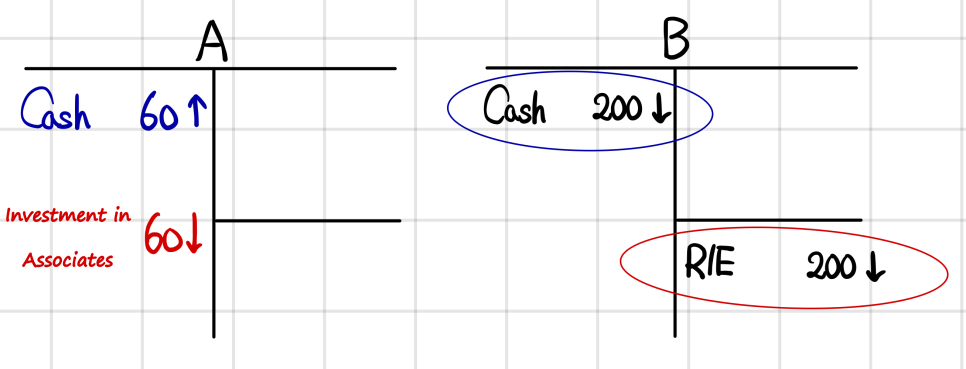
OK now let’s say next year, B pays out that whole 200 of Net Income as dividends. B’s retained earnings drop by 200. Oh! B’s net assets just shrank — so A’s Investment in Associates has to come down right along with it. But 30% of the 200 in dividends comes in to me as cash dividends, so cash goes up by 60.
So the equity method income of 60 that already got recorded — it wasn’t recorded at the moment the dividend was paid. It was recorded ahead of time, back when B first generated the profit that would later be available for dividends. If this had been a regular financial asset instead of an associate, that 60 would only have hit the books when the dividend got paid.
In other words, A has recognized its share of B’s profit before receiving cash. That 60 does enter A’s retained earnings, but accounting profit and legally distributable profit aren’t the same thing: Korea’s Commercial Act deducts specified unrealized profits when working out the dividend limit.
So what happens if B falls into capital impairment and its net assets go negative..?
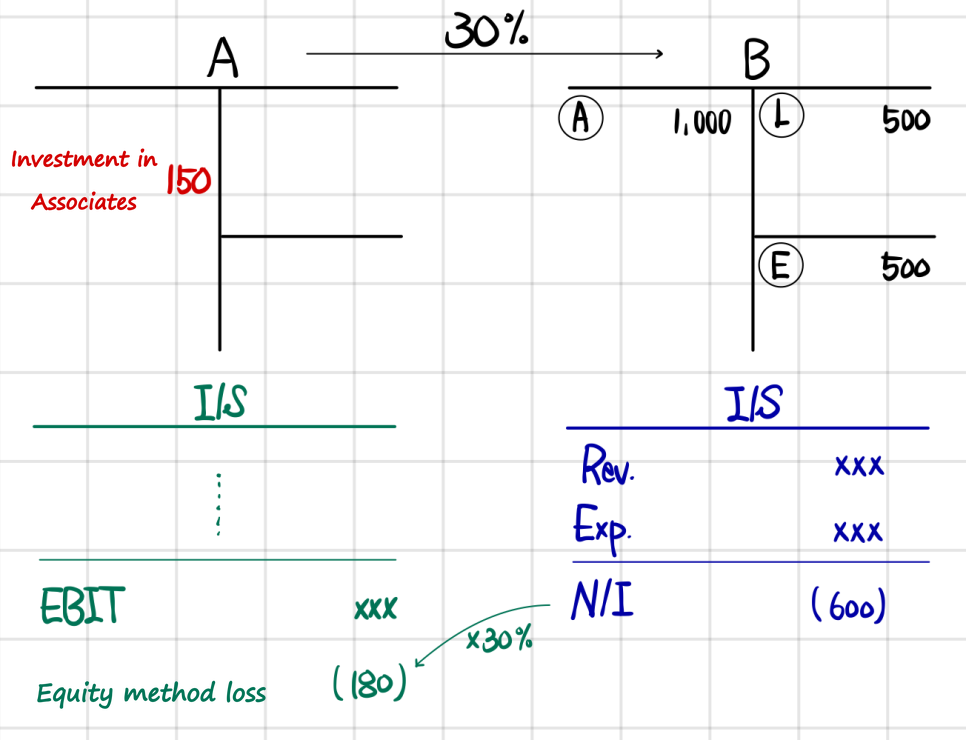
Let’s say B didn’t post Net Income of 200 — instead, B posted a loss of 600. Then 30% of (600) = (180), which should flow into A too?! But here’s the problem. Investment in Associates is 150. Apply (180), and you’d be recording an Asset of (30)..
Can you record an Asset (an asset!) as negative in accounting..?
Nope — we don’t turn this equity investment into a negative asset just to absorb the extra loss.
The reason is, in accounting an asset is defined as “a present economic resource controlled by the entity as a result of past events” (this is stuff I studied on the CPA side, so I’m graying it out..), where an economic resource means “a right that has the potential to produce economic benefits.”
An equity stake normally gives us rights to benefits, not an automatic duty to cover every loss. But a separate guarantee or funding obligation can still make us liable — limited liability isn’t the whole accounting rule.
So in this example, with no other long-term net-investment interests or obligation to support B, Investment in Associates only reflects equity method losses down to 0. Long-term interests that form part of the net investment absorb losses too; legal or constructive obligations, or payments on B’s behalf, can require a liability beyond zero.
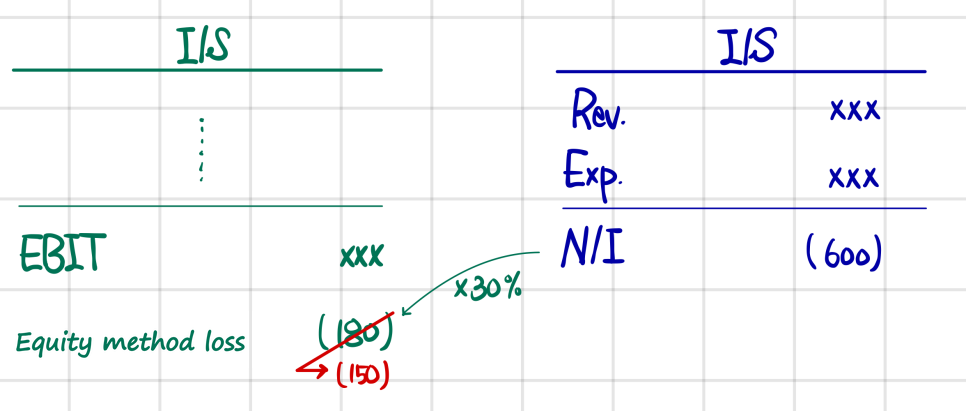
Whoa, so the actual loss could be something like 100 billion won, and only 100 million won of it shows up on the financial statements?? Which is why, apparently, the Accumulated Loss (the share of losses that went unrecognized) absolutely, absolutely, absolutely has to be disclosed in the notes. There’s a real chance of hidden deficits sitting underneath..heh
If the investee’s losses reduce the investment account to zero, the investor usually discontinues use of the equity method. The equity method is resumed once the proportionate share of the investee’s earnings exceeds the share of losses that were not recognized during the suspension period.
Fair Value Option
US-GAAP allows equity method investments to be recorded at fair value.
Under IFRS, the fair value option is only available to venture capital firms, mutual funds, and similar entities.
For investment companies, even if they pick up 20%–50% of someone’s shares, that’s for Exit purposes anyway, right? So for those kinds of entities, they’re allowed to carry those stakes at Fair Value instead of using the equity method. But under IFRS it only gets granted to a really narrow set of industries, so it’s probably fine to just go “huh, that’s a thing” and move on.
(Side note: sometimes when you flip through a quant investing book, you’ll see them filter all holding companies out of the universe — and the reason is that even though a holding company’s financial statements look similar to other companies’, it’s a stretch to compare them apples-to-apples.. that’s why they do that kind of thing.)
So from here on, instead of A buying 30% of B’s 500 in net assets for 150, we’re going to look at cases where A pays more on top of that.. cases where a premium is tacked on.
I had a brief run-in with the account name Goodwill back in Level 1 — let’s quickly look at how it showed up there, and then move on to the next one!
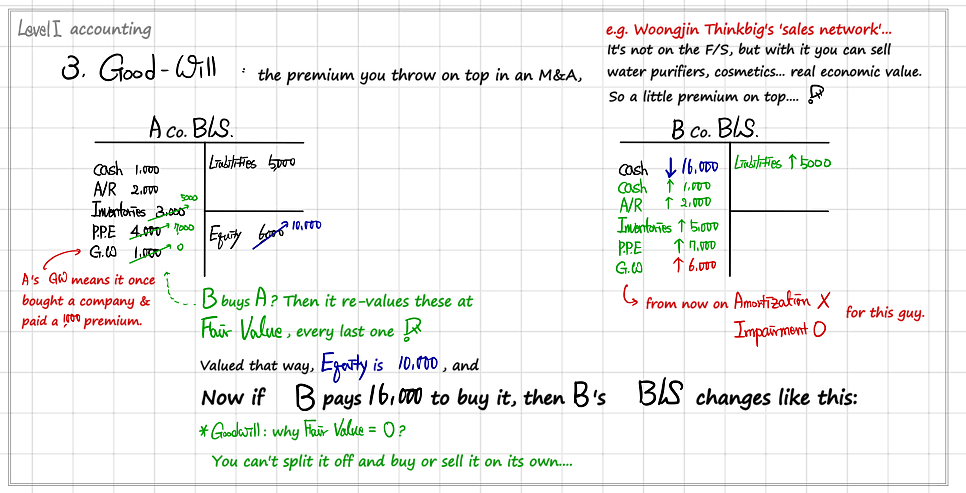
Heads-up. The figures here are the original notes, slips and all. A few things to watch for:
- In the Level I goodwill refresher, goodwill cannot be sold separately, but that does not mean its economic value is zero. In a business combination it is the residual purchase price after identifying and measuring the other net assets.
Comments
Discussion happens via GitHub Discussions. You'll need a GitHub account to comment.