Equity Method Accounting: Advanced Topics
Equity-method accounting when BV ≠ FV: allocate the purchase-price premium, then reconstruct income from the acquisition-date FV lens.
Excess of Purchase Price Over Book Value Acquired
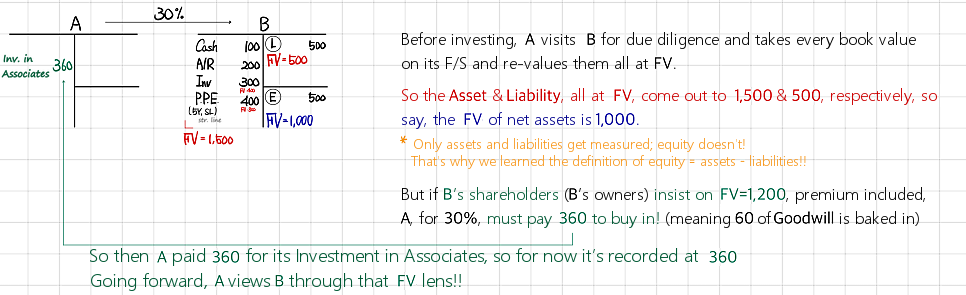
OK so the case we just saw assumed Book Value = Fair Value for Company B. But come on — in real life, when Company A buys into Company B, the basis isn’t BV. It’s the FV at the moment of acquisition!!!
And here’s the thing: when you’re not just nibbling on a small stake but actually swallowing a big chunk of the company, the seller is going to want more on top of FV. The vibe of the conversation: “Ohhh my~ the fact that you’re buying that much means you’re planning to step into management here too, riiight? Sounds like you’ll need to pay a little extra for that management-participation slice.. we good?”
The notes call that extra payment a control premium. Here, though, the 30% stake gives A significant influence, not control; think of it as the negotiated premium above A’s share of the identifiable net assets’ FV.
So let’s look at this kind of case (and obviously — this is the only kind of case that’s ever going to show up on the exam).
Two steps are getting smushed together here:
- ➀ From here on, BV≠FV is fair game, and the basis has to be FV.
- ➁ Whatever they ask for on top of that FV is, in character, Goodwill!!
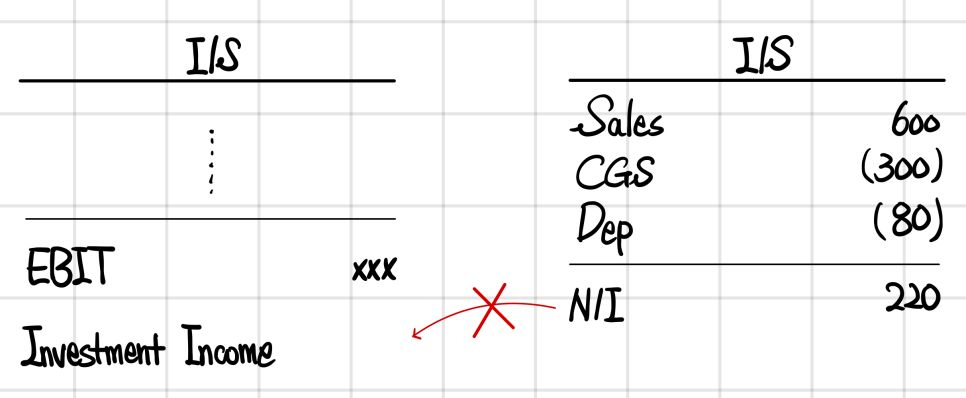
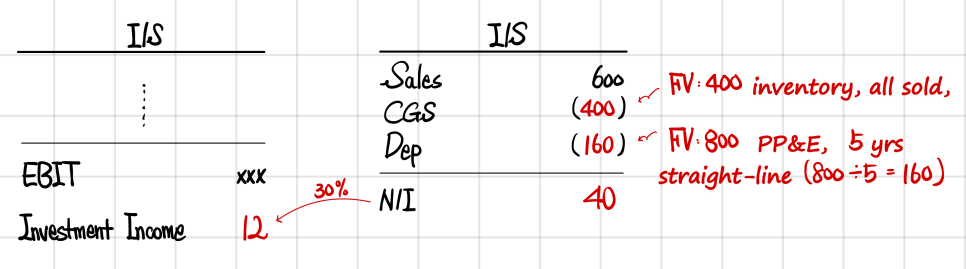
And let’s say B’s performance comes in like this — all inventory sold, cash revenue 600, no other expenses except depreciation — so Net Income works out to 220. But you cannot use that 220 to compute equity-method income!!! Because A isn’t looking at B on a BV basis. A is looking on an FV basis. So you’ve gotta reconstruct the I/S from that FV lens.
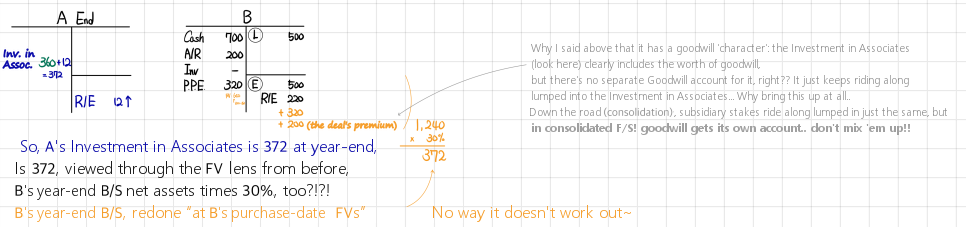
I really didn’t want to get into this section, but now that I’m down in the consolidation chapter.. I had to scroll all the way back up here to write it (sobbing) (real talk: this grey text is something I came back up here to write while I was in the middle of the consolidation part lol).
Originally, when you study equity-method accounting, there are 3 things to keep in your head total. If I sort which parts of those 3 actually matter for CFA studying, it shakes out like this..
- ➀ BV≠FV: the part that gets distorted because of over/understatement of net assets ← Heavily tested in the CFA curriculum
- ➁ The part paid on top of FV: Goodwill ← Heavily tested in the CFA curriculum
- ➂ Intercompany transactions with associates (up-stream & down-stream) ← Not a big focus of CFA questions


Part A? Meh — Goodwill is $5,000, easy enough.
Part B is where it actually gets real, but before we dive in for real, keep this stuck in your head.
(Time for Gungseo, the dead-serious font lol. the old editor doesn’t have Gungseo;;)
The equity method, at the end of the day, is just 2 things: ➀ whatever profit the associate posted — my share of it is mine! ➁ When a dividend gets paid, it offsets!!
That’s it. The whole thing. Two bullets.
BUT — when you recognize income → it has to be income from my perspective, i.e. through the FV-at-acquisition lens!!!
That’s the whole game.
OK first, let me work out the income from what I (Red) actually see. Blue’s out here saying its Net Income is $100,000, but yeah.. that’s what you think.
From where I’m standing, P.P.E. is marked up by $50,000, so the extra depreciation on that markup — $50,000 over 10 years straight-line, a.k.a. $5,000 — should’ve been expensed on top.
So I’m knocking another $5,000 off the Net Income you’re quoting me!!! Which means Blue’s N/I as I see it is $95,000, and 30% of that — $28,500 — is mine!!!!
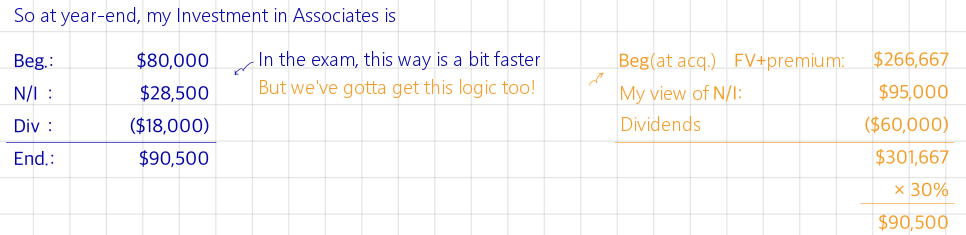
Since the CFA exam usually asks about the following year, this approach will carry you through exam day. If this were a CPA problem, they usually push it to the year after next — like x3, x4 — and if you don’t have the right-hand side absolutely cold, there is no way you’re solving it in time..
For us though, the exam usually stops right about here!! The stuff past this point is what crawls out when they really crank the difficulty knob up..?
Well, just how hard can it possibly be..??? Yeahhh yeah yeah, very hard lol.
Heads-up. The figures here are the original notes, slips and all. A few things to watch for:
- In the Red and Blue example, the book value of 200,000 dollars is that of Blue’s identifiable net assets (assets minus liabilities), not of its assets; the solution and the notes use it that way, so the numbers are unaffected.
Comments
Discussion happens via GitHub Discussions. You'll need a GitHub account to comment.