Full Consolidation: The Acquisition Method
A casual breakdown of why full consolidation wins over proportionate consolidation, how NCI keeps the balance sheet balanced, and what it does to your ROE and ROA.
OK so — how does the consolidation the standards actually recognize work? It’s the thing called "(Full) Consolidation by the Acquisition Method."
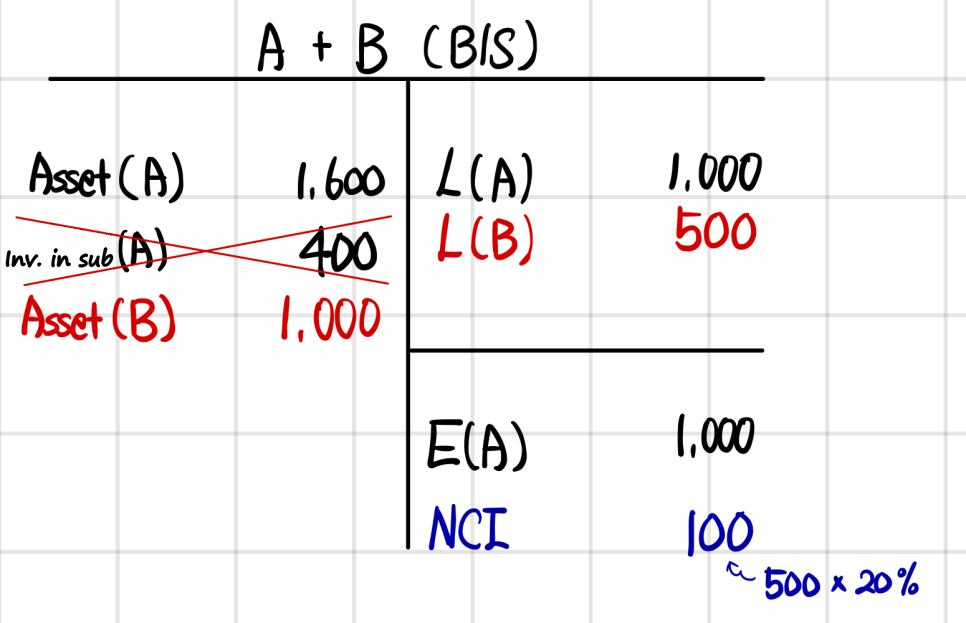
Instead of pulling in assets and liabilities in proportion to your ownership stake, you wipe out the investment-in-subsidiary line and just yank in everything — all of B’s assets, all of B’s liabilities. Just pull it all in!
But… if you grab 100%, the balance sheet obviously won’t balance, right? Bringing in 100% of B’s assets and liabilities means you’ve also brought in 100% of B’s net assets.
So how do you make it balance?
You pull in 100% first, and then the slice that isn’t actually yours gets shoved into equity as Non-Controlling Interest. Bam — balanced.
Honestly, common-sensically, proportionate consolidation — where you only pull in your own ownership slice — kinda sounds like the more reasonable method, no?
So why on earth — whether US-GAAP or IFRS — did they pick Full Consolidation as the standard…?
Think about it in terms of actual physical stuff, though, and full consolidation will probably feel more right. Say the company I control is Hyundai Motor. If you proportionately-consolidate it, each car gets sliced at 80% — that part is mine; each machine that builds the cars gets sliced at 80% — that part is mine; snip snip snip, everything gets sliced and “this much is mine!!” — that’s the financial statement you’d get.

But acquisition-method consolidation says: “nah, just use all of theirs for now~~, and then on top of that, list out who has a claim on what.” You’d think that’s the more self-evident view…
OK so, up to this point we’ve got the methods that describe relationships between companies. Line up the three: equity method vs. proportionate consolidation vs. consolidation.
Which one comes out with the biggest size?!?!
→ Consolidation, obviously!! You’re not slicing and bringing in, you’re bringing it in whole — and not only the assets and liabilities: equity is also biggest under consolidation, because NCI is sitting in there. Let’s eyeball a comparison.
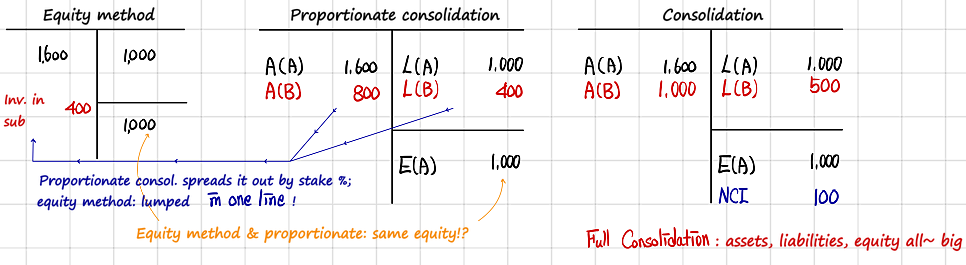
For this positive-profit example, keep the numerator fixed at income attributable to A’s owners. More assets then means a smaller return-on-assets ratio: equity method > proportionate consolidation > full consolidation. But don’t turn that into a universal ranking! For owners’ ROE, pair A’s owners’ income with A’s owners’ equity, excluding NCI from both; that ROE stays the same here.
(they might ask about this kind of comparison)
Quick history detour: before Korea adopted IFRS in 2011, a parent’s main financial statements didn’t consolidate its subsidiaries — they carried them with the equity method. When consolidated financial statements became the primary statements, the reported scale and some ratios changed even though the underlying business hadn’t suddenly changed. The direction isn’t universal — it depends on the subsidiary’s results and on how the ratio is defined.
OK now let’s also look at consolidation on the income side. Same vibe — you bring in 100% of everything first, and then at the bottom you peel off the slice that isn’t yours, like so.
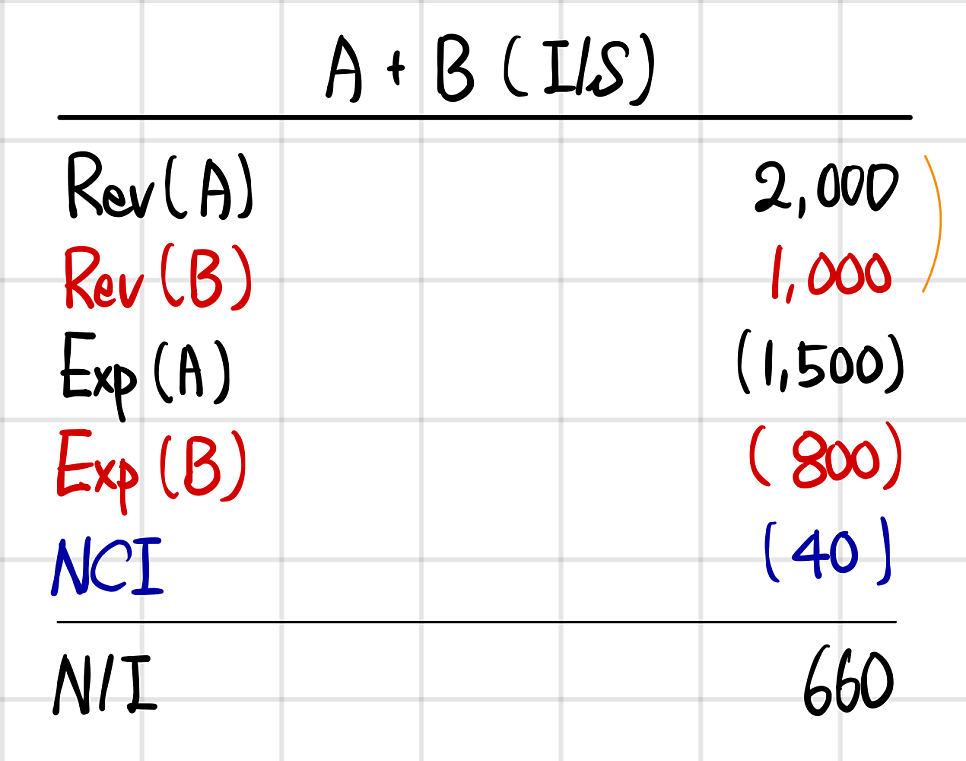
Out of B’s profit of 200, you peel off 20% as not-mine (net income attributable to non-controlling interest). The not-mine deduction is the same as in the other methods, so the bottom-line number ends up identical.
And since the leftover is what belongs to A’s shareholders, we call it “net income attributable to controlling interest.”
Now that we’ve got the rough picture, let’s summarize the I/S impact across the three treatments:
- Revenue: equity method < proportionate consolidation < consolidation
- |Expenses|: equity method < proportionate consolidation < consolidation
- Income (A’s share): equity method = proportionate consolidation = consolidation
In this simplified comparison, income attributable to A’s owners comes out equal~ Total consolidated net income also includes the NCI’s share; we’ll split those out below.
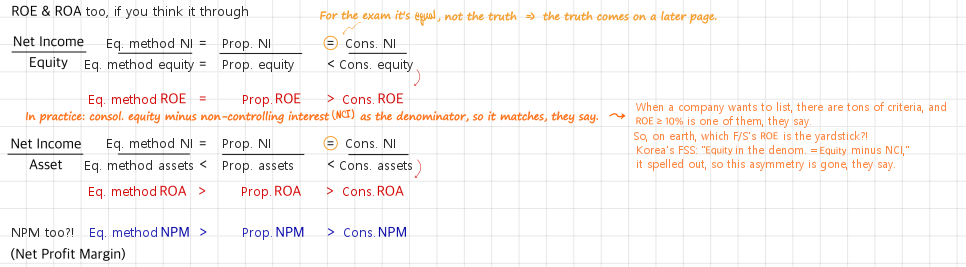
OK let’s run the year-end consolidation all the way through and close it out.
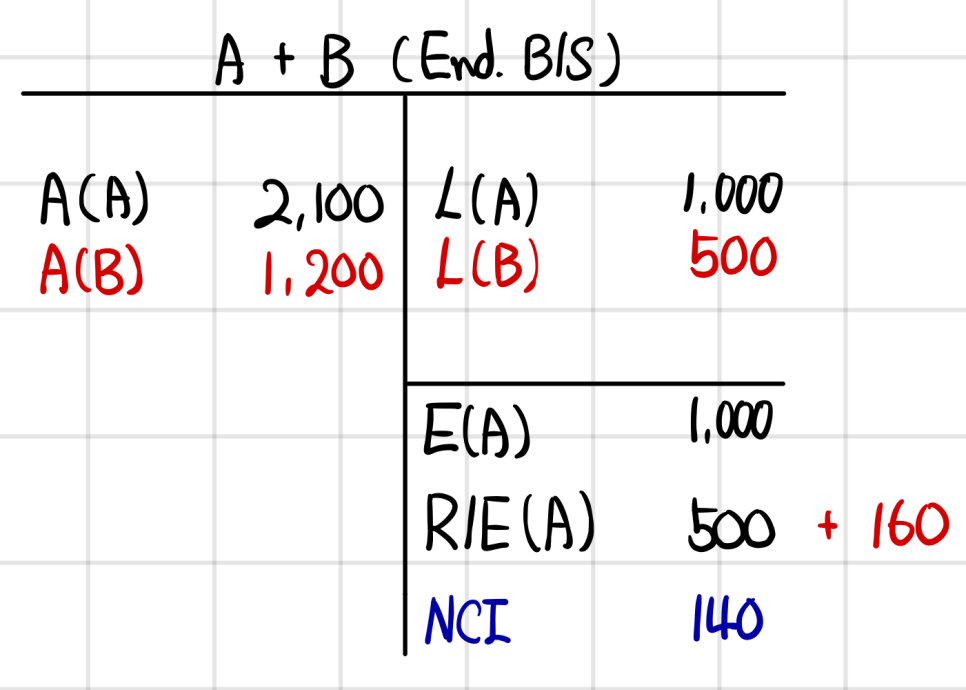
➀ In the consolidated B/S at the start of x1, R/E was zero, and looking at the I/S, the net income attributable to controlling interest is what flows into A’s consolidated R/E. Tracks. So at end of x1, A’s consolidated R/E = 0 + 660 = 660. NCI was 100 at the start, then during the period net income attributable to non-controlling interest of 40 piled on, so ending NCI = 100 + 40.
Approach ➀ is the logic of “beginning consolidated B/S of x1 + consolidated I/S of x1 ⇒ ending consolidated B/S of x1.” You also need to be able to derive it using approach ➁: “A’s end-of-x1 separate + B’s end-of-x1 separate ⇒ ending consolidated B/S.”

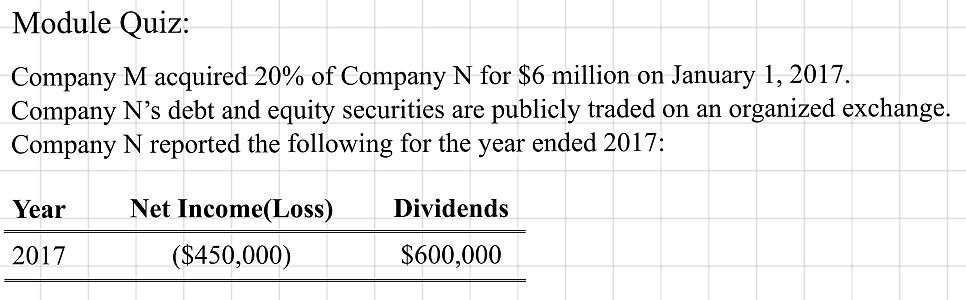

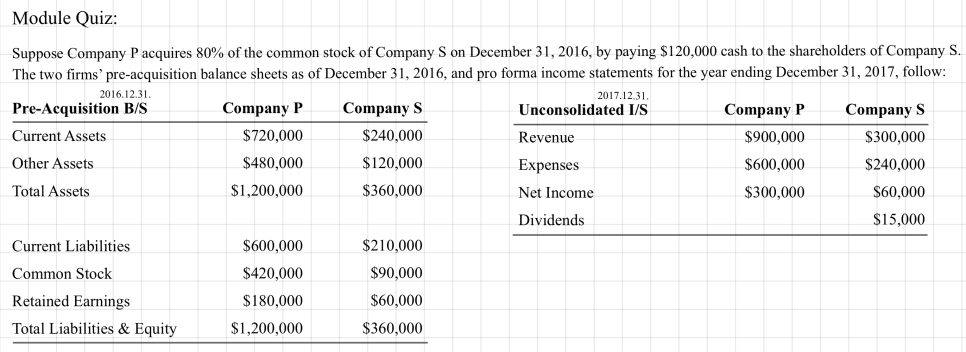
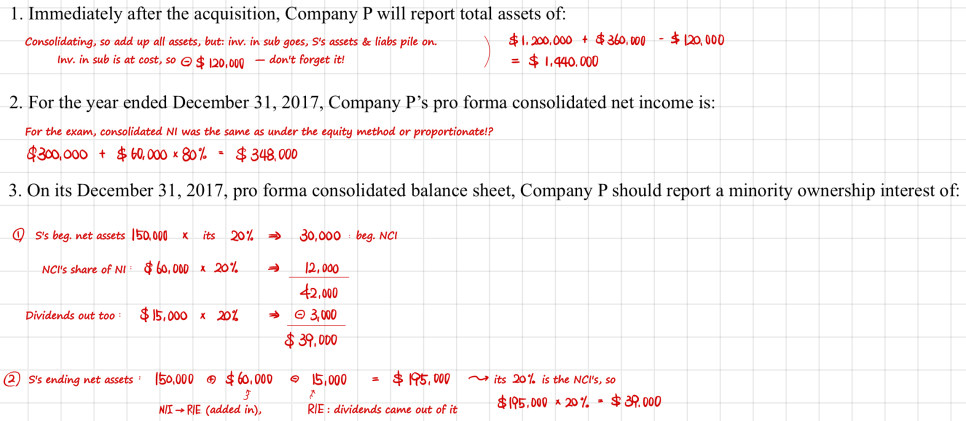
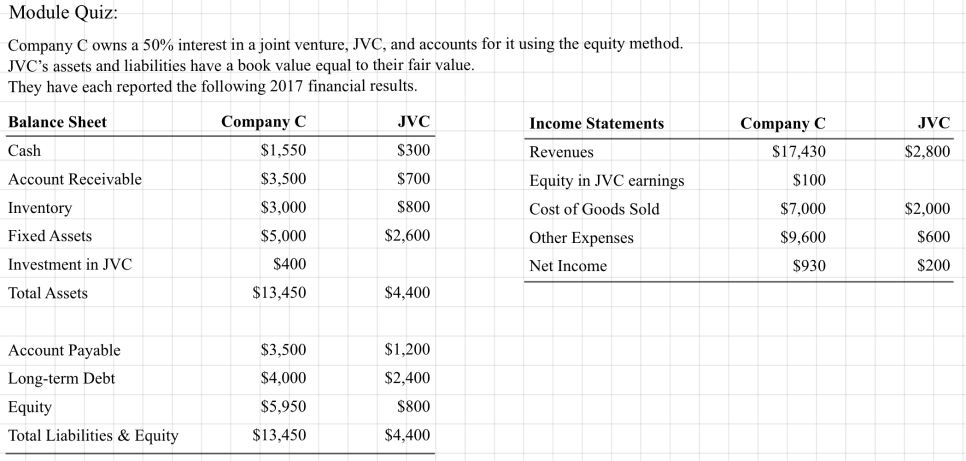

Now the moment of truth..
If you actually pop into DART and open up a real set of consolidated financial statements — are they written the way we saw above?
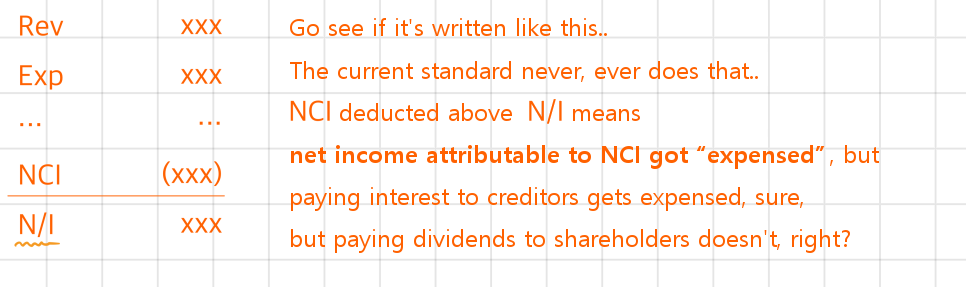

Here’s a real one, Samsung Electronics’ consolidated income statement for Q1 2022 on DART: it ends with net income of 11,324,628 million won, and right under it splits that into 11,129,094 attributable to owners of the parent and 195,534 attributable to non-controlling interests. Exactly that layout!
OK story time — the real-brain use case of the equity method vs. proportionate consolidation.. (this one gives me chills..)
Earlier I mentioned Joint Ventures briefly — “just slap equity method on it..” — that was about it, and we moved on. But for setups like this, the actual ownership percentage isn’t really the thing that matters.. because even when the percentages are uneven, you’ll see lots of deals along the lines of: “when it comes to decision-making, it’s 5:5!”
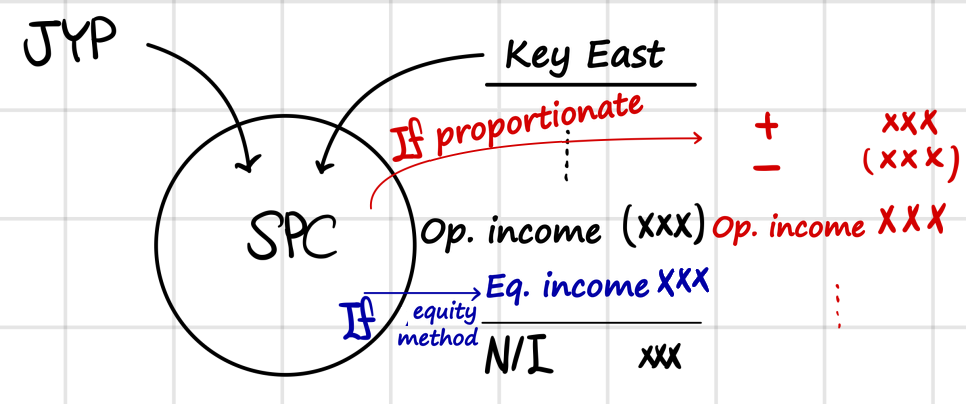
OK so. Back in the day, Key East — an entertainment company — and JYP set up a JV and shot a drama. At that point, Key East’s separate financials were in their 4th straight year of operating losses. Then this drama became an absolute megahit, right? (None other than “Dream High.”) Oh sweet, saved! …or so you’d think?
Nope. Not at all. If you apply equity method accounting, equity-method income gets parked as non-operating income, below the operating line, so they were stuck — no way around a 4th straight year of operating losses..
Back then, IAS 31 allowed proportionate consolidation for jointly controlled entities. This is a historical story: current IFRS 11 generally requires the equity method for joint ventures, so this isn’t a choice you can simply make today.
And if you use proportionate consolidation, you pull in everything proportionately starting from revenue, so you can actually swing the operating line into the black…
Key East’s CEO at the time happened to have an accountant background, flipped his thinking in this exact direction, and — apparently — that’s how they dodged delisting.. A real-deal Brain.. shivers
Heads-up. The figures here are the original notes, slips and all. A few things to watch for:
- The ratio chart holds the positive parent-attributable profit numerator fixed. For a consistent owners’ ROE, exclude NCI from both income and equity; using parent profit over total equity would mix two different ownership scopes. The acquisition-method JV quiz is a hypothetical comparison, not permission to consolidate a jointly controlled venture as a subsidiary.
Comments
Discussion happens via GitHub Discussions. You'll need a GitHub account to comment.