Goodwill (Full and Partial) and Bargain Purchases
Breaking down how goodwill pops out of consolidation accounting, how NCI gets booked, and what happens with partial goodwill and bargain purchases — CFA-style.
Remember that bit I mentioned in gray during the equity method section? Equity method accounting bundles the goodwill-flavored value inside the equity-method investment line and just lets it ride along — but consolidation breaks goodwill out and accounts for it separately! That’s exactly what we’re cracking open now.
And remember — out of the 3 things you have to think about in equity method accounting, I said CFA only really asks about 2 of them. In consolidation? You need all 3.
CFA-style consolidated accounting!!!!
➀ BV ≠ FV: the part that gets distorted because net assets are over- or understated ➁ The part you paid on top of FV: Goodwill ➂ Intercompany transactions with the subsidiary (up-stream & down-stream)
Honestly — the odds of #3 showing up on the exam? Basically zero. In consolidation, the effect is totally different depending on whether it’s upstream or downstream, and it gets ridiculously, ridiculously complicated. No way CFA’s gonna make you do that lol.
Phew. OK, I think we’re set up enough! Let’s dive in.
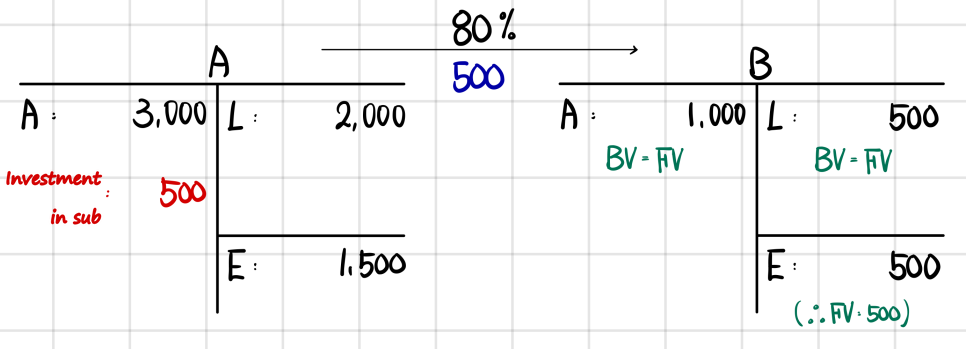
Suppose A negotiates to acquire 80% of B’s shares, and let’s say B’s BV happens to equal its FV. Then if there were no premium on top, to grab 80% of something worth 500, you’d just pay 400. Easy~
But — they decided to pay 500. Meaning they paid a premium of 100 on top.
(So what were they valuing B at? Working backward from $625 \times 80\% = 500$, they priced B as a whole — its market cap, the thing people casually call “valuation” — at 625.)
So A handed over 500 of value, and on its standalone financial statements would have booked an investment in subsidiary of 500. Same as we did with consolidation before — let’s eliminate that investment and flip B’s assets and liabilities onto our books, and watch how Goodwill pops out of the process.
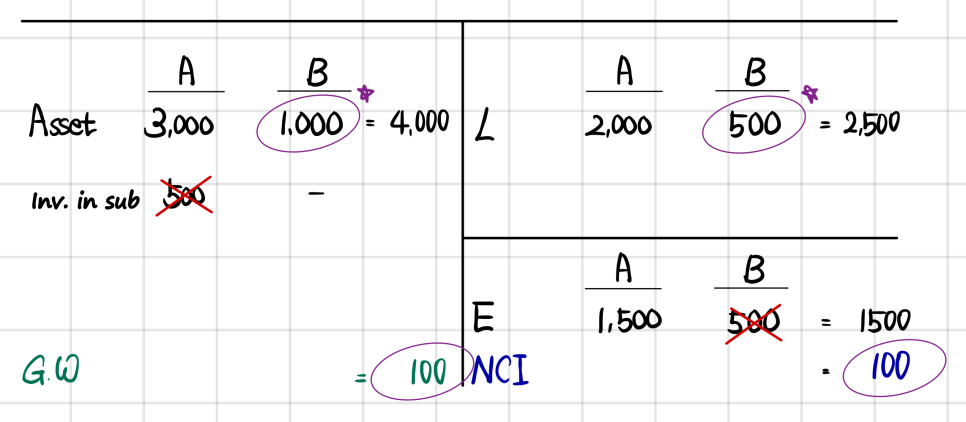
➀ On A’s books, kill the investment line and flip in all of B’s assets & liabilities, the way I see them. (Same idea as “eliminate the investment, eliminate B’s equity, pull in everything else” — we already saw this in the equity method section!)
➁ Out of B’s net assets (500) we just dragged in, the part that isn’t ours has to be tagged as NCI. So we book NCI for the 20% that isn’t ours, which is 100.
➂ At this point, the balance sheet doesn’t balance. Why? Because the investment of 500 we eliminated contained goodwill-flavored value (just like it was hiding in the equity-method investment line!).
The equity-method investment was kept on one line (so was the standalone investment line), but the consolidated statements are the ones that unpack it — and that’s where Goodwill jumps out!!
✵ The circled stuff is what was previously bundled inside the investment line. ✵ If BV ≠ FV, the starred items get written “at FV as of the acquisition date.”
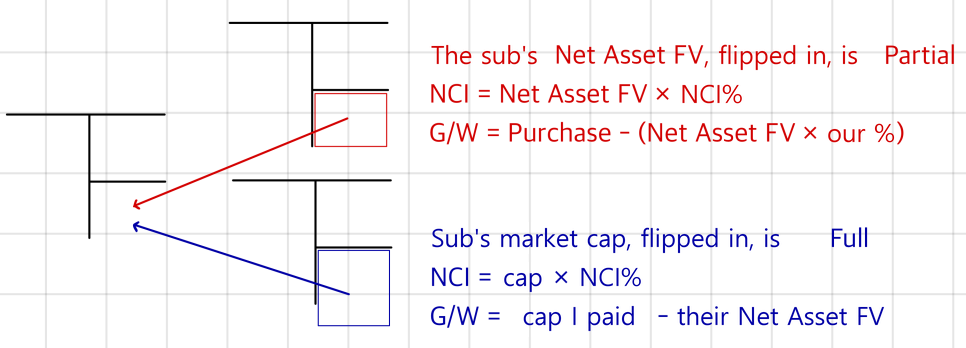
Just for completeness, let’s write the formulas for Goodwill and NCI:
For partial goodwill: NCI = FV of identifiable Net Assets × NCI%.
GW = Purchase Price − (ownership% × FV of Net Assets) — in words: it’s whatever you paid over and above your ownership share of the net assets!!!
Partial Goodwill vs Full Goodwill
The Goodwill of 100 we just calculated? That’s “Partial Goodwill.” You also need to know the concept of Full Goodwill.
What’s Full Goodwill?
Right now we only pulled in 80%, so there’s some Goodwill that’s invisible — Full Goodwill is the version that puts that on the books too. In this simplified example, assume the NCI has the same value per share as the acquired stake. Then the implied whole-company equity value is 625, so full Goodwill is 125. In general, full Goodwill = consideration paid + NCI’s acquisition-date FV − identifiable net assets’ FV; a control premium can make the per-share values differ.
(Every Goodwill we saw from Level 1 onwards was Partial Goodwill.)
Partial Goodwill: IFRS only. Full Goodwill: both IFRS and US-GAAP.
(If the question is US-GAAP, you have to use Full Goodwill, no exceptions. If it’s IFRS, the problem will tell you which method to use.)
✵ The thing you need to remember about Partial vs Full for the exam → Full makes assets and equity bigger. ✵ NCI under Full is measured at its own acquisition-date FV. In our same-price-per-share example, that’s the implied whole-company equity value × NCI%. ✵ In Korea, the vast majority of companies use Partial in practice, because Full is a pain heh.

A friendlier version!
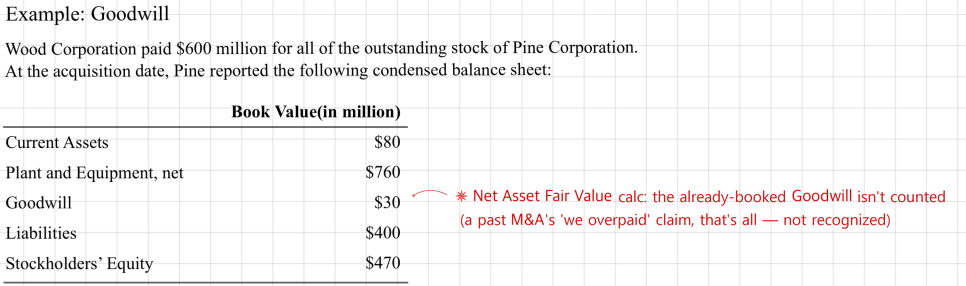
The fair value of the plant and equipment was $120 million more than its recorded book value. The fair values of all other identifiable assets and liabilities were equal to their recorded book values. Calculate the amount of goodwill Wood should report in its consolidated balance sheet.
Wait — the FV of net assets at the acquisition date is already different from BV. What’s going on lol.
Anyway: Pine’s existing Goodwill (the 30) doesn’t count, and we tack on +120 to PPE to bring it to FV → $80 + (760 + 120) - 400 = 560$. They acquired everything for 600, which is 40 more than 560, so book Goodwill of 40.
Example: Full Goodwill vs. Partial Goodwill Continuing the previous example, suppose that Wood paid $450 million for 75% of the stock of Pine. Calculate the amount of goodwill Wood should report using the full goodwill method and the partial goodwill method.
Net asset FV from above was 560, and 75% of 560 is 420. They paid 450 for that 75% → Partial Goodwill is 30.
Assuming the same value per share for the NCI, the implied 100% price is 600. That’s 40 over the 560 FV of net assets → Full Goodwill is 40.
Goodwill Impairment
From what we did at Level 1: Goodwill is classified as an intangible asset with an indefinite useful life, so no amortization. No amortization, sure — but test it for impairment at least annually, and sooner if impairment indicators show up. When the relevant test fails, you book the impairment!!!
The standard here actually splits a bit between US-GAAP and IFRS. Quick recall from Level 1 on tangible/intangible asset impairment:
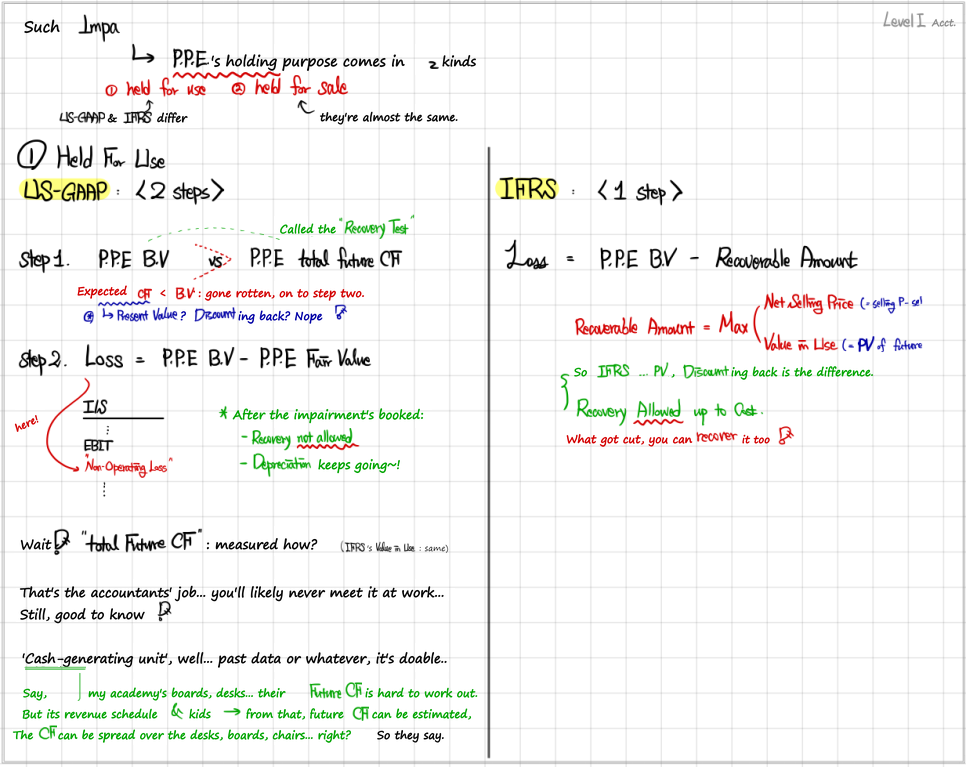
For held-for-use long-lived assets under US-GAAP, compare BV with undiscounted cash flows. If they fall short, write the asset down to FV. That’s the recoverability test — not the goodwill test.
IFRS: compute the so-called Recoverable Amount = Max(Value in Use, Net Selling Price), and impair down to that.
* Value in Use: forecast future cash flows, discount to PV.
Now you might think, “hey, Goodwill is an intangible asset, just do the same impairment dance,” but accounting actually views Goodwill kind of differently from other intangibles. Tangibles like machines, intangibles like trademarks and patents — the key thing is: you can peel them off and transact in them on their own.
Goodwill? Not so much. The official stance is that forecasting future cash flows attributable to Goodwill alone is basically impossible. So both US-GAAP and IFRS clearly chewed on this for a while, and the conclusion they landed on was:
“For Goodwill impairment, attach it to the business unit / cash-generating unit that’s actually producing cash flows, do your forecasting there, and check whether that has gone rotten.”
So the very starting point is different from other tangible/intangible assets!
1. Judgment criteria
US-GAAP: attach it to a Reporting Unit (an operating segment, or one level below it) and judge there. (An operating segment is basically a business division of the company.)
IFRS: attach it to a CGU (Cash Generating Unit) and judge there.
* Where the CGU starts and stops… in practice this gets ridiculously complicated, but since this is for the exam, just hold the words in your head.
* Reporting Unit, by definition, is a broader concept than CGU.
The judgment is basically: using those respective units, decide whether to impair or not.
For US-GAAP — say G/W is 1,000, and it’s allocated 400 / 300 / 300 to business divisions 𝛼, 𝛽, 𝛾:
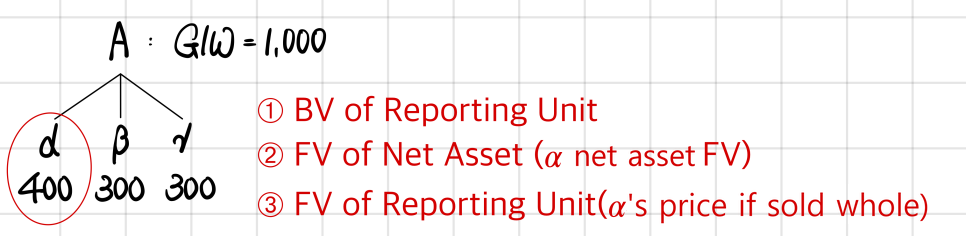
i) If ➀ < ➂: no signs of impairment yet. If ➀ > ➂: signs of impairment detected.
ii) How much do you record as Impairment Loss? Loss = BV of G/W − FV of G/W
That is, you need to realign BV down to the Fair Value of G/W. And ➂ − ➁ is exactly that Fair Value of G/W, so the Loss is BV of G/W − (➂ − ➁).
You just run that process division by division. Heh. (That’s the classic two-step test. Since ASU 2017-04, US-GAAP skips step ii): the Loss is simply ➀ − ➂, capped at the G/W’s BV.)
For IFRS — the truth is it’s way more complex, but the textbook also just glosses over it in like 3 lines;; Let’s just roughly remember it like this. A single step is applied:
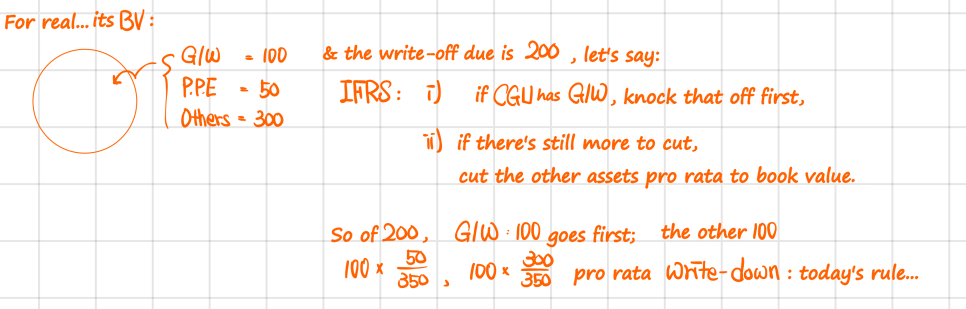
If BV exceeds recoverable amount, recognize that shortfall as Loss: goodwill first, then other assets pro rata, subject to each asset’s applicable floor. (Recov. Amt. of CGU = Max(Value in Use, Net Selling Price))
If BV of CGU < RA of CGU: the CGU’s assets still carry their weight. If BV of CGU > RA of CGU: knock BV down to RA.
Bargain Purchase
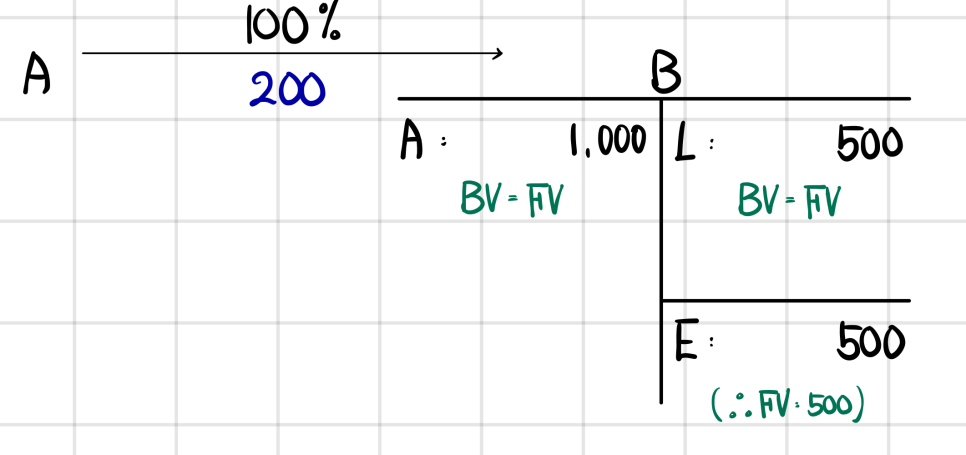
Bargain Purchase is the flip case — instead of paying over the 500 FV of B’s net assets at an implied 625, you pay at a discount.
Say A pays 200 to bring 500 worth of net assets onto A’s balance sheet. Cash drops by 200, 500 of net assets gets flipped onto our books — and obviously the balance sheet won’t balance. Something worth 300 has to materialize on the liabilities or equity side.
This 300 that just got created? It is definitely not a liability. So it has to bump up equity. In the old days, this was parked directly in equity under an account called “merger surplus” — never touched the income statement.
These days, it does go through P&L (basically: “nice deal, congrats!”). The account is called Bargain Purchase Gain — booked into N/I, which then flows through to R/E.
For exam purposes, that’s all you need!!
A bargain purchase isn’t the everyday deal, but it absolutely can happen — particularly when a seller is distressed.
So… do we have a real example of someone buying below?
Yes! When UBS acquired Credit Suisse in 2023, its initial second-quarter results included about USD 29 billion of negative goodwill. That’s a documented, very large example — see UBS’s original results announcement. The initial estimate was later revised during purchase accounting.
Don’t read that as 29 billion of ordinary operating earnings or a new cash receipt, though! A bargain-purchase gain comes from acquisition accounting. It doesn’t, by itself, make the business safer or guarantee a credit-rating upgrade.
My original notes also retold a story about Hanwha buying Korea Life. Hanwha’s own history confirms the 2002 acquisition. I haven’t established the financing motives, subsidiary-merger accounting or alleged controversy from primary records, so I’m keeping those claims out of this example. The current accounting lesson is the bargain-purchase calculation above.
Heads-up. The figures here are the original notes, slips and all. A few things to watch for:
- In the Level I note on PP&E impairment, US GAAP’s first step is the recoverability test (ASC 360-10-35-17), and the impairment loss is part of operating income, not a non-operating loss below EBIT (ASC 360-10-45-4).
- Under IFRS, a reversal of an impairment loss is capped at the carrying amount the asset would have had, after depreciation, if no impairment had been booked, not at its original cost (IAS 36.117).
- The partial/full goodwill shortcuts in the figures assume equal per-share values for the controlling stake and NCI. Generally, full goodwill uses the NCI’s independently measured fair value, which may differ because of a control premium. In the CGU write-down example, other assets cannot be reduced below the highest of their separately determinable fair value less disposal costs, value in use, and zero.
Comments
Discussion happens via GitHub Discussions. You'll need a GitHub account to comment.