Share-Based Compensation
Picking up with post-employment benefits and share-based comp — breaking down the actuarial stuff, stock options, SARs, and the vesting quirks you actually need to know.
OK so, picking up where we left off, stock options are up next — but first, let me pause for just a sec.
The chapter we’re in for this second theme is called Employee Compensation: Post-Employment and Share-Based, and the way it’s actually broken down, out of all the different kinds of Employee Compensation, is…
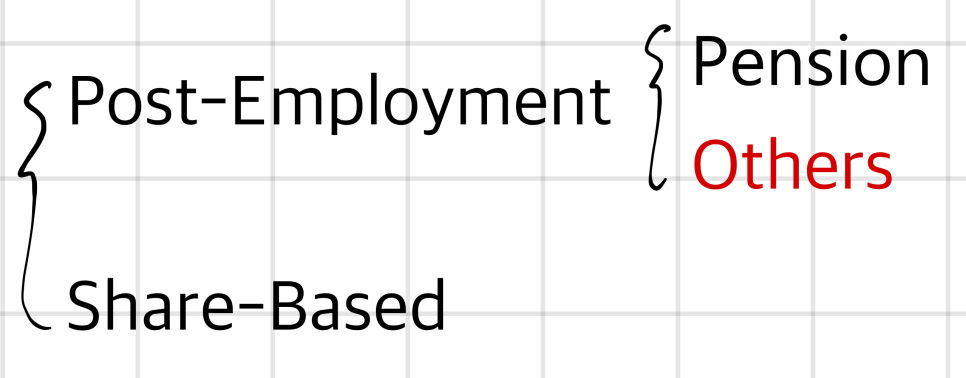
So those various odds-and-ends bundled under “Others” — they only get a paragraph or two (T_T) Tuition / Health Care / etc. — stuff you don’t see much in Korea but that’s common in the US.
And in the US they even have clauses like this.. “Work for our company for 15 years, and no matter when you leave after that, if you ever come down with such-and-such disease, we’ll cover you” — or — “Work for our company for 20 years, and no matter when you leave after that, if your kid goes to college, we’ll cover their Tuition”
Wow.. how on earth do you do accounting for something like that??? lol
If they promised cancer-related support, for instance, you’d have to estimate the probability the employee actually completes that tenure, and when they might get cancer, all of that..
Back in the day, because there were just way too many shaky assumptions stacked into this part, even at the cost of breaking the matching principle of revenues and expenses… they just didn’t account for it at all, and when the actual event happened, then they’d expense it. That’s apparently how it used to work.
Now? None of that. Just like in the DB type, where the actuary forecasts everything and takes the Present Value, this stuff is aaall estimated piece by piece so that the accounting doesn’t break the matching principle — apparently!
So the change in PBO or Expense for this “other benefit” from changes in Assumptions? Exactly the same drill. You can solve it just like a DB-type problem.
The way you’d solve for the effect of the expected wage growth rate on retirement pensions — same as the effect of expected inflation on other benefits. That’s what I mean.
One more thing. With retirement pensions, as employees keep racking up service years, the benefit keeps building up continuously. For the fixed-entitlement examples above, service cost is attributed over the service that earns that benefit. More generally, follow the plan’s benefit formula until further service produces no material additional benefits — the vesting date alone isn’t a universal stopping rule.
Funding rules depend on the country and plan. Unlike a funded pension, these other post-employment benefits may be unfunded — so an obligation can be recognized with no matching plan assets. Let’s just carry these “others” differences forward in our heads.
Share-Based Compensation
When this shows up as a problem, the combo style is: the main course is a DB-type problem, and occasionally one stock option problem gets slipped in. Apparently.
Stock-based compensation actually covers a bunch of things besides stock options — the headliner is stock options, and there’s also Stock Appreciation Right (SAR), Stock Grant, and others. Apparently. But problems most likely come out as stock options…
✷ Stock options got introduced in Korea sometime after the mid-1990s. The related laws got cleaned up around then too, and the procedures for granting stock options were written into the Commercial Act. Apparently.
✷ Stock options can’t exceed 10% of the company’s total shares. For ventures the ceiling’s way higher (up to 50%), and listed corporations get an exception too: the Commercial Act lets their cap go up to 20%, double (the decree sets it at 15% for now).
✷ Many Korean unlisted companies use K-GAAP, and under K-GAAP an unlisted small or mid-sized company doesn’t have to expense its stock options — you just disclose them in the notes.. But when they decide to go public, everything has to be converted to IFRS, and suddenly expense recognition kicks in — so apparently this becomes one of those classic IPO-time issues.
✷ This isn’t weird. The US used to not expense stock options either. Microsoft is a good example of the old treatment. It went public in 1986; years later, its 1996 annual report said that treating vested options’ grant-date Black-Scholes value as cash compensation would have added about 570 million dollars of pretax expense for 1996. So leaving an option’s fair value out of expense could make reported profit look bigger.
When you grant a stock option, there are basically 3 conditions attached. Apparently.
➀ the number of shares — how many shares the option lets you buy
➁ Exercise Price — what the exercise price is
➂ Vesting Period — how much tenure you have to put in to exercise (under the Korean rule being discussed here, the usual legal floor is 2 years)
OK so how do we account for this.. ➀ the right to buy 1,000 shares ➁ at $10 ➂ 3 years from now — say you got a stock option like that.
That employee’s gonna work hard~~ for 3 years so the stock price climbs above $10 after 3 years, and that’s how they get rewarded for grinding through those 3 years.
So the accounting.. because it has to live inside the matching principle of revenues and expenses, the equity-settled award’s grant-date fair value has to be spread out neatly across that 3-year service period, adjusted for the applicable vesting conditions.
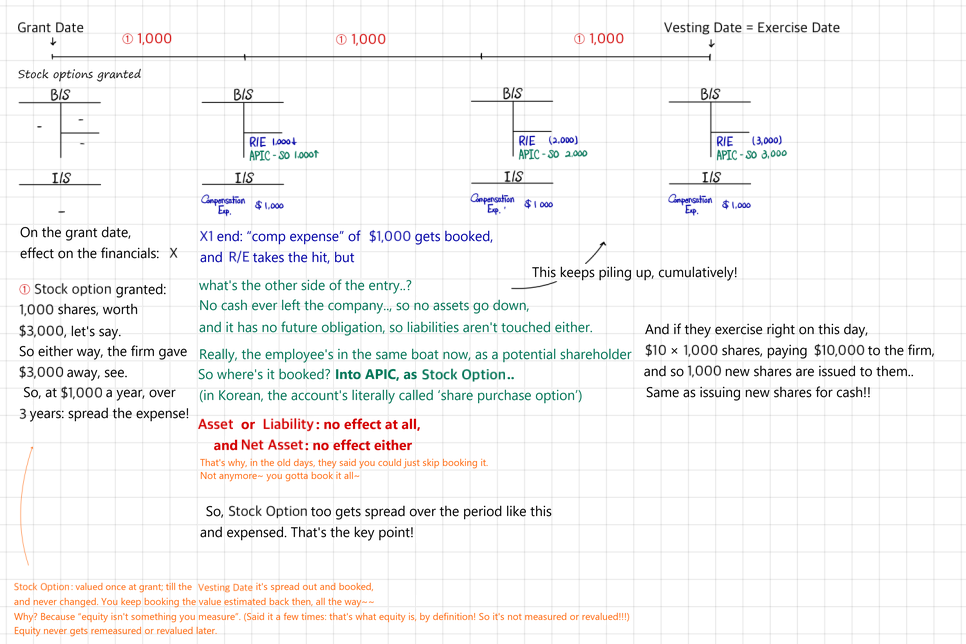
BUT!!! Here’s the thing. No calculation problems! No accounting treatment!
For Stock Options, based on the Black-Scholes equation — what will the Option Price be!
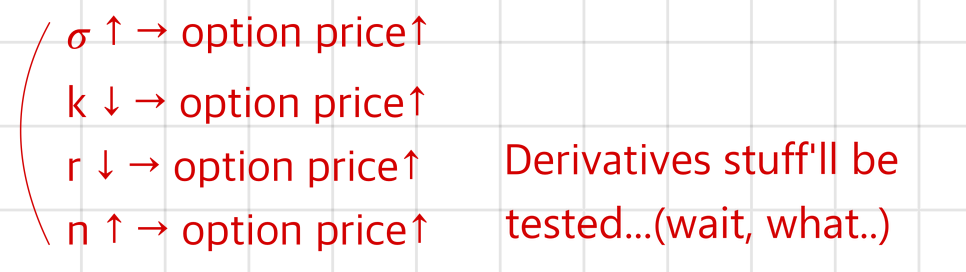
When I studied this part in intermediate accounting originally, this stuff is no joke either, and I figured we’d be going that deep.. lol disappointing — no no no, what a relief!!!
The other share-based comp stuff… nothing really worth calling “content,” lol, more like fun accounting trivia..
Stock Grant is, well, it’s basically the same as a stock option.. You’re giving someone shares and going “they’re yours in 3 years^^ work hard!” Except when that right vests, a stock option requires you to pony up cash equal to number of shares × exercise price, but a stock grant doesn’t have that — so employees would obviously prefer this.
(In Korea, stock grants are almost nonexistent..)
SAR (Stock Appreciation Right), what is it..
The difference is that it’s tied to the stock price and that difference is just paid out in cash, and the character of it is basically the same as a stock option.
Why did this come about?
Apparently it was something that actually happened at a certain unicorn startup recently. Quick version: the stock options have vested (= conditions satisfied! ready to exercise!!) I can now buy stocks worth 100 billion won at Fair Value for 1 billion won. But wait — I don’t have 1 billion won???
In cases like that, the company apparently hooks the employees up with financial institutions to arrange loans. So I exercise. Then in my account, instead of 100 billion won in cash, I’ve got 100 billion won worth of stock.
Should I sell it right away? Eh, I’d wait a bit. Could go higher.
But wow — under the Korean tax rules being described here, when you exercise a Stock Option, whether the gain is realized or unrealized, they slap a tax on that income… If you exercise while still at the company it’s treated as earned income / if you exercise after leaving it’s treated as other income → and the tax treatment can differ too lol. Special exemptions, deferral or other relief can apply, especially to qualifying venture-company options
Anyway, stock options have this kinda crappy side, and what came out of that is SAR. Apparently.
Also — the equity-settled employee stock option in our example doesn’t get its grant-date fair value remeasured along the way. That’s because it’s classified as equity.
On the other hand, a cash-settled SAR gets recorded as a Liability, and it’s subject to measurement and evaluation. So it gets remeasured and updated every year.
If the stock price shoots up, the company’s liability keeps ballooning & expense recognition↑ — that’s the accounting treatment it falls into. This has no shareholder dilution and everything’s clean, but that’s the burdensome part.
Chapter 2 is done!!!! That means 2 out of the 3 main pieces are finished~!
Heads-up. The figures here are the original notes, slips and all. A few things to watch for:
- In the note on the option-pricing inputs, a higher risk-free rate raises the option’s fair value (r up, option price up; in Black-Scholes, rho is positive for a call); the note has the arrow on r the wrong way round.
Comments
Discussion happens via GitHub Discussions. You'll need a GitHub account to comment.