The Temporal Method
Breaking down the Temporal Method — when to use it, which assets get translated at what rate, and how to snap to a gain/loss answer fast on the CFA.
Temporal Method (Remeasurement)
The book also calls this one “Remeasurement” — so how does it work~?
1. In the first case here, the sub keeps its books in LC but its Functional Currency is the parent’s Presentation Currency (LC ≠ FC = PC). So we first remeasure those books into FC. More generally, remeasurement is needed whenever the bookkeeping currency differs from FC, even if FC and PC also differ. In other words, the sub mostly does business with the parent… it’s leaning on the parent.
So: Subsidiary → Dependent or well-integrated into the parent company. A sentence phrased like that is your tell — that’s the problem nudging you toward Temporal.
In real life, figuring out what the Functional Currency actually is… yeah, not easy at all. But generally, the FC of an overseas sub is said to be the local currency, and the Temporal Method doesn’t really get used that much.. heh.
2. Once you’ve decided to use this method, the order of translation is: translate the B/S first → then the I/S, which is the reverse of the Current Method.
And the gains/losses that pop out here? Not OCI. They land straight in current period P/L!
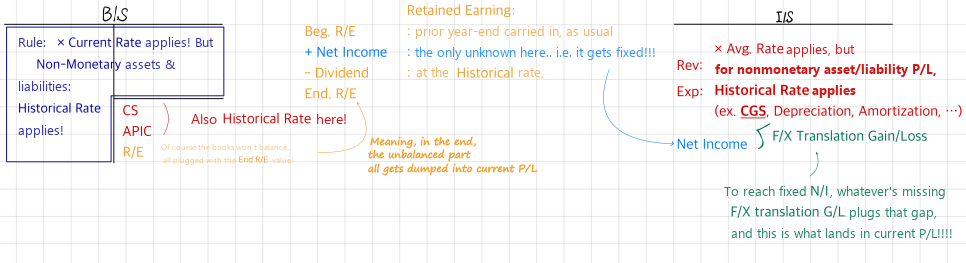
Monetary items are cash, or rights and obligations to receive or pay a fixed or determinable number of currency units. Non-monetary items lack that fixed-currency feature. So ordinary receivables and payables are monetary; inventory and land are non-monetary. Their prices can move with inflation, but that isn’t the defining test.
Non-monetary items to keep in your head for CFA: Inventory / P.P.E. / Intangible Asset / Unearned Revenue (that last one’s a liability settled by supplying goods or services). Non-monetary items at historical cost use the transaction-date rate; if measured at FV, use the rate when that FV was measured. The figures’ historical-rate shortcut assumes historical-cost items.
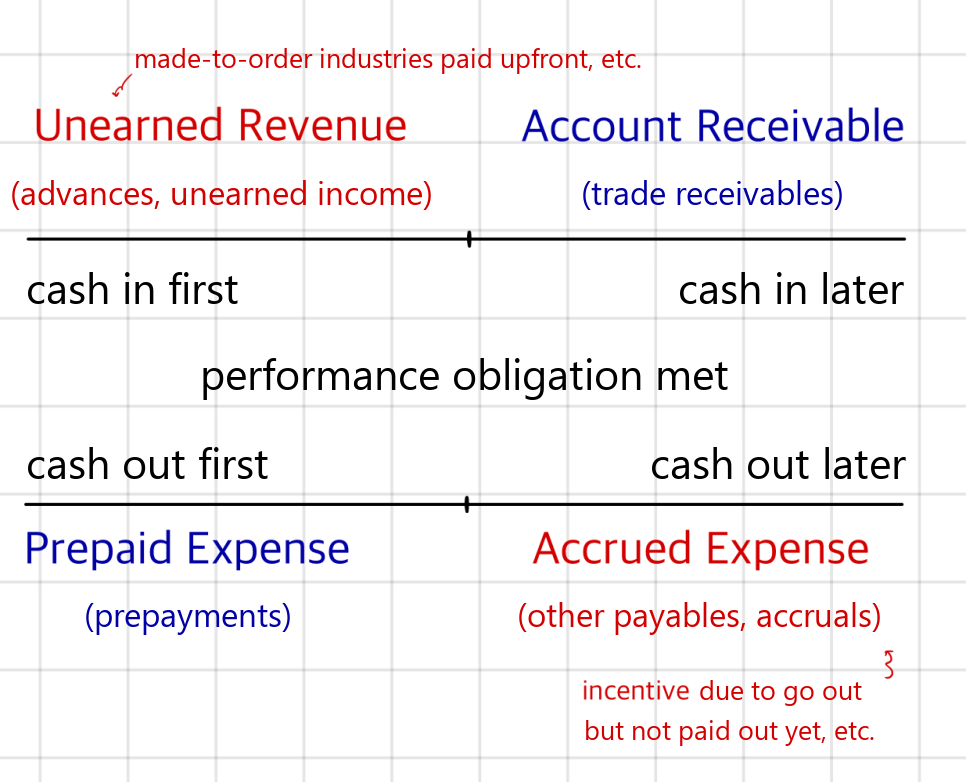
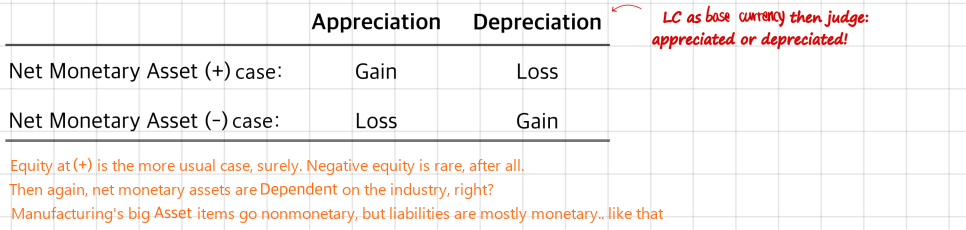
Side note: same deal here — if the question only wants to know whether that F/X translation is a Gain or a Loss, there’s no need to translate every line like that; you should be able to get there fast with the idea below and be done!!! Let’s look.
Back in the Current Rate Method, the entire net assets of the foreign sub were exposed to the Current Rate. All of it. In the Temporal Method, not all assets and liabilities are exposed to the Current Rate. Only the monetary ones are.
So for this one, you can quickly call (+)/(-) based on Appreciation/Depreciation just by checking whether Net Monetary Asset is (+) or (-)!
The exam doesn’t ask the Why, but let’s spend a sec on the Why anyway and actually get it. (Now that we’ve also covered Temporal, this should click — heh heh.)
The setup: [ LC ≠ FC ≠ PC ] — a Japanese company → spins up a subsidiary in Hong Kong → for the purpose of breaking into the Chinese market (China is socialist, so having a legal entity in China is… you know).
In this case, when the Japanese parent wants to consolidate the Hong Kong sub, what’s the right way to translate?
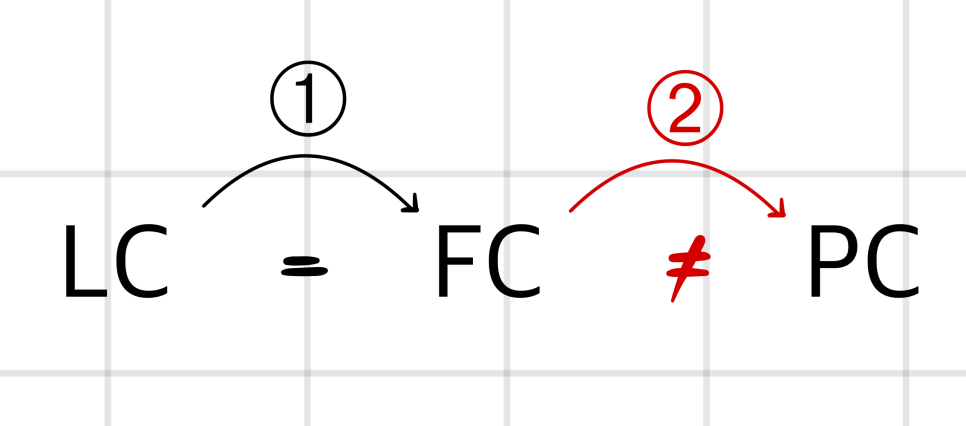
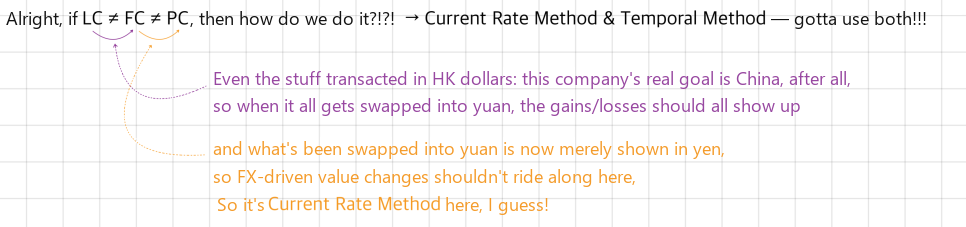
I’m gonna think this through with plain common-sense intuition. That is: I want to figure out how to handle LC ≠ FC ≠ PC, and I’ll build the logic by warming up with 1. LC ≠ FC = PC and 2. LC = FC ≠ PC first!!!
But before that — suppose the sub has some assets and liabilities sitting on its books, and you just slap the current exchange rate on every single one of them… There are obviously monetary and non-monetary items mixed in there. If you don’t distinguish, just smash the current rate on everything, and then dump the whole thing into AOCI — then the translation difference goes to OCI rather than current P&L. It is still reflected in comprehensive income and equity — it hasn’t vanished.
Because when you hold something in monetary form, there’s clearly a value change as the exchange rate moves. Think about it that way and Temporal Method starts making sense. OK OK.
Alright — case 1. The Hong Kong sub usually transacts only with the Japanese parent. Then depending on whether the yen (= the Functional Currency) appreciates or depreciates, it makes total sense to split monetary/non-monetary and recognize a Loss/Gain!! It’s right that gains and losses should pop out here.
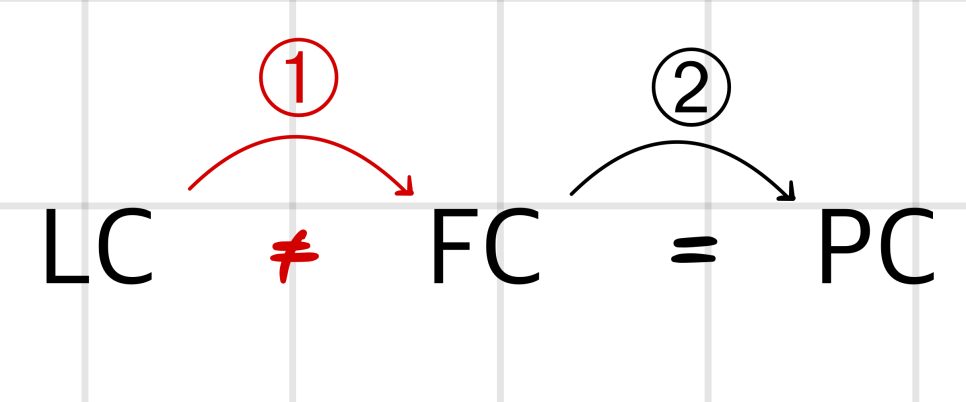
Case 2. The Hong Kong sub is being run independently, all its action happening in Hong Kong. Then the vibe is: “I do my economic activities in a different country’s currency, that’s just my life. But the parent is dragging me along!!”
In that case, we’re changing the presentation from FC to PC. That doesn’t create a remeasurement gain in current P&L, but exchange-rate changes still produce a translation adjustment in OCI and equity.


OK now let’s flip through the book a bit and skim what’s worth reading at least once.
Management determines functional currency from the underlying economic facts — it isn’t a free choice of whichever currency makes the accounts look better. Per IASB, management should consider:
- The currency that influences sales prices of goods and services
- The currency of the country whose competitive forces and regulations mainly drive the sales price of goods and services
- The currency that influences labor, material, and other costs
- The currency in which funds are generated
- The currency in which receipts from operating activities usually get retained
For FASB, all we get is a “pretty similar~” mention, sob. Anyway — this is just to show that yes, there’s guidance for this in the standards.
Inventory and COGS Under the Temporal Method
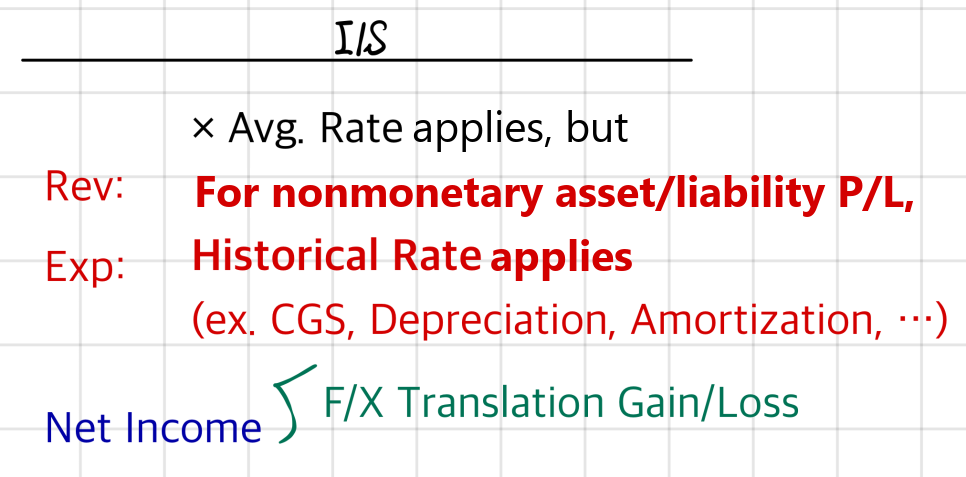
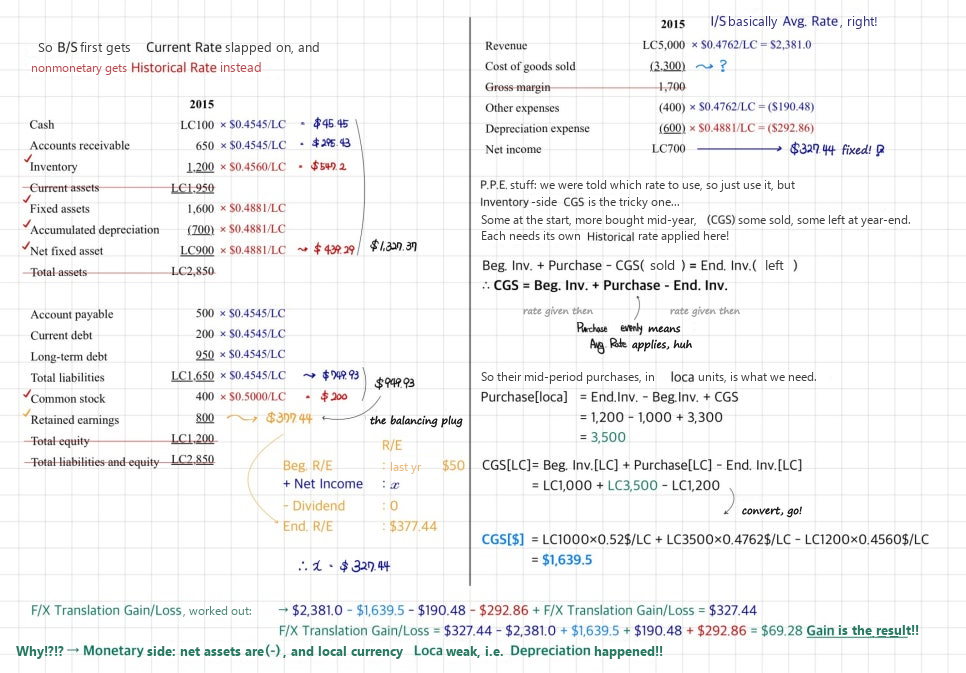
I bled through the practice problems on this one too. COGS, the poster-child expense tied to a non-monetary asset, supposedly gets the historical rate — but here’s the thing: some companies use FIFO and some use LIFO. Under FIFO, the goods being sold off are the old ones (so old exchange rates apply). Under LIFO, the goods being sold off are the recent ones (so recent exchange rates apply).
What the textbook author is really getting at: “Hey buddy, under the Current Method we used Avg. Rate, so this whole issue didn’t even come up. But Temporal applies Historical — so this kind of issue shows up too ^^”
That’s the message, I think → I’ll work through a word-problem-style example below, so don’t sweat it! I’d say that’s about all there is to read on this page, so let’s get back to grinding more problems..!
A foreign subsidiary is operating in a country where the local currency is depreciating relative to the parent’s presentation currency. Assuming the subsidiary is a FIFO firm, which accounting method will result in the highest gross profit margin reported in the parent’s consolidated income statement?
A. Current rate method B. Temporal method C. The current rate method and the temporal method will result in the same COGS
The sub is in a country where the currency has depreciated, and they run their inventory on FIFO.
Which one — Current Rate or Temporal — gives the higher gross profit margin?!
- Sales: ← both methods apply Avg. Rate to this.
- COGS: ← Current Rate: Avg. Rate / Temporal: Hist. Rate.
Under Temporal, the old exchange rate applies. And the currency being weak now means: the more recent the rate you apply, the smaller the cost comes out.
Say a cost of 13,000 won was incurred:
- Won strong (appreciation): at 1,000 won per dollar → USD 13 of cost recognized
- Won weak (depreciation): at 1,300 won per dollar → USD 10 of cost recognized

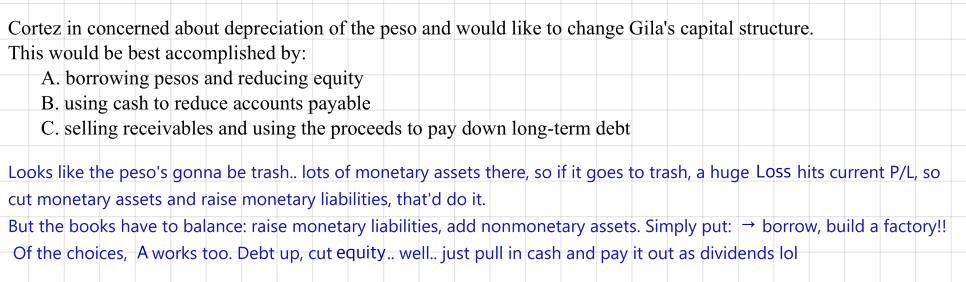
By the way — that whole move of borrowing money and shoving it out as dividends? It’s called “recapitalization (recap)”. It was apparently a fast-exit play that got popular among American IBs for a stretch. Lone Star pulled this exact thing when they came into Korea, and their whole game was: exit before maturity, full stop.
And these days there’s also this thing called dividend-in-kind — so apparently they take a company’s most prized assets as the dividend itself. (It’s a way of shrinking assets and squeezing R/E down..) Like, say you walked in as a shareholder with about 100 billion won invested, and there’s an 80-billion-won building sitting on the books?? Then you exit with the building first, and go from there.
Survival of the company? Not on the agenda. Only the exit. (People commonly call this “eat and run”.) A vulture is the bird that picks a corpse clean down to the guts, so — that’s why these guys got called vulture funds. (a.k.a. corporate raiders.)
When Lone Star bought Kukdong Construction, too, not long after the acquisition they sold the Kukdong Construction headquarters building and yanked the money out.. And most of it didn’t even come out as dividends — it came out through capital reductions. The tax result depends on the investor, jurisdiction and transaction. A capital reduction can return invested capital, but an excess over the relevant share cost may be treated as a deemed dividend — it isn’t automatically a tax-free substitute for a dividend.
If the assets looked thin and even a paid-in capital reduction wouldn’t fly, then — yep — you borrow money using the company itself as collateral, and pull the cash out that way.. haha.
In cases like this, the stock price can actually pop a fair bit, apparently. People often invoke the “disciplinary effect of debt” here. Logic being: load up on debt and now you have the justification to cut costs. Justification to lower salaries, gut research budgets, restructure, the whole package — all in the name of cost reduction..
“Manage by the Numbers, Vol. 2 — from ‘What Is the Right Level of Dividends?’:”
Recap as a defense against hostile takeover attempts??? lmaooo. Who burns down their own house because they’re worried about a burglar.. Apparently almost no one actually does it that way in practice.
There are cases where it was used to push through deliberate restructuring. The classic one is Sealed Air in the US, 1989. Sealed Air’s CEO was a big shareholder himself, so not only did he pocket a fat slug of cash through the dividend, he deliberately threw the company into crisis mode — manufacturing the justification to do large-scale restructuring. The whole intent was supposedly to crank up management efficiency.
(Stock was at USD 45 — they fired off a USD 40-per-share dividend! The dividend was paid almost entirely with borrowed money.)
(Lucky for them no economic crisis was overlapping at the time — if this had hit 2008, the company probably would’ve just gone under…)
And in the end, the only ones really eating the damage would’ve been the employees who had no choice but to absorb the restructuring..
Heads-up. The figures here are the original notes, slips and all. A few things to watch for:
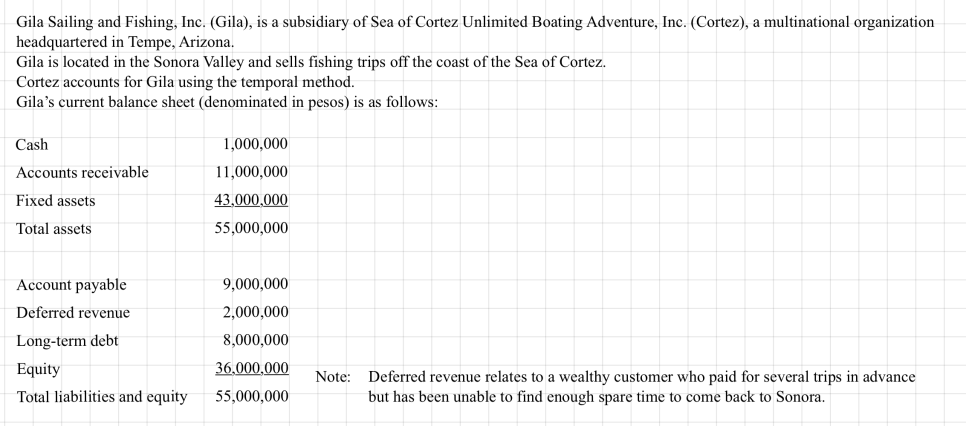
- In the Cortez question, Gila already has more monetary liabilities than monetary assets (a net monetary liability of about 5,000,000 pesos), so under the temporal method a falling peso brings a remeasurement gain, not a loss. Borrowing pesos and reducing equity (A) makes that net monetary liability bigger, which is why A is the answer either way.
- In the overview figures, historical rates for non-monetary items assume historical-cost measurement; FV-measured items use the rate at the FV measurement date. ‘Just changing the reporting currency’ still creates translation differences in OCI/equity, rather than removing exchange-rate effects altogether.
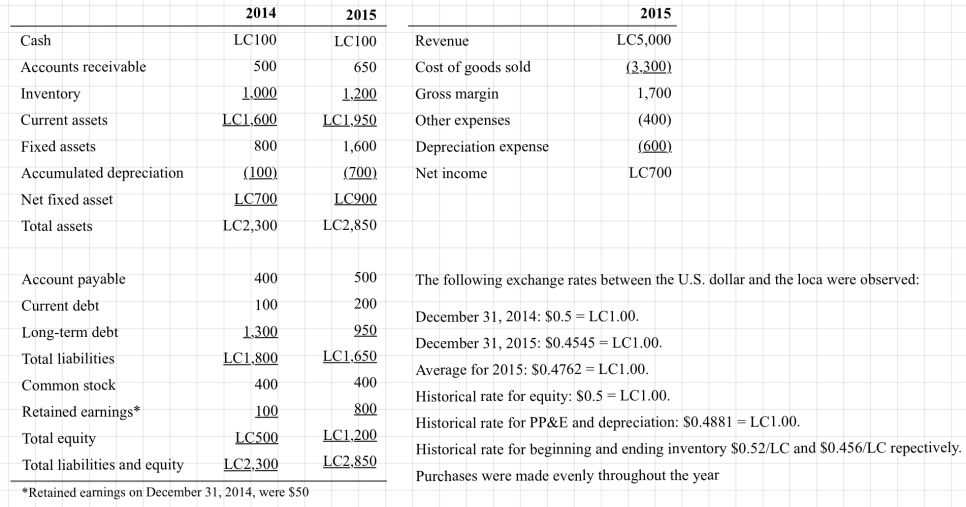
- The Vibrant example explicitly gives opening retained earnings of USD 50; the worked USD 69.28 gain uses that input. However, remeasuring all the opening balance-sheet items at the listed rates implies opening retained earnings of about USD 61.67. Those supplied inputs do not fully reconcile: using 61.67 instead would reduce the plug gain to about USD 57.61. Don’t treat the 11.67 difference as a rounding error.
Comments
Discussion happens via GitHub Discussions. You'll need a GitHub account to comment.