Work-Energy Theorem and Conservative Forces
Deriving the Work-Energy Theorem and potential energy straight from F=ma using the chain rule — turns out it's shockingly simple and kinda blew my mind!!!
At first I welcomed it thinking it’d be easy, but after reading through it sli~~ghtly I didn’t think it was going to be simple, so I shouted Bye.
What’s there in Newtonian mechanics that goes beyond the high school level????
First of all, do they teach the chain rule in high school?????
(sigh… am I getting old… why can’t I remember my student days)
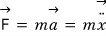
If we express this differently using the chain rule,
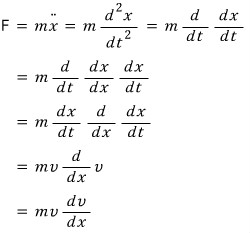
I changed something about time into an equation in terms of x! I sneakily~~~ hid the time term. If I strip away the time term even more blatantly~
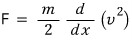
This relation can be used when we want to extract information about position rather than time!!!!!
And one more thing!!! F(x) is (1/2)mv^2 differentiated with respect to position x!!!! In other words, the definition of kinetic energy is
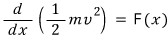
Let’s define this one-half-m-v-squared thing as the physical quantity called Energy — kinetic energy, T, to be exact!!!
Therefore, the concept of force is “how much energy has changed with respect to distance x? (Did you inject it? Or take it away?)”
Again, the change in energy is how much force was given per distance dx, all~~~~ summed up together!!!! We could say that, right?
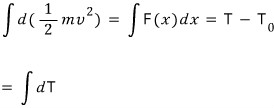
heh heh heh heh but the integral of F dx is what we were taught to call Work!?!?!?!!
Yep! This is where it was born! Right here, the “Work-Energy Theorem”!!!
Don’t be shocked when you hear this!!!! I was a little shocked
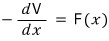
Let’s define a function V(x) that satisfies this. Let’s call such a function V(x) the Potential energy!!!
If we use the above equation and integrate F(x) with respect to dx again,
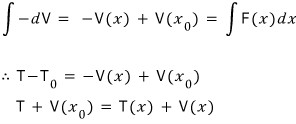
Super super easy stuff, right?!! They call this the ’energy equation’ lol
It seems so obvious, but one thing we need to note is
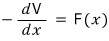
we got here by assuming that there’s a V(x) that satisfies this….!!!
But! It turns out there ARE forces that follow this assumption!!!! Such forces depend only on position x, and people then call such forces conservative forces!!
Now there will be someone like this: “Hey dude, who are you trying to sell snake oil to -_- where in the world is there a force that depends only on position, you punk!!!”
Hmm… but, forces that depend only on position: gravity, electric force, elastic force,,,,

These conservative forces — as we’ll learn later — satisfy  : their curl is 0~~~~ (Roughly speaking, a force whose curl is 0 is called a ‘conservative force’.)
Looking at it this way, it seems like many forces in the world depend only on position….. But, well, that’s not quite the case either. Well roughly…
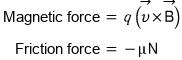
Magnetic force has a v term,,,, friction doesn’t have a single term involving position,,,, so I guess non-conservative forces are more dominant than conservative ones~~!!
As for why we learned this kind of content~~~ it seems it was so that, from now on, we can look at forces that don’t depend on position — things like air resistance, for example.
You’re riding in a car and you stuck your hand out the window.
When is the resistive force you feel on your hand big, and when is it small?
If I ask that, you’d say “when the speed is big it’s big, when the speed is small it’s small~^^”, wouldn’t you???? Aha~ so it’s proportional to speed~~
Would it be correct to conclude it like this???
Bzzzt~~~~ How would we know if it’s proportional to speed, to the square of speed, or to the square root of speed? Ugh. Oh no, this is getting hard…..
ok ok ok ok in practice, people approximate the velocity-dependent force with a few simple powers: a term proportional to velocity and a term proportional to velocity squared. (That’s an empirical approximation, an assumption, not something every power of v turns into.)
Okay then

let’s represent it like this~~~!!
(The reason for bothering to represent it with an absolute value is apparently to also account for the direction of velocity~! And this is the resistance term; the drag force itself points against the velocity, so it carries a minus sign, as in the examples below.)
The velocity-dependent force F(v) can now only be obtained experimentally, it seems. Data obtained by some scientist or engineer through experiments is
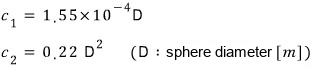
Now with this relation, we can figure out “which term is more dominant~~~~”
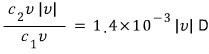
depending on whether this is greater than or less than 1, we can see which term shows up more dominantly in F(v)!!! hehe
Let me try solving a problem;;hehe
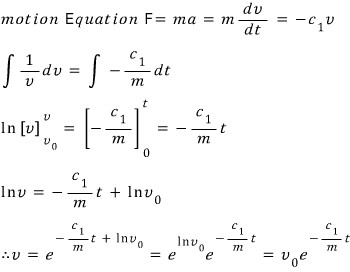
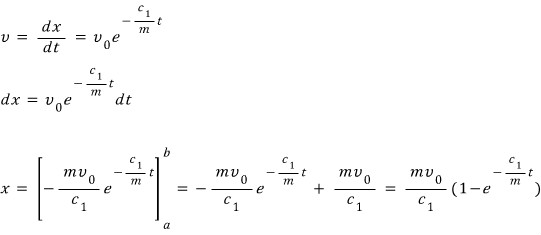
- (Let’s say the air resistance is dominated by the linear term.)
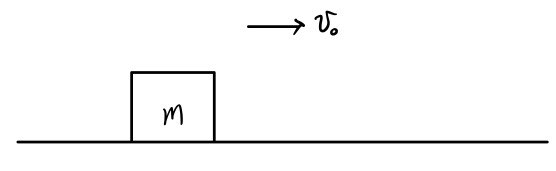
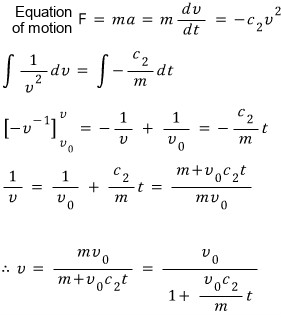
- (Let’s say the air resistance is dominated by the nonlinear (v squared) term.)
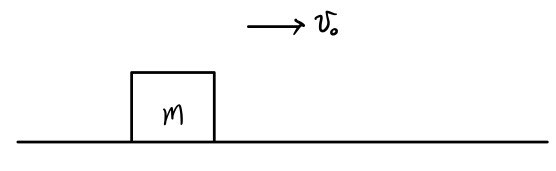
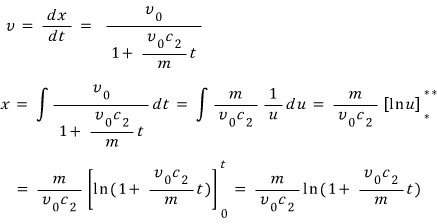
Heads-up. The figures here are the original notes, slips and all. A few things to watch for:
- In the last line of the energy picture the left side should be $T_0 + V(x_0)$: the kinetic energy at $x_0$, as in the line above it.
- In the picture that compares the two drag terms, the ratio is $1.4\times10^{3}\,|v|\,D$, not $10^{-3}$: $c_2/c_1 = 0.22D^2/(1.55\times10^{-4}D) \approx 1.4\times10^{3}D$. So for everyday sizes and speeds the quadratic term usually wins.
- In the linear-drag integration the bracket’s limits should be $0$ and $t$, not $a$ and $b$; the result is right.
- In the quadratic-drag integration the factor in front should be $m/c_2$, not $m/(v_0c_2)$: $x = \frac{m}{c_2}\ln\left(1 + \frac{v_0c_2}{m}t\right)$.
Original post: Work-energy theorem and conservative forces (2015)
Comments
Discussion happens via GitHub Discussions. You'll need a GitHub account to comment.