Forced Harmonic Oscillation and Resonance
What happens when the driving frequency hits just right? We work through forced harmonic oscillation — no damping first, then with resistance — to see why resonance is so wild.
I was going to keep going from last post straight through to resonance, but if I glued it all together it’d get ridiculously long. So this one’s gonna be a bit short — whatever, let’s just do it!
The core idea: the driving frequency
$$\left( w \right)$$and the natural frequency of the oscillator
$$\left( w_{0} \right)$$have some kind of relationship going on, and at a certain driving frequency something weird happens.
Let’s figure out what that weird thing is.
Step 1. Start with no damping (no resistance, yes external force)
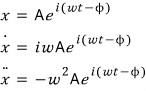
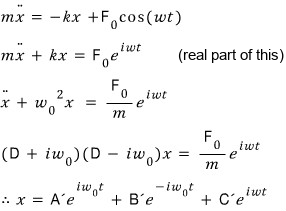
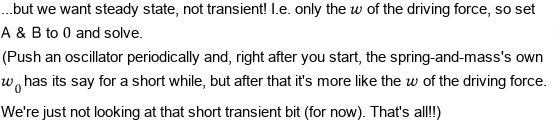
$$m\ddot {x}\quad =\quad -kx\quad +F_{0}\cos(wt)\\ m\ddot {x}\quad +\quad kx\quad =\quad F_{0}e^{iwt}\quad (\text{take real part})\\ \ddot {x}\quad +\quad w_{0}^{2}x\quad =\quad \frac {F_{0}}{m}e^{iwt}\\ (D\quad +\quad iw_{0})(D\quad -\quad iw_{0})x\quad =\quad \frac {F_{0}}{m}e^{iwt}\\ \therefore \quad x\quad =\quad A'e^{iw_{0}t}\quad +\quad B'e^{-iw_{0}t}\quad +\quad C'e^{iwt}$$$$\text{but we only care about steady state, not transient! meaning, we only look at the piece that tracks the driving }w,\\ \text{so set }A\text{ and }B\text{ to }0\text{ and solve.}\\ (\text{when you periodically shove the oscillator, right at the moment you start shoving, the system's own}\\ w_{0}\text{ — spring + mass — matters for a short bit, but after that it settles into the driving }w.\\ \text{that short transient window, we're ignoring for now. that's the deal!!)}$$$$x\quad =\quad C'e^{iwt}\quad \text{to keep the algebra from getting messy,}\\ \quad =\quad Ae^{i(wt-\varphi )}\quad \text{let's rename it.}$$$$x\quad =\quad Ae^{i(wt-\varphi )}\\ \dot {x}\quad =\quad iwAe^{i(wt-\varphi )}\\ \ddot {x}\quad =\quad -w^{2}Ae^{i(wt-\varphi )}$$Plug into the equation of motion:
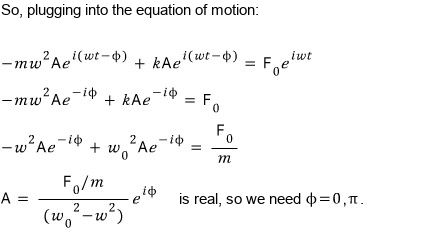
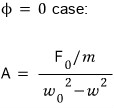
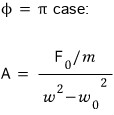
$$-mw^{2}Ae^{i(wt-\varphi )}\quad +\quad kAe^{i(wt-\varphi )}\quad =\quad F_{0}e^{iwt}\\ -mw^{2}Ae^{-i\varphi}\quad +\quad kAe^{-i\varphi}\quad =\quad F_{0}\\ -w^{2}Ae^{-i\varphi}\quad +\quad w_{0}^{2}Ae^{-i\varphi}\quad =\quad \frac {F_{0}}{m}\\ A\quad =\quad \frac {F_{0}/m}{(w_{0}^{2}-w^{2})}e^{i\varphi}\quad \text{is real, so }\varphi \text{ has to be }0\text{ or }\pi.$$$$\text{when }\varphi \quad =\quad 0,\quad \\ A\quad =\quad \frac {F_{0}/m}{w_{0}^{2}-w^{2}}$$$$\text{when }\varphi \quad =\quad \pi ,\quad \\ A\quad =\quad \frac {F_{0}/m}{w^{2}-w_{0}^{2}}$$
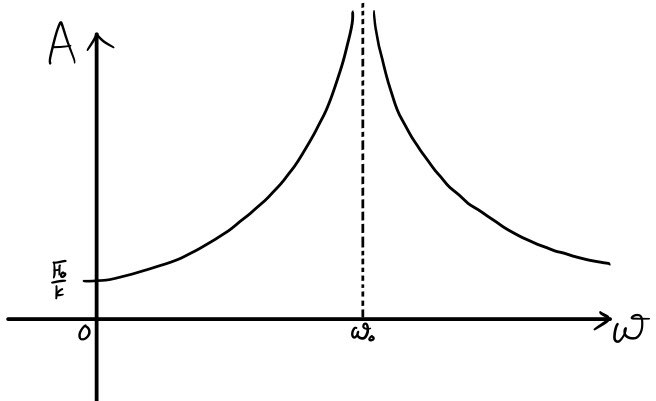
The relationship between $w$ and $A$ looks like this, yeah????????????????
And now this whole phenomenon starts making sense!!!!
OK now, like we always do, let’s throw in the resistance term too! heh heh
Just one more term tacked on, right?
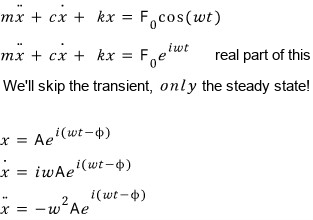
$$m\ddot {x}\quad +\quad c\dot {x}\quad +\quad kx\quad =\quad F_{0}\cos(wt)\\ m\ddot {x}\quad +\quad c\dot {x}\quad +\quad kx\quad =\quad F_{0}e^{iwt}\quad \text{(real part)}\\ \text{transient, skip. steady state only!} \\ x\quad =\quad Ae^{i(wt-\varphi )}\\ \dot {x}\quad =\quad iwAe^{i(wt-\varphi )}\\ \ddot {x}\quad =\quad -w^{2}Ae^{i(wt-\varphi )}$$So the equation of motion becomes:
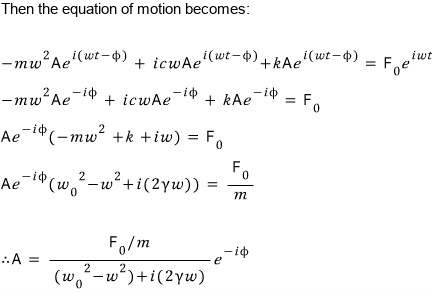
$$-mw^{2}Ae^{i(wt-\varphi )}\quad +\quad icwAe^{i(wt-\varphi )}+kAe^{i(wt-\varphi )}\quad =\quad F_{0}e^{iwt}\\ -mw^{2}Ae^{-i\varphi}\quad +\quad icwAe^{-i\varphi}\quad +\quad kAe^{-i\varphi}\quad =\quad F_{0}\\ Ae^{-i\varphi}(-mw^{2}\quad +k\quad +iw)\quad =\quad F_{0}\\ Ae^{-i\varphi}(w_{0}^{2}-w^{2}+i(2\gamma w))\quad =\quad \frac {F_{0}}{m} \\ \therefore A\quad =\quad \frac {F_{0}/m}{(w_{0}^{2}-w^{2})+i(2\gamma w)}e^{-i\varphi}$$In the no-damping case this was clean, ‘cause the imaginary piece just vanishes when $\sin\varphi=0$. But now… different story. We get two equations.
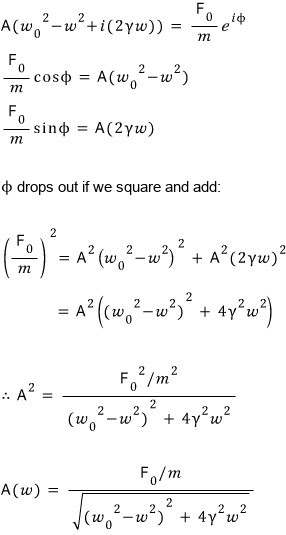
$$A(w_{0}^{2}-w^{2}+i(2\gamma w))\quad =\quad \frac {F_{0}}{m}e^{i\varphi}\\ \frac {F_{0}}{m}\cos\varphi \quad =\quad A(w_{0}^{2}-w^{2})\\ \frac {F_{0}}{m}\sin\varphi \quad =\quad A(2\gamma w) \\ \text{square and add to kill }\varphi: \\ \left( \frac {F_{0}}{m} \right)^{2}=\quad A^{2}\left( w_{0}^{2}-w^{2} \right)^{2}\quad +\quad A^{2}(2\gamma w)^{2}\\ \quad =\quad A^{2}\left( (w_{0}^{2}-w^{2})^{2}\quad +\quad 4\gamma^{2}w^{2} \right) \\ \therefore \quad A^{2}\quad =\quad \frac {F_{0}^{2}/m^{2}}{(w_{0}^{2}-w^{2})^{2}\quad +\quad 4\gamma^{2}w^{2}} \\ A(w)\quad =\quad \frac {F_{0}/m}{\sqrt {(w_{0}^{2}-w^{2})^{2}\quad +\quad 4\gamma^{2}w^{2}}}$$Hint!!!!!
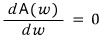
$$\frac {dA(w)}{dw}\quad =\quad 0$$That’ll give us the max amplitude.
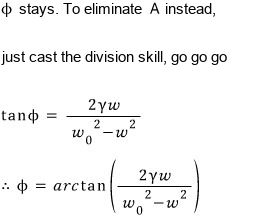
$$\text{and if instead of killing }\varphi\text{, we kill }A — \\ \text{just do the divide trick, go go go} \\ \tan\varphi \quad =\quad \frac {2\gamma w}{w_{0}^{2}-w^{2}}\\ \therefore \quad \varphi \quad =\quad \arctan\left( \frac {2\gamma w}{w_{0}^{2}-w^{2}} \right)$$OK so, like I said — 1!!! Let’s find the max of $A(w)$.
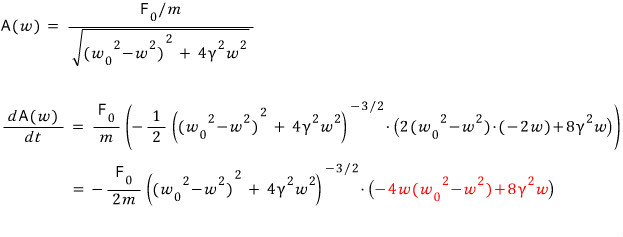
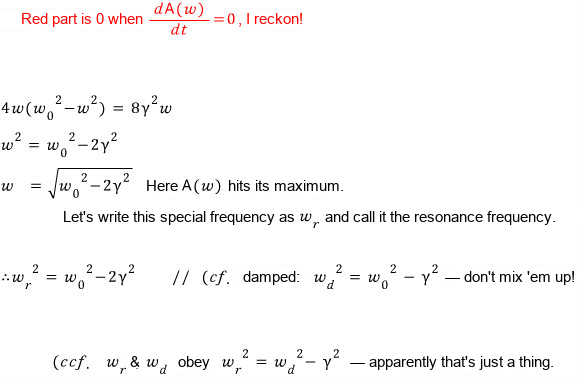
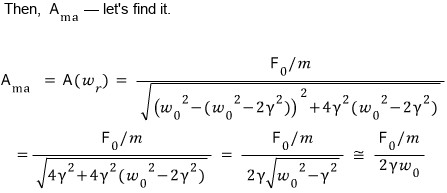
$$A(w)\quad =\quad \frac {F_{0}/m}{\sqrt {(w_{0}^{2}-w^{2})^{2}\quad +\quad 4\gamma^{2}w^{2}}} \\ \frac {dA(w)}{dt}\quad =\quad \frac {F_{0}}{m}\left( -\frac {1}{2}\left( (w_{0}^{2}-w^{2})^{2}\quad +\quad 4\gamma^{2}w^{2} \right)^{-3/2}\cdot \left( 2(w_{0}^{2}-w^{2})\cdot (-2w)+8\gamma^{2}w \right) \right) \\ \quad =\quad -\frac {F_{0}}{2m}\left( (w_{0}^{2}-w^{2})^{2}\quad +\quad 4\gamma^{2}w^{2} \right)^{-3/2}\cdot \left( -4w(w_{0}^{2}-w^{2})+8\gamma^{2}w \right)$$$$\text{when the red part hits }0\text{, we get }\frac {dA(w)}{dt}=0: \\ 4w(w_{0}^{2}-w^{2})\quad =\quad 8\gamma^{2}w\\ w^{2}\quad =\quad w_{0}^{2}-2\gamma^{2}\\ w\quad =\quad \sqrt {w_{0}^{2}-2\gamma^{2}}\quad \text{— at this }w,\ A(w)\text{ is maxed out.}\\ \quad \text{let's give this frequency its own name: }w_{r}\text{, the resonance frequency.} \\ \therefore w_{r}^{2}\quad =\quad w_{0}^{2}-2\gamma^{2}\quad //\quad (cf.\quad \text{don't confuse this with the damped frequency }w_{d}^{2}\quad =\quad w_{0}^{2}\quad -\quad \gamma^{2}!) \\ \quad (ccf.\quad \text{and the relationship between }w_{r}\text{ and }w_{d}\text{ is }w_{r}^{2}\quad =\quad w_{d}^{2}-\quad \gamma^{2}\text{ — apparently that's just a thing that exists.})$$$$\text{now let's find }A_{max}: \\ A_{max}\quad =\quad A(w_{r})\quad =\quad \frac {F_{0}/m}{\sqrt {\left( w_{0}^{2}-(w_{0}^{2}-2\gamma^{2}) \right)^{2}+4\gamma^{2}(w_{0}^{2}-2\gamma^{2})}}\\ \quad =\frac {F_{0}/m}{\sqrt {4\gamma^{2}+4\gamma^{2}(w_{0}^{2}-2\gamma^{2})}}\quad =\quad \frac {F_{0}/m}{2\gamma \sqrt {w_{0}^{2}-\gamma^{2}}}\quad \cong \quad \frac {F_{0}/m}{2\gamma w_{0}}$$Originally written in Korean on my Naver blog (2015-06). Translated to English for gdpark.blog.