2D and 3D Isotropic Harmonic Oscillators and Lissajous Figures
We're already at chapter 4 — diving into isotropic harmonic oscillators in 2D and 3D, where separating x and y equations leads to super cool Lissajous figures!
Megaton super speed, we’re already at chapter 4!!! hehehe
And even the mid-to-late part of chapter 4??? It’s isotropic harmonic oscillators in 2D and 3D!!! The earlier content is about high-school Physics II level, I think? It’s just a bit of differential equations??? so I skipped it all!!
Alright, let’s get started. The book says, “let’s consider the motion of a particle receiving a linear restoring force only in the direction of a fixed point,”
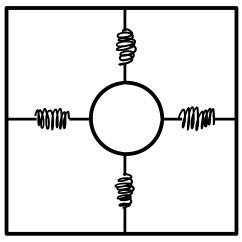
and gives a situation like this as an example, but I could also imagine a situation like this!
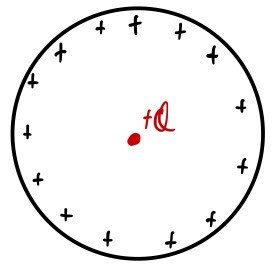
Hm, a similar phenomenon might happen in this kind of situation too!!! But…. this one, the force (the electric force) isn’t linear…. it would get more complicated… heh.heh.heh? Let’s go with the situation the book gave as an example^^*
Since it only receives force toward a single fixed point, (isotropic harmonic oscillator)
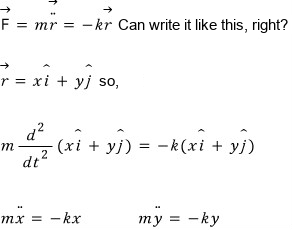
We can ‘separate’ the force like this!!! hehe Now, this kind of diffeq~ is just a piece of cake hehehe
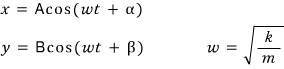
Are we done now??!?! That’s no no ~~~
We separated x and y and analyzed them, but~ the two aren’t… without a connection, right?!?!?!
And since x is an equation in t, and y is also an equation in t, if we somehow eliminate that t, it seems like we could couple x and y….
Alright, here we go!!! A, B, α, β are determined by the initial conditions, so for now! Let me express just α and β grouped together.

Then that equation for y becomes
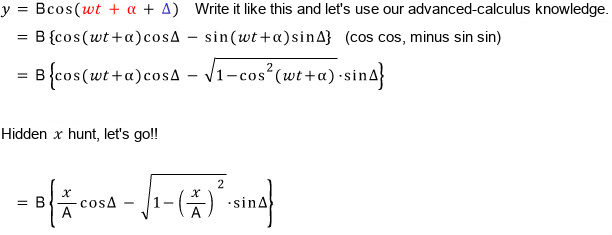
Now let me clean up the equation a bit~~
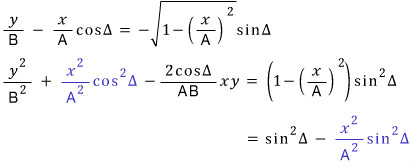
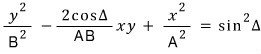
We’ve derived this much!!!!

In the quadratic equation of this form,  depending on whether this is less than 0, equal to 0, or greater than 0, it becomes an ellipse, parabola, or hyperbola respectively, and the discriminant for the equation above is
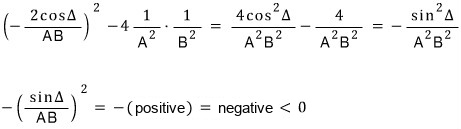
That is, since the discriminant is less than 0, we can see that those x and y trace an elliptical orbit.
Also, to add just a tiny bit more, if Δ is π/2, then cosΔ=0, sinΔ=1, so the xy term disappears and you get an ellipse nicely drawn on the x,y axes, and if Δ is 0 or π, then sinΔ=0 and cosΔ=+1 or −1, so now the trajectory doesn’t draw an ellipse but bounces back and forth~~ in a straight line (the sign of cosΔ sets which way it slopes), you can catch that!!!
And lastly, for the angle psi that the ellipse’s axis makes, I derived it in Classical Mechanics #27: The angle between the ellipse axis and the x-axis. The principle is simple. I did a linear mapping by the angle psi so that the xy term vanishes, and found the relationship between that psi, delta, and A, B; the details are all in that post.
Alright, that’s enough for 2D, let’s move on — what about the 3D isotropic harmonic oscillator???
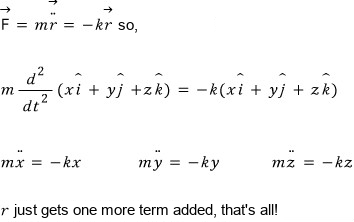
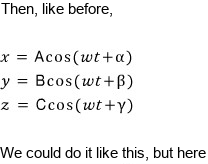
Let’s do it roughly and move on lol it’s the same content as the 2D case heh
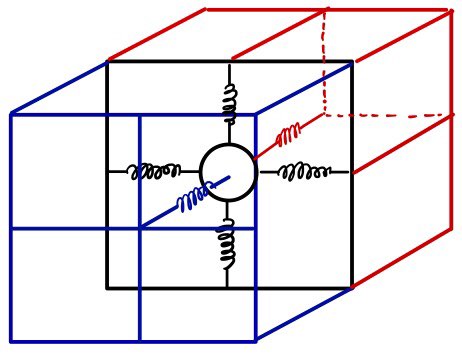
Well, it would be a situation like this heh heh Since it’s an isotropic harmonic oscillator!!!
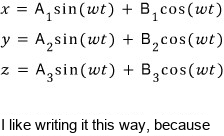
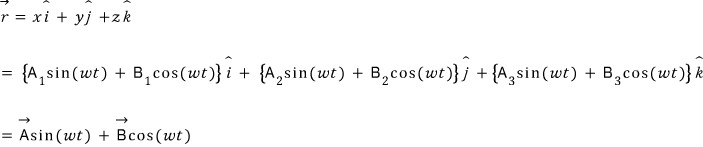
If you write it like this, you can instantly see that the r vector is a vector contained in the plane formed by vector A and vector B.
And then it’s easy to shift your perspective to think “in that plane~~~”, and that way you can drop the dimension down to 2D, and since the analysis from that point on is the same as the method we used before!! hehe
Conti~~~nuously, up front I kept saying isotropic isotropic isotropic…
So then what is non-isotropic???
It means not isotropic, right!!!! Simply put, if the spring constant is different in the x, y, z directions, it becomes non-isotropic!?! hehehe
Then
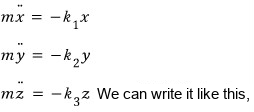
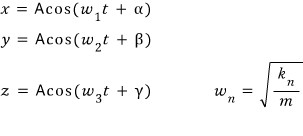
and at this time,
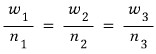
if integers n that satisfy this kind of relation ’exist’, then the trajectory this thing traces as it oscillates is called a Lissajous figure, apparently.
Time
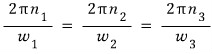
because it means that a time satisfying this kind of relation ’exists’ — well, it means that somehow it returns to its initial position!!! heh heh
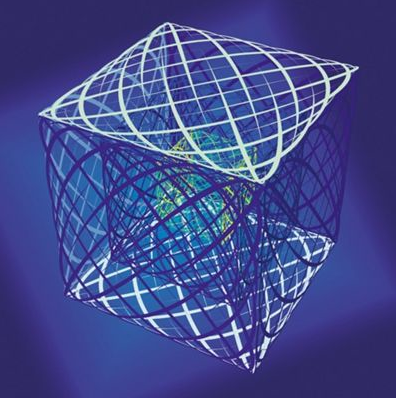
(This is a reference Lissajous pattern image picture hehehe)
Heads-up. The figures here are the original notes, slips and all. A few things to watch for:
- In the discriminant picture the last step drops a factor 4: $4\cos^2\Delta/(A^2B^2) - 4/(A^2B^2) = -4\sin^2\Delta/(A^2B^2)$. Only the sign is used next, and it is unaffected.
- In the anisotropic 3D picture all three amplitudes are written $A$; in general they differ ($A$, $B$, $C$), like the phases.
Comments
Discussion happens via GitHub Discussions. You'll need a GitHub account to comment.