Kepler's Laws: Ellipse Law, Equal-Area Law, and Harmonic Law (Part 1)
Newton slickly combined Galileo's earthly motion with Kepler's celestial laws into universal gravitation, and yes — you really can treat a planet as a point mass!!
Before we jump into Kepler’s laws, let me lay down some background on universal gravitation.
Let’s talk about Newton for a moment. The cartoon people use most often to portray this fellow is this one. (Warning: contains profanity.)
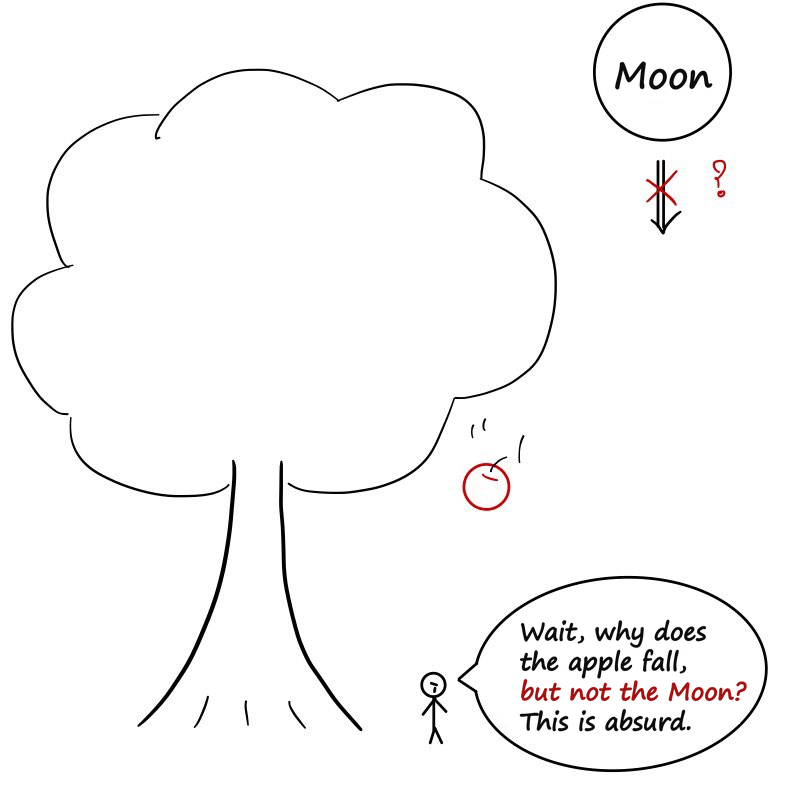
Newton, lost in thought like this,
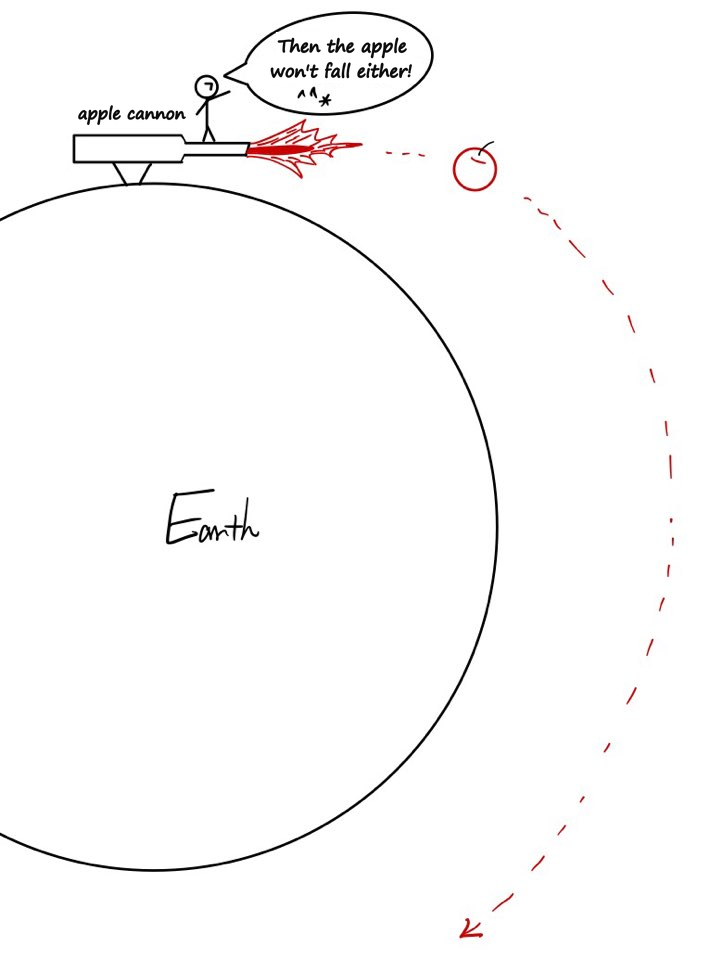
supposedly thought, “If I fire an apple cannon like this, it wouldn’t fall~~~”?!
But have you also heard the saying that Newton was merely “a small boy standing on the shoulders of giants”?! What that means is, Galileo had pretty~~~ much established the motions that happen on Earth (including inertia) before Newton’s time. And the motions of celestial bodies beyond Earth, as everyone knows, were elegantly established mathematically by Kepler, apparently? (Also before Newton.)
So what Newton did was take these two seemingly disparate things and slick~~ly combine them into universal gravitation,  , apparently hehe
Reductionist thinking and the point-mass question
Alright, now I need to talk about reductionist thinking, because we’re about to enter Section 2, “Gravity between a uniform sphere and a particle”!!!
To unpack what “reductionist thinking” means a bit: “If you break everything down, you can find out it’s all a conclusion that follows from scientific cause and effect. There’s a scientific cause everywhere!!!!!” Well lol, apparently this reductionist way of thinking was philosophically in vogue in Newton’s era??
(Could we say that “Love is nothing but a hormonal prank happening in the brain!!!” also followed that way of thinking???)
Alright, so what am I getting at here? I’m trying to verify this:
Here, r is the distance between the centers of the two celestial bodies, and M and m are the total masses!!! Is it really okay to write it like that!!
Here’s how Newton thought about it:
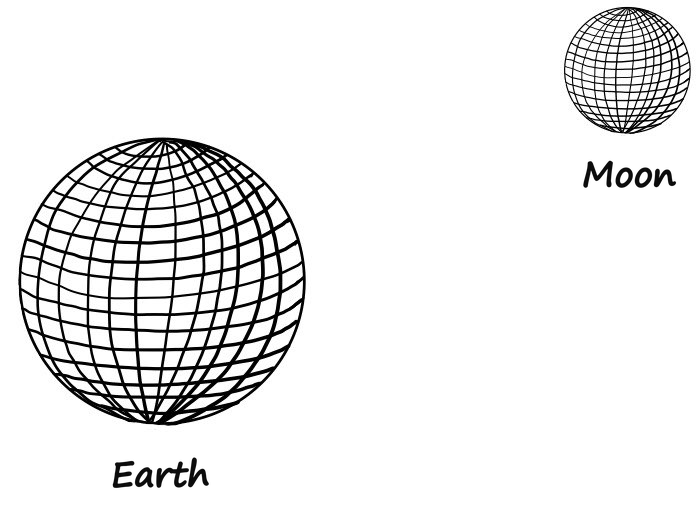
Take the Earth and the Moon, the whole lot~~ and chop it all up into stupidly tiny pieces like that. Then the total force is the sum of the gravitational attractions between every little chunk of the Earth and every little chunk of the Moon. This~ is universal gravitation~~, he said. But we just go “F is Great-Mama over r-squared” (G, M, m: get it?) and move on, don’t we???
Is that really okay?! Can we treat it as a point mass?!
We should do a quick check of this, but since it works out exactly the same way as when we derived the electric force, let’s each do that quick check on our own!!!! heh — the conclusion is “yes, we can treat it as a point mass!!”
(I’ll post this as an appendix next time!)
Kepler’s three laws
Let’s move on now to Kepler’s laws. So what ARE Kepler’s laws, the ones that described celestial motion almost perfectly in mathematical form before Newton~~!!!
- Law 1. The law of ellipses (1609): The orbit of each planet is an ellipse with the Sun at one focus!
- Law 2. The law of equal areas (1609): The straight line connecting the Sun and a planet sweeps out equal areas in equal times as the planet orbits around the Sun.
- Law 3. The harmonic law (1618): The square of a planet’s period (the time it takes for the planet to go around the Sun once) is proportional to the cube of the semi-major axis of its orbit.
Now, proving these laws with Newtonian mechanics becomes our job!!!
The law of equal areas
First, let me derive the 2nd law!!!
Alright, we know that the Earth orbits around the Sun, but apparently we didn’t really know if it goes around in a circle, or an ellipse, or in a spiral drifting farther and farther away.
But we do know this much!!! The Sun’s pull on the planet points straight along the line joining them: it’s a central force!! heh
The force points along r…. so the torque that affects the rotational motion, which is r cross F, is 0, since the two vectors are parallel.
And if the torque is 0, then the angular momentum L is constant!!!!

Then let me write it this way!!!!
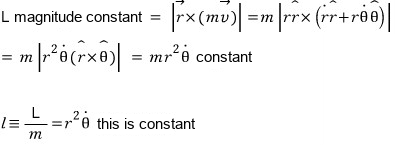
Now I’m going to calculate the areal velocity during the planet’s motion. First, the area!!!!
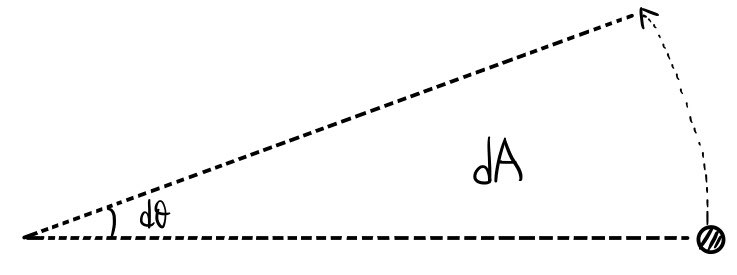
This is roughly the area we’re going to calculate~~
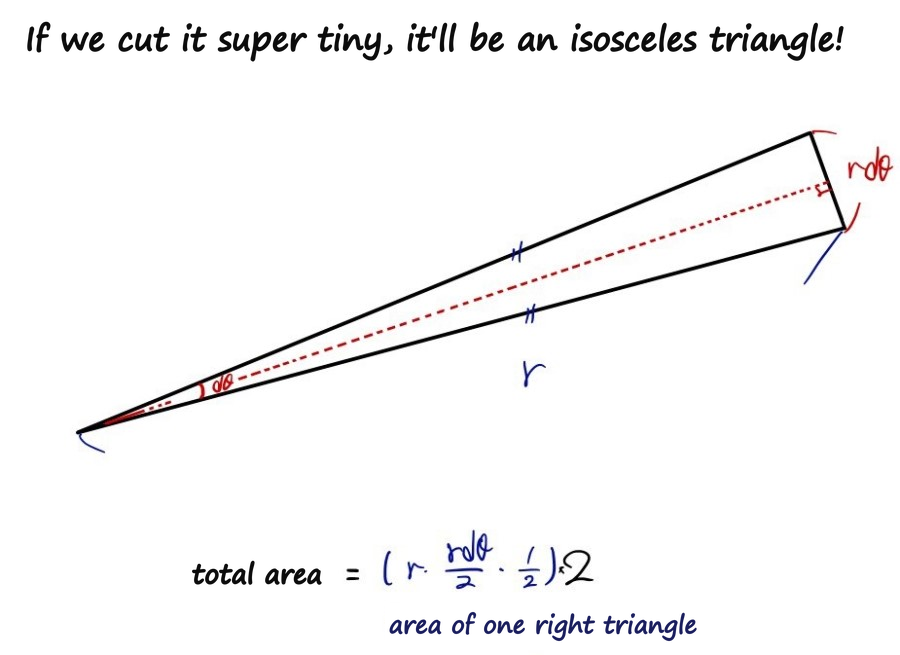
Pretty easy to understand, right??
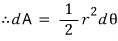
Dividing both sides by dt and taking the limit,

Oh my god!!!! There’s an r-squared-theta-dot in there!!!!
Since angular momentum is constant, as we showed above!! the conclusion comes out that the areal velocity is constant!!!!!~
And just like that, Kepler’s 2nd law has been proved.
The law of ellipses and the orbit equation
Now I’m going to derive Kepler’s 1st law, the law of ellipses. But first, instead of writing universal gravitation as , for now let’s write it as  . Let’s see it as something that depends only on r~~~~
Then the equation of motion becomes

which looks like this, and I’ll solve this equation of motion! hehe
So the double-dot of r was done in Chapter 2, but let me write it once more and carry on!
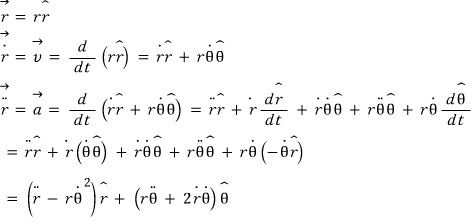
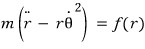
Alright alright alright, so the equation of motion above becomes

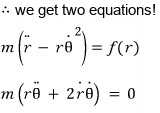
What the bottom equation means is,
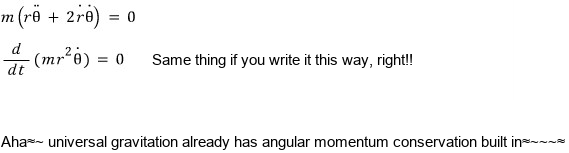
Alright, now let’s focus on this one:
What we’re going to do here is a substitution,  . I’ll reveal why we substitute like this a bit later. For now, we need to express
  in terms of the substituted u, but that’s kind of a headache…. ugh
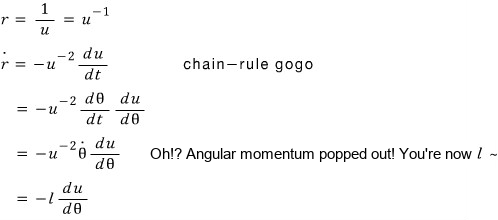

What just happened is, the information about time got hidden on the right-hand side. The  that contained information about time joined forces with
  , disguised itself as angular momentum, became a constant, and just like that the time-dependence vanished,,, T_T
To give you a little spoiler of where we’re heading now,,,, we’re heading toward the orbit equation!!
Alright, since we’ve done r-dot, let’s head to the double-dot too!!!!
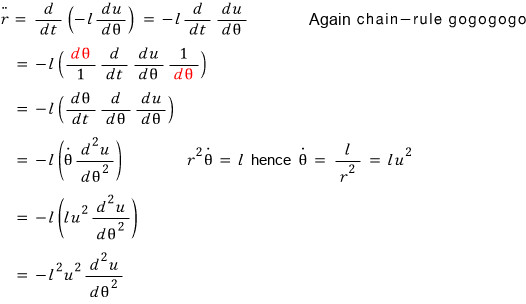
Okay!!!! We’ve expressed the double-dot of r in terms of l, theta, and u!!! Then let’s go back to the equation of motion!!!

For theta-dot, just like before,
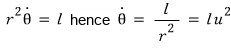
I used this logic~~~ Keep going~~~~
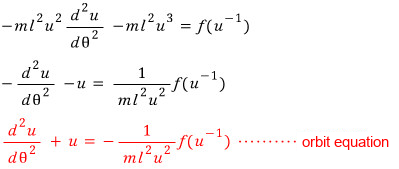
This is apparently called the orbit equation. It’s expressed as a relation between r and theta.
But there’s a crucial premise!!!! f(r) has to be a central force field (or an isotropic force, in the r direction). Now, within a central force field, once we see r(θ), we can figure out the force!~ Let’s keep going!!
So why an ellipse?
Wanna solve an example problem and move on?????? Ah, nope.
We now understand how the orbit equation we derived turns out that way. But then…
Why on earth does the Earth just happe~n to go around not in a circle, not in some squiggly mess, but, of all things, in an ellipse?
I think we should figure that out first!!!! hehe
(Actually it’s apparently very~~~ close to a circular orbit hahaha You’ll find out later on.)
Then now I’ll substitute the real universal gravitation into f(r)~~~ (since we’re going to look at the real Earth now!)
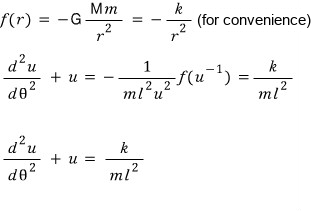
Whoa, what this implies is that universal gravitation, “of all things,” was inversely proportional to r squared?!?!~? We’re apparently supposed to feel that, hahaha. Our creator made universal gravitation, of all things, proportional to the inverse of the square of the distance,,, and made us physics majors suffer……darn….
Ah, or maybe not? Maybe if it weren’t proportional to the inverse of r squared,,, it would’ve been even harder?????? hehe thanks thanks thanks thanks.
Then let’s solve the differential equation above!!!!
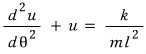
Let’s knock out this differential equation with simple intuition!

For the second derivative plus the thing itself to equal a constant, what would u have to be???
Ah, first let’s see what happens if the constant is 0.
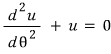
If u were sin or cos, it would work out….??! Then let me set up the trial solution like this:
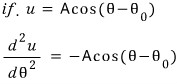
Oh~! Doing it this way works!!!
Then the general solution that satisfies the differential equation with a constant on the right-hand side is
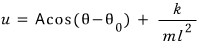
if it’s this, then the differential equation with a constant on the right-hand side holds, right????
Okay~~~!!~ We’ve now succeeded in expressing u in terms of theta!!
I’ve written down the u(θ) that satisfies the orbit equation above, hehe. Now let me express it as r(θ).
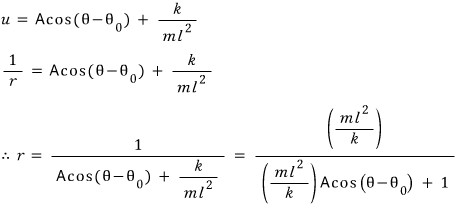
This little guy is supposed to be an ellipse….. But it’s in polar coordinates, so I can’t really get a feel for it~~!!!
To see why~~~~ this equation is an ellipse, I’ll derive a Real, for-real ellipse in polar coordinates!!! and compare it against that one, and then we can go “Ahhhh~~ so that equation is an ellipse~~~~~~~” — that kind of admiring sigh is where we’re headed!!!
First, the definition of an ellipse is “the points where the sum of the distances from the two foci is the same!!! The set of all such points!!!!” Let’s derive the locus equation of an ellipse from this definition!! We did this back in high school math class too, and the only difference is that we’re doing it in polar coordinates (said in a goofy voice)!!! hehehe
The post has gotten too long, so I’ll continue in the next one!!!! Continuing right after!!!! hehe
Heads-up. The figures here are the original notes, slips and all. A few things to watch for:
- In the first picture of the angular-momentum argument, the first formula says $F = 0$. The Sun’s pull on the planet isn’t zero; it is a central force (it points along $\vec r$), so $\vec r \times \vec F = 0$, and the rest of the chain, $\vec N = d\vec L/dt = 0$, holds.
Comments
Discussion happens via GitHub Discussions. You'll need a GitHub account to comment.