Kepler's Laws: Ellipse Law, Equal-Area Law, and Harmonic Law (Part 2)
We derive the polar-coordinate equation of an ellipse from scratch to confirm, in proper 'Ahhhh~~~~' fashion, that the orbit equation from last time really is an ellipse.
I’ll pick up a bit from the previous post and go straight on. We derived the orbit equation like this:
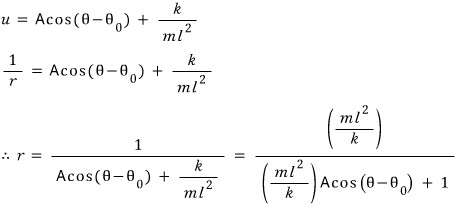
This little guy is supposed to be an ellipse….. But it’s in polar coordinates, so I can’t really get a feel for it~~!!!
To see why~~~~ this equation is an ellipse, I’ll derive a Real, for-real ellipse in polar coordinates!!! and compare it against that one, and then we can go “Ahhhh~~ so that equation is an ellipse~~~~~~~” — that kind of admiring sigh is where we’re headed!!!
First, the definition of an ellipse is “the points where the sum of the distances from the two foci is the same!!! The set of all such points!!!!”
Let’s derive the locus equation of an ellipse from this definition!! We did this back in high school math class too, and the only difference is that we’re doing it in polar coordinates (said in a goofy voice)!!! hehehe
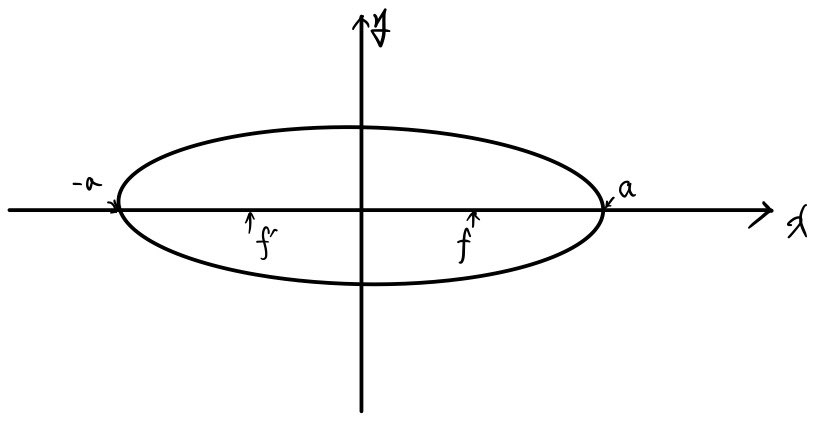
Now, draw an ellipse and let its semi-major axis be $a$, and let the distance from the origin to the focus $f$ be $\varepsilon$ times the semi-major axis $a$:

Then let’s pick out the points for which the sum of the distances to the two foci is the same. Take one such point: its distance from $f'$ is $r'$ and its distance from $f$ is $r$. And $\theta$ has to be set up like this.
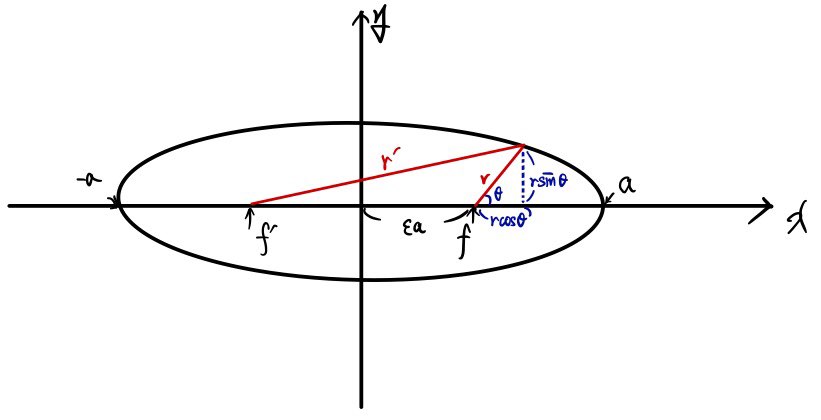
ta-daaa~~~~ I’ll define all these various variables like this.~~ And by the definition of an ellipse,  .
.
$r'$ can be expressed in terms of $\theta$ and $r$~~! How you do it is — by Pythagoras-goras Mr. Pythagoras’s theorem:
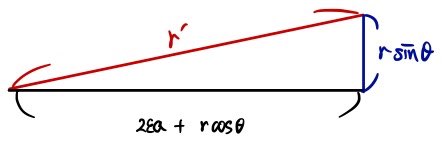
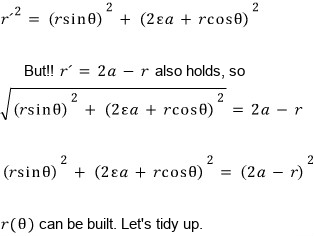
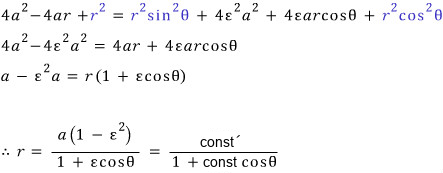
This is the ellipse equation expressed as $r(\theta)$! Let me just point out one thing!
What if $\varepsilon=0$???~?~?
It becomes $r=a$. This represents a “circle”~!!! And $\varepsilon$ is called the eccentricity!
- $\varepsilon>1$ ☞ hyperbola
- $\varepsilon=1$ ☞ parabola
- $0<\varepsilon<1$ ☞ ellipse
- $\varepsilon=0$ ☞ circle
Anyway, the $r(\theta)$ we got by applying universal gravitation to the orbit equation (in a central force field) has the same shape as the one above!!! So it’s an ellipse!!!
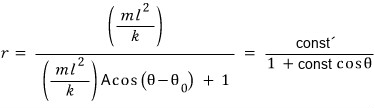
chotto matte kudasai!!! (hold on a sec!!!) The constant that plays the role of $\varepsilon$ is  .
.
Is it greater than 0 and less than 1? We should check, right!!!
As for that $A$ over there, there’s no way to even work it out from the equation itself… hehe. Only through observation…. we have no choice but to get it experimentally…. Let me show you that~ hehe
Here it is: a table of planetary data from a textbook (period, semi-major axis and eccentricity $\varepsilon$ for each planet), and Earth’s $\varepsilon$ is 0.017. Kra-ra-ra-ra-ha-ha-ha-ha! Earth is moving in alllllllmost a circle!!!! hehehe
Alright, now the 3rd!! Let’s get into the harmonic law!!!
Kepler’s 3rd law, the harmonic law, says that the square of a planet’s orbital period $T$ and the cube of the semi-major axis $a$ of its elliptical orbit are proportional, so everybody goes “wooo~~~wow~~~ how beautiful~~~~~~ the world is in such harmony~~~~~~~”
……bullshit, beautiful my ass. T_T
Anyway, deriving that formula is simple. This also comes from conservation of angular momentum. According to the law of constant areal velocity, the areal velocity was  .
.
If we integrate this over one period $T$, with respect to $dt$!!!

I’ll express the semi-minor axis $b$ in terms of $a$ — drumroll: da-da-da-da-da-da-da!!!
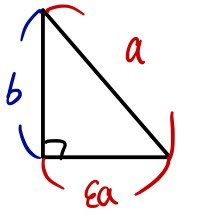

so~ (remember, $l = L/m$ from last time)

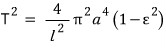
Into this~ now, into this thing made of ellipse info, we’re going to plug in the info about our Earth and the Sun~ We can bring the info from the orbit equation and plug it in, right?

This is what we’ll plug in hehehe
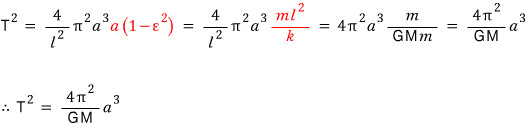
And that’s how we derived the harmonic law~~!!
Comments
Discussion happens via GitHub Discussions. You'll need a GitHub account to comment.