The Orbit Equation via Energy Methods
We rederive the orbit equation using energy conservation — kinetic plus potential — then sneak in angular momentum and the u=1/r substitution to nail the same result.
Alright, what we’ve done up to now is, in spherical coordinates,
we put angular momentum conservation at the front and scored a goal all the way to the orbit equation!!!
This time we’re going to derive the orbit equation from energy relations.
But before that, I think we need to talk about this.
Potential Energy
Why is it (-)????
You’ve all probably heard about it roughly.
“To set the potential V to 0 when you’re really far away from some source (r=∞)”
There’s also a reason for setting it to 0.

What if at a place where V=-1, K (kinetic energy) was 1??
What happens to K at the position where V=0??
K becomes 0, right?
Then if K=0 at the position where V=-1????
Well, it wouldn’t move.
If K=2 at the position where V=-1???
K at V=0 will be K=1…
That means it can go further out.
To organize again, V+K (the conserved quantity), if it’s
$V+K>0$
then it indicates not being bound, and
$V+K<0$
indicates being bound to that source over there.
Earth (at least from our experience) doesn’t escape outside the Sun, so K+V<0~~~
That’s what I wanted to say,
Now we’ll seriously derive the orbit equation through the energy relation,
V is super super easy
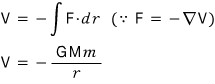
and
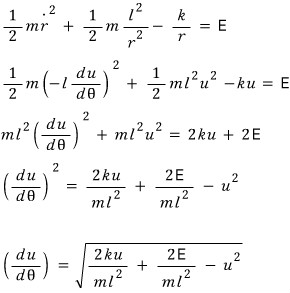
K is ½mv², and if we express v² in spherical coordinates,
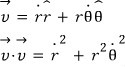

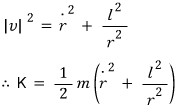
Now we add.

Now we’ll express this equation by substituting r=1/u.
(We did it earlier so I won’t go through it in detail, just throwing it out!!!!!)
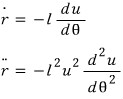
Since we just need to use this relation,
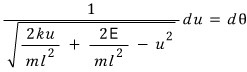
Oh shit….. a damn hell-integral has appeared……
For stuff like this you look at an integral table lolololol
Let’s not get into how this formula came about lololol since we’re not math majors.

Apparently this is the formula.
Then let’s smash it in!!!
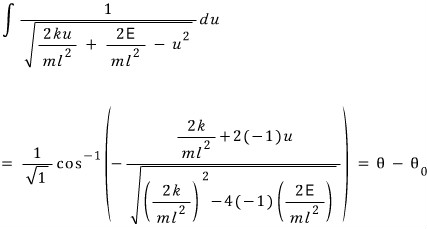
Therefore
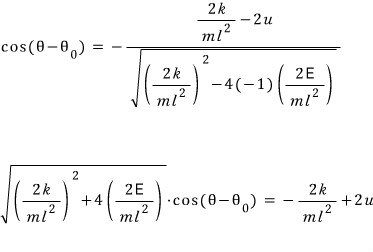


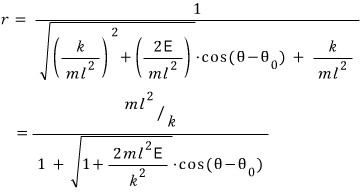

We’ve pulled out the equation, and again, by just looking at it bam~~~~ you can just tell that the eccentricity is
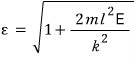
~
Let’s look at the relation between eccentricity and energy!!! (ε vs E)

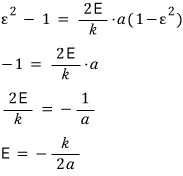
Huh………hehehe just E<0….
Of course…..hehehe
Then let’s look at it like this
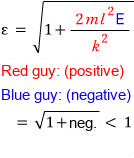
What comes out is that the eccentricity is less than 1!!!!!
0<ε<1 ☞ E.lli.pti.cal orbit
To organize once more, this thing E, which is E=K+V,
depending on whether it’s less than 0, greater than 0, or 0, the eccentricity changes,
so if eccentricity is less than 1, ellipse or circle (bound state),
if greater than 1, hyperbolic orbit,
if 1, parabolic orbit!!
By dealing with it through energy, we got to know the relation between E and the orbit even more clearly~~!!!
Alright, and now let’s look at the content we kind of glossed over earlier as if it were obvious.

The point you need to feel here is that the total energy E is a function of r!!!!!!
(There’s no θ!!!)
And we’ve been saying nonstop up to now that this is when it’s doing orbital motion!!!
If it’s circular motion, r is constant the whoooole time so

would be the case~
If it’s elliptical motion, r gets bigger, gets to its biggest,
then gets smaller, gets to its smallest, and so on, right?
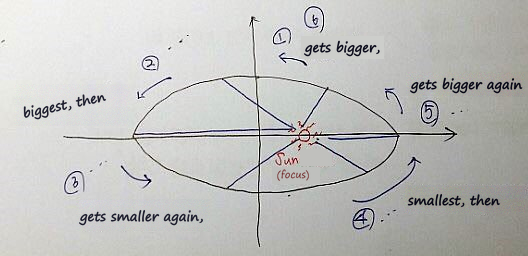
What this is similar to right now is —
it seems similar to the case of something hanging on an elastic body~~~
K+V = E is constant and the energy

goes back and forth like this,
continuously showing a periodic pattern!!! It seems similar to that hehehehe
The point is to look at it that way here too.
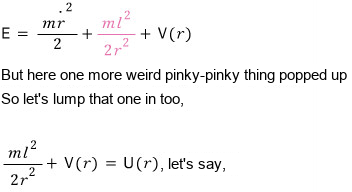
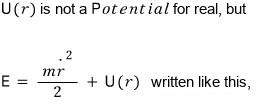

let’s look at it like that — like before where energy got passed back and forth!!
So U(r) is called the Effective Potential Energy,
effective potential ~~~
(The content on effective potential is going to come up in quantum mechanics when we deal with the hydrogen atom. So it’s definitely worth remembering hehehe)
We’re dealing with celestial bodies right now, but it’ll come up when dealing with atoms in the microscopic world……the world is……truly………sigh….heh
Alright then,
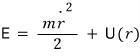
In this equation, the point where U(r) is maximum!!! at that time,

=0 right!!!
Where would such a point be?

Since it’s =0, it means we’re trying to find the place where r increases and then decreases,
or where it decreases and then increases.
To predict for now, since it means the place where r is largest and the place where r is smallest will come out (because of the maximum and minimum),
the right point of the major axis and the left point will come out, right?
Alright then let’s do it!
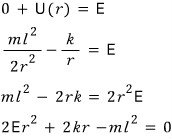
You know the quadratic formula~~~

For the roots that come out from the quadratic formula! depending on whether the inside of the root is 0, (+), or (-),
it splits into a double root, two real roots, or 0 real roots (2 imaginary roots)~~
let’s look at the inside of the root.
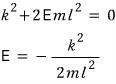
Taking E at this point as the boundary, if E is greater than this, two real roots,
if E is smaller than this, 0 real roots,
if E is exactly~~ this, 1 real root.
Right now ‘roots’ meant roots with respect to r,
so what does it mean to have 1 r that satisfies it????
It ends up meaning it’s moving in a circular orbit, right??
Having two r’s that satisfy it means it’s moving in an elliptical orbit,
and having no such r means it’s moving in an “open orbit,” that is, in a parabolic or hyperbolic orbit, like that!
We just looked at this from the energy side,
and the same conclusion is drawn as when we looked at it from the orbit equation side earlier!
This is why I can’t quit physics T_Tlolololol
Comments
Discussion happens via GitHub Discussions. You'll need a GitHub account to comment.