Orbital Stability
Why does a circular orbit stay stable instead of flying off after a tiny shock?! Spoiler: there's a sneaky spring constant hiding in the equation of motion!
The goal of this post — I tried to express it in a picture!
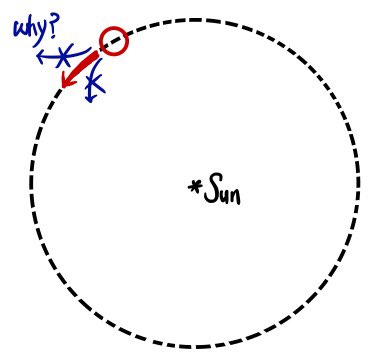
Why……… can it keep stably maintaining a circular orbit without ever deviating from it??
And why is it hard to even imagine it receiving even a tiny shock, deviating from the orbit and flying far away?!! Let’s find out.
So let’s look at Earth’s equation of motion again!!!
(It’s the exaaact same as what we did before)

$f(r)$ is universal gravitation, but to keep it general, let’s go with $f(r)$ again.
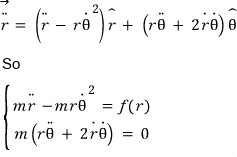
As for the second one, as we did before,

Now let’s attack the first equation again.
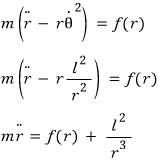
We can write the equation of motion like this.
Here’s the stunt I’m about to pull: I will show that the spring constant $k$ is hidden in that equation of motion for $r$.
Once we discover and confirm that the spring constant $k$ is in the equation of motion for $r$, then what this equation ends up meaning is
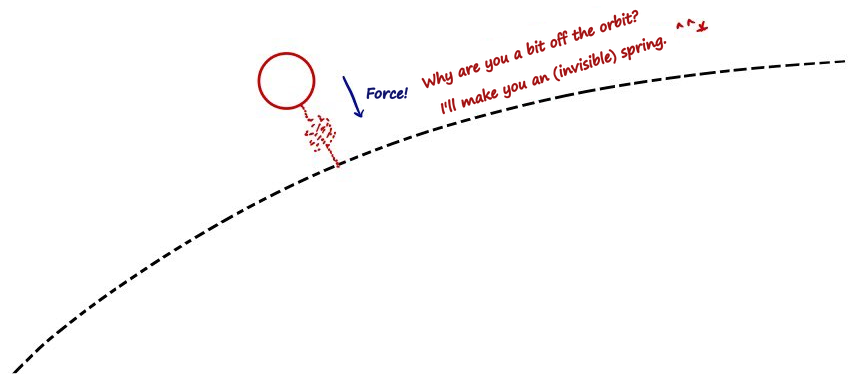
So now we don’t just need the equation of motion at exactly the orbit’s distance $a$ from the sun! We need the equation of motion at a place slightly~~~~ off from there, so let’s say  and I’ll just go ahead and do a Taylor expansion around $r=a$. That’s still fine, right?

This one’s just, well, this
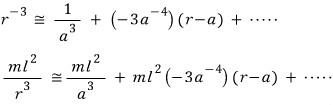
Then

It becomes like this, and the reason I colored them is that the constant terms can fly away!! (Well, the green ones do; the red ones just team up with the $r$ terms to make $(r-a)$.)
Suppose we don’t know whether Earth is currently orbiting in an ellipse, orbiting in a circle, or traveling far far away in space.
(Of course, by observation, the far-far-away case is not happening, not in a million years, so there’s no need to even assume it.)
So I thought about each case, and when you assume it orbits in a circle, the green terms fly away.
Wanna see?
Orbiting in a circle means $\ddot{r}$ (r double-dot) is 0,
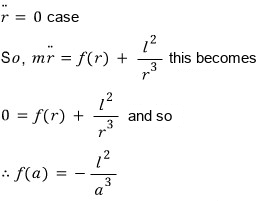
Therefore
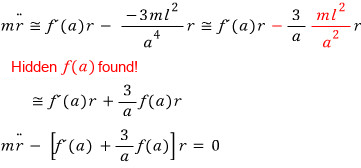
I found the hidden spring constant.
Let me write it like this (here $x$ is the distance from the orbit, $x = r-a$)
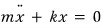
The spring equation of motion,,, if $k>0$ it oscillates, right?!
(We need $k>0$ so that $F = -kx$ points the opposite way from the displacement $x$, always pushing it back!!)
Then over there,

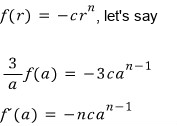
Then
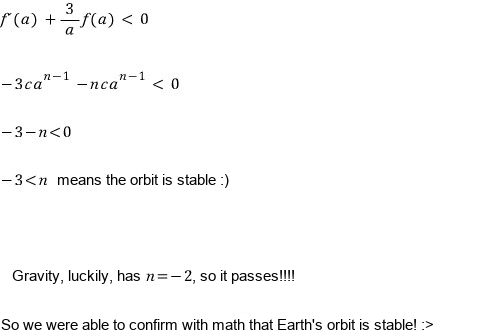
Heads-up. The figures here are the original notes, slips and all. A few things to watch for:
- In the picture of the $\theta$ equation, the middle step misses a factor $r$: $\frac{d}{dt}(mr^2\dot\theta) = mr(r\ddot\theta + 2\dot r\dot\theta)$. The left side is $0$, so $dL/dt = 0$ still follows.
- In the radial equation, $r\dot\theta^2 = r\frac{l^2}{r^4} = \frac{l^2}{r^3}$ (the picture has $r^2$ in that denominator), and the centrifugal term keeps its mass: $m\ddot r = f(r) + \frac{ml^2}{r^3}$. The next picture drops the same $m$, so the circular-orbit condition is $f(a) = -\frac{ml^2}{a^3}$.
- In the expansion around $r = a$, the term from $f'(a)(r-a)$ is $-af'(a)$, not $-af(a)$, and $\frac{ml^2}{r^3}$ gives $-\frac{3ml^2}{a^4}r + \frac{3ml^2}{a^3}$; the picture flips both signs.
- In the step after it, $\frac{3ml^2}{a^4} = \frac{3}{a}\cdot\frac{ml^2}{a^3}$ (not $\frac{ml^2}{a^2}$), and the last equation is about the displacement $x = r - a$: $m\ddot x - \left[f'(a) + \frac{3}{a}f(a)\right]x = 0$. The stability condition $f'(a) + \frac{3}{a}f(a) < 0$ is right.
Comments
Discussion happens via GitHub Discussions. You'll need a GitHub account to comment.