Center of Mass (CM)
Center of mass is basically lumping all your particles into one spot — a weighted average of positions that makes multi-particle dynamics way less of a headache!
Dynamics of a particle ‘system’
So the system we want to deal with,
it’s made up of several particles, and when each of those particles is at a different position,
handling this is freakin’ complicated~
so the concept called center of mass (Center-of-Mass : CM) gets introduced.
It’s basically lumping all the particles together and thinking of it as if the sum of all those particles’ masses is — bam! — at some single position.
Let me write the formula first (it’s not a formula.)
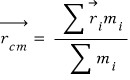
If you look at this equation carefully, since we divided a vector by a scalar,
it is indeed a vector!!!
Look carefully at the numerator!!!!
It’s the position of the i-th particle,

the vector, multiplied by the scalar value of that i-th particle’s mass

and then we summed them all up.
Um so yeah,
if there’s a somewhat larger infinitesimal mass, the vector becomes exaggerated compared to the actual vector,
and if the infinitesimal mass is less than 1, the vector becomes underscaled compared to the actual position vector
And then summing all those vectors up whoosh~ gives you the numerator!
Try supposing that the particles’ masses Mi are all the same.
Then

since the weights multiplied onto the mass vector are all the same,
the vector that’s the sum of all the vectors will?? lean toward where there are lots of particles, right??!!
Aha, now I get it a bit.
We multiplied the scalar Mi (the weight) onto the vector ri and summed them.
And if we divide that total sum by the total mass again, we can see it as an “average”!!!
The center-of-mass vector can be thought of as giving the particles a weight called position… and then the average of those.
Alright alright alright alright, now those particles are moving~~
The center-of-mass velocity vector, also, is each individual particle’s velocity vector
multiplied by the particle mass Mi and divided by the total mass.
Let me look at the relationship between this and the center-of-mass position vector.

Differentiating the center-of-mass position vector with respect to time gives the center-of-mass velocity vector..
Obviously, right? lololol yes, obviously.
Well then, I’ll skip the center-of-mass acceleration vector.
Comments
Discussion happens via GitHub Discussions. You'll need a GitHub account to comment.