Momentum of a System of Particles
We walk through how a system's total momentum equals m·v_cm, and why zero external force means momentum stays constant — aka conservation of linear momentum!
In mechanics, what plays the role of a particle’s or an object’s ID card is “momentum”.
Unlike when there’s just one object, right now we’re dealing with a particle system, so
the momentum of that particle ‘system’ is defined as the vector sum of the momenta of each particle!!!
P= P1 + P2 + P3 + ………. + Pn (bold letters are vectors, vectors!!!! and will continue to be~~)

since that’s the case
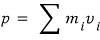
wow~ I’ve seen this somewhere before lol, if we multiply the numerator and denominator by the total mass m
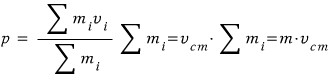
aha, so the total~ momentum becomes the total mass times the velocity vector of the center of mass~ let’s move on
Now let’s look at force (F)
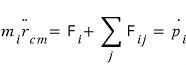
The force acting on the i-th particle is

right? lol
What kinds of forces might affect each of these particles
Broadly, 1. forces from the outside (outside the system), and
- forces from the inside (inside the system), i.e., interactions with other particles, I’d say~
meaning that two kinds of forces act on this one particle at the same time — wild, bro.
That is
So, the total force acting on the particle system can be written like this~
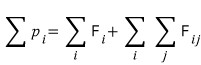
As for the latter term… if there’s Fij, there’s Fji, and they point in opposite directions, so when added together they become 0!!!!
Physically speaking, since we’re looking at the “system”,
the internal forces become 0, so the double sum becomes 0!!!
So
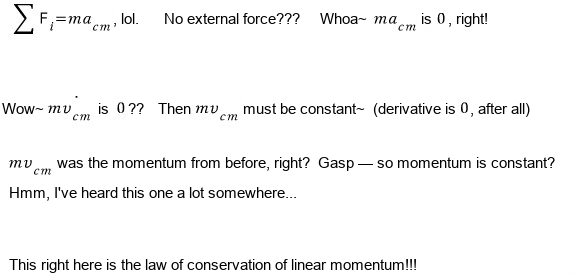
We’ve covered up to the law of conservation of linear momentum (linear moment)~
Comments
Discussion happens via GitHub Discussions. You'll need a GitHub account to comment.