Angular Momentum of a System of Particles
Spinning into rotational mechanics — we break down angular momentum for particle systems, torque, conservation laws, and how to re-express everything around the center of mass!
Last time we covered linear momentum (linear moment)!
This time it’s rotation!! Spinny-spin~!
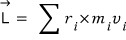
When a particle rotates about some axis, the angular momentum is L = r x mv (bold letters are vectors~)
Then for a “particle system”, the angular momentum would be the vector sum of the individual particles’ momentum vectors
<For translational motion (just straight-line motion), what was force F? It was F = P’, right?>
It’s the same for rotational motion.
The derivative of angular momentum is the turning force! Called torque (torque : N).
Just like with translational motion, if there’s no externally applied torque, then N = 0, so L’ = 0, which means L is a constant.
This is exactly~
“The Law of Conservation of Angular Momentum”
But our real studying starts from here.
Since what we’re dealing with is a particle ‘system’ made up of single particles gathered together, there are cases that are slightly~ different from when we had a single particle.
That system-level difference ends up creating small differences in the equations!!
So today’s study is about thinking through how we can describe a particle system centered on the center of mass!!
Alright, let’s go!!
Now we’re going to re-set the position vector ri from origin O to some particle, based on the center of mass, cleanly~~~~.
(Since the velocity vector is just the derivative of the position vector, the only difference there would be the letter r changing to v, nothing else)
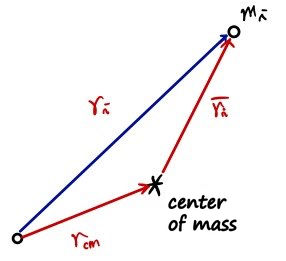
When you set things up like this. Let’s re-express the equation we saw above using the new numbers we just set.
(This is in order to describe things centered on the center of mass)
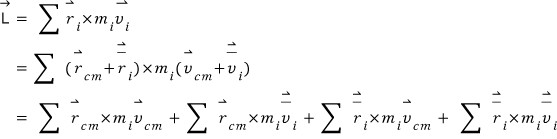

So it becomes this, and the front term — the particle system, the system I mean
That system!! — when it rotates, the term means the orbital motion part of that system
And the back term is the expression for each individual particle relative to the center of mass, right???
In other words, it means the ‘spin’ motion part of the particle system.
The terms shown in red are the terms that become 0.
If you hop on board the center of mass and think about the sum of velocity vectors and the sum of position vectors seen from there, it’s obvious they become 0, right???
Please imagine it carefully.
For reference, if we want to look at why that term becomes 0 mathematically
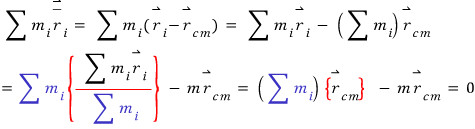
Mathematically it comes out to 0 like this, but if you can, just hop on board the center of mass, gogo.
So for angular momentum, we ripped the position vector apart and dug into the meaning of each piece
but I got curious about why we don’t do that for linear momentum.
So I tried it myself.
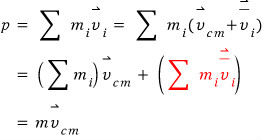
Ahaa~~
You could think “ah, since it comes out like this anyway, that’s why we didn’t bother~~~”,
or you could just intuitively think that the sum of the ripped-apart pieces and doing it through the center of mass are the same thing,
but I attached the equation in case anyone needed it.
Alright, now we’ve seen all the vector physical quantities. So now let’s look at the representative of scalar physical quantities, ’energy’.
For the energy of the whole particle system, first let’s look at summing up the energy of each-each-each-each-each-each-each individual particle.
Then we’re going to go into how that relates to the center of mass through equations.
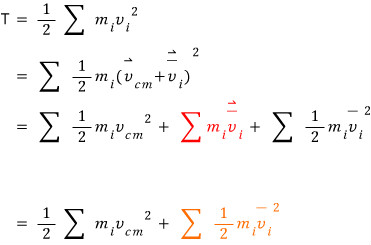
It turns out like this.
Unlike our expectation, there’s an orange term at the back.
The reason this orange term gets added is exactly because of the difference between a single-particle system and a particle system like the one we have now, right?????
The reason the back term is important, you see.
The reason the orange term is important!!! it’s because
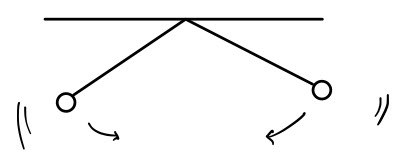
Okay, consider a situation like this, where two weights come charging out from the center bang-bang-bang-bang-bang
Did you hop on board the center of mass????
Would the energy of this system seen from that center of mass you’re riding on be the same as the energy seen from outside?????
Not a chance, right??
That ’no way’ is exactly what the orange term is telling us hehe
I’ll stop here.
Comments
Discussion happens via GitHub Discussions. You'll need a GitHub account to comment.